Bitcoin and Ethereum ETFs Attract $2.6 Billion in Most Successful Week Since October

cryptonews.ruPublished on 2026-08-24Last updated on 2026-08-24

Abstract

Bitcoin and Ethereum ETFs attracted a record $2.62 billion in net inflows over the week, marking their best performance since October 2025. Bitcoin ETFs led the surge with $1.92 billion in weekly inflows, driven by strong demand as Bitcoin's price surpassed $70,000. BlackRock's IBIT fund was the top performer, attracting $1.33 billion. Ethereum ETFs followed with $697 million in inflows, representing a higher proportional increase relative to their asset base. Altcoin ETFs for XRP and Solana also saw modest gains, attracting $39.78 million and $28.34 million, respectively. Total trading volume for Bitcoin ETFs soared to $22.1 billion, more than tripling from the previous week. Analysts noted that Ethereum's stronger relative demand, alongside corporate treasury buying and staking-related supply constraints, contributed to its significant price rally from around $1,900 to over $2,500. The week concluded as one of the most active for institutional crypto purchases this year.

The week began with recovery and ended with a surge.

Bitcoin ETFs attracted fresh capital in every session: the inflow, which started on Monday at $297.56 million, grew into a three-day spike that led this category to its strongest weekly result in recent months. Ethereum followed the same path, while $XRP and Solana funds quietly gained momentum throughout the week.

Bitcoin Leads Five-Day Buying Wave

The net inflow into Bitcoin ETFs for the week amounted to $1.92 billion.

$297.56 million came in on Monday, and $189.30 million on Tuesday. Demand accelerated on Wednesday as the price of Bitcoin exceeded the $70,000 mark, leading to a $517.19 million inflow into the funds. Thursday saw the largest daily inflow of $606.29 million, and Friday added another $307.45 million.

BlackRock's IBIT fund led the weekly report with an inflow of $1.33 billion. Fidelity's FBTC fund attracted $293.1 million, and ARK 21Shares' ARKB attracted $126.9 million.
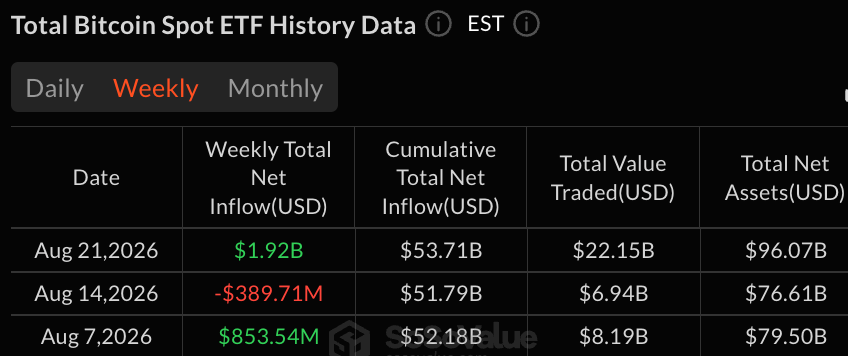
The total inflow into Bitcoin ETFs in August currently stands at $2.38 billion. Source: Sosovalue

Bitwise's BITB fund attracted $87.3 million. Morgan Stanley's MSBT fund attracted $28.9 million, Grayscale's GBTC fund - $21.2 million, and the Bitcoin Mini Trust - $36.2 million. Vaneck's HODL fund was the main exception, losing $16.1 million.

Bitcoin ETF trading volume for the week reached $22.1 billion, more than triple the figure from the previous week ($6.9 billion). Assets under management grew to $96.07 billion, a 25% increase. In just the last three trading sessions, nearly $1 billion flowed into Bitcoin ETFs—the strongest three-day growth since Bitcoin last traded above $80,000.
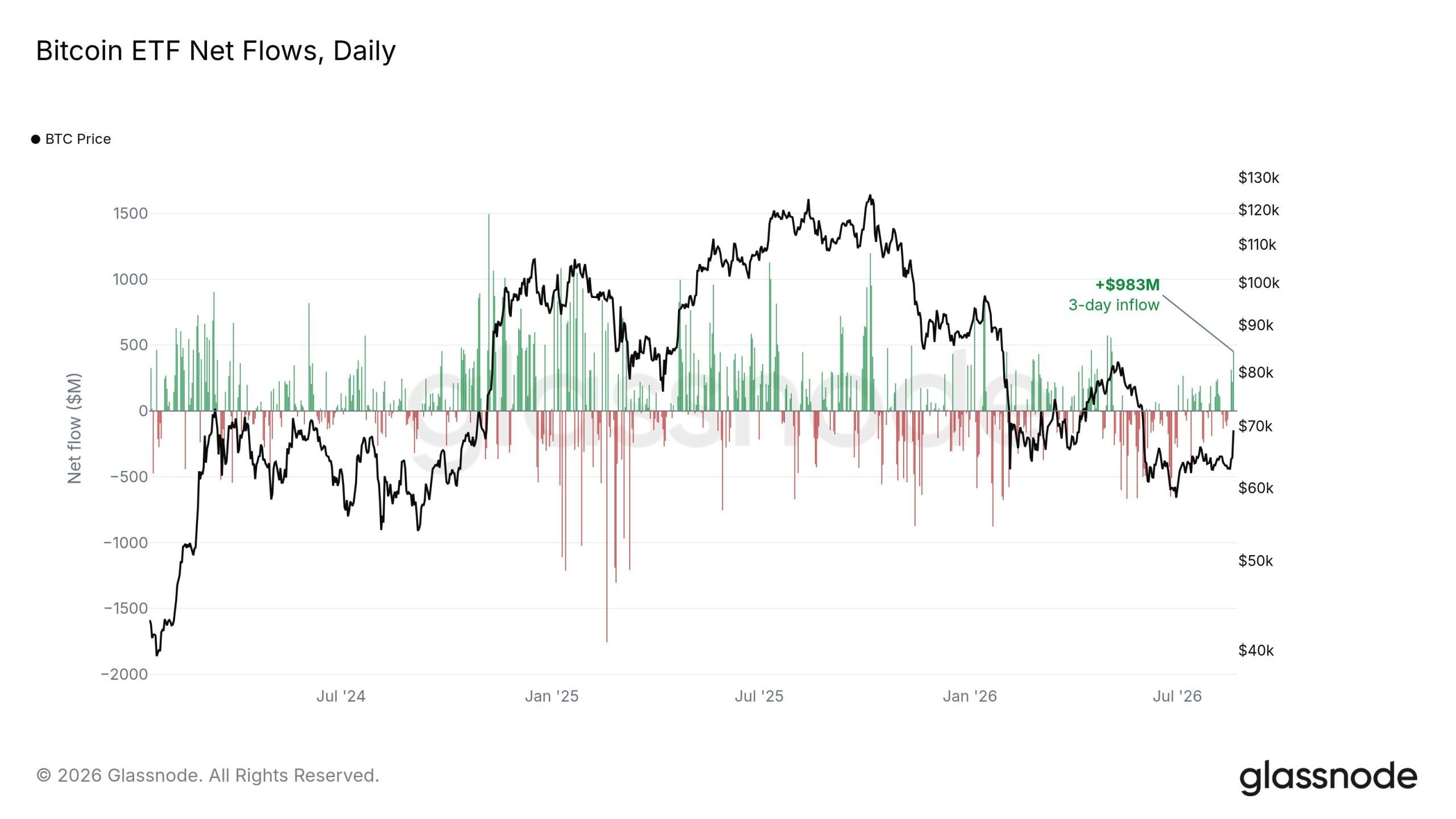
Source: Glassnode

Ethereum and Altcoins Join the Rally

Ethereum ETFs also ended each session in positive territory, attracting $697 million for the week.

The inflow grew from $30.85 million on Monday to $71.47 million on Tuesday, then accelerated to $189.15 million on Wednesday and $220.77 million on Thursday. On Friday, the inflow closed at $184.93 million.

The combined inflow into Bitcoin and Ethereum ETFs reached $2.62 billion—the largest weekly figure since October 2025.

$XRP ETFs attracted $39.78 million, driven by significant inflows on Thursday and Friday of $13.24 million and $18.38 million, respectively.

Solana funds attracted $28.34 million, with most of the demand coming at the end of the week. The net inflow into HYPE ETFs was $3.89 million. A Wednesday outflow of $1.97 million was more than offset by a Thursday inflow of $5.86 million.

Sosovalue highlighted the difference in inflow intensity between the two largest crypto assets. The weekly Bitcoin inflow of $1.92 billion represented about 2.0% of its $96.07 billion assets, while the Ethereum inflow of $697 million equaled roughly 4.9% of its asset base of $14.29 billion.

"ETH continued to attract significantly more capital relative to the current ETF volume," noted Sosovalue. This stronger proportional demand contributed to Ethereum's price rising from around $1,900 to a high of $2,546, with ETF buying, corporate treasury positions, and supply constraints related to staking all contributing to tightening supply and demand dynamics.

By the close of trading on Friday, the market had demonstrated one of the most active weeks of institutional buying this year. Bitcoin remained the clear center of attraction, while Ethereum and major altcoin funds also participated in this surge.

end-content

Trending Cryptos

Related Questions

QWhat was the total net inflow for Bitcoin ETFs during the reporting week, according to the article?

AThe total net inflow for Bitcoin ETFs during the reporting week was $1.92 billion.

QWhich specific Bitcoin ETF had the largest weekly inflow, and what was the amount?

ABlackRock's IBIT ETF had the largest weekly inflow, attracting $1.33 billion.

QWhat was the combined weekly inflow for Bitcoin and Ethereum ETFs, and why was this figure notable?

AThe combined weekly inflow for Bitcoin and Ethereum ETFs was $2.62 billion. This was notable because it was the largest weekly figure since October 2025.

QHow did the proportion of inflows relative to assets under management (AUM) differ between Bitcoin and Ethereum ETFs?

ABitcoin's weekly inflow of $1.92 billion represented about 2.0% of its $96.07 billion AUM, while Ethereum's inflow of $697 million equaled approximately 4.9% of its $14.29 billion AUM, indicating stronger proportional demand for Ethereum ETFs.

QWhat factors contributed to the surge in Ethereum's price from around $1,900 to a high of $2,546, as mentioned in the article?

AThe surge in Ethereum's price was driven by a combination of ETF buying, corporate treasury purchases, and supply constraints related to staking, which tightened the demand and supply dynamics.

Related Reads

Bitcoin Reaches $80,000: Three Arguments Against a Bull Market

Bitcoin reached $80,000 on August 24, 2026, a 38% rise from its July low of $57,800. While this surge is notable, analyst Rekt Capital presents three arguments against it signaling a true bull market reversal, suggesting it may instead be a rally within a broader bear market. First, if July 2026 was the bear market bottom, its formation time was 27% shorter than historical averages, a conclusion only valid if no new lower low forms by year-end. Second, Bitcoin broke down from a macro triangle pattern in July, but the subsequent ~30% drop was significantly smaller than the 48-62% declines seen after similar breakdowns in past cycles. Third, and crucially, the price has failed to break the long-term descending trendline from early 2025 highs, meaning Bitcoin is still making lower highs on macro timeframes, indicating underlying weakness. Rekt Capital notes the dynamic trendline resistance is near $79,000 this month, dropping to ~$76,300 next month. A monthly close below it could open the door for a correction. On weekly charts, resistance sits at $74.5k-$83.5k, with support at $62.5k-$68.5k. Adding another perspective, Crypto Rover highlights two key liquidation levels on Bitcoin's heatmap: a cluster of short positions at $80k-$90k (which could fuel a squeeze higher) and a concentration of long positions at $48k-$60k, acting as competing price "magnets." The article contrasts Rekt Capital's current cautious stance with his past calls in 2025, noting he correctly identified market direction but underestimated the scale of both the subsequent spring rally and the following autumn/winter decline. His current analysis again emphasizes macro weakness despite the recent price rise.

cryptonews.ru3m ago

Bitcoin Reaches $80,000: Three Arguments Against a Bull Market

cryptonews.ru3m ago

Trading

Spot

Hot Articles

Discussions

Welcome to the HTX Community. Here, you can stay informed about the latest platform developments and gain access to professional market insights. Users' opinions on the price of ETH (ETH) are presented below.

活动图片