Bitcoin Activity Surges as On-Chain Momentum Signals Fresh Breakout Potential

TheNewsCryptoPublished on 2026-04-07Last updated on 2026-04-07

Abstract

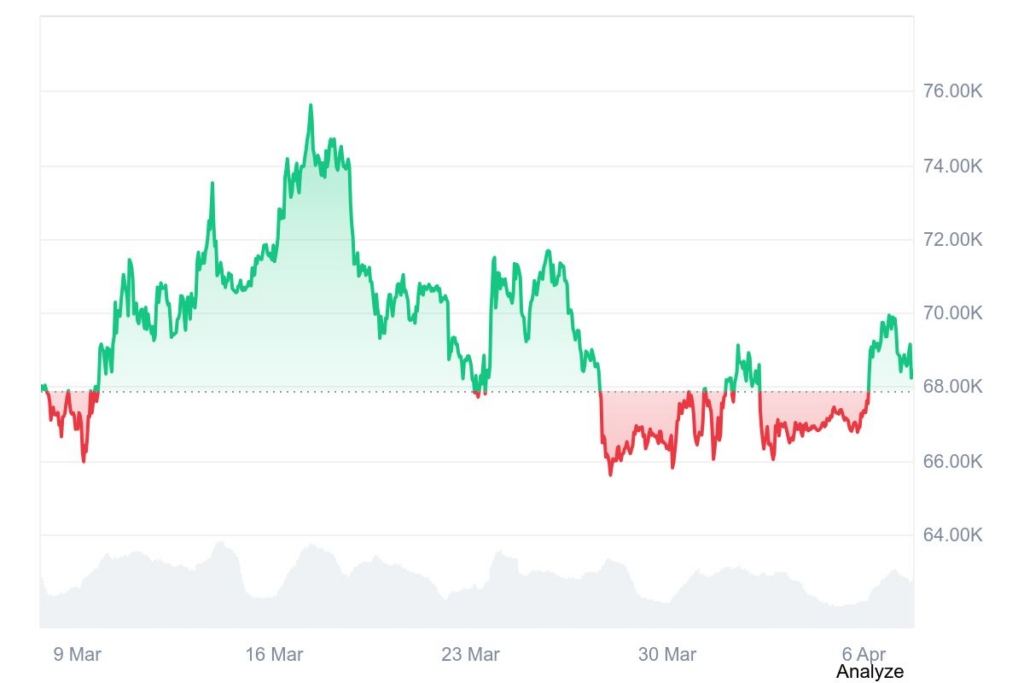
Bitcoin network activity has surged significantly after months of decline, according to analytics firm CryptoQuant. Daily transactions exceeded 615,000, the highest since November 2024. This uptick coincides with low transaction fees, suggesting the increase may be driven by operational adjustments—such as UTXO consolidation by large holders and exchanges—rather than purely organic demand. Despite the activity surge, Bitcoin’s price remains subdued, trading around $68,423 with a slight decline. Meanwhile, U.S. spot Bitcoin ETFs saw substantial inflows, with $471 million recorded on Monday—the highest since late February. The price briefly surpassed $70,000 before retreating amid ongoing geopolitical tensions and concerns over quantum resistance. Analysts note similarities in stochastic RSI patterns to early 2023, suggesting a potential bullish breakout reminiscent of the previous cycle’s recovery.

Bitcoin network activity “just snapped higher after months of decline,” according to Monday’s assessment by CryptoQuant. A blockchain analytics provider’s index keeps tabs on demand for blockspace, addresses, transactions, and UTXOs.

It pointed out that there had been over 615,000 Bitcoin transactions per day, the most since November 2024. This change is taking place at a time when Bitcoin fees are still low, so it’s possible that some of the recent activity bump is due to operational factors rather than purely organic demand.

CryptoQuant noted that under low-fee situations, big holders, exchanges, and custodians may combine UTXOs, rebalance wallets, and rearrange funds on-chain more cheaply.

Consequently, the lackluster price movement may have little to do with this surge in activity. Following a period of compression, the current breakout indicates a fresh effort to confront overhead resistance, according to Glassnode’s Monday analysis.

Positive Momentum

The rate of inflows into US-listed spot Bitcoin ETFs has picked back up, with the highest daily volumes seen in weeks. Monday saw $471 million pour into spot Bitcoin ETFs, the most daily inflow since $507 million on February 25 (as reported by SoSoValue).

According to CoinGecko statistics, the inflows occurred when the price of Bitcoin momentarily surpassed $70,000 before falling below $69,000. The Crypto Fear & Greed Index stayed in “Extreme Fear” at 13, and the volatility happened under ongoing geopolitical pressure and fresh worries about Bitcoin’s quantum resistance.
Quantum Ascend, a crypto trader, revealed copycat movements on Bitcoin’s stochastic relative strength index (RSI) in a Monday X post. In the comparison chart posted by the analyst, it was highlighted that stoch RSI and price made a double bottom before they both rocketed upward in early 2023. The Bitcoin/USD had just hit a multi-year low of $15,600, which would later represent the bottom of the bear market.

According to the analyst, everything is “playing out nearly perfectly” for the repeat performance now. After hitting local lows in late January and late March, the stoch RSI is currently trying to break out of its 50/100 midway. At the time of writing, Bitcoin is trading at $68,423, down 1.48% in the last 24 hours as per data from CMC.

Highlighted Crypto News Today:

Grayscale Highlights Bitcoin’s Resilience as Community Prepares for Quantum Era

TagsAltcoinBitcoin

Related Questions

QWhat does the CryptoQuant Network Activity Index track according to the article?

AThe CryptoQuant Network Activity Index tracks demand for blockspace, addresses, transactions, and UTXOs.

QHow many Bitcoin transactions per day were reported, and when was the last time such a high number was seen?

AThere were over 615,000 Bitcoin transactions per day, which is the most since November 2024.

QWhat was the amount of daily inflow into US-listed spot Bitcoin ETFs on the Monday, and how does it compare to a previous date?

AOn Monday, $471 million poured into spot Bitcoin ETFs, which is the most daily inflow since $507 million on February 25.

QWhat pattern did the analyst Quantum Ascend identify on Bitcoin's stochastic RSI, and what historical event does it resemble?

AThe analyst identified copycat movements where the stoch RSI and price made a double bottom, resembling the pattern from early 2023 when Bitcoin hit a multi-year low of $15,600 before rallying.

QWhat are some operational factors that might be contributing to the recent surge in Bitcoin network activity under low-fee conditions?

AUnder low-fee situations, big holders, exchanges, and custodians may combine UTXOs, rebalance wallets, and rearrange funds on-chain more cheaply, which could contribute to the activity surge.

Related Reads

From SpaceX's IPO to the Future of Crypto: Which Crypto Sectors Will Host the Trillion-Dollar Narrative?

From the SpaceX IPO, which targets a $750 billion raise at a $1.77 trillion valuation, we can extrapolate capital flow trends relevant to crypto. The focus shifts from speculative narratives to foundational infrastructure and real-world asset (RWA) integration. Key crypto sectors poised to benefit include: 1. **AI Infrastructure**: The narrative is moving from consumer-facing AI applications to underlying, scarce resources like compute power and decentralized GPU networks (e.g., TAO, RENDER, AKT, IO). These protocols are positioning as the essential "picks and shovels" providers for the AI economy. 2. **Real-World Assets (RWA)**: Beyond tokenized treasury bonds, RWA's future lies in on-chain equity and pre-IPO assets like SpaceX. This could democratize access to high-growth assets and reshape global capital flows, benefiting infrastructure projects like ONDO, LINK, and Plume that facilitate issuance, data, and liquidity. 3. **Core Financial Infrastructure**: Stablecoins, payment networks, and DePIN (Decentralized Physical Infrastructure Networks) are critical for settling the future on-chain economy. Their role expands from internal trading tools to foundational layers for global finance, AI systems, and real-world asset networks, leading to potential value reassessment. In summary, the next cycle may prioritize long-term infrastructure value—AI compute, asset tokenization networks, and settlement layers—over short-lived application hype, mirroring the broader market's shift towards funding the foundational systems of the future.

marsbit20m ago

From SpaceX's IPO to the Future of Crypto: Which Crypto Sectors Will Host the Trillion-Dollar Narrative?

marsbit20m ago

Tech Stocks Plunge and Bitcoin Slumps, Retail Investors Face Ultimate Test Ahead of SpaceX IPO

Technology stocks suffered their biggest drop in months, and Bitcoin fell below the $60,000 mark, coinciding with the eve of SpaceX's massive IPO plans. The sell-off was triggered by strong U.S. jobs data, dashing hopes for Fed rate cuts and reviving fears of further hikes. High-valuation sectors like AI and semiconductors led the declines, with the Nasdaq plunging over 4%. Cryptocurrencies, sensitive to higher interest rates and a strong dollar, also tumbled sharply. This market stress test raises critical questions about the limits of retail investor capital and its next destination. SpaceX's upcoming IPO, which plans to allocate an unusually high 30% of shares to retail investors, now faces a more uncertain landscape. Analysts warn that to buy SpaceX,散户 may need to sell existing holdings, with Tesla seen as a potential source of funds. The market is saturated with speculative options—from crypto and meme stocks to zero-day options and AI-themed ETFs—all competing for the same pool of retail attention and capital. While SpaceX's listing could inject fresh excitement, it also enters a fiercely competitive environment where investor loyalty is fleeting. The ease of zero-commission trading and lower barriers to margin trading accelerate capital rotation between narratives, making it difficult for any single story, even a historic IPO like SpaceX's, to dominate for long.

华尔街日报1h ago

Tech Stocks Plunge and Bitcoin Slumps, Retail Investors Face Ultimate Test Ahead of SpaceX IPO

华尔街日报1h ago

Trading

Spot
Futures

Hot Articles

What is $BITCOIN

DIGITAL GOLD ($BITCOIN): A Comprehensive Analysis Introduction to DIGITAL GOLD ($BITCOIN) DIGITAL GOLD ($BITCOIN) is a blockchain-based project operating on the Solana network, which aims to combine the characteristics of traditional precious metals with the innovation of decentralized technologies. While it shares a name with Bitcoin, often referred to as “digital gold” due to its perception as a store of value, DIGITAL GOLD is a separate token designed to create a unique ecosystem within the Web3 landscape. Its goal is to position itself as a viable alternative digital asset, although specifics regarding its applications and functionalities are still developing. What is DIGITAL GOLD ($BITCOIN)? DIGITAL GOLD ($BITCOIN) is a cryptocurrency token explicitly designed for use on the Solana blockchain. In contrast to Bitcoin, which provides a widely recognized value storage role, this token appears to focus on broader applications and characteristics. Notable aspects include: Blockchain Infrastructure: The token is built on the Solana blockchain, known for its capacity to handle high-speed and low-cost transactions. Supply Dynamics: DIGITAL GOLD has a maximum supply capped at 100 quadrillion tokens (100P $BITCOIN), although details regarding its circulating supply are currently undisclosed. Utility: While precise functionalities are not explicitly outlined, there are indications that the token could be utilized for various applications, potentially involving decentralized applications (dApps) or asset tokenization strategies. Who is the Creator of DIGITAL GOLD ($BITCOIN)? At present, the identity of the creators and development team behind DIGITAL GOLD ($BITCOIN) remains unknown. This situation is typical among many innovative projects within the blockchain space, particularly those aligning with decentralized finance and meme coin phenomena. While such anonymity may foster a community-driven culture, it intensifies concerns about governance and accountability. Who are the Investors of DIGITAL GOLD ($BITCOIN)? The available information indicates that DIGITAL GOLD ($BITCOIN) does not have any known institutional backers or prominent venture capital investments. The project seems to operate on a peer-to-peer model focused on community support and adoption rather than traditional funding routes. Its activity and liquidity are primarily situated on decentralized exchanges (DEXs), such as PumpSwap, rather than established centralized trading platforms, further highlighting its grassroots approach. How DIGITAL GOLD ($BITCOIN) Works The operational mechanics of DIGITAL GOLD ($BITCOIN) can be elaborated on based on its blockchain design and network attributes: Consensus Mechanism: By leveraging Solana’s unique proof-of-history (PoH) combined with a proof-of-stake (PoS) model, the project ensures efficient transaction validation contributing to the network's high performance. Tokenomics: While specific deflationary mechanisms have not been extensively detailed, the vast maximum token supply implies that it may cater to microtransactions or niche use cases that are still to be defined. Interoperability: There exists the potential for integration with Solana’s broader ecosystem, including various decentralized finance (DeFi) platforms. However, the details regarding specific integrations remain unspecified. Timeline of Key Events Here is a timeline that highlights significant milestones concerning DIGITAL GOLD ($BITCOIN): 2023: The initial deployment of the token occurs on the Solana blockchain, marked by its contract address. 2024: DIGITAL GOLD gains visibility as it becomes available for trading on decentralized exchanges like PumpSwap, allowing users to trade it against SOL. 2025: The project witnesses sporadic trading activity and potential interest in community-led engagements, although no noteworthy partnerships or technical advancements have been documented as of yet. Critical Analysis Strengths Scalability: The underlying Solana infrastructure supports high transaction volumes, which could enhance the utility of $BITCOIN in various transaction scenarios. Accessibility: The potential low trading price per token could attract retail investors, facilitating wider participation due to fractional ownership opportunities. Risks Lack of Transparency: The absence of publicly known backers, developers, or an audit process may yield skepticism regarding the project's sustainability and trustworthiness. Market Volatility: The trading activity is heavily reliant on speculative behavior, which can result in significant price volatility and uncertainty for investors. Conclusion DIGITAL GOLD ($BITCOIN) emerges as an intriguing yet ambiguous project within the rapidly evolving Solana ecosystem. While it attempts to leverage the “digital gold” narrative, its departure from Bitcoin's established role as a store of value underscores the need for a clearer differentiation of its intended utility and governance structure. Future acceptance and adoption will likely depend on addressing the current opacity and defining its operational and economic strategies more explicitly. Note: This report encompasses synthesised information available as of October 2023, and developments may have transpired beyond the research period.

363 Total ViewsPublished 2025.05.13Updated 2025.05.13

What is $BITCOIN

Discussions

Welcome to the HTX Community. Here, you can stay informed about the latest platform developments and gain access to professional market insights. Users' opinions on the price of BTC (BTC) are presented below.

活动图片