BIP-110 Fork Resulting from Bitcoin Network Split Falls 18 Blocks Behind

cryptonews.ruPublished on 2026-08-09Last updated on 2026-08-09

Abstract

A fork of the Bitcoin network, created by a split over BIP-110 implementation, is now 18 blocks behind the dominant chain. The fork was triggered after Bitcoin surpassed the BIP-110 signaling threshold at block 961632. Proponents of BIP-110, including Bitcoin Knots creator Luke Dashjr and anonymous developer Daton Om, have issued warnings, stating the Bitcoin network is under attack by hostile miners and urging users to upgrade software to avoid accepting fraudulent transactions. The mining pool Roughnecks, supporting BIP-110, mined competing blocks at heights 961632 and 961633, but remains on a minority chain with drastically reduced hash power. A recent difficulty adjustment to 127.48 trillion has made mining new blocks on this chain exceedingly slow. Notably, hash power associated with Ocean Mining—closely linked to the BIP-110 camp—mined a block (961634) on the dominant chain, indicating a lack of unified support for the fork. Some BIP-110 supporters express defeat, while others discuss potentially changing the minority chain's proof-of-work algorithm. Dashjr asserts that updated full nodes are protected from the perceived attacks, framing the situation as a conflict between updated and vulnerable network participants.

After two years of fierce debates, Bitcoin surpassed the BIP-110 signaling threshold at block 961632, and now reality speaks for itself as $BTC blocks continue to pile up. BIP-110 supporters appear stunned by the outcome, while Bitcoin Knots creator Luke Dashjr has issued a statement to everyone.

"Important warning: If you have not yet upgraded to Bitcoin Knots 29.3.knots20260508 (or 29.4), you are now vulnerable to double-spend attacks assisted by [Foundry and Antpool]," Dashjr wrote on social network X. In bold, he also added: "Upgrade as soon as possible to avoid accepting fake bitcoins."

Da Ton Om, an anonymous BIP-110 developer, also spoke out on X and further emphasized:

"The Bitcoin network is currently under attack by hostile miners."

Roughnecks Gains Momentum Again as Main Bitcoin Chain Pulls Ahead

As previously reported by Bitcoin.com News, the BIP-110-supporting mining company Roughnecks directly competed with Antpool for block 961632. Antpool won the race on the dominant Bitcoin chain, while the competing block 961632 from Roughnecks remained on the BIP-110 version. Since then, Roughnecks has managed to mine another block on the minority chain at height 961633.

Adding another twist to an already chaotic situation, Bitcoin's mining difficulty also adjusted at height 961632, rising to 127.48 trillion just as the blockchain split into competing versions. This difficulty jump makes life particularly hard for the BIP-110 minority chain.
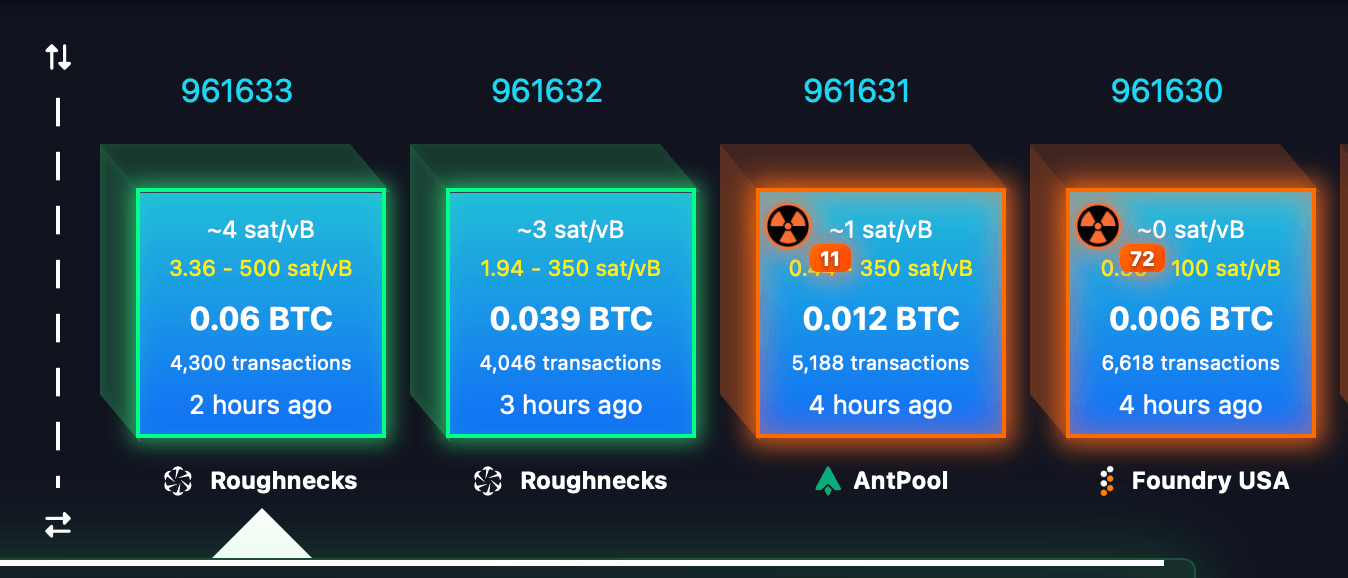
Image source: mempool.kilombino.com, showing two consecutive BIP-110 blocks mined by Roughnecks.

Bitcoin's mining difficulty does not magically decrease when the majority of miners leave, meaning Roughnecks and its allies are still trying to solve blocks at the same target difficulty of 127.48 trillion, but with only a tiny fraction of the main chain's hashpower. Unless significantly more hashpower joins the split-off chain, blocks will appear at agonizingly slow intervals, effectively leaving BIP-110 stuck waiting for enough blocks for the next difficulty adjustment.

Hashpower Linked to Ocean Mining Breaks Ranks on Dominant Chain

Another surprise regarding the split: Simple Mining, a major hosting provider from Iowa directing hashpower to Ocean Mining, mined block No. 961634 on the dominant chain. Simple Mining uses Ocean's DATUM system, which allows individual miners and hosters to create their own block templates, including choosing whether to set the BIP-110 version bit.
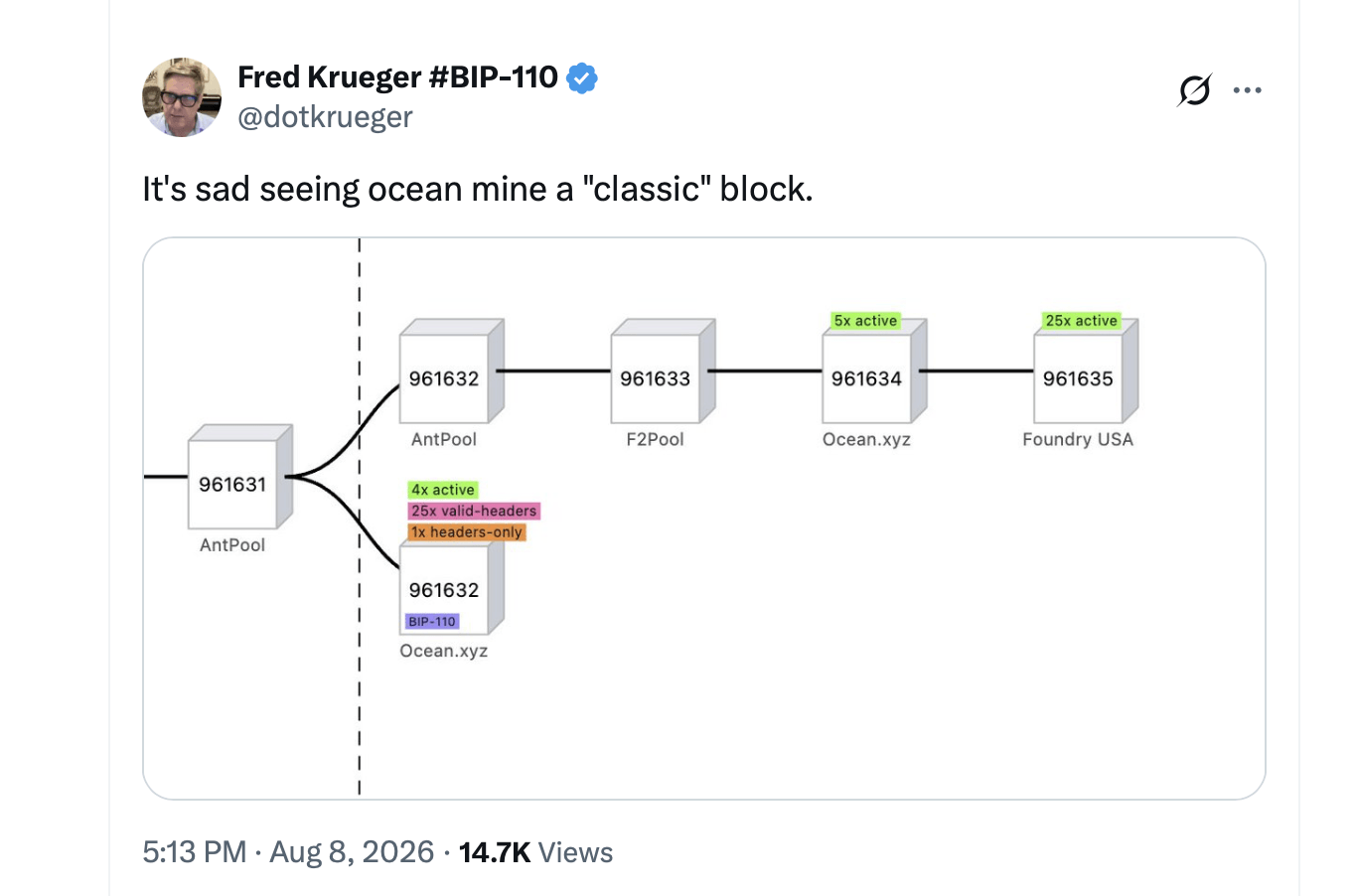
Image source: X

This makes the block particularly noteworthy. Ocean is closely associated with the BIP-110 camp: Dashjr holds the CTO position of the pool, and a large portion of the early signals supporting the proposal came from Ocean and DATUM miners. Yet, Simple Mining's block landed squarely on the dominant Bitcoin chain — another sign that hashpower linked to Ocean is not marching in step with the BIP-110 minority fork.

Roughnecks Continues 'Wildcat Mining' on Split-Off Chain

Roughnecks Mining Division 110 celebrated successfully mining two consecutive BIP-110 blocks — 961632 and 961633 — comparing this achievement to "wildcat oil drilling" on oilfields, where speculators make large bets on untested plots in hopes of striking oil. Whether this holds true remains to be seen. After Roughnecks published, a Dashjr user reposted this post on X.

BIP-110 Supporters Insist Bitcoin Is Broken and Are Prepared to Change PoW Algorithm for Minority Chain

BIP-110 supporters have not taken this outcome well. "RIP, Bitcoin. You've just become another captured speculative asset. Sorry, Satoshi, we failed you," lamented one X user and BIP-110 supporter under the handle BTCbello. One of the most active and recognizable BIP-110 proponents, Matthew Kratter, acknowledged that it would now take "a real miracle" for the BIP-110 chain to overtake the main chain.
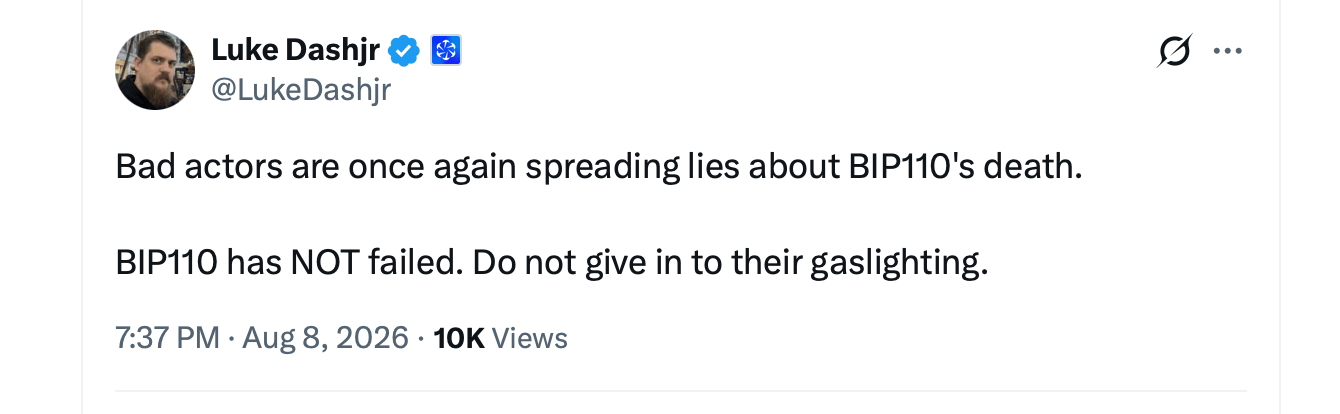
Dashjr also informed users that "BIP-110 is active on the Bitcoin network. Malicious pools and miners are attacking the network, deceiving old nodes and light wallets. Users using updated full nodes (i.e., versions 20260508) are unaffected."

Meanwhile, other BIP-110 supporters still signaled willingness to change the minority chain's mining algorithm. "We have nothing to lose by starting from scratch with a POW algorithm. There's huge potential and freedom in this — the chance to clearly see what just happened and make the necessary adjustments to preserve the system. This is Independence Day for sound, decentralized money," wrote user Maitreya Lockwood in an X account in response to Kratter's latest video on the topic.


Trending Cryptos

Related Questions

QAccording to the article, what is the current status of the BIP-110 fork in relation to the main Bitcoin blockchain?

AThe BIP-110 fork is lagging behind the main Bitcoin chain by 18 blocks.

QWhat is the key security warning issued by Luke Dashjr regarding the BIP-110 fork event?

ALuke Dashjr warned that users who have not updated to Bitcoin Knots version 29.3.knots20260508 (or 29.4) are vulnerable to double-spend attacks facilitated by certain mining pools and should update immediately to avoid accepting fake bitcoins.

QWhich mining company is actively mining on the minority BIP-110 chain, and what term did they use to describe their activity?

AThe mining company Roughnecks is actively mining on the minority BIP-110 chain. They described their activity as 'wildcat mining,' comparing it to speculative oil drilling.

QWhat significant change occurred to Bitcoin's mining difficulty at the time of the chain split, and what is its impact on the BIP-110 chain?

AAt block height 961632, when the split occurred, Bitcoin's mining difficulty increased to 127.48 trillion. This makes it extremely hard for the minority BIP-110 chain to find new blocks, as they must meet the same high difficulty target with only a fraction of the total hashpower, causing blocks to be found at a painfully slow rate.

QWhat drastic measure are some BIP-110 supporters reportedly considering for the minority chain?

ASome BIP-110 supporters are signaling a readiness to change the Proof-of-Work (PoW) algorithm for the minority chain, viewing it as a chance to start fresh and build a more robust and decentralized monetary system.

Related Reads

The Biggest Dark Horse in AI Payments Might Be Coinbase Giving Agents a Wallet

In the AI payments race, while most focus on traditional giants like Visa or AI platforms like OpenAI, Coinbase has quietly emerged as a key player. Data from 2026 shows over 90% of on-chain Agent transactions occur on Coinbase's Base network, with 99% settled in USDC and over 97% using the x402 protocol. Coinbase's pivotal move was launching "Agentic Wallets" in February 2026—a dedicated wallet infrastructure giving AI Agents their own financial identity. Unlike Visa or Stripe, which connect Agents to existing payment rails, Coinbase provides Agents with autonomous wallets to hold assets (like stablecoins), initiate transfers, and execute transactions under predefined rules. This solves core issues for machine-to-machine payments: high credit card fees for micropayments, the need for constant human authorization, and unclear transaction attribution. Coinbase's strength lies in its closed-loop ecosystem: the Base blockchain (low-cost, high-throughput), the x402 payment protocol, Agentic Wallets, and native assets like USDC. This integrated stack, built through years of infrastructure investment, positioned Coinbase to capture early Agent payment demand as the AI economy surged. The key insight is that AI payment adoption may depend less on whose standard wins and more on whose usable infrastructure is ready first. While debates over protocols and payment rails continue, real Agent transactions are already flowing—primarily through Coinbase's ecosystem. It may not be the ultimate winner, but for now, it's the frontrunner by being prepared.

marsbit18m ago

The Biggest Dark Horse in AI Payments Might Be Coinbase Giving Agents a Wallet

marsbit18m ago

Dialogue with Bitwise CIO: Bitcoin May Be Near Bottom, Who Will Drive the Next Rally?

In a recent podcast, Bitwise CIO Matt Hougan analyzed Bitcoin's current market cycle, suggesting it is near a bottom characterized by low volatility and investor indifference. He believes the next major price surge will be driven primarily by wealth management platforms, financial advisors, and family offices, who control trillions in assets and are now gaining access to Bitcoin ETFs. Hougan views Bitcoin as a long-dated, out-of-the-money call option on it becoming a global reserve asset. Its value increases with global monetary system volatility, making it a natural hedge against currency disorder. He outlined Bitcoin's adoption path: first as a global digital store of value (competing with gold), and potentially later as a check against fiat currency abuse by sovereign states. Addressing the muted price action despite institutional ETF inflows, Hougan explained that significant selling by long-term retail holders has offset buying pressure. However, he is optimistic as data shows retail selling has subsided, which, combined with continued institutional inflows, could propel prices higher. Hougan downplayed the future impact of Federal Reserve interest rates and MicroStrategy's actions on Bitcoin's price, arguing they are becoming less relevant. Instead, he pointed to runaway U.S. fiscal deficits and debt as the core long-term drivers. Finally, he discussed the transformative potential of asset tokenization, predicting all traditional assets will eventually trade 24/7 on blockchains. This will merge traditional and crypto markets, increasing efficiency but also introducing crypto-like features such as overnight volatility and easier access to leverage into traditional finance.

marsbit58m ago

Dialogue with Bitwise CIO: Bitcoin May Be Near Bottom, Who Will Drive the Next Rally?

marsbit58m ago

Dalio Warns of U.S. Bond Supply-Demand Imbalance: Gold and Bitcoin Could Become Hedge Assets in Debt Crisis

Ray Dalio warns of an unsustainable imbalance in US Treasury supply and demand, drawing parallels to the mechanisms of a "big debt cycle" described in his book. Key recent developments include Japan selling US bonds to support the yen, rising US long-term yields amid weak demand, and limited Treasury buybacks. Dalio explains that when debt service burdens become too large relative to income, and bond supply outstrips market demand, a crisis point approaches. Typically, central banks then print money to buy bonds, leading to currency devaluation and inflation. He simplifies the US government's position: with ~$5.5T in revenue, ~$7.5T in spending, a $2T deficit, and $32T in debt, annual debt service is roughly $1T in interest plus ~$10T in maturing principal needing refinancing. Without change, he estimates a potential debt crisis in roughly three years, give or take two. Dalio proposes a "3% three-part solution" to reduce the deficit to 3% of GDP through balanced spending cuts, tax increases, and naturally lower interest rates. He warns that Japan's high debt, often cited as sustainable, has led to poor bond returns and significant currency losses versus gold and the dollar. In response to questions, Dalio states that all reserve currencies eventually decline via this debt cycle mechanism. He advises investors to diversify globally, favor countries with strong finances and stable politics, underweight bonds, overweight gold, and allocate a small portion (e.g., 10-15%) to Bitcoin as hedges against government-created currency devaluation.

marsbit58m ago

Dalio Warns of U.S. Bond Supply-Demand Imbalance: Gold and Bitcoin Could Become Hedge Assets in Debt Crisis

marsbit58m ago

Trading

Spot

Hot Articles

What is $BITCOIN

DIGITAL GOLD ($BITCOIN): A Comprehensive Analysis Introduction to DIGITAL GOLD ($BITCOIN) DIGITAL GOLD ($BITCOIN) is a blockchain-based project operating on the Solana network, which aims to combine the characteristics of traditional precious metals with the innovation of decentralized technologies. While it shares a name with Bitcoin, often referred to as “digital gold” due to its perception as a store of value, DIGITAL GOLD is a separate token designed to create a unique ecosystem within the Web3 landscape. Its goal is to position itself as a viable alternative digital asset, although specifics regarding its applications and functionalities are still developing. What is DIGITAL GOLD ($BITCOIN)? DIGITAL GOLD ($BITCOIN) is a cryptocurrency token explicitly designed for use on the Solana blockchain. In contrast to Bitcoin, which provides a widely recognized value storage role, this token appears to focus on broader applications and characteristics. Notable aspects include: Blockchain Infrastructure: The token is built on the Solana blockchain, known for its capacity to handle high-speed and low-cost transactions. Supply Dynamics: DIGITAL GOLD has a maximum supply capped at 100 quadrillion tokens (100P $BITCOIN), although details regarding its circulating supply are currently undisclosed. Utility: While precise functionalities are not explicitly outlined, there are indications that the token could be utilized for various applications, potentially involving decentralized applications (dApps) or asset tokenization strategies. Who is the Creator of DIGITAL GOLD ($BITCOIN)? At present, the identity of the creators and development team behind DIGITAL GOLD ($BITCOIN) remains unknown. This situation is typical among many innovative projects within the blockchain space, particularly those aligning with decentralized finance and meme coin phenomena. While such anonymity may foster a community-driven culture, it intensifies concerns about governance and accountability. Who are the Investors of DIGITAL GOLD ($BITCOIN)? The available information indicates that DIGITAL GOLD ($BITCOIN) does not have any known institutional backers or prominent venture capital investments. The project seems to operate on a peer-to-peer model focused on community support and adoption rather than traditional funding routes. Its activity and liquidity are primarily situated on decentralized exchanges (DEXs), such as PumpSwap, rather than established centralized trading platforms, further highlighting its grassroots approach. How DIGITAL GOLD ($BITCOIN) Works The operational mechanics of DIGITAL GOLD ($BITCOIN) can be elaborated on based on its blockchain design and network attributes: Consensus Mechanism: By leveraging Solana’s unique proof-of-history (PoH) combined with a proof-of-stake (PoS) model, the project ensures efficient transaction validation contributing to the network's high performance. Tokenomics: While specific deflationary mechanisms have not been extensively detailed, the vast maximum token supply implies that it may cater to microtransactions or niche use cases that are still to be defined. Interoperability: There exists the potential for integration with Solana’s broader ecosystem, including various decentralized finance (DeFi) platforms. However, the details regarding specific integrations remain unspecified. Timeline of Key Events Here is a timeline that highlights significant milestones concerning DIGITAL GOLD ($BITCOIN): 2023: The initial deployment of the token occurs on the Solana blockchain, marked by its contract address. 2024: DIGITAL GOLD gains visibility as it becomes available for trading on decentralized exchanges like PumpSwap, allowing users to trade it against SOL. 2025: The project witnesses sporadic trading activity and potential interest in community-led engagements, although no noteworthy partnerships or technical advancements have been documented as of yet. Critical Analysis Strengths Scalability: The underlying Solana infrastructure supports high transaction volumes, which could enhance the utility of $BITCOIN in various transaction scenarios. Accessibility: The potential low trading price per token could attract retail investors, facilitating wider participation due to fractional ownership opportunities. Risks Lack of Transparency: The absence of publicly known backers, developers, or an audit process may yield skepticism regarding the project's sustainability and trustworthiness. Market Volatility: The trading activity is heavily reliant on speculative behavior, which can result in significant price volatility and uncertainty for investors. Conclusion DIGITAL GOLD ($BITCOIN) emerges as an intriguing yet ambiguous project within the rapidly evolving Solana ecosystem. While it attempts to leverage the “digital gold” narrative, its departure from Bitcoin's established role as a store of value underscores the need for a clearer differentiation of its intended utility and governance structure. Future acceptance and adoption will likely depend on addressing the current opacity and defining its operational and economic strategies more explicitly. Note: This report encompasses synthesised information available as of October 2023, and developments may have transpired beyond the research period.

2.0k Total ViewsPublished 2025.05.13Updated 2025.05.13

What is $BITCOIN

Discussions

Welcome to the HTX Community. Here, you can stay informed about the latest platform developments and gain access to professional market insights. Users' opinions on the price of BTC (BTC) are presented below.

活动图片