"Big Short" Burry: Bitcoin Has Already Crashed 40%, If It Falls Another 10%, It Will Trigger "Disastrous Consequences"

华尔街日报Published on 2026-02-04Last updated on 2026-02-04

Abstract

Famed "Big Short" investor Michael Burry warns that a further 10% drop in Bitcoin, which has already fallen over 40% from its peak, could trigger "disastrous consequences." He argues Bitcoin has failed as a hedge asset and remains purely speculative, noting its inability to respond to typical drivers like dollar weakness or geopolitical risk. Burry highlights that nearly 200 public companies hold Bitcoin, and a continued decline could force corporate treasuries to sell, exacerbating losses. He specifically cautions that a 10% drop would push aggressive corporate holder Strategy Inc. into billions in losses and cut off its access to capital markets. Additionally, Burry warns that Bitcoin sell-off could spill over to broader markets, potentially causing a "collateral death spiral" in tokenized metal futures—which aren’t backed by physical metal—as investors liquidate positions. Despite the warning, the report notes Bitcoin’s relatively small market size may limit wider financial contagion.

Michael Burry, known for successfully predicting the 2008 U.S. housing market crash, warned that Bitcoin has already plummeted 40%, and if it continues to fall, it could cause lasting damage to companies that have heavily accumulated the asset over the past year. He believes Bitcoin has proven to be a purely speculative asset, failing to act as a hedge like precious metals.

In a Substack article published on Monday, Burry pointed out that if Bitcoin falls another 10%, one of the most aggressive Bitcoin-hoarding companies, Strategy Inc., would face billions of dollars in losses and would be largely shut out of capital markets. He warned that a Bitcoin decline could trigger "disastrous consequences," including spillover into broader markets and causing a "collateral death spiral" in tokenized metal futures.

This warning comes as Bitcoin continued its sharp decline on Tuesday, briefly falling below $73,000, erasing all gains since Donald Trump's re-election in November 2024. Since hitting an all-time high in early October, the digital currency has dropped more than 40%.
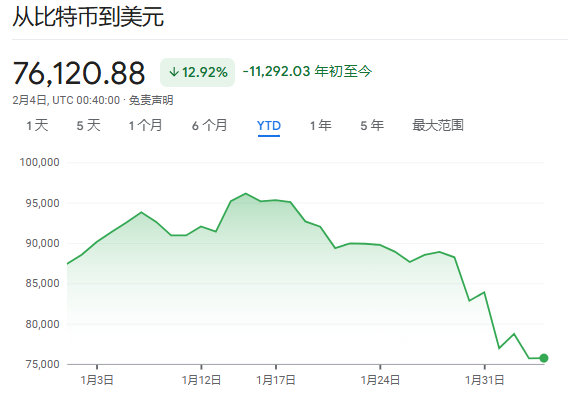
Despite Burry's warning, the cryptocurrency market remains relatively small and is unlikely to cause widespread contagion. With a market capitalization of less than $1.5 trillion, limited household ownership, and narrow corporate adoption, any wealth effects are likely to remain contained.

Bitcoin Exposes Speculative Nature, Fails as Safe-Haven Asset

Burry noted in the article that Bitcoin has failed to respond to typical drivers like a weak U.S. dollar or geopolitical risks, while gold and silver have hit record highs amid global tensions and fears of dollar devaluation. "Bitcoin has no organic use case rationale to slow or stop its decline," Burry said.

According to Bloomberg, analysts attribute Bitcoin's decline to multiple factors, including vanishing inflows, shrinking liquidity, and a broad loss of macro appeal. Many crypto-native traders have also cooled on tokens, shifting to event betting with the rise of prediction markets.

Bitcoin fell over the weekend to its lowest level since last year's tariff-induced turmoil and continued to drop on Tuesday. This performance contrasts sharply with the arguments of its long-term supporters, who believe Bitcoin's fixed supply makes it comparable to gold.

Treasury Companies Face Immense Pressure

Burry warned that the adoption of Bitcoin by corporate treasuries and the launch of new spot cryptocurrency exchange-traded funds (ETFs) are not enough to support its price indefinitely or prevent disastrous consequences in a sharp downturn. He pointed out that nearly 200 publicly traded companies hold Bitcoin.

While this has helped broaden demand, "inventory assets are not permanent," he wrote. Inventory assets must be marked to market and included in financial reports. If Bitcoin's price continues to fall, risk managers will begin advising their companies to sell.

Burry specifically mentioned that if Bitcoin falls another 10%, Strategy Inc., one of the most aggressive Bitcoin-hoarding companies, would be plunged into billions of dollars in losses and find capital markets largely closed to it. He described these "nauseating scenarios as now within reach."

ETFs Amplify Speculation and Increase Market Correlation

Burry added that the emergence of spot ETFs has only intensified Bitcoin's speculative nature while also increasing the token's correlation with the stock market. He wrote that Bitcoin's correlation with the S&P 500 recently approached 0.50. Theoretically, liquidation will kick in aggressively as losing positions start to grow.

Burry noted that since late November, Bitcoin ETFs have been setting some of the largest single-day outflow records, with three occurring in the last 10 days of January.

This trend suggests that institutional investor confidence in Bitcoin is waning, and ETFs, which were originally seen as a tool to broaden Bitcoin adoption, may instead accelerate selling during a market downturn.

Warns of "Collateral Death Spiral" Risk

As Bitcoin continues to fall below certain key levels, Burry believes it is spilling over into broader markets. He noted that the cryptocurrency's decline is partly responsible for the recent crash in gold and silver, as corporate treasurers and speculators need to de-risk by selling profitable positions in tokenized gold and silver futures.

These tokenized metal futures are not backed by actual physical metal and could overwhelm physical metal trading, leading to a "collateral death spiral," he said.

"It appears that at month-end, up to $1 billion in precious metals were liquidated due to falling crypto prices," Burry wrote. If Bitcoin falls to $50,000, miners will go bankrupt, and "tokenized metal futures would collapse into a black hole with no buyers," he stated.

Nevertheless, some market observers point out that past crashes—from Terra to FTX—failed to infect traditional markets. Bulls now point to regulatory clarity and cheap valuations as potential fuel for another rally. But Burry's warning highlights the systemic risks posed by Bitcoin's role as a treasury asset for corporations.


Related Questions

QWhat specific warning did Michael Burry issue regarding Bitcoin's potential further decline?

AMichael Burry warned that if Bitcoin falls another 10%, it could cause 'disastrous consequences,' including billions in losses for aggressive corporate holders like Strategy Inc., inability to access capital markets, and potentially triggering a 'collateral death spiral' in tokenized metal futures.

QAccording to Burry, why has Bitcoin failed to serve as a hedge asset compared to precious metals?

ABurry stated that Bitcoin has failed to react to typical drivers like dollar weakness or geopolitical risks, unlike gold and silver, which hit record highs due to global tensions. He called Bitcoin a purely speculative asset with no organic use case to slow or stop its decline.

QHow have Bitcoin ETFs affected its market behavior, as per Burry's analysis?

ABurry argued that Bitcoin ETFs have intensified its speculative nature and increased its correlation with the stock market, nearing 0.50 with the S&P 500. He noted significant outflows from Bitcoin ETFs, particularly in late January, indicating weakening confidence and potential accelerated selling during downturns.

QWhat risk does Burry associate with tokenized metal futures in the context of Bitcoin's decline?

ABurry warned that tokenized metal futures, not backed by physical metal, could be overwhelmed by Bitcoin's decline, leading to a 'collateral death spiral.' He estimated up to $1 billion in precious metals were liquidated due to crypto price drops, and if Bitcoin falls to $50,000, these futures could collapse into a 'black hole' with no buyers.

QHow does Burry characterize the impact of corporate Bitcoin adoption on market stability?

ABurry highlighted that nearly 200 public companies hold Bitcoin as treasury assets, which must be marked to market. If prices fall, risk managers may force sales, exacerbating declines. He emphasized that treasury assets are not permanent and could lead to systemic risks, as seen with Strategy Inc. facing massive losses and capital market exclusion.

Related Reads

It Took Me a Year to See the Bitter Truth About Agent Payments

After a year building infrastructure for the Agent economy, engaging with major players like Stripe, Visa, and Coinbase, the author shares a sobering analysis of the current state of Agent payments. The core finding is a stark lack of genuine, immediate demand across most envisioned use cases. The article breaks down four key market segments: 1. **Agent-to-Merchant (Consumer Shopping):** For most product categories (e.g., clothing, electronics), conversational AI shopping is a step backwards from visual e-commerce interfaces. While agents excel at understanding needs, they can't replace side-by-side product comparison. Real merchant interest is defensive "Agent Engine Optimization," not driven by current customer demand. Potential exists for high-frequency, low-decision purchases (like food delivery) or navigating complex store UIs, but these require massive B2C distribution channels dominated by giants like Amazon. 2. **Agent-to-API (Developer Services):** Developers already have subscriptions and billing relationships for APIs (compute, data). Prepaid balances solve micro-payment issues for low transaction volumes. A deeper structural problem is that major SaaS vendors' business models rely on enterprise contracts, resisting granular pay-per-call pricing. While protocols like MPP and x402 serve the long tail of niche services, this market is small and developers are historically low-willingness-to-pay. 3. **Agent-to-Agent:** This remains largely theoretical with minimal transaction volume. While it represents a long-term bet on a fundamentally new transaction infrastructure (sub-second, micro-penny to million-dollar, multi-party settlements), it does not constitute a present market. 4. **Agent-to-Finance:** This is the only category with existing, paying demand. Integrating AI into financial workflows (trading, portfolio management) is a natural evolution and enables new capabilities like autonomous rebalancing. However, competition favors established, regulated institutions. The "real problem" is not moving money between agents, but the broader challenge of **coordination**—orchestrating work between agents and humans, verifying outcomes, and settling results. Payment is just one component of settlement, which is itself part of coordination. Companies that solve the coordination layer will subsume payment, not the other way around. While well-funded incumbents build defensively for a long-term future, startups must find where the market is today—which, for the author's team, lies outside these four categories in an area of real, growing, and underserved activity.

marsbit12m ago

It Took Me a Year to See the Bitter Truth About Agent Payments

marsbit12m ago

It Took Me a Year to See the Hard Truth About Agent Payments

**Title: It Took Me a Year to See the Hard Truth About Agent Payments** Over the past year, I've worked on infrastructure for the Agent economy, engaging with major players like Stripe, Visa, Coinbase, and numerous startups. The findings reveal a stark reality: genuine, widespread demand for Agent-based payments does not yet exist. **Key Observations:** * **Agent-to-Merchant (Shopping):** The user experience for AI shopping often falls short, especially for visual product discovery. While AI excels at understanding needs, conversational interfaces can't yet replace browsing and comparing multiple products visually. Current merchant interest is largely defensive ("Agent Engine Optimization") for a future that hasn't arrived. High-frequency, low-friction purchases (like food delivery) are potential fits, but lack open APIs and face high AI inference costs. Simpler, more affordable, or cross-language interactions for complex UIs are a niche opportunity but require massive consumer distribution to scale. * **Agent-to-API (Developer Tools):** Developer payment needs for APIs (computing, data, models) are already met through subscriptions and prepaid credits. The core challenge is not payment friction but supplier economics: most large SaaS providers prefer enterprise contracts over micropayments for API calls. Protocols like MPP and x402 suit the long-tail of smaller services but cater to a developer market historically reluctant to pay for these tools. Major infrastructure needs at the top of the stack are already being addressed. * **Agent-to-Agent (Machine Commerce):** This is a long-term vision with almost no current transaction volume. While a future with high-speed, high-frequency, multi-party machine-to-machine transactions would require novel infrastructure, it remains theoretical. The market is not here yet. * **Agent-to-Finance:** This is the only category with clear, present demand. Financial professionals and DeFi users already pay for tools, and AI augmentation is a natural evolution. Autonomous AI agents can enable entirely new financial strategies. However, competition is fierce from established, regulated incumbents who can more easily layer AI onto their existing products. **The Core Insight:** Companies, especially giants with long time horizons, are building defensively for a potential future of mass machine commerce. For them, early investment is a low-cost hedge. For startups, the current market reality is different. The primary challenge isn't just moving money between agents (payments). The larger, unsolved problem is **orchestration** – coordinating work between agents and humans, verifying outcomes, and then settling. Payment is just a part of settlement, which is just a part of orchestration. Companies that solve the orchestration problem will subsume payments, not the other way around. After a year of building, we see the real, growing, and underserved market opportunity lies in this broader domain of orchestration.

链捕手35m ago

It Took Me a Year to See the Hard Truth About Agent Payments

链捕手35m ago

Claude Opus 4.8 Finds a $4.5 Billion Bug: The AI Era is Mass-Producing Hackers

A researcher discovered a critical "infinite mint" vulnerability in the Zcash cryptocurrency's Orchard protocol using Claude Opus 4.8, leading to a swift fix but also a 50% market drop, erasing billions in value. This incident highlights a new era where powerful, accessible AI models are dramatically lowering the barrier to finding software vulnerabilities. Previously, the security community feared specialized models like Claude Mythos Preview, capable of finding decades-old zero-day exploits. The Zcash case, however, involved a publicly available, general-purpose model. This shift makes advanced security auditing—and attack capabilities—accessible to far more people, not just experts. The mass democratization of vulnerability discovery brings a dual challenge: a flood of low-quality, AI-generated false reports that overwhelm maintainers, and the real, rapid uncovering of deep, dangerous bugs. Open-source projects, often understaffed and unfunded, are particularly vulnerable to this "attention DDoS." The article cites examples like curl shutting down its bug bounty program due to the unsustainable workload. Our perceived digital safety has often been luck, relying on the high cost and effort required to find deeply hidden flaws in complex systems, as seen with historical vulnerabilities like Heartbleed or Baron Samedit. AI changes this cost structure, effectively "mass-producing flashlights" to illuminate every corner of our codebase. While large companies operate extensive security chains involving external white-hat hackers and massive defensive operations, the global cybersecurity workforce faces a severe shortage, especially of experienced personnel capable of analyzing complex threats and coordinating fixes. The core dilemma emerges: AI makes *finding* bugs cheap and scalable, but *fixing* them remains a slow, expensive, and human-intensive process. The article concludes that AI won't destroy the internet but acts as a bright light, revealing that our digital existence is not inherently secure but is precariously maintained by ongoing human effort. The true cost in the AI era may not be discovery, but whether there will be enough people left willing and able to do the hard work of repair.

marsbit1h ago

Claude Opus 4.8 Finds a $4.5 Billion Bug: The AI Era is Mass-Producing Hackers

marsbit1h ago

Codex Goal Mode Usage Guide: How to Make AI Continuously Pursue a Specific Objective

"Codex Goal Mode: How to Make AI Work Continuously Toward a Specific Goal" OpenAI's Codex "goal mode" (/goal) transforms the AI from a reactive code assistant into a proactive execution agent capable of working autonomously for hours or even days to achieve a defined objective. To maximize its effectiveness, follow these key principles: 1. **Define Clear, Verifiable Exit Criteria:** The goal prompt should be a concise, measurable success condition, not a lengthy specification. Use quantifiable metrics like "reduce build time by 30%" or "achieve 100% test parity." 2. **Provide Initial Guidance and Tools:** Direct Codex toward likely problem areas and specify available tools (e.g., browsers, testing environments) to prevent it from exploring unproductive paths. 3. **Enable Progress Measurement:** Equip Codex with ways to track advancement, such as creating comparison tools for visual tasks or evaluation sets, ensuring it can gauge its own progress. 4. **Use a Realistic Execution Environment:** For tasks like performance optimization, provide access to environments that closely mimic production (e.g., similar configs, databases) to yield valid results. 5. **Be Cautious with Visual Goals:** Avoid vague "pixel-perfect" instructions. Instead, supplement visual references with functional checklists or design system specifications to prevent Codex from obsessing over minor details. 6. **Implement Progress Tracking:** For long-running tasks, have Codex commit code to draft PRs, update progress documents, or send Slack updates to maintain visibility into its work. 7. **Review and Consolidate Results:** Once the goal is met, instruct Codex to review its work, clean up ineffective experimental code, and reflect on what strategies succeeded or failed. Ultimately, using goal mode shifts the developer's role from writing prompts to managing a persistent engineering agent—defining objectives, establishing metrics, configuring environments, and conducting final reviews.

marsbit2h ago

Codex Goal Mode Usage Guide: How to Make AI Continuously Pursue a Specific Objective

marsbit2h ago

Trading

Spot
Futures

Hot Articles

What is $BITCOIN

DIGITAL GOLD ($BITCOIN): A Comprehensive Analysis Introduction to DIGITAL GOLD ($BITCOIN) DIGITAL GOLD ($BITCOIN) is a blockchain-based project operating on the Solana network, which aims to combine the characteristics of traditional precious metals with the innovation of decentralized technologies. While it shares a name with Bitcoin, often referred to as “digital gold” due to its perception as a store of value, DIGITAL GOLD is a separate token designed to create a unique ecosystem within the Web3 landscape. Its goal is to position itself as a viable alternative digital asset, although specifics regarding its applications and functionalities are still developing. What is DIGITAL GOLD ($BITCOIN)? DIGITAL GOLD ($BITCOIN) is a cryptocurrency token explicitly designed for use on the Solana blockchain. In contrast to Bitcoin, which provides a widely recognized value storage role, this token appears to focus on broader applications and characteristics. Notable aspects include: Blockchain Infrastructure: The token is built on the Solana blockchain, known for its capacity to handle high-speed and low-cost transactions. Supply Dynamics: DIGITAL GOLD has a maximum supply capped at 100 quadrillion tokens (100P $BITCOIN), although details regarding its circulating supply are currently undisclosed. Utility: While precise functionalities are not explicitly outlined, there are indications that the token could be utilized for various applications, potentially involving decentralized applications (dApps) or asset tokenization strategies. Who is the Creator of DIGITAL GOLD ($BITCOIN)? At present, the identity of the creators and development team behind DIGITAL GOLD ($BITCOIN) remains unknown. This situation is typical among many innovative projects within the blockchain space, particularly those aligning with decentralized finance and meme coin phenomena. While such anonymity may foster a community-driven culture, it intensifies concerns about governance and accountability. Who are the Investors of DIGITAL GOLD ($BITCOIN)? The available information indicates that DIGITAL GOLD ($BITCOIN) does not have any known institutional backers or prominent venture capital investments. The project seems to operate on a peer-to-peer model focused on community support and adoption rather than traditional funding routes. Its activity and liquidity are primarily situated on decentralized exchanges (DEXs), such as PumpSwap, rather than established centralized trading platforms, further highlighting its grassroots approach. How DIGITAL GOLD ($BITCOIN) Works The operational mechanics of DIGITAL GOLD ($BITCOIN) can be elaborated on based on its blockchain design and network attributes: Consensus Mechanism: By leveraging Solana’s unique proof-of-history (PoH) combined with a proof-of-stake (PoS) model, the project ensures efficient transaction validation contributing to the network's high performance. Tokenomics: While specific deflationary mechanisms have not been extensively detailed, the vast maximum token supply implies that it may cater to microtransactions or niche use cases that are still to be defined. Interoperability: There exists the potential for integration with Solana’s broader ecosystem, including various decentralized finance (DeFi) platforms. However, the details regarding specific integrations remain unspecified. Timeline of Key Events Here is a timeline that highlights significant milestones concerning DIGITAL GOLD ($BITCOIN): 2023: The initial deployment of the token occurs on the Solana blockchain, marked by its contract address. 2024: DIGITAL GOLD gains visibility as it becomes available for trading on decentralized exchanges like PumpSwap, allowing users to trade it against SOL. 2025: The project witnesses sporadic trading activity and potential interest in community-led engagements, although no noteworthy partnerships or technical advancements have been documented as of yet. Critical Analysis Strengths Scalability: The underlying Solana infrastructure supports high transaction volumes, which could enhance the utility of $BITCOIN in various transaction scenarios. Accessibility: The potential low trading price per token could attract retail investors, facilitating wider participation due to fractional ownership opportunities. Risks Lack of Transparency: The absence of publicly known backers, developers, or an audit process may yield skepticism regarding the project's sustainability and trustworthiness. Market Volatility: The trading activity is heavily reliant on speculative behavior, which can result in significant price volatility and uncertainty for investors. Conclusion DIGITAL GOLD ($BITCOIN) emerges as an intriguing yet ambiguous project within the rapidly evolving Solana ecosystem. While it attempts to leverage the “digital gold” narrative, its departure from Bitcoin's established role as a store of value underscores the need for a clearer differentiation of its intended utility and governance structure. Future acceptance and adoption will likely depend on addressing the current opacity and defining its operational and economic strategies more explicitly. Note: This report encompasses synthesised information available as of October 2023, and developments may have transpired beyond the research period.

363 Total ViewsPublished 2025.05.13Updated 2025.05.13

What is $BITCOIN

Discussions

Welcome to the HTX Community. Here, you can stay informed about the latest platform developments and gain access to professional market insights. Users' opinions on the price of BTC (BTC) are presented below.

活动图片














