Bessent Draws a Line on Bitcoin Bailouts: Why Investors are Flocking to $SUBBD for Self-Sustaining Yield

bitcoinistPublished on 2026-02-05Last updated on 2026-02-05

Abstract

Scott Bessent, the anticipated U.S. Treasury Secretary, has signaled that the federal government will not bail out the cryptocurrency sector, forcing the market to rely on self-sustaining economics. This shift is driving investor interest toward assets with real-world utility and external revenue streams, such as SUBBD Token ($SUBBD). Targeting the $85B creator economy, SUBBD uses an Ethereum-based ecosystem with AI tools to reduce platform fees and empower creators. The token has raised over $1.47M in its presale and offers a 20% APY staking reward for early adopters, positioning itself as a defensible investment in a post-bailout crypto landscape.

The era of implied safety nets for digital assets isn’t just closing; it never really opened.

Scott Bessent, the anticipated U.S. Treasury Secretary, has signaled that the federal government won’t extend bailouts to the cryptocurrency sector. This stance effectively removes the ‘moral hazard’ that has plagued traditional finance, serving notice that crypto markets must stand on their own merit, liquidity, and solvency.
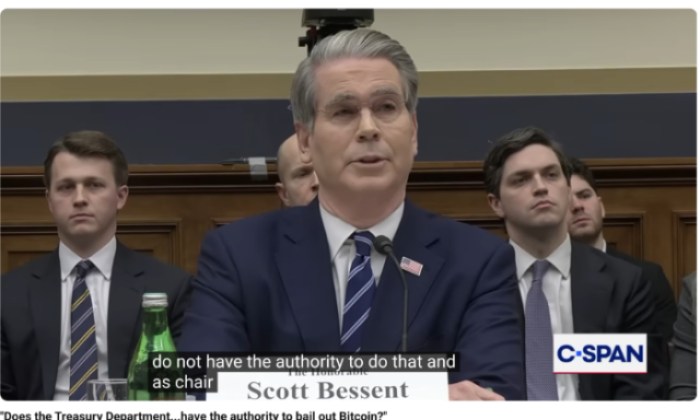
This clarity lands at a pivotal moment. While Bitcoin ($BTC) continues to trade low, the broader altcoin market also faces a reckoning. Bessent’s ‘no bailout’ doctrine suggests that protocols relying on speculative leverage or obscure backing mechanisms will face unchecked liquidation risks during downturns.

The market is listening. Smart money is already rotating away from governance tokens with vague value accrual and toward assets backed by external revenue streams.

The takeaway? Survival now depends on self-sustaining economics. This shift in sentiment is driving capital toward sectors that generate cash flow independent of broader market volatility.

Specifically, the convergence of AI and the $85B creator economy has emerged as a primary flight-to-safety destination. Leading this charge is SUBBD Token ($SUBBD), a platform using Web3 architecture to ensure creators and investors capture value directly, bypassing the need for systemic support.

SUBBD Token Disrupts The $85B Creator Economy With AI Integration

Bessent’s philosophy favors assets that solve real-world inefficiencies over those relying on circular DeFi yield. SUBBD Token targets the content creation industry, a sector historically plagued by predatory intermediaries.

Traditional Web2 platforms often grab between 20% and 70% of creator earnings while retaining absolute control over account suspension. This centralization creates a fragile ecosystem where income can vanish overnight, a risk profile that aligns poorly with the strict market discipline the Treasury now advocates.

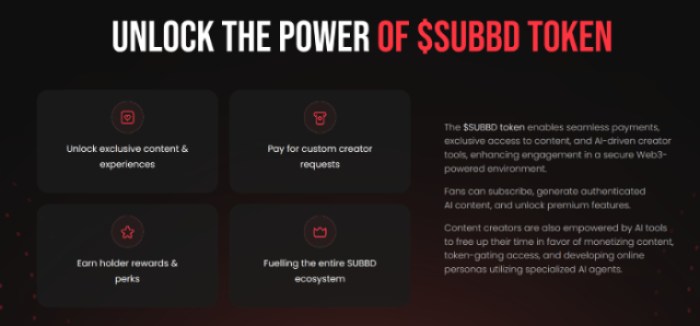
SUBBD addresses this by deploying an Ethereum-based (ERC-20) ecosystem that merges AI utility with decentralized payments. The platform democratizes advanced tools previously reserved for studio-level production.

Users will gain access to AI Personal Assistants for automated interactions, AI Voice Cloning, and tools for generating AI-exclusive content. That matters because it lowers the barrier to entry for creators while simultaneously slashing the fees they pay to platforms.
By using blockchain for transactions, SUBBD creates a transparent revenue model where earnings are settled instantly.

For investors, the utility argument is straightforward. The token isn’t merely a speculative vehicle; it’s the currency of a functional economy. $SUBBD is required for token-gated exclusive content, tipping, and NFT sales.

Plus, the platform introduces ‘HoneyHive’ governance, allowing token holders to vote on feature rollouts. In a market where the Treasury has ruled out rescuing failed projects, protocols like SUBBD (which anchor their value in the high-growth demand of the creator economy) offer a defensive play against regulatory indifference.

VISIT THE $SUBBD PRESALE TO BE PART OF THE DISRUPTION

Early Adopters Secure 20% Staking APY As Presale Crosses $1.47M

While headlines focus on regulatory shifts, on-chain data shows a distinct appetite for yield-bearing assets during the presale phase. SUBBD Token has raised over $1.47M to date, signaling robust demand despite broader market uncertainty. The current entry price is set at $0.05749, positioning early participants at a potentially advantageous cost basis before the platform’s full public launch.

The project’s staking structure is designed to reward long-term conviction over short-term flipping, a crucial feature in a market stripped of government backstops. $SUBBD offers a fixed 20% APY for the first year to users who lock their tokens.

This high-yield incentive serves a dual purpose: it secures network stability during the critical bootstrapping phase and provides investors with predictable returns unrelated to Bitcoin’s price action. Beyond simple yield, stakers gain access to VIP benefits, including exclusive livestreams, daily ‘Behind The Scenes’ drops, and XP multipliers that enhance platform status.

What most coverage misses is the strategic importance of the ‘Platform Benefit Staking’ model that kicks in after the first year. Unlike inflationary farming tokens that print endless supply, SUBBD’s staking rewards evolve to offer tangible platform utility. Find out more in our ‘What is SUBBD Token‘ guide.

This transition from monetary inflation to utility-based rewards creates deflationary pressure on the circulating supply as the platform grows. With features like AI influencer creation already integrated, the project is positioning itself not just as a crypto asset but as infrastructure for the next generation of digital media.

GET YOUR $SUBBD HERE

This article is for informational purposes only and does not constitute financial advice. Cryptocurrency investments carry high risks, including the potential loss of all invested capital. Always conduct independent research before participating in any presale.


Trending Cryptos

Related Questions

QWhat stance has Scott Bessent, the anticipated U.S. Treasury Secretary, taken regarding cryptocurrency bailouts?

AScott Bessent has signaled that the federal government will not extend bailouts to the cryptocurrency sector, removing the 'moral hazard' and requiring crypto markets to stand on their own merit, liquidity, and solvency.

QWhich token is highlighted as a solution for self-sustaining yield in the article and what sector does it target?

AThe SUBBD Token ($SUBBD) is highlighted, and it targets the $85 billion creator economy, using Web3 and AI integration to provide value directly to creators and investors.

QWhat is the current presale achievement of SUBBD Token mentioned in the article?

ASUBBD Token has raised over $1.47 million in its presale to date.

QWhat annual percentage yield (APY) does SUBBD Token offer for staking in the first year?

ASUBBD Token offers a fixed 20% APY for the first year to users who lock their tokens.

QHow does SUBBD Token aim to address issues in the content creation industry?

ASUBBD Token uses an Ethereum-based ecosystem to democratize advanced AI tools, reduce platform fees, and create a decentralized payment model, allowing creators to retain more value and avoid the control of predatory intermediaries.

Related Reads

Agent Race Ends, Super Workbench Takes Over

The era of fragmented AI agents is ending. Over the past month, China's tech giants—Tencent, Alibaba, and ByteDance—have simultaneously shifted strategy: instead of launching new, standalone AI agents, they are consolidating their various agent projects into unified "super workbenches." Tencent integrated its QClaw teams into WorkBuddy, a strategic product hailed as a potential third flagship after QQ and WeChat. Alibaba is merging its QoderWork, Wukong, and MuleRun agents into a new "Qianwen Office" platform under DingTalk's leadership. ByteDance rebranded its TRAE SOLO coding agent to TRAE Work, signaling a broader focus on workflow collaboration. This convergence marks a pivotal industry consensus. The initial exploration phase, where companies rapidly built numerous overlapping agents for different scenarios, proved costly and inefficient. With open-source tools eroding technical barriers, competition has shifted from agent creation to resource consolidation and cost control. Historically, platform wars are won not by creating more products, but by simplifying them—as seen with browsers unifying web access and super-apps consolidating services. Now, the "super workbench" aims to become the unified AI entry point for work. This reflects a deeper market realization: the primary audience for AI is no longer just programmers (a market in the tens of millions) but all knowledge workers (a market of billions). The real opportunity lies in augmenting everyday tasks—managing emails, documents, data, and meetings—across the entire workday. The core battleground is becoming control over the primary AI entry point that employees use daily. Tencent's WorkBuddy leverages WeChat and Tencent Docs; Alibaba's Qianwen Office taps into DingTalk's organizational data; ByteDance's TRAE Work integrates with Feishu's workflows. Whoever owns this "super workbench" gains strategic control over orchestrating enterprise data and APIs. This shift is redefining enterprise software. Traditional SaaS applications, valued for their user interfaces, will recede into the background. Their core functionalities will be exposed as standardized "Skills" or APIs for the super workbench's agents to invoke. Software value will shift from selling user seats to charging based on API calls and outcomes delivered. The evolution of agents is moving through clear stages: first as novel standalone products, then as consolidated primary work entry points, and finally as pervasive, invisible capabilities embedded into the digital fabric. The recent moves by major tech firms signal the transition from the first stage into the second, accelerating toward the third. In the end, the most successful agent technology may become invisible—like electricity or the HTTP protocol—a fundamental, unnamed infrastructure powering work itself.

marsbit9m ago

Agent Race Ends, Super Workbench Takes Over

marsbit9m ago

Michael Saylor: 110 Reasons to Oppose BIP-110

Michael Saylor presents 110 arguments against Bitcoin Improvement Proposal (BIP) 110, a soft fork aimed at restricting certain non-monetary data storage uses (like inscriptions) on the Bitcoin blockchain. He acknowledges the proponents' valid concerns—such as node costs, fee pressure, and preserving Bitcoin's monetary focus—but fundamentally disagrees with the proposed solution. Saylor argues that BIP 110 represents a dangerous precedent of using consensus rules to enforce value judgments on transaction validity, moving away from Bitcoin's core principles of neutrality and permissionless innovation. His key objections are organized into eleven categories: 1) It violates neutrality and hard consensus by banning currently valid transactions. 2) It fails to meet the high burden of proof required for a consensus change, lacking concrete data on the alleged crisis. 3) Its seven bundled technical restrictions are overly broad, targeting generic script functionalities and blocking future upgrade paths. 4) It sacrifices compatibility and future optionality by closing off designed upgrade hooks. 5) Its temporary rules add significant complexity (grandfathering, expiry states) without sufficient justification. 6) The economic and security impacts, particularly on miner revenue and fee markets, are uncertain and unmodeled. 7) Superior, market-based tools (fee markets, relay/mining policies) already exist to manage blockchain load. 8) It stifles innovation by creating a chilling effect for developers. 9) Its modified activation mechanism (55% threshold, forced signaling) is aggressive and risks network splits. 10) The precedent it sets—using consensus to suppress disliked but legal uses—is more dangerous than the problem it aims to solve. 11) A better path exists: improving measurements, refining resource-based policies, and allowing market forces to work. Saylor concludes that Bitcoin's strength lies in its neutral rules, open markets, and hard consensus. Changing these foundational elements to target specific use cases is an unnecessary and risky "iatrogenic" intervention. He advocates for guarding Bitcoin's neutrality rather than acting as its redeemer.

marsbit24m ago

Michael Saylor: 110 Reasons to Oppose BIP-110

marsbit24m ago

Trading

Spot

Hot Articles

What is $BITCOIN

DIGITAL GOLD ($BITCOIN): A Comprehensive Analysis Introduction to DIGITAL GOLD ($BITCOIN) DIGITAL GOLD ($BITCOIN) is a blockchain-based project operating on the Solana network, which aims to combine the characteristics of traditional precious metals with the innovation of decentralized technologies. While it shares a name with Bitcoin, often referred to as “digital gold” due to its perception as a store of value, DIGITAL GOLD is a separate token designed to create a unique ecosystem within the Web3 landscape. Its goal is to position itself as a viable alternative digital asset, although specifics regarding its applications and functionalities are still developing. What is DIGITAL GOLD ($BITCOIN)? DIGITAL GOLD ($BITCOIN) is a cryptocurrency token explicitly designed for use on the Solana blockchain. In contrast to Bitcoin, which provides a widely recognized value storage role, this token appears to focus on broader applications and characteristics. Notable aspects include: Blockchain Infrastructure: The token is built on the Solana blockchain, known for its capacity to handle high-speed and low-cost transactions. Supply Dynamics: DIGITAL GOLD has a maximum supply capped at 100 quadrillion tokens (100P $BITCOIN), although details regarding its circulating supply are currently undisclosed. Utility: While precise functionalities are not explicitly outlined, there are indications that the token could be utilized for various applications, potentially involving decentralized applications (dApps) or asset tokenization strategies. Who is the Creator of DIGITAL GOLD ($BITCOIN)? At present, the identity of the creators and development team behind DIGITAL GOLD ($BITCOIN) remains unknown. This situation is typical among many innovative projects within the blockchain space, particularly those aligning with decentralized finance and meme coin phenomena. While such anonymity may foster a community-driven culture, it intensifies concerns about governance and accountability. Who are the Investors of DIGITAL GOLD ($BITCOIN)? The available information indicates that DIGITAL GOLD ($BITCOIN) does not have any known institutional backers or prominent venture capital investments. The project seems to operate on a peer-to-peer model focused on community support and adoption rather than traditional funding routes. Its activity and liquidity are primarily situated on decentralized exchanges (DEXs), such as PumpSwap, rather than established centralized trading platforms, further highlighting its grassroots approach. How DIGITAL GOLD ($BITCOIN) Works The operational mechanics of DIGITAL GOLD ($BITCOIN) can be elaborated on based on its blockchain design and network attributes: Consensus Mechanism: By leveraging Solana’s unique proof-of-history (PoH) combined with a proof-of-stake (PoS) model, the project ensures efficient transaction validation contributing to the network's high performance. Tokenomics: While specific deflationary mechanisms have not been extensively detailed, the vast maximum token supply implies that it may cater to microtransactions or niche use cases that are still to be defined. Interoperability: There exists the potential for integration with Solana’s broader ecosystem, including various decentralized finance (DeFi) platforms. However, the details regarding specific integrations remain unspecified. Timeline of Key Events Here is a timeline that highlights significant milestones concerning DIGITAL GOLD ($BITCOIN): 2023: The initial deployment of the token occurs on the Solana blockchain, marked by its contract address. 2024: DIGITAL GOLD gains visibility as it becomes available for trading on decentralized exchanges like PumpSwap, allowing users to trade it against SOL. 2025: The project witnesses sporadic trading activity and potential interest in community-led engagements, although no noteworthy partnerships or technical advancements have been documented as of yet. Critical Analysis Strengths Scalability: The underlying Solana infrastructure supports high transaction volumes, which could enhance the utility of $BITCOIN in various transaction scenarios. Accessibility: The potential low trading price per token could attract retail investors, facilitating wider participation due to fractional ownership opportunities. Risks Lack of Transparency: The absence of publicly known backers, developers, or an audit process may yield skepticism regarding the project's sustainability and trustworthiness. Market Volatility: The trading activity is heavily reliant on speculative behavior, which can result in significant price volatility and uncertainty for investors. Conclusion DIGITAL GOLD ($BITCOIN) emerges as an intriguing yet ambiguous project within the rapidly evolving Solana ecosystem. While it attempts to leverage the “digital gold” narrative, its departure from Bitcoin's established role as a store of value underscores the need for a clearer differentiation of its intended utility and governance structure. Future acceptance and adoption will likely depend on addressing the current opacity and defining its operational and economic strategies more explicitly. Note: This report encompasses synthesised information available as of October 2023, and developments may have transpired beyond the research period.

969 Total ViewsPublished 2025.05.13Updated 2025.05.13

What is $BITCOIN

Discussions

Welcome to the HTX Community. Here, you can stay informed about the latest platform developments and gain access to professional market insights. Users' opinions on the price of BTC (BTC) are presented below.

活动图片











