Bank Of England Open To Review Stablecoin Ownership Cap Proposal Following Backlash

bitcoinistPublished on 2026-03-13Last updated on 2026-03-13

Abstract

The Bank of England (BoE) has indicated it is open to revising its proposed regulations for systemic pound-pegged stablecoins following significant backlash from lawmakers and industry leaders. Deputy Governor Sarah Breeden stated the central bank is considering alternatives to its controversial proposals, which include temporary ownership caps of £10,000-£20,000 for individuals and £10 million for businesses, and a requirement for issuers to hold at least 40% of reserves as deposits at the BoE. Industry figures argued the caps are too restrictive and administratively burdensome, potentially damaging the UK's ambition to be a digital asset hub. The BoE plans to release draft rules for consultation in June and finalize them by year-end.

The Bank of England (BoE) has signaled openness to softening its regulatory approach to systemic pound-pegged stablecoins after facing backlash from lawmakers and industry leaders over certain proposed policies.

BoE To Revise Stablecoin Regulation Proposal

On Wednesday, Bank of England Deputy Governor Sarah Breeden affirmed that the financial authority was “genuinely open” to revising its stablecoin proposals, including an ownership cap and a 60:40 split of asset backing, published for public consultation in late 2025.

For context, the financial regulator has proposed to temporarily cap stablecoin ownership to “mitigate financial stability risks stemming from large and rapid outflows of deposits from the banking sector.”

According to the November consultation paper, the restriction would set limits of £10,000 to £20,000 for individuals and £10 million for businesses, mirroring its proposed approach to the digital pound.

In addition, the BoE suggested that systemic stablecoin issuers are required to hold at least 40% of reserves backing a stablecoin as unremunerated deposits at the central bank, aiming to ensure “robust redemption and public confidence, even under stress.”

During a meeting with the House of Lords Financial Services Regulation Committee, Breeden said the BoE remained receptive to alternative approaches that could achieve its financial stability objective without relying on its controversial proposals.

According to recent reports, the central bank “proposed holding limits as a way of managing that risk.” Breeden told the House of Lords Committee that they “are open to feedback on other ways of achieving it.”

She also revealed that the BoE would review whether the 60:40 asset allocation supporting stablecoins is “excessively conservative.” However, she argued that the structure aligns broadly with measures proposed in the United States and has already been adopted in the European Union (EU).

Industry Pressure Is ‘Very Real’

Breeden reportedly recognized the technical difficulties with imposing the stablecoin caps but defended the central bank’s proposed rules, arguing that the caps “are there to support an orderly transition as the shape of the system changes.”

Benoit Marzouk, CEO of Tokenised GBP, the issuer of one of the few pound-pegged stablecoins currently available, told Bloomberg that there’s a “really small” window to get policy right. “It could be really damaging for the UK if we had this limit for both retail and companies,” he affirmed, adding, “As a business, you can’t do anything with £10 million.”

Meanwhile, Tom Rhodes, CLO at Agant, a company planning to issue a pound-denominated stablecoin, stated that tracking who’s holding the tokens would be “a massive administrative burden” for issuers.

The Deputy Governor also acknowledged the industry’s backlash, affirming that the pressure is “very real.” Although she asserted that the central bank has not received yet “the constructive engagement on a different way to solve the problem that I might have hoped for.”

As reported by Bitcoinist, a coalition of UK lawmakers opposed the BoE’s stablecoin policies, which could undermine the government’s efforts to position the UK as a leading nation in the digital assets industry.

In a letter to Chancellor Rachel Reeves, members of the House of Lords, the House of Commons, and peers argued that the financial regulator’s proposal to cap stablecoin ownership could prevent the UK from fully capitalizing on opportunities, drive innovation offshore, and lead investors to USD-pegged alternatives, while potentially positioning the UK “as a global outlier.”

Similarly, local crypto industry groups affirmed that the stablecoin cap proposal was a “step in the wrong direction” and urged the Bank of England to scrap it last year.

Breeden announced that the central bank would release draft rules for public consultation in June. The bank aims to finalize the regulations by the end of the year to align with global regulatory standards.
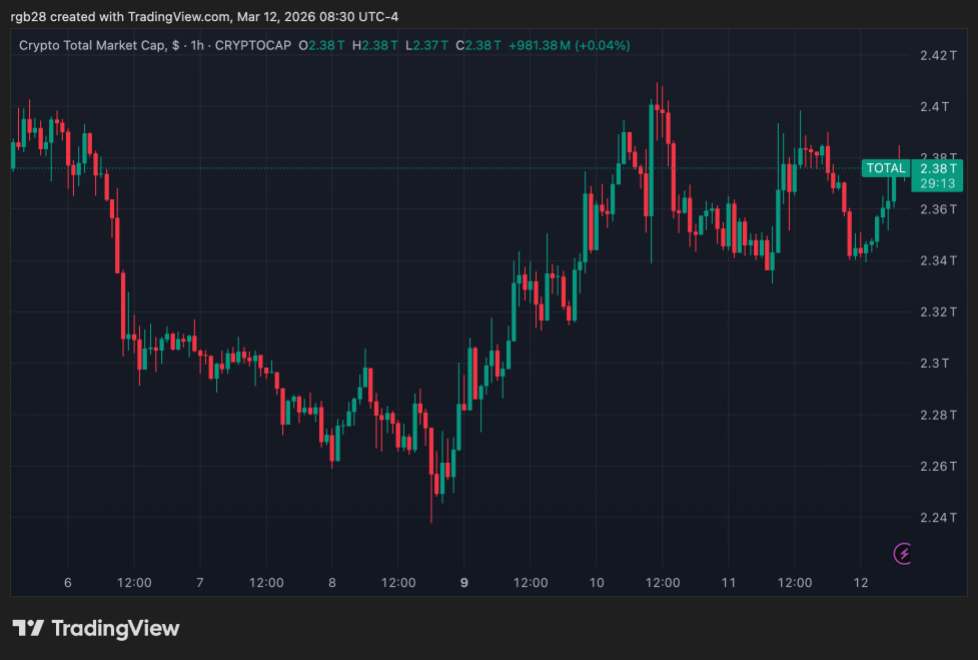
The total crypto market capitalization sits at $2.38 trillion on the one-week chart. Source: TOTAL on TradingView


Related Questions

QWhat specific policy proposals from the Bank of England regarding stablecoins are facing backlash?

AThe Bank of England's proposals facing backlash include a temporary ownership cap of £10,000 to £20,000 for individuals and £10 million for businesses, and a requirement for systemic stablecoin issuers to hold at least 40% of reserves as unremunerated deposits at the central bank.

QWhy did the Bank of England propose an ownership cap for stablecoins?

AThe Bank of England proposed the ownership cap to mitigate financial stability risks stemming from large and rapid outflows of deposits from the banking sector.

QWhat did Deputy Governor Sarah Breeden say about the 60:40 asset allocation proposal?

ASarah Breeden stated that the Bank of England would review whether the 60:40 asset allocation is 'excessively conservative,' but argued that it aligns broadly with measures proposed in the United States and has been adopted in the European Union.

QWhat were two main criticisms from industry leaders regarding the proposed stablecoin cap?

AIndustry leaders criticized the cap, stating that £10 million is too low for businesses to operate effectively and that tracking token ownership would impose a 'massive administrative burden' on issuers.

QWhat was the concern raised by UK lawmakers in their letter to Chancellor Rachel Reeves?

ALawmakers argued that the ownership cap could prevent the UK from capitalizing on digital asset opportunities, drive innovation offshore, lead investors to USD-pegged alternatives, and position the UK 'as a global outlier.'

Related Reads

The Waged Worker Driven to Poverty by AI Subscriptions

"AI Membership: The Hidden Cost Pushing Workers Toward 'Poverty'" The widespread corporate push for AI adoption is creating a hidden financial burden for employees. Companies, from giants like Alibaba to small firms, are mandating AI use, often tying token consumption to KPIs, but frequently refuse to cover the costs. Workers are forced to pay for subscriptions out of pocket to stay competitive and avoid being replaced. Front-end developer Long Shen spends up to 2000 RMB monthly on tools like Cursor and ChatGPT Plus, seeing it as a necessary 3% salary investment to handle 90% of his coding tasks. While it boosted his performance and led to promotions, he now faces idle time at work, pretending to be busy. Designer Peng Peng navigates strict company firewalls by using personal devices and accounts for AI image generation tools like Midjourney, spending hundreds monthly without reimbursement, while her boss demands faster, more numerous revisions. The pressure creates workplace anxiety and suspicion. Programmer Li Huahua, after a friend's experience of raised KPIs following AI success, fears being branded a "traitor" for using it yet worries about falling behind if she doesn't. The dynamic allows management to demand results without understanding the tools or covering expenses, treating employees like AI "agents." While some, like entrepreneur Jin Tu, find high value in paid AI, building entire systems and winning competitions, for most, it's a trap. Free tools like Kimi and Doubao are introducing fees, closing off alternatives. The initial efficiency gains individual advantage, but as AI becomes ubiquitous, the personal edge disappears, workloads increase, and a cycle of dependency begins. Workers like Long Shen realize they cannot maintain AI-generated code without AI, making stopping harder than continuing to pay. The tool promising liberation is instead becoming a compulsory, costly chain in the modern workplace.

marsbit37m ago

The Waged Worker Driven to Poverty by AI Subscriptions

marsbit37m ago

SK Hynix's Trillion-Won Empire: The Successors

"SK Hynix's Trillion-Won Empire and Its Heirs" explores the unconventional succession narrative within SK Group, South Korea's second-largest conglomerate, following SK Hynix's dramatic market rise. Unlike traditional chaebol scripts prioritizing the eldest son, ownership, and political marriages, Chairman Choi Tae-won's three children from his first marriage are charting distinct paths. The eldest daughter, Choi Yun-jeong, is considered the most visible candidate. With a background in biology, consulting, and a PhD, she holds executive roles at SK Bioscience and SK Inc.'s growth strategy unit, focusing on biopharma and new businesses. Her marriage is to an AI infrastructure entrepreneur, not a traditional chaebol heir. The second daughter, Choi Min-jeong, took a unique route by voluntarily serving as a South Korean naval officer, including a tour in the Gulf of Aden. She later worked on policy and strategy for SK Hynix in Washington D.C. before co-founding an AI-driven healthcare startup in San Francisco. She married a former U.S. Marine Corps officer, connecting the family to U.S. defense and policy networks. The son, Choi In-geun, who has Type 1 diabetes, followed a more classic preparatory path with a physics degree and a stint at SK E&S but left to join McKinsey's Seoul office. He remains publicly silent and holds no SK shares, defying the traditional "crown prince" archetype. Their paths unfold against the backdrop of their parents' high-profile, contentious divorce and a record-setting asset division lawsuit. The article argues that as SK Hynix becomes a geopolitical asset in the AI era, the conventional rules of chaebol inheritance are changing. The heirs are being groomed not simply to take over, but to navigate a complex global landscape defined by AI, biotech, geopolitics, and policy, forging legitimacy through their own expertise and networks rather than birth order alone.

marsbit46m ago

SK Hynix's Trillion-Won Empire: The Successors

marsbit46m ago

BitMart Research Institute Weekly Highlights: A Comprehensive Review of Macro Environment, Crude Oil, AI Tech Stocks, and Crypto Market

**Weekly Market Review: Macro, Oil, AI Tech Stocks & Crypto Market** **Macroeconomic & Traditional Finance** The April U.S. Non-Farm Payrolls report of 115K new jobs exceeded expectations, but the data's quality was questioned. Growth was heavily concentrated in healthcare, while other sectors contracted, and manufacturing employment turned negative. A statistical model accounted for a large portion of the gains, conflicting with household survey data showing a loss of 226K jobs. Meanwhile, AI's impact on jobs is emerging, with information sector roles declining, though overall unemployment remains at ~4.3%. Oil prices hovered near $100 per barrel. Global oil buffer inventories have drawn down significantly, supporting prices, but high costs are suppressing demand. China's recent reduction in crude imports acted as a market stabilizer. Geopolitically, the U.S. and Iran are likely to reach a tentative agreement to keep the Strait of Hormuz open and avoid price spikes. For AI tech stocks, short-term prospects are mixed. A potential SpaceX IPO in June could pressure current index heavyweights like Nvidia, while smaller components might benefit. The mid-term focus shifts to Q2 earnings, emphasizing AI's return on investment. Long-term risks include potential election policy shifts and massive IPOs from companies like OpenAI, which could test the sector's sustainability. **Crypto Market & Ecosystem** Crypto markets rose moderately, with BTC climbing from ~$77K to ~$82K, driven by improved risk sentiment. Spot trading volumes remain low, but buying pressure is evident. ETF inflows continued (~$791M last week). However, institutional purchases of BTC and ETH were more modest than expected. The derivatives market shows lingering bearish bets, particularly on alts and ETH. A key trend is the "dual-track" model where projects pursue public listings for traditional funding while also building their own blockchains/tokens to capture crypto liquidity, as seen with Circle's ARC chain. Stablecoins and institutional chains present significant future opportunities. *Disclaimer: This is market analysis, not investment advice.*

marsbit1h ago

BitMart Research Institute Weekly Highlights: A Comprehensive Review of Macro Environment, Crude Oil, AI Tech Stocks, and Crypto Market

marsbit1h ago

Trading

Spot
Futures

Hot Articles

What is $BANK

Bank AI: A Revolutionary Step in the Future of Banking Introduction In an era marked by rapid advancements in technology, Bank AI stands at the intersection of artificial intelligence (AI) and banking services. This innovative project seeks to redefine the financial landscape, enhancing operational efficiency, security measures, and customer experiences through the power of AI. As we embark on this exploration of Bank AI, we will delve into what the project entails, its operational dynamics, its historical context, and significant milestones. What is Bank AI? At its core, Bank AI represents a transformative initiative aimed at integrating artificial intelligence into various banking operations. This project harnesses the capabilities of AI to automate processes, improve risk management protocols, and enhance customer interaction through personalised services. The primary objectives of Bank AI include: Automation of Banking Functions: By leveraging AI technologies, Bank AI aims to automate routine tasks, reducing the burden on human resources and enhancing efficiency. Enhanced Risk Management: The project utilises AI algorithms to predict and identify risks, thereby fortifying security measures against fraud and other threats. Personalisation of Banking Services: Bank AI focuses on offering tailored financial products and services by analysing customer data and behaviours. Improving Customer Experience: The implementation of AI-driven solutions, such as chatbots and virtual assistants, aims to provide users with more human-like interactions, revolutionising the way customers engage with banks. With these goals, Bank AI positions itself as a crucial player in rendering banking more efficient, secure, and user-centric. Who is the Creator of Bank AI? Details regarding the creator of Bank AI remain unknown. As such, no specific individual or organisation has been identified in the available information. The anonymity surrounding the project's inception raises questions but does not detract from its ambitious vision and objectives. Who are the Investors of Bank AI? Similar to the project's creator, specific information regarding the investors or supporting organisations of Bank AI has not been disclosed. Without this information, it is challenging to outline the financial backing and institutional support that might be propelling the project forward. Nevertheless, the importance of having a robust investment foundation is pivotal for sustaining development in such an innovative field. How Does Bank AI Work? Bank AI operates on several innovative fronts, focusing on unique factors that differentiate it from traditional banking frameworks. Below are key operational features: Automation: By applying machine learning algorithms, Bank AI automates various manual processes within banks. This results in reduced operational costs and allows human workers to redirect their efforts towards more strategic activities. Advanced Risk Management: The integration of AI into risk management practices equips banks with tools to accurately predict potential threats such as fraud, ensuring that customer information and assets remain secure. Tailored Financial Recommendations: Through continuous learning from customer interactions, the AI systems develop a nuanced understanding of user needs, enabling them to offer tailored advice on financial decisions. Enhanced Customer Interactions: Utilizing chatbots and virtual assistants powered by AI, Bank AI enables a more engaging customer experience, allowing users to have their queries resolved quickly, thus reducing wait times and improving satisfaction levels. Together, these operational features position Bank AI as a pioneer in the banking sector, establishing new benchmarks for service delivery and operational excellence. Timeline of Bank AI Understanding the trajectory of Bank AI requires a look at its historical context. Below is a timeline highlighting important milestones and developments: Early 2010s: The conceptualisation of AI integration into banking services began to gain attention as banking institutions recognised the potential benefits. 2018: A marked increase in the implementation of AI technologies occurred when banks started using AI tools like chatbots for basic customer service and risk management systems for improved security handling. 2023: The sophistication of AI continued to advance, with generative AI being introduced for more complex tasks such as document processing and real-time investment analysis. This year marked a significant leap in the capabilities afforded to banks by AI technology. 2024-Current Status: As of this year, Bank AI is on an upward trajectory, with ongoing research and developments poised to further enhance capabilities in banking operations. Continued exploration of AI applications hints at exciting developments yet to come. Key Points About Bank AI Integration of AI in Banking: Bank AI focuses on adopting artificial intelligence to streamline banking processes and improve user experiences. Automation and Risk Management Focus: The project strongly emphasises these areas, aiming to shift the burden of routine tasks while enhancing security frameworks through predictive analytics. Personalised Banking Solutions: By harnessing customer data, Bank AI enables tailored banking services that cater to individual user needs. Commitment to Development: Bank AI remains committed to ongoing research and development efforts, ensuring its adaptability and ongoing relevance as technology continues to evolve. Conclusion In summary, Bank AI exemplifies a crucial step forward in the banking industry, leveraging artificial intelligence to reshape operational paradigms, enhance security, and promote customer satisfaction. Despite gaps in information surrounding the creator and investors, the clear objectives and functional mechanisms of Bank AI provide a strong foundation for its ongoing evolution. As AI technology continues to advance and merge with the banking sector, Bank AI is well-positioned to significantly impact the future of financial services, enhancing the way we understand and interact with banking.

152 Total ViewsPublished 2024.04.06Updated 2024.12.03

What is $BANK

Discussions

Welcome to the HTX Community. Here, you can stay informed about the latest platform developments and gain access to professional market insights. Users' opinions on the price of BANK (BANK) are presented below.

活动图片












