Strategy Says Its Software Business Is Quietly Powering Its Bitcoin Machine

bitcoinistPublished on 2026-05-12Last updated on 2026-05-12

Abstract

Strategy CEO Phong Le emphasizes that the company's legacy software business is integral to its Bitcoin Treasury Company model, creating unique operational, financial, and cultural synergies. He argues that the software division, which recently reported its strongest quarter in a decade with 12% revenue growth and 27% margin expansion, funds Bitcoin-related expenses and provides a critical institutional foundation. This includes a 35-year operating history, public company infrastructure, and extensive compliance standards that most digital asset firms lack. Conversely, Le states the Bitcoin strategy has energized employees and engaged customers. Looking ahead, Strategy is leveraging its "Mosaic" AI data platform to automate internal systems and drive its software evolution, aiming for more autonomous and adaptive operations.

Strategy’s Phong Le pushed back against the idea that the company’s Bitcoin identity can be separated from its legacy software business, arguing that the two sides now reinforce each other operationally, financially, and culturally.

In a post on X, Le said Strategy’s success is “rooted in more than Bitcoin on our balance sheet,” framing the company’s enterprise software unit as a key part of the infrastructure behind its Bitcoin Treasury Company model. The comments come as the firm continues to be viewed primarily through the lens of its Bitcoin holdings, even as management seeks to highlight the operating business that predates its digital asset strategy.

“I’m sometimes asked why a Bitcoin Treasury Company should also operate a software business,” Le wrote. “The two create powerful and unique synergies. I plan to provide more regular updates on Strategy Software, and will start here with a foundational overview.”

Why Strategy Thinks Software Gives Its Bitcoin Treasury Model An Edge

Le said Q1 2026 was the software division’s strongest financial quarter in a decade. According to his post, software revenue rose 12%, led by 59% growth in cloud revenue, while controllable margin increased 27%. He said that margin expansion helped fund Strategy’s Bitcoin operating expenses, positioning the software business as more than a legacy asset sitting alongside the treasury strategy.

“Over the last six years, we transformed the software business while simultaneously becoming a Bitcoin Treasury Company,” Le wrote.

The scale of that business was central to his argument. Le said Strategy has 1,500 employees serving more than 3,000 customers, over 500,000 active users, and nearly half of the Fortune 500. Its customer base includes major banks, healthcare companies, retailers, and government agencies. He also pointed to the company’s operating history, noting that it has been in business since 1989, public since 1998, and active in more than 25 countries.

For Le, that history matters because it gives Strategy a level of institutional infrastructure that most digital asset firms do not have. He cited the company’s NASDAQ listing, WKSI status, quarterly 10-Q and annual 10-K filings, KPMG audits, and compliance with SOC 2 Type 2, ISO 27001, FedRAMP, PCI DSS, HIPAA, DPF, and GDPR standards.

“This directly benefits our Bitcoin Treasury Company,” Le said. “We have world-class software engineers, product managers, customer success teams, cloud and security experts, enterprise sales and consulting professionals, and experienced leaders in operations, finance, legal, and HR. Many employees have been with the company for more than 25 years.”

Le added that “no company in the digital asset ecosystem has this depth of institutional experience,” describing Strategy’s organizational maturity as intentional and differentiated in an industry often associated with faster-moving, less established corporate structures.

He also argued that the relationship works in the other direction: Bitcoin has helped accelerate the software business. Le said employees have been energized by Strategy’s mission, equity performance, and global community, while customers have moved “from skeptical to curious to supportive” and are increasingly engaged with the company’s digital asset strategy.

A large part of the next phase, according to Le, is AI. He said Strategy has built an AI data foundation called “Mosaic,” which integrates LLMs, hyperscalers, and data warehouses into a “trusted, secure, open platform.” The system is designed to provide an AI-driven semantic layer for enterprise data, with AI agents as end users.

Le said Strategy is also rebuilding internal systems using multiple AI models. “Over the next year, I expect we will automate many core workflows and replace much of our internal enterprise software,” he wrote. “Our systems and software will become increasingly autonomous, adaptive, self-healing, and self-improving.”

At press time, MSTR traded at $187.59
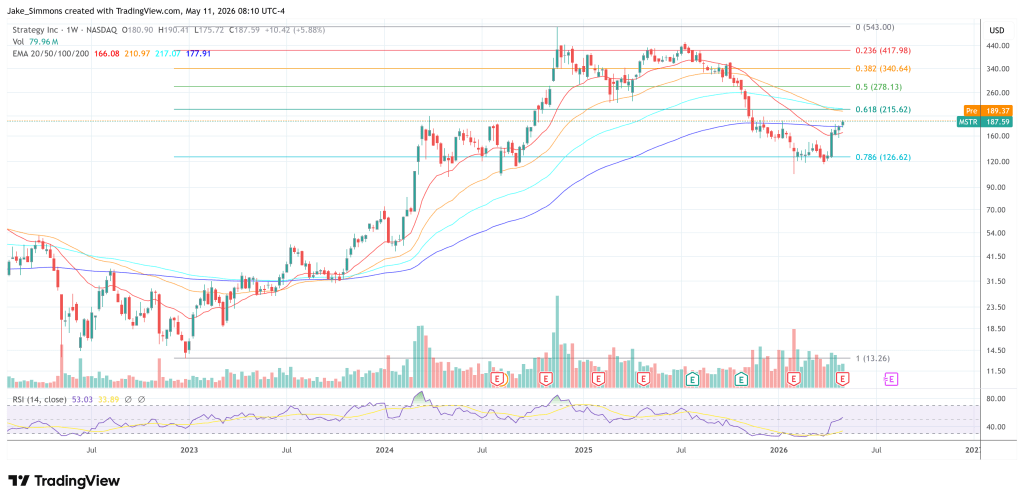
MSTR recovers above the 200-week EMA, 1-week chart | Source: MSTR on TradingView.com

Related Questions

QAccording to Phong Le, why should a Bitcoin Treasury Company also operate a software business?

APhong Le states that the software business and Bitcoin treasury operations create powerful and unique synergies. The software business provides financial strength and institutional infrastructure that directly benefits the Bitcoin strategy, while the Bitcoin mission energizes the software side.

QWhat were the key financial highlights for Strategy's software division in Q1 2026?

AIn Q1 2026, Strategy's software division had its strongest financial quarter in a decade. Revenue rose 12%, led by 59% growth in cloud revenue, and controllable margin increased by 27%.

QWhat institutional advantages does Strategy claim over typical digital asset firms?

AStrategy claims advantages including a NASDAQ listing, WKSI status, regular SEC filings, audits by KPMG, and compliance with major standards like SOC 2, ISO 27001, FedRAMP, PCI DSS, HIPAA, DPF, and GDPR. It also highlights its long operating history, large employee base, and deep institutional experience.

QHow has Bitcoin helped accelerate Strategy's software business, according to Le?

ALe argues that Bitcoin has energized Strategy's employees through its mission and equity performance. Additionally, customers have moved from being skeptical to curious and supportive, becoming increasingly engaged with the company's digital asset strategy.

QWhat is 'Mosaic,' and what role does AI play in Strategy's future plans?

A'Mosaic' is Strategy's AI data foundation, integrating LLMs, hyperscalers, and data warehouses into a trusted, secure, open platform. It's designed as an AI-driven semantic layer for enterprise data. Strategy plans to rebuild internal systems using multiple AI models to automate workflows, replace internal software, and create increasingly autonomous systems.

Related Reads

The AI Investment Landscape Is Being Reshaped: Beyond the 'Magnificent Seven', What Opportunities Lie in the Semiconductor Supply Chain?

AI Investment Map is Reshaping: Opportunities Beyond the 'Magnificent Seven' Since ChatGPT ignited the AI wave, investment initially focused on the "Magnificent Seven" tech giants dominating cloud infrastructure. However, the rise of DeepSeek and debates on AI capital expenditure effectiveness are shifting this dynamic. Investors now recognize opportunities deeper in the supply chain—the companies providing the essential "picks and shovels." Early concerns about an AI investment "arms race" and potential low returns were partly alleviated by strong Q1 earnings from cloud providers, validating robust compute demand. This has highlighted a more certain investment thesis: regardless of which AI applications ultimately win, massive capital expenditure will first fuel demand for semiconductors and related components. This "pick-and-shovel" logic has driven semiconductor ETFs to record highs. Key beneficiaries include: * **Memory Chipmakers (e.g., SK Hynix, Samsung, Micron)**: High Bandwidth Memory (HBM) is a critical bottleneck for AI training. * **Photonics Companies**: Crucial for high-speed data transfer within AI data centers. * **The Broader "AI-11" Semiconductor Ecosystem**: This encompasses foundries & lithography (TSMC, ASML), logic & custom chips (AMD, Broadcom, Intel, Marvell), and enterprise storage (SanDisk, Western Digital). Every dollar of AI infrastructure spending flows through this chain. While the "Magnificent Seven" remain dominant in market size, their earnings growth premium over the rest of the S&P 500 ("S&P 493") is narrowing. Market attention and marginal investment are shifting towards the expanding semiconductor supply chain. The investment narrative is evolving from "betting on the ultimate AI winner" to "investing in the certainty of the infrastructure build-out." Understanding this shift from the demand side to the supply side is key to identifying future AI investment opportunities.

marsbit14m ago

The AI Investment Landscape Is Being Reshaped: Beyond the 'Magnificent Seven', What Opportunities Lie in the Semiconductor Supply Chain?

marsbit14m ago

600 People, $66 Billion: The First Major Cash-Out in the Era of Large Models

The first systematic "big cash-out" of the AI era occurred in October 2025, when over 600 current and former OpenAI employees sold a total of $6.6 billion in shares via a secondary market. Approximately 75 individuals maxed out a $30 million per-person sale limit, while around 525 others cashed out an average of $8.3 million each. This event, exceeding the scale of any 2024 US IPO, functioned as a "shadow IPO." It marked a radical departure from the traditional Silicon Valley path of waiting for a public listing, instead allowing employees to convert equity to cash after just two years of tenure—a direct retention tool in a fiercely competitive talent market where rivals like Meta have offered packages worth hundreds of millions. This massive liquidity event presents a dual-edged sword for OpenAI. While it helps retain talent, it also risks triggering a brain drain as newly wealthy employees may depart. Furthermore, it creates a dilemma for those who sold: they forfeited potential future gains as the company's valuation soared from $400 billion to $852 billion within months. In stark contrast, employees at rival Anthropic demonstrated greater reluctance to sell during their own secondary offering. The financial narratives of the two labs also diverge sharply. OpenAI, while achieving over $20 billion in annualized revenue by 2025, faces massive projected losses (up to $14 billion in 2026), a long path to cash flow positivity, and significant revenue-sharing payments to Microsoft. Anthropic reports rapid revenue growth, improving gross margins, and a faster path to profitability. OpenAI's trajectory is thus balanced precariously between skyrocketing valuation based on funding narratives and the pressures of sustained financial losses post-cash-out. The event underscores that the AI race has evolved into a capital and human experiment, where immense wealth crystallizes the complex calculations of greed, fear, and ambition within the industry.

marsbit34m ago

600 People, $66 Billion: The First Major Cash-Out in the Era of Large Models

marsbit34m ago

NVIDIA Begins Adding Soap to the Bubble

NVIDIA is taking on a dual role: not just as a leading chip supplier, but as a massive capital allocator across the entire AI supply chain. In 2026, the company has committed over $40 billion in investments within five months, targeting everything from optical fiber manufacturing and data center operations to foundational AI model development. This investment spree, described as a systematic "sprinkler" approach, primarily funds companies that are major buyers of NVIDIA's own GPUs. Critics, including analysts from Goldman Sachs, label this a "circular revenue" loop—comparable to a supplier financing a customer to buy more of its products. A prominent example is NVIDIA's investment in OpenAI, which is expected to generate around $13 billion in revenue for NVIDIA, much of which may be reinvested back into OpenAI. While CEO Jensen Huang dismisses the "circular financing" critique as "absurd," arguing the investments are confidence votes in long-term generational shifts, some analysts express discomfort. They note that while investments in critical supply chain components like optics are strategically sound, funding new cloud providers like CoreWeave feels like "pre-paying for your own GPUs." The strategy carries significant risks. If the AI investment cycle turns, the market may question how much demand is genuine versus artificially sustained by NVIDIA's own balance sheet. Despite posting record-breaking earnings—$215.9 billion in annual revenue and $120 billion in net profit for FY2026—NVIDIA's stock fell after its report, signaling that "beating expectations" may no longer be enough to assure investors about the duration of the AI spending boom. The article concludes that while a bubble isn't necessarily a fraud, NVIDIA's actions resemble adding soap to a bubble—making it appear more robust and durable. This creates a complex scenario requiring extreme冷静 from investors to distinguish between real structural growth and financial engineering.

marsbit51m ago

NVIDIA Begins Adding Soap to the Bubble

marsbit51m ago

Short Positions Have Been Squeezed Out: Will the Next Leg of the U.S. Stock AI Rally Continue in Seoul?

"Short Squeeze Exhausted: Will the Next Leg of the AI Rally Continue in Seoul?" A Nomura report suggests the US AI stock rally, which saw the S&P 500 rise ~16.6% in 28 days largely driven by 10 key stocks, may be pausing. The fuel from short covering, CTA fund positioning, and volatility-control strategies is nearing its limit. For the rally to continue, new momentum from retail and sentiment-driven FOMO (Fear Of Missing Out) is needed. South Korea's market provided a potential answer on the very day the report was published. The KOSPI index surged 4.32%, triggering a buy-side circuit breaker, led by massive gains in chip giants SK Hynix (+11.98%) and Samsung. This surge is characterized by retail "hynix FOMO" and overseas funds precisely buying into AI themes via chip-focused ETFs, shifting from broad Korean market ETFs. The Korean rally is a high-beta extension of the US AI capital expenditure story, as major cloud providers plan massive infrastructure spending, directly benefiting memory chip leaders. However, this linkage also implies vulnerability. The sustainability of this next leg depends on whether US tech stocks correct, the trajectory of US inflation (with upcoming CPI data key), and geopolitical tensions around the Strait of Hormuz. Seoul has emerged as the new epicenter of the AI trade, but its fate remains tied to these broader macro and market dynamics.

marsbit55m ago

Short Positions Have Been Squeezed Out: Will the Next Leg of the U.S. Stock AI Rally Continue in Seoul?

marsbit55m ago

Trading

Spot
Futures

Hot Articles

What is $BITCOIN

DIGITAL GOLD ($BITCOIN): A Comprehensive Analysis Introduction to DIGITAL GOLD ($BITCOIN) DIGITAL GOLD ($BITCOIN) is a blockchain-based project operating on the Solana network, which aims to combine the characteristics of traditional precious metals with the innovation of decentralized technologies. While it shares a name with Bitcoin, often referred to as “digital gold” due to its perception as a store of value, DIGITAL GOLD is a separate token designed to create a unique ecosystem within the Web3 landscape. Its goal is to position itself as a viable alternative digital asset, although specifics regarding its applications and functionalities are still developing. What is DIGITAL GOLD ($BITCOIN)? DIGITAL GOLD ($BITCOIN) is a cryptocurrency token explicitly designed for use on the Solana blockchain. In contrast to Bitcoin, which provides a widely recognized value storage role, this token appears to focus on broader applications and characteristics. Notable aspects include: Blockchain Infrastructure: The token is built on the Solana blockchain, known for its capacity to handle high-speed and low-cost transactions. Supply Dynamics: DIGITAL GOLD has a maximum supply capped at 100 quadrillion tokens (100P $BITCOIN), although details regarding its circulating supply are currently undisclosed. Utility: While precise functionalities are not explicitly outlined, there are indications that the token could be utilized for various applications, potentially involving decentralized applications (dApps) or asset tokenization strategies. Who is the Creator of DIGITAL GOLD ($BITCOIN)? At present, the identity of the creators and development team behind DIGITAL GOLD ($BITCOIN) remains unknown. This situation is typical among many innovative projects within the blockchain space, particularly those aligning with decentralized finance and meme coin phenomena. While such anonymity may foster a community-driven culture, it intensifies concerns about governance and accountability. Who are the Investors of DIGITAL GOLD ($BITCOIN)? The available information indicates that DIGITAL GOLD ($BITCOIN) does not have any known institutional backers or prominent venture capital investments. The project seems to operate on a peer-to-peer model focused on community support and adoption rather than traditional funding routes. Its activity and liquidity are primarily situated on decentralized exchanges (DEXs), such as PumpSwap, rather than established centralized trading platforms, further highlighting its grassroots approach. How DIGITAL GOLD ($BITCOIN) Works The operational mechanics of DIGITAL GOLD ($BITCOIN) can be elaborated on based on its blockchain design and network attributes: Consensus Mechanism: By leveraging Solana’s unique proof-of-history (PoH) combined with a proof-of-stake (PoS) model, the project ensures efficient transaction validation contributing to the network's high performance. Tokenomics: While specific deflationary mechanisms have not been extensively detailed, the vast maximum token supply implies that it may cater to microtransactions or niche use cases that are still to be defined. Interoperability: There exists the potential for integration with Solana’s broader ecosystem, including various decentralized finance (DeFi) platforms. However, the details regarding specific integrations remain unspecified. Timeline of Key Events Here is a timeline that highlights significant milestones concerning DIGITAL GOLD ($BITCOIN): 2023: The initial deployment of the token occurs on the Solana blockchain, marked by its contract address. 2024: DIGITAL GOLD gains visibility as it becomes available for trading on decentralized exchanges like PumpSwap, allowing users to trade it against SOL. 2025: The project witnesses sporadic trading activity and potential interest in community-led engagements, although no noteworthy partnerships or technical advancements have been documented as of yet. Critical Analysis Strengths Scalability: The underlying Solana infrastructure supports high transaction volumes, which could enhance the utility of $BITCOIN in various transaction scenarios. Accessibility: The potential low trading price per token could attract retail investors, facilitating wider participation due to fractional ownership opportunities. Risks Lack of Transparency: The absence of publicly known backers, developers, or an audit process may yield skepticism regarding the project's sustainability and trustworthiness. Market Volatility: The trading activity is heavily reliant on speculative behavior, which can result in significant price volatility and uncertainty for investors. Conclusion DIGITAL GOLD ($BITCOIN) emerges as an intriguing yet ambiguous project within the rapidly evolving Solana ecosystem. While it attempts to leverage the “digital gold” narrative, its departure from Bitcoin's established role as a store of value underscores the need for a clearer differentiation of its intended utility and governance structure. Future acceptance and adoption will likely depend on addressing the current opacity and defining its operational and economic strategies more explicitly. Note: This report encompasses synthesised information available as of October 2023, and developments may have transpired beyond the research period.

363 Total ViewsPublished 2025.05.13Updated 2025.05.13

What is $BITCOIN

Discussions

Welcome to the HTX Community. Here, you can stay informed about the latest platform developments and gain access to professional market insights. Users' opinions on the price of BTC (BTC) are presented below.

活动图片