Solana ETF Draws $39 Million Inflow in Single Week, Highest Since February, Futures Open Interest Surges 30%, Traders Target $120

marsbitPublished on 2026-05-12Last updated on 2026-05-12

Abstract

Solana ETF sees its strongest weekly inflow since February, attracting $39.23 million with Bitwise's BSOL ETF accounting for 92% of the total. This marks a potential reversal of a six-month downtrend in monthly inflows. Simultaneously, SOL futures open interest surged 29.5% in the first half of May, reaching $6.4 billion, indicating significant new capital entering the derivatives market. Spot buying pressure also increased, with the Cumulative Volume Difference (CVD) rising sharply. On the fundamental side, Solana's largest-ever consensus upgrade, Alpenglow, has launched on a community testnet, aiming to drastically reduce transaction finality times. Mainnet deployment could occur next quarter. Analysts note that after a four-month consolidation period, short-term traders have largely exited, leaving conviction holders in control of the supply. This shift in holder structure means any renewed trading volume is more likely to push prices upward. A technical Adam & Eve bottom pattern suggests a price target of $120. However, short-term momentum has shown signs of cooling near the $95-$96 resistance level. Risks remain, including potential pressure from exchange sell orders if ETF inflows weaken again and the threat of cascading liquidations from highly leveraged positions.

Author: Claude, Deep Tide TechFlow

Deep Tide Introduction: Solana spot ETFs recorded a net inflow of $39.23 million last week, their strongest weekly performance since February, with Bitwise's BSOL capturing 92% of the share. Futures open interest surged 29.5% in the first two weeks of May to $6.4 billion, with spot and derivatives buying activity amplifying simultaneously.

Technically, an Adam & Eve bottom pattern has emerged, pointing to a target of $120. Concurrently, Solana's largest-ever consensus upgrade, Alpenglow, went live on the community testnet on May 11, with co-founder Yakovenko indicating mainnet deployment could happen as early as next quarter. Capital flows, derivatives, and on-chain fundamentals are all emitting bullish signals simultaneously.

SOL is experiencing a multi-dimensional signal convergence.

According to a Cointelegraph report on May 11, Solana spot ETFs recorded a net inflow of $39.23 million last week, their strongest weekly performance since February. During the same period, the SOL price rose about 15% in seven days to around $97, while futures open interest grew by nearly $1.5 billion in half a month.

The on-chain holder structure is also quietly shifting: traders and hot money gradually exited during the four-month consolidation, and strong holders have regained control of the token supply. Any increase in volume after the sharp contraction will tend to push prices upward.

Signals from multiple independent data sources are lighting up simultaneously.

ETF Fund Flows Reverse Six-Month Downtrend, Bitwise BSOL Captures Over 80% Share

According to SoSoValue data, Solana spot ETFs saw a net inflow of $39.23 million last week, with Bitwise's staking ETF BSOL contributing $36 million, accounting for approximately 92%; Fidelity's FSOL saw an inflow of about $1.8 million. Since its launch, BSOL has accumulated approximately $861 million, representing 81% of the total cumulative inflow (approximately $1.06 billion) into all SOL spot ETFs.
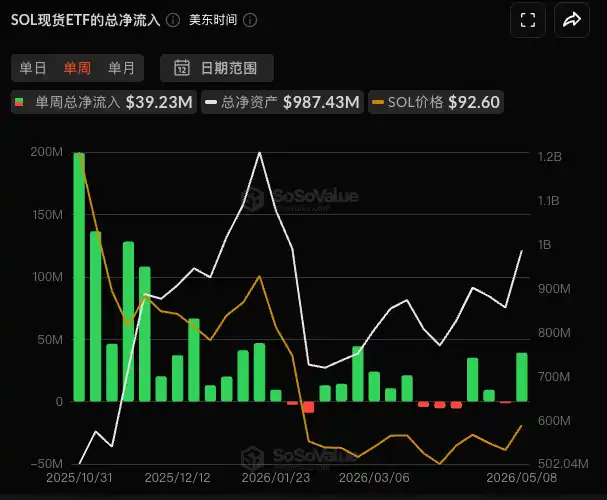
The significance of this figure needs to be understood within a longer timeline. Citing SoSoValue data, BeInCrypto reported that monthly inflows into Solana ETFs have declined for six consecutive months after hitting a peak of $419 million last November: $148 million in December, $105 million in January, $63 million in February, $45.44 million in March, and only $39.93 million in April, the lowest monthly performance since the products launched. The weekly inflow in the first two weeks of May has already approached April's full-month level. If the current pace continues, it will mark the first reversal of the six-month downtrend.

As of publication, the total net asset value of all SOL spot ETFs is approximately $938 million, with SOL accounting for about 1.82% of ETF net assets, and historical cumulative net inflows exceeding $1 billion.

Futures Open Interest Surges 30% in Half a Month to $6.4 Billion, Spot Buying Volume Also Expands

The signal from the derivatives market is equally clear.

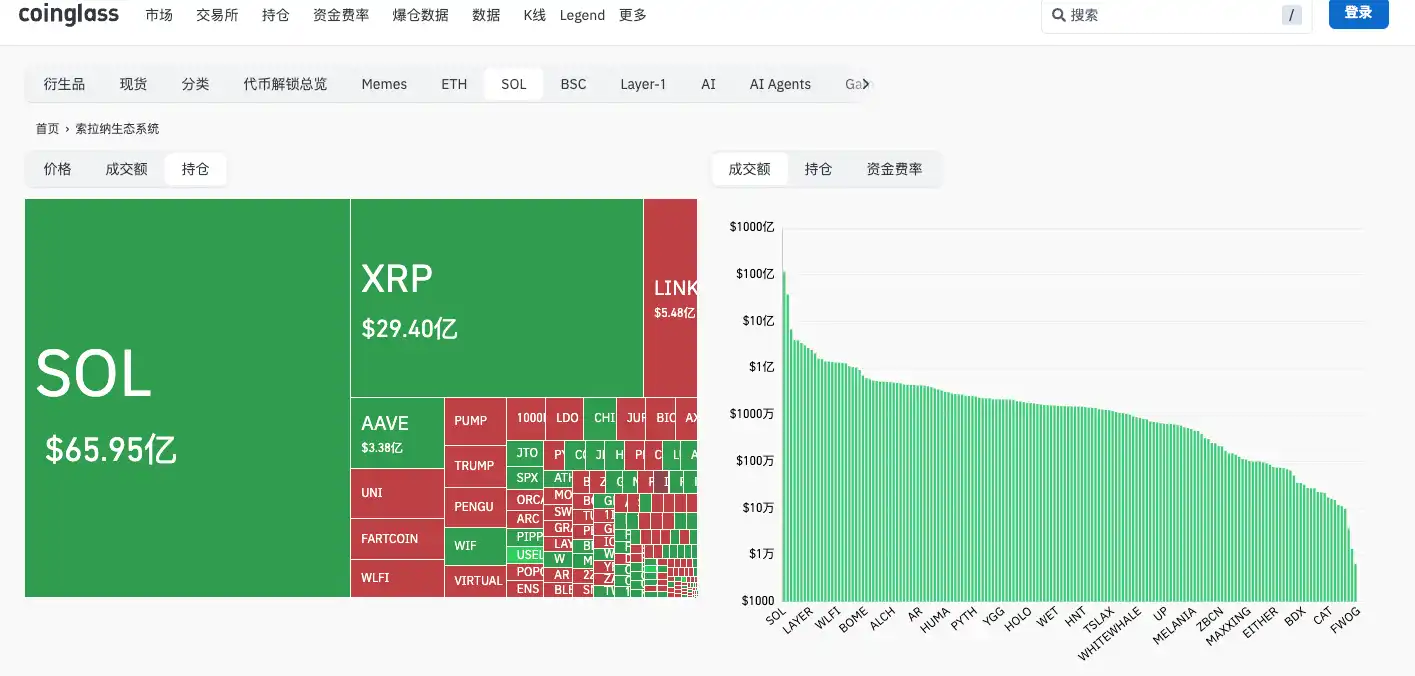
According to Coinglass data, SOL futures open interest climbed from $4.94 billion on May 1st to $6.4 billion, a 29.5% increase within half a month, representing an increment of approximately $1.5 billion. This is not merely increased leverage from existing players, but direct evidence of new capital entering the market.

Spot market buying activity is also cooperating. According to velo.chart data, the spot Cumulative Volume Delta (CVD, measuring the net difference between active buying and selling in the market) rose from $163 million to nearly $250 million over five days; futures CVD has been rising steadily since May 5th, expanding to approximately $594 million. Buyers are absorbing selling liquidity in both the spot and futures markets simultaneously.

The funding rate remains around 0.065%, indicating that longs are still paying to maintain their positions, but it hasn't reached overheated levels. However, after SOL reached the $95 to $96 range, the spot and futures CVD have started to flatten, suggesting short-term momentum has cooled somewhat.
Alpenglow Launches on Testnet, Solana's Largest-Ever Consensus Upgrade Enters Countdown

Beyond capital flows and technicals, fundamentals are also providing a catalyst.

According to a CoinDesk report on May 11, Solana's core development team Anza announced that the network's largest-ever consensus upgrade, Alpenglow, has gone live on a community test cluster. This upgrade will replace the current Proof-of-History and TowerBFT systems with the new Votor and Rotor protocols, aiming to compress transaction finality time from the current ~12.8 seconds to around 150 milliseconds—a speedup of nearly 100 times.

In a community vote last September, 98.27% of stakers voted in favor of the proposal, with a participation rate of 52%. Solana co-founder Anatoly Yakovenko stated at the Consensus conference in Miami last week that if testing goes smoothly, Alpenglow could launch on the mainnet as early as next quarter.

Silent Shift in Holder Structure, Healthier Token Distribution After 'Tourists Depart'

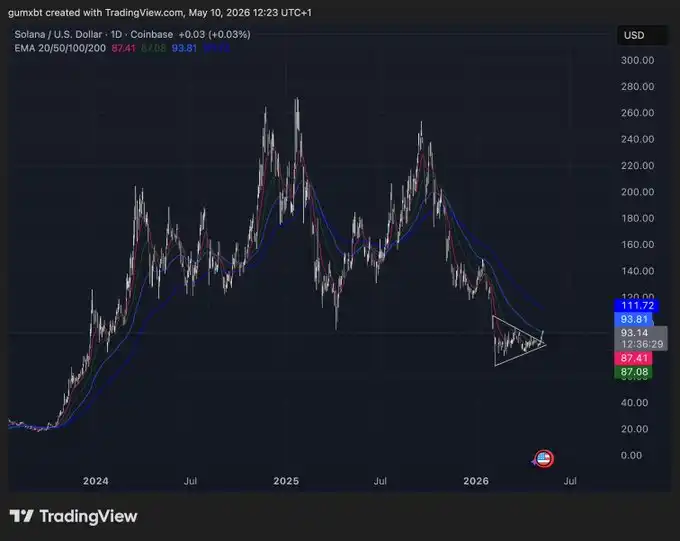
Crypto KOL gum pointed out on platform X that SOL is breaking out from a four-month consolidation period, but the underlying reason for this breakout is not just technical. He believes SOL is breaking out now, rather than a month ago, because it acts as a barometer for the entire crypto market's risk appetite, and its current price action is pricing in a 'return of risk'.

More crucially, it's about the token distribution structure. gum notes that during the four-month consolidation, short-term traders and hot money have abandoned SOL and exited, leading to a sharp decline in trading volume. Strong holders (conviction holders) have regained control of the token distribution. With this distribution structure, any reasonable recovery in trading volume will tend to push momentum in an upward direction.
Reference: KOL Perspective: Why SOL is Poised for a Rise at This Price Point?

Risk Warning: Short-term Momentum Shows Signs of Cooling

It's important to note that buying intensity for SOL in the $95 to $96 range has already begun to weaken, with spot and futures CVD flattening over the past 24 hours. The Adam & Eve pattern still requires daily close confirmation; failure to hold above $95 could lead to a pullback towards the $89 to $91 support zone.

Furthermore, a previous BeInCrypto analysis pointed out that if ETF inflows in May fail to stabilize or even continue to decline, SOL could face selling pressure from exchanges. The rapid buildup of high-leverage positions also means that any price retracement could amplify volatility through cascading liquidations. The liquidity vacuum left after meme-coin-driven retail frenzy subsides is another recurring risk pattern historically.

Multiple signals from capital flows, derivatives, and technicals are all pointing in the same direction, but the market is never short of precedents for moving in the opposite direction when 'signals align'. The $120 technical target is clearly visible, but every step from $95 to $120 will require real buying volume to materialize.


Related Questions

QWhat was the net inflow for Solana spot ETFs in the recent week, and why is this figure significant?

ASolana spot ETFs recorded a net inflow of $39.23 million in the recent week. This is significant because it represents the strongest weekly performance since February, potentially marking a reversal of a six-month consecutive decline in monthly inflows.

QAccording to the article, how much did Solana futures open interest increase in the first two weeks of May, and what does this signify?

ASolana futures open interest increased by 29.5% in the first two weeks of May, reaching $6.4 billion, with an increase of approximately $1.5 billion. This signifies that new capital, not just leverage from existing players, is entering the market.

QWhat is the Alpenglow upgrade for Solana, and what is its primary goal?

AAlpenglow is Solana's largest-ever consensus upgrade. It aims to replace the current Proof-of-History and TowerBFT systems with new Votor and Rotor protocols, with the primary goal of reducing transaction finality time from about 12.8 seconds to roughly 150 milliseconds.

QHow has the holder structure of SOL changed during its four-month consolidation, according to the KOL gum?

AAccording to KOL gum, during the four-month consolidation, short-term traders and 'tourist capital' gradually exited SOL. This led to a sharp decline in trading volume, allowing 'conviction holders' or strong holders to regain control of the token distribution.

QWhat are some of the key risk factors mentioned for SOL's price in the near term?

AKey near-term risk factors include: buying pressure weakening in the $95-$96 range; the need for the Adam & Eve technical pattern to be confirmed with a daily close above $95; potential for a pullback to the $89-$91 support zone if that fails; pressure from exchange sell-offs if ETF inflows don't stabilize; and the risk of cascading liquidations due to rapid high-leverage accumulation.

Related Reads

How to Automate Any Workflow with Claude Skills (Complete Tutorial)

This is a comprehensive guide to mastering Claude Skills, a feature for creating permanent, reusable instruction sets that automate specific workflows. Unlike simple saved prompts, Skills function like trained employees, delivering consistent, high-quality outputs by defining the entire task process, standards, error handling, and output format. The guide is structured in four phases: **Phase 1: Installation (5 minutes).** Skills are folders containing a `SKILL.md` file. The user is instructed to find a relevant Skill online, install it, test it on a real task, and compare its performance to one-off prompts. **Phase 2: Building Your First Custom Skill.** Start by rigorously defining the Skill's purpose, trigger phrases, and providing a concrete example of perfect output. The `SKILL.md` file has two parts: a YAML frontmatter with a specific name/description/triggers, and a detailed, step-by-step workflow written in natural language with examples and quality standards. **Phase 3: Testing & Optimization for Production.** Test the Skill in three scenarios: 1) a standard, common task; 2) edge cases with missing or conflicting data; and 3) a pressure test with maximum complexity. Any failure indicates a needed instruction. Implement a weekly optimization cycle to continuously refine the Skill based on real usage. **Phase 4: Building a Complete Skill Library.** The goal is to create a team of Skills for all repetitive tasks. Examples are given for industries like real estate, marketing, finance, consulting, and e-commerce. The user should list their tasks, prioritize them, and build one new Skill per week, maintaining a master document to track their library. The conclusion emphasizes the compounding time savings: ten Skills saving 30 minutes each per week reclaims over 260 hours (6.5 work weeks) per year, fundamentally transforming one's work system.

marsbit10m ago

How to Automate Any Workflow with Claude Skills (Complete Tutorial)

marsbit10m ago

Dialogue with Vitalik, Xiao Feng, Aya Miyaguchi, and Joseph Chalom: From the 'Subtraction Principle' to the Agent Economy

Conversation with Vitalik Buterin, Xiao Feng, Aya Miyaguchi, and Joseph Chalom: Highlights from the Ethereum Application Summit on key future directions. Vitalik Buterin discussed the concept of "Full Stack Open Source Security," extending security from the protocol to hardware layers like wallets and chips. He predicted AI will simplify blockchain interaction, enabling natural language commands for complex operations. He emphasized that Ethereum's future focus should be on security, decentralization, and trustless infrastructure—the areas where it holds its core competitive edge. The fusion of AI, Fully Homomorphic Encryption (FHE), and blockchain is seen as crucial for real-world applications requiring privacy, such as healthcare. Xiao Feng underscored the importance of simplifying technology for mass adoption. He drew parallels to the evolution from command lines to GUIs and apps, suggesting that AI-driven natural language interfaces will be key to bringing more users into Web3. He stressed that while performance is important, Ethereum must continue to uphold its foundational principles of decentralization and user sovereignty. Aya Miyaguchi, Chair of the Ethereum Foundation, explained the evolving role of the Foundation through the "Principle of Subtraction." As the ecosystem matures, the EF is stepping back from areas where the community can take the lead, acting as one of many "gardeners" rather than a central driver. She highlighted that real applications are built on Ethereum's core values: censorship resistance, open source, security, and privacy. The concept of "Local-first" initiatives, like the Ethereum Applications Guild (EAG), was also emphasized for leveraging regional strengths to create global impact. Joseph Chalom, CEO of SharpLink, positioned Ethereum as the future infrastructure for global capital markets, differentiating it from Bitcoin through its "productivity" via staking yields. He envisioned the rise of an "Agent Economy" by 2027, where AI agents, powered by Web3 wallets, will autonomously manage financial tasks like yield optimization and RWA investments. The summit concluded that with core infrastructure maturing, the application layer is now the key driver for Ethereum's next phase of growth and real-world adoption.

marsbit12m ago

Dialogue with Vitalik, Xiao Feng, Aya Miyaguchi, and Joseph Chalom: From the 'Subtraction Principle' to the Agent Economy

marsbit12m ago

Cerebras IPO: A $48.8 Billion Valuation—Is the 'Nvidia Challenger' a Bubble or a New King?

Cerebras Systems, positioning itself as an NVIDIA challenger, is going public with a $48.8 billion valuation despite several underlying paradoxes revealed in its S-1 filing. While 2025 revenue grew 76% to $510M and GAAP net income was $237.8M, this profitability relies heavily on a one-time, non-cash accounting gain. Adjusting for this, the company's non-GAAP net loss actually widened to $75.7M. Furthermore, customer concentration remains extreme: 86% of 2025 revenue came from two Abu Dhabi-based entities, MBZUAI (62%) and G42 (24%). Its landmark deal with OpenAI, valued at over $20 billion, creates a complex, nested relationship where OpenAI is simultaneously a major customer, lender, warrant holder, and strategic partner with exclusivity clauses. Cerebras's technical edge in latency-sensitive AI inference is real, with its wafer-scale chip outperforming competitors in benchmarks. However, this advantage is confined to a specific niche, not the broader AI training market dominated by NVIDIA's CUDA ecosystem. With a 95x price-to-sales ratio, the valuation demands flawless execution of the OpenAI contract and massive future revenue growth. Key long-term risks include intense competition from giants like NVIDIA and AMD, a dual-class share structure granting insiders near-total voting control, and ongoing geopolitical uncertainties regarding export controls. The IPO is a pivotal capital markets event for AI infrastructure. As an investment, it represents a high-risk, high-reward bet on the "inference-first" narrative and Cerebras's ability to dominate its specialized segment, underpinned by a valuation that highlights the current fervor in the sector.

marsbit50m ago

Cerebras IPO: A $48.8 Billion Valuation—Is the 'Nvidia Challenger' a Bubble or a New King?

marsbit50m ago

Trading

Spot
Futures

Hot Articles

Discussions

Welcome to the HTX Community. Here, you can stay informed about the latest platform developments and gain access to professional market insights. Users' opinions on the price of SOL (SOL) are presented below.

活动图片