Arizona lawmaker proposes barring taxes on crypto and blockchain

cointelegraphPublished on 2025-12-22Last updated on 2025-12-22

Abstract

Arizona State Senator Wendy Rogers has introduced two bills and a resolution to change how digital assets are taxed in the state. The proposals include exempting virtual currency from taxation (SB 1044), preventing local governments from taxing or fining blockchain node operators (SB 1045), and amending the state constitution to exclude digital assets from property tax (SCR 1003). While the node bill may pass through the legislature, the tax exemption and constitutional change would require voter approval in the 2026 general election. Arizona is among a small group of states, including New Hampshire and Texas, with laws establishing digital asset reserve policies. The move follows broader U.S. state-level efforts to create supportive regulatory frameworks for cryptocurrency.

Arizona state Senator Wendy Rogers has proposed two bills and a resolution in an effort to change the state’s laws on taxing digital assets.

In legislation prefiled with the Arizona Senate on Friday, Rogers proposed amending state statues to exempt virtual currency from taxation (SB 1044), barring counties, cities and towns from taxing or fining entities running blockchain nodes (SB 1045), and amending the state constitution’s definition of property taxes to clarify rules on digital assets (SCR 1003).

The blockchain node bill may move through the state legislature, but the crypto tax bill and resolution would require a vote by Arizona voters during the next general election, in November 2026.

SCR 1003 would amend Arizona’s constitution to specifically exclude virtual currency from property tax, while SB 1044 would add similar language to the state’s statutes. SB 1045 would prohibit cities, towns and counties in the state from imposing “a tax or fee on a person that runs a node on blockchain technology.”
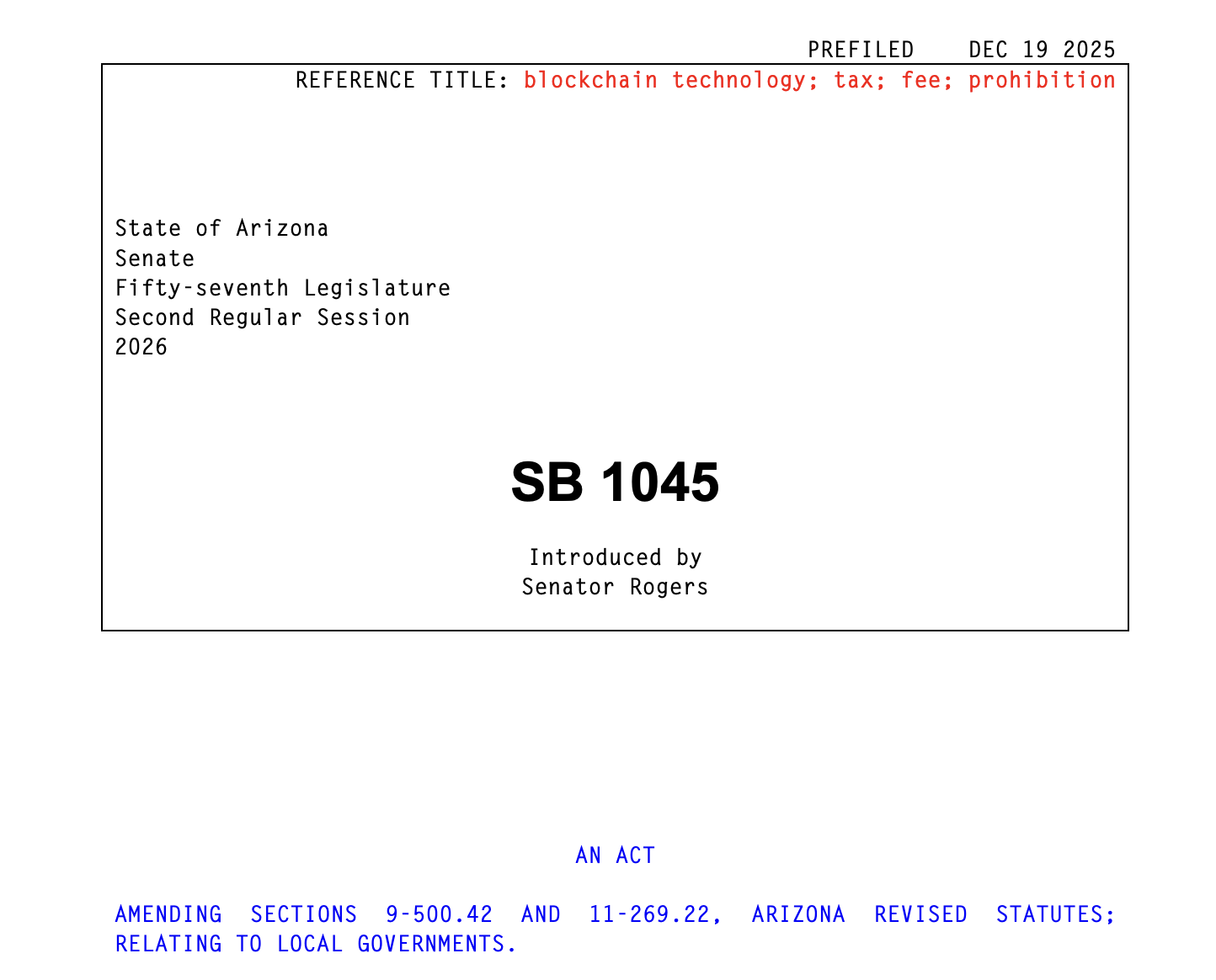
Bill barring cities or towns from taxing blockchain node activity: Source: Arizona legislature

Arizona is one of the few US states that has a law on the books allowing the government to claim ownership of digital assets that have been abandoned for at least three years. The law was part of efforts by crypto advocates to establish a digital asset reserve in Arizona, but there are other proposals to give the state more authority to invest in cryptocurrencies like Bitcoin (BTC).

Related: New Hampshire governor signs crypto reserve bill into law

Rogers was one of the co-sponsors of a Bitcoin reserve bill vetoed by Arizona Governor Katie Hobbs in May. The senator condemned the move and said she would refile the bill during the next session. Cointelegraph reached out to Rogers for comment but had not received a response at the time of publication.

US states adopt crypto reserve bills, different digital asset policies

Arizona remains one of the few US states with a law establishing a digital asset reserve, along with New Hampshire and Texas. Although some lawmakers in other states have been attempting to gather support for similar bills, there are also many suggesting a different approach to digital asset taxation.

For example, Ohio’s House of Representatives passed a bill that could exempt crypto transactions under $200 from the state’s capital gain taxes. The legislation does not appear to have advanced since June.

New York Assemblymember Phil Steck proposed adding a 0.2% excise tax on “digital asset transactions, including the sale or transfer of digital assets” for the state’s residents. The bill was referred to the ways and means committee and did not appear to have advanced since August.

At the federal level, Wyoming Senator Cynthia Lummis submitted a draft bill in July proposing a de minimis exemption for digital asset transactions and capital gains of $300 or less. Lummis announced on Friday that she would retire from the US Senate in January 2027.

Magazine: When privacy and AML laws conflict: Crypto projects’ impossible choice

Related Questions

QWhat are the three legislative actions proposed by Arizona state Senator Wendy Rogers regarding digital assets?

ASenator Wendy Rogers proposed two bills and one resolution: SB 1044 to exempt virtual currency from taxation, SB 1045 to bar counties, cities, and towns from taxing or fining blockchain node operators, and SCR 1003 to amend the state's constitution to clarify property tax rules for digital assets.

QWhich of Senator Rogers' proposals would require a vote by Arizona voters in the 2026 general election?

AThe crypto tax bill (SB 1044) and the resolution to amend the state constitution (SCR 1003) would require a vote by Arizona voters in the November 2026 general election.

QWhat does SB 1045 specifically prohibit local governments in Arizona from doing?

ASB 1045 prohibits cities, towns, and counties in Arizona from imposing a tax or fee on any person running a node on blockchain technology.

QWhich other US states have laws establishing a digital asset reserve, similar to Arizona?

ANew Hampshire and Texas are the other US states that have laws establishing a digital asset reserve, similar to Arizona.

QWhat federal-level proposal did Wyoming Senator Cynthia Lummis make regarding digital asset transactions in July?

AIn July, Wyoming Senator Cynthia Lummis submitted a draft bill proposing a de minimis exemption for digital asset transactions and capital gains of $300 or less at the federal level.

Related Reads

380,000 Apps Exposed, 2,000+ Apps Leaked Secrets: AI Programming Turns 'Intranet' into Public Internet

Israeli cybersecurity firm RedAccess uncovered a severe data exposure trend linked to "vibe coding" or AI-powered software development tools. Their research found approximately 38,000 publicly accessible web applications built with platforms like Lovable, Base44, Netlify, and Replit. Of these, an estimated 2,000 apps exposed sensitive corporate and personal data, including medical records, financial information, internal strategic documents, and customer chat logs. In some cases, access even granted administrative privileges. The core issue stems from default privacy settings that make applications public by default, combined with a lack of built-in security controls (like authentication) in the AI-generated code. This allows employees without security expertise—"citizen developers"—to easily create and deploy applications that bypass standard corporate security reviews. The exposed apps, often indexed by search engines, are trivially discoverable. While some platform providers (Replit, Lovable, Wix/Base44) argue that security configuration is the user's responsibility and question the validity of some findings, security researchers confirm the widespread reality of such exposures. This pattern, also noted in prior studies, highlights a critical security gap as AI democratizes app creation, potentially leading to massive, unintentional data leaks.

marsbit22m ago

380,000 Apps Exposed, 2,000+ Apps Leaked Secrets: AI Programming Turns 'Intranet' into Public Internet

marsbit22m ago

Attracting Global Capital, Asia's New 'Super Cycle' Is Unfolding

Investors are turning to Asia as the next frontier for global equity growth, with a new "super cycle" unfolding across the region. Driven by the AI revolution, Asian markets, particularly South Korea, have seen significant rallies. According to Morgan Stanley analysis, the underlying drivers of Asia's industrial cycle are shifting from traditional sectors like real estate and manufacturing to massive investments in AI infrastructure, energy security and transition, and supply chain resilience. Fixed asset investment in Asia is projected to grow from around $11 trillion in 2025 to $16 trillion by 2030, with a 7% annual growth rate from 2026-2030. The AI wave is a primary catalyst, driving immense capital expenditure for chips, servers, data centers, and power systems. Asia is central to this hardware supply chain. In China, AI investment is focused on building a full-system domestic capability, with the local AI chip market potentially reaching $86 billion by 2030. Beyond AI, China's export story is expanding from EVs and batteries to robotics. The country already captures about half of new global industrial robot demand and over 90% of humanoid robot shipments. This growth phase mirrors the early stages of China's EV export boom. Simultaneously, energy security investments, spurred by AI's massive power needs, are rising, with China benefiting from its leadership in solar, batteries, and EVs. Regional defense spending is also increasing structurally, supporting demand for advanced manufacturing. The main beneficiaries are China, South Korea, and Japan, positioned in core supply chain areas. However, risks remain, including potential overcapacity, profit margin pressures from competition, persistent technological restrictions, geopolitical friction, and workforce displacement due to AI-driven automation. Market volatility is also expected to increase as investor expectations diverge on the realization of these capital investment and export themes.

marsbit23m ago

Attracting Global Capital, Asia's New 'Super Cycle' Is Unfolding

marsbit23m ago

Funding Weekly Report | 14 Public Funding Events, Kalshi Completes $10B New Funding Round at $220B Valuation Led by Coatue Management

Weekly Funding Roundup: 14 Deals and $10.49B+ in Total Funding, Led by Kalshi's $1B Round Last week (5.4-5.10) saw 14 notable funding events in the global blockchain ecosystem, raising over $10.49 billion in total. Key highlights include Kalshi, a prediction market platform, securing a $1 billion round led by Coatue Management, reaching a $22 billion valuation. The platform now boasts ~2 million MAUs and $178B in annualized trading volume. In DeFi, regulated on-chain reinsurer OnRe raised $5 million in Series A funding, and Bitcoin-backed credit protocol Saturn Credit completed a $2 million seed round. For Infrastructure & Tools, OpenTrade raised $17 million to expand its stablecoin yield infrastructure, and RWA platform Balcony secured $12.7 million to deploy its property settlement service in the US. Centralized Finance saw one deal: AI-driven trading platform Stockcoin.ai completed a seed round led by Amber Group. In the prediction market sector alongside Kalshi, AI-powered platform Elastics raised $2 million. Other notable deals include SC Ventures' strategic investment in crypto market maker GSR and Centrifuge securing a "seven-figure" investment from Coinbase to become a core RWA partner for Base. On the investor side, Haun Ventures raised a new $1 billion fund targeting crypto and AI, and Multi Investment raised ~$616 million to focus on blockchain and Web3 investments.

marsbit1h ago

Funding Weekly Report | 14 Public Funding Events, Kalshi Completes $10B New Funding Round at $220B Valuation Led by Coatue Management

marsbit1h ago

Trading

Spot
Futures
活动图片





