Did you know?
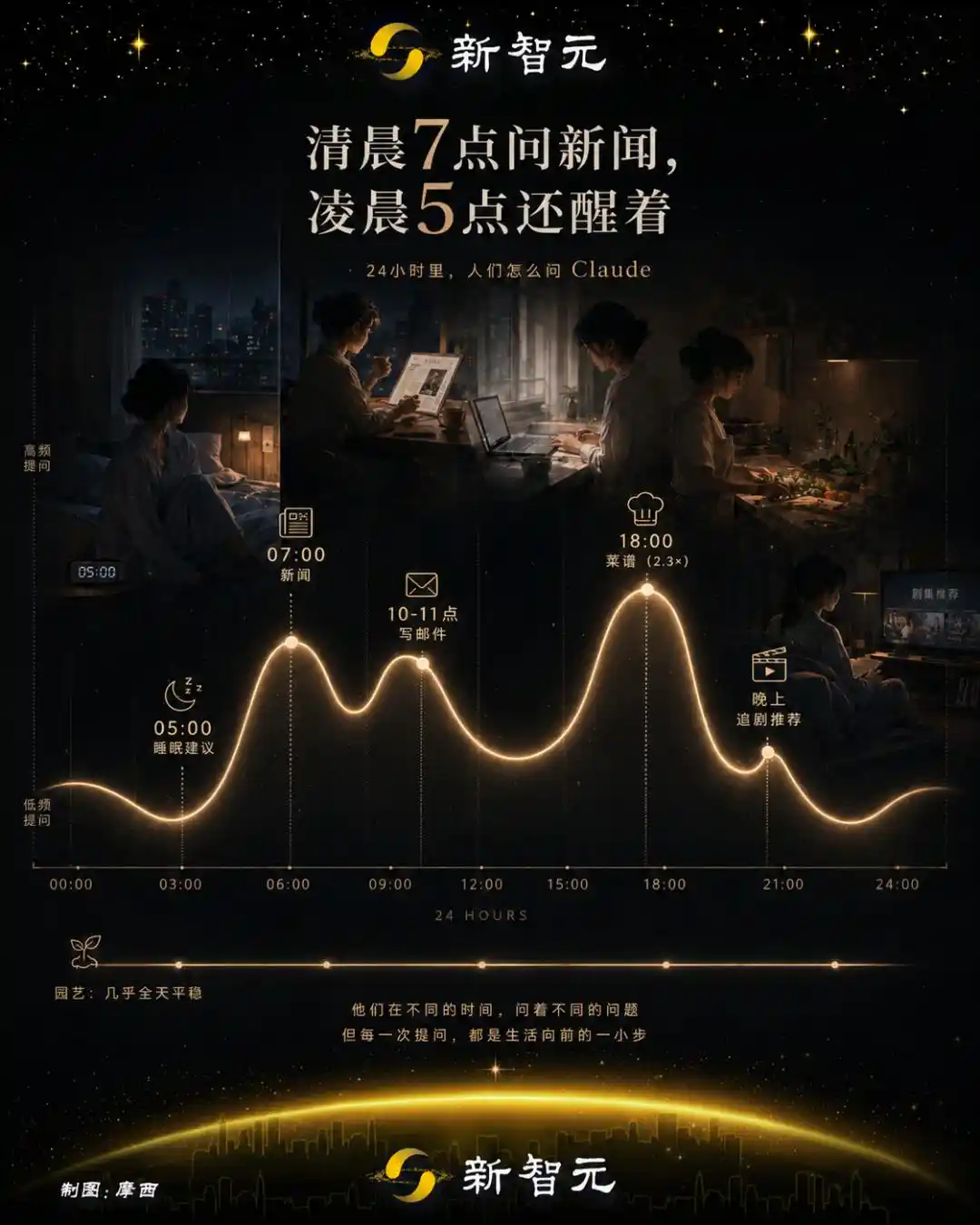
At 5 a.m., the most common question people ask AI is how to fall asleep.
At 7 a.m., it's what major events happened in the world.
At 6 p.m., it's what to cook for dinner.
Just last night, Anthropic released the sixth report in its economic index series—for the first time, increasing the sampling precision of millions of Claude conversations from weekly to hourly!
What time you feel anxious, when you crave food, and when you can't sleep—it's all in the data.
AI knows your daily routine better than your partner.
AI Knows When You're Anxious or Craving Better Than Your Partner
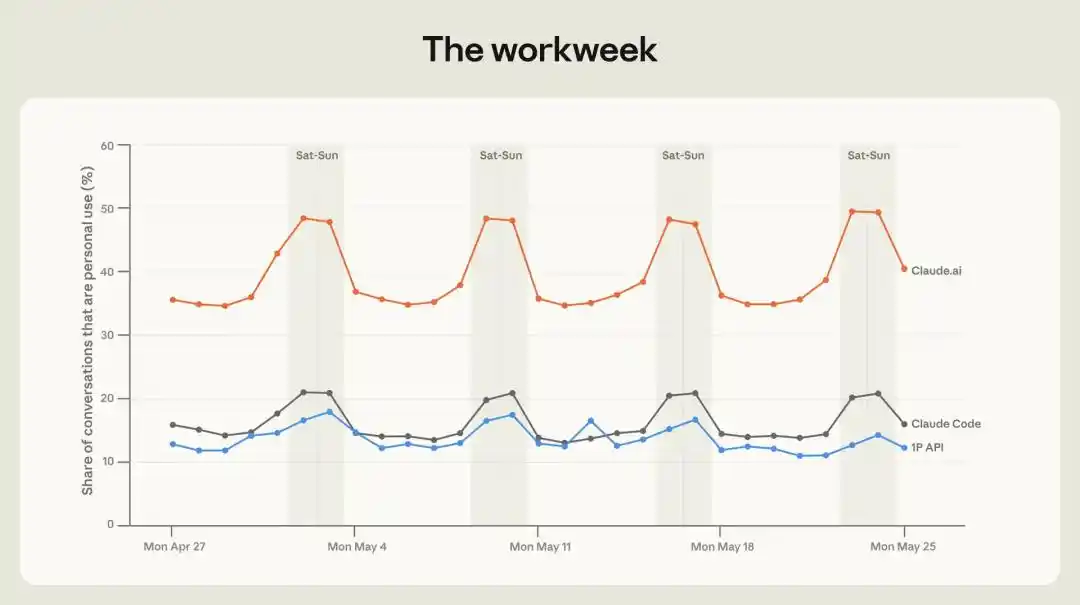
First, there's the distinction between weekdays and weekends.
Monday to Friday: Business emails, PowerPoint presentations, marketing copy.
Saturday and Sunday: Emotional support, medical questions, investment advice.
In Claude conversations, the proportion of personal use remains stable at around 35% on weekdays. But on weekends, it jumps to nearly 50%.
The usage of Claude Code also changes accordingly. Backend architecture, API debugging, and data storage all decline over the weekend, replaced by AI Agent design, quantitative trading, and game development.
The same group of people: working for five days, being themselves for two.
However, this "being themselves" isn't all about relaxing.
Entrepreneurship-related conversations peak across all countries on weekends, but job-seeking activities drop along with other work tasks.
Weekends are for dreaming of being a boss, not for submitting resumes.
Then, there's the 24-hour cycle of a day.
Anthropic plotted the frequency of different conversation categories by hour, creating what can be called an electrocardiogram of human life rhythm—
7 a.m.: News. 10-11 a.m.: A small peak for email writing. 6 p.m.: Recipe searches, the largest single-category spike of the day. Evening: Concentrated requests for TV show recommendations. Around 5 a.m.: The insomniacs arrive.
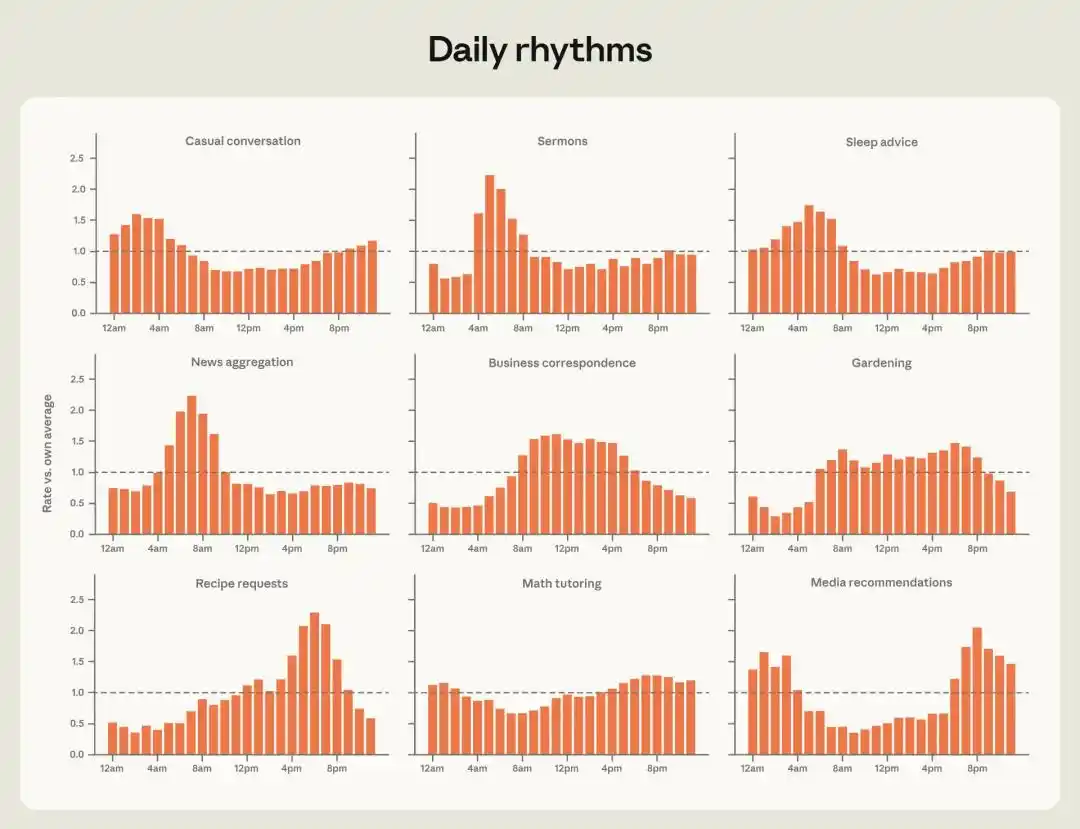
In contrast, gardening topics remain almost completely flat from sunrise to sunset.
Anthropic couldn't resist adding a pun in the report, calling gardening a "perennial topic of interest"—both "consistently popular" and referring to "perennial plants."
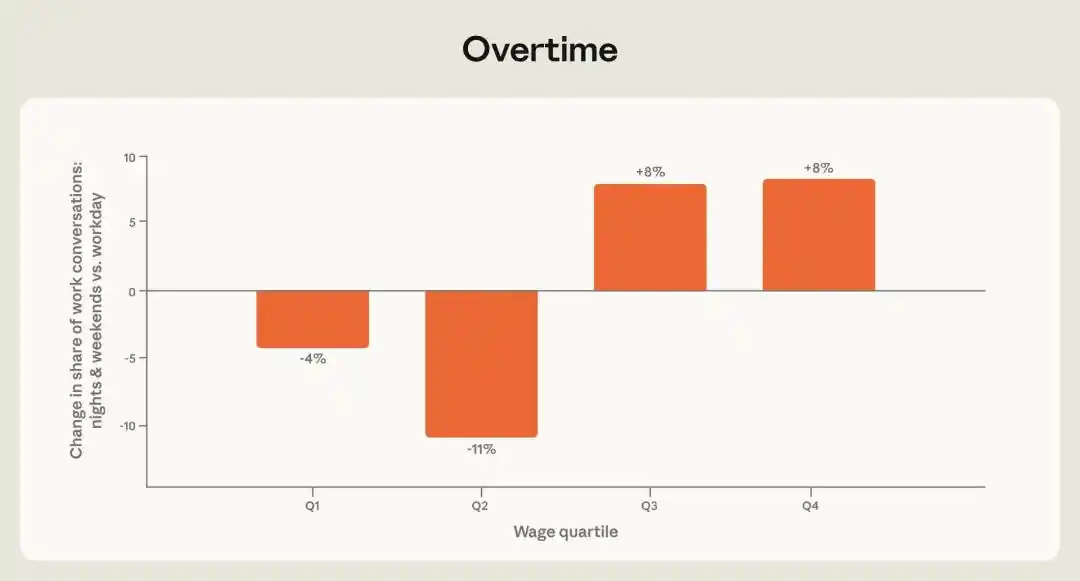
The post-work and weekend data also hides another layer of information: The work tasks Claude handles are clearly skewed towards higher-paying professions.
Conversations for low-wage positions like secretaries and telemarketers decline after hours, but the proportion for high-wage positions like marketing managers and programmers actually increases.
High-income workers have no off-hours. This isn't a new conclusion, but now it's backed by hourly data.
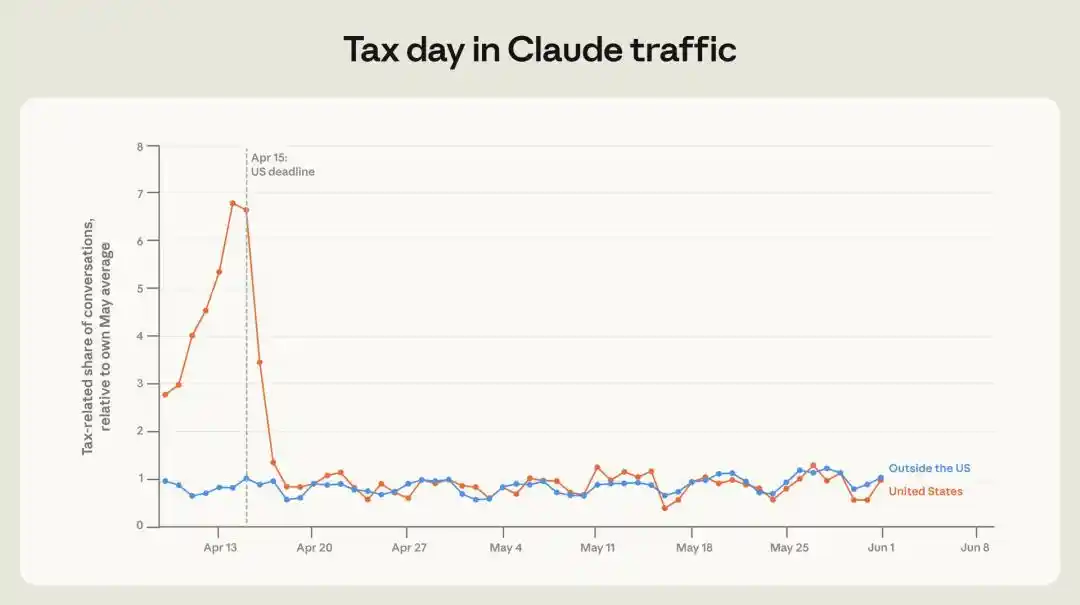
Of course, the most dramatic data point is Tax Day.
On April 14th, tax-related conversations were 8 times the daily average in May. They remained high on April 15th. On April 16th, they plummeted.
The American public collectively rushed to AI for tax help the day before the deadline, then scattered faster than anyone once it passed.
Creating PowerPoints by Day, Fan Fiction by Night
In this report, Anthropic also introduced a new analytical dimension: artifact.
The thing you take away after a conversation with Claude—a document, a piece of code, an explanation, an email—counts as an artifact.
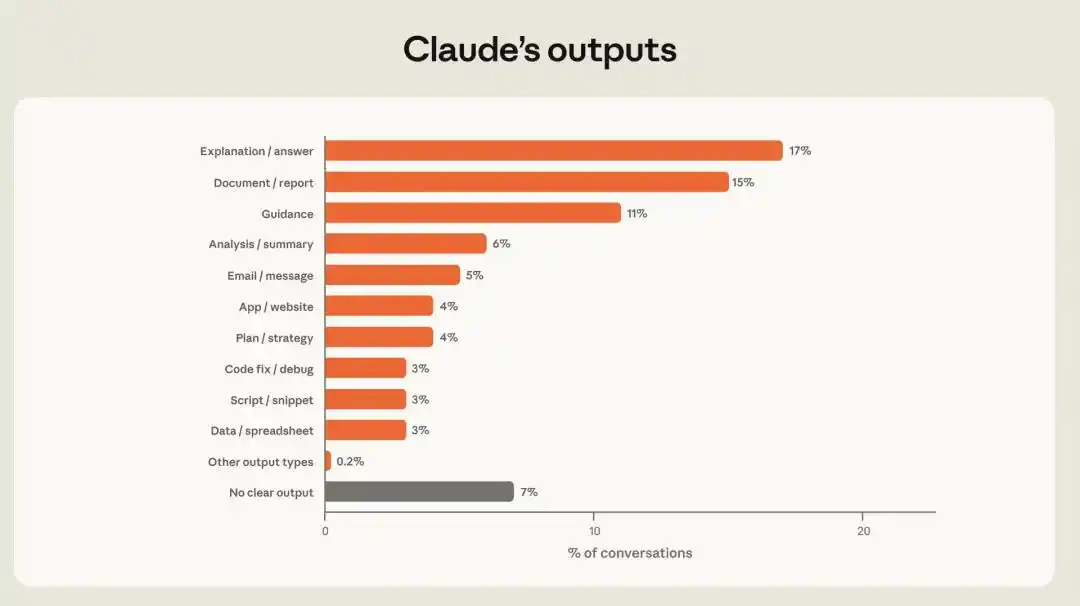
93% of conversations produced an artifact. Only 7% were pure chat, leaving nothing behind.
The top three categories were: Explanations (17%), Documents & Reports (15%), and Guidance & Advice (11%).
Overall, conversational outputs and written deliverables each account for about one-third, while code and technical work make up one-sixth.
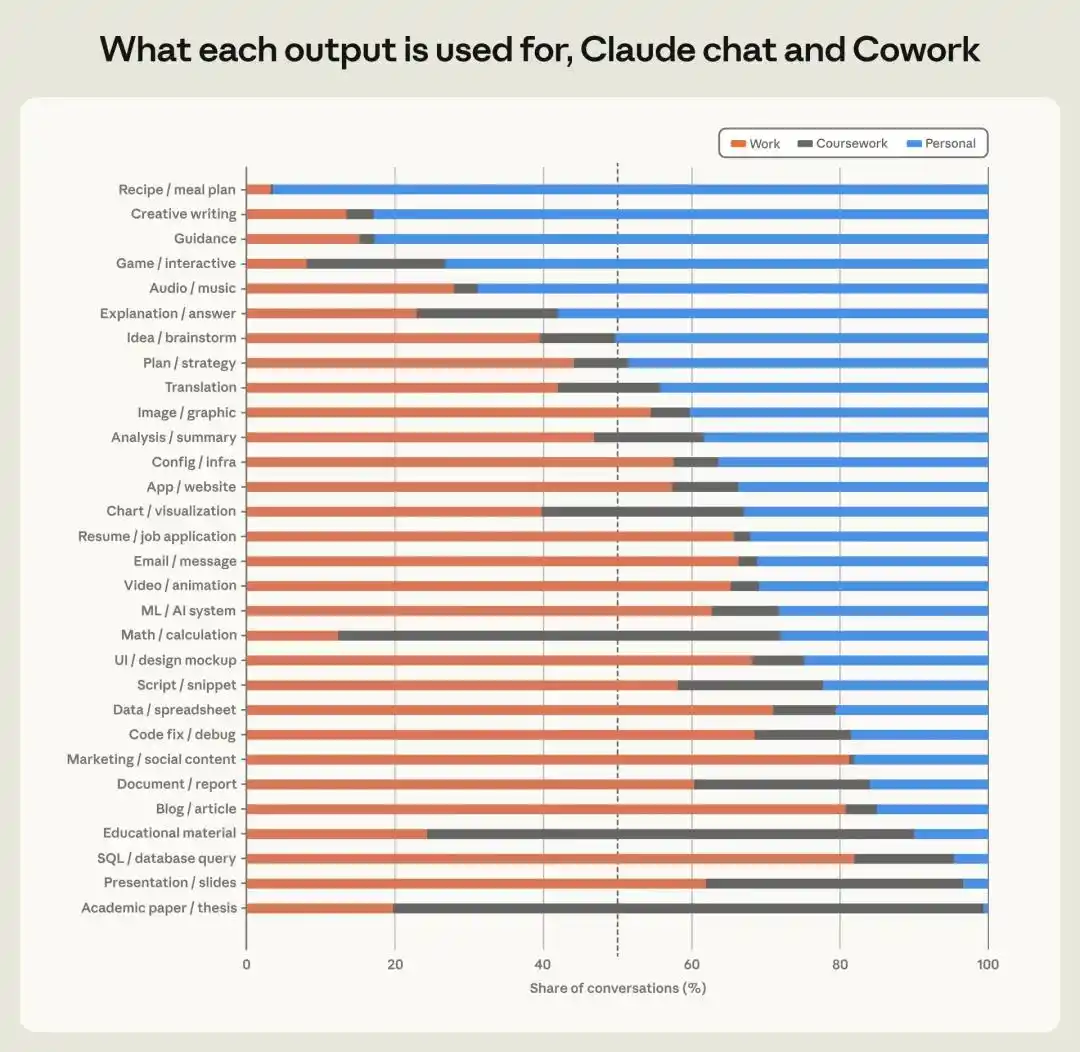
After categorization, Anthropic asked a follow-up question: Are these outputs for work or for life?
The answer varies by category.
Blogs and articles: 81% are for work.
Creative writing is the exact opposite: Over 80% are for personal use, mainly fan fiction, world-building, and poetry. Of the remaining work scenarios, 13% are for short video scripts and speeches.
Translation is the most "neutral," with 42% for work and 44% for personal use. Planning is similar: 44% for work (startup strategy, content strategy), 49% for personal use (travel itineraries, fitness plans).
By day, it's a productivity engine. By night, it's a life assistant.
The Higher the Pay, the Harder AI Works
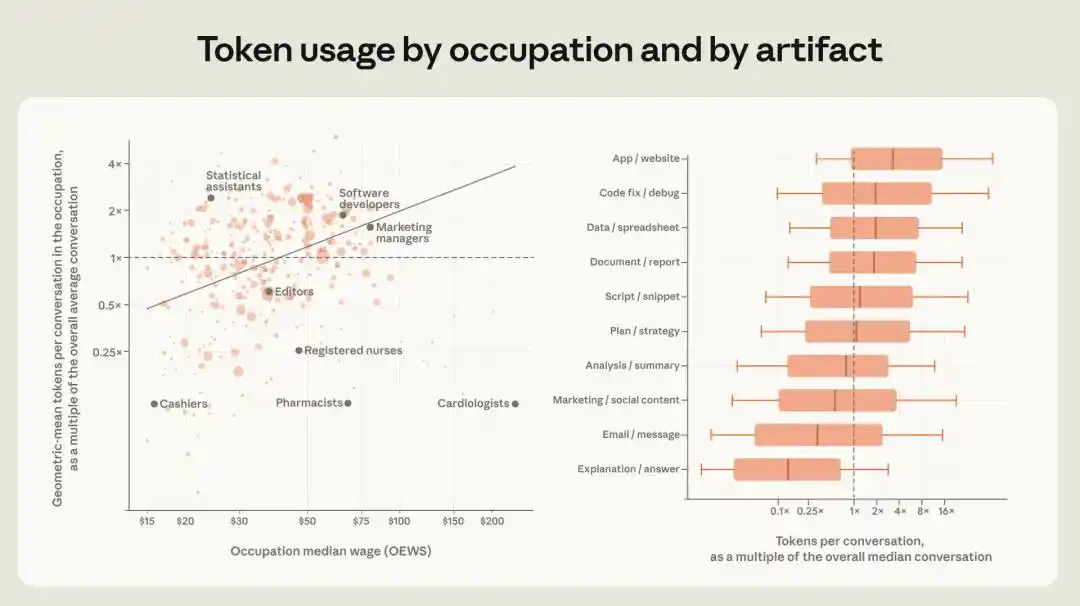
More interesting is the relationship between token consumption and salary.
Anthropic matched each conversation to the most relevant occupation and then compared it to the median wage for that profession.
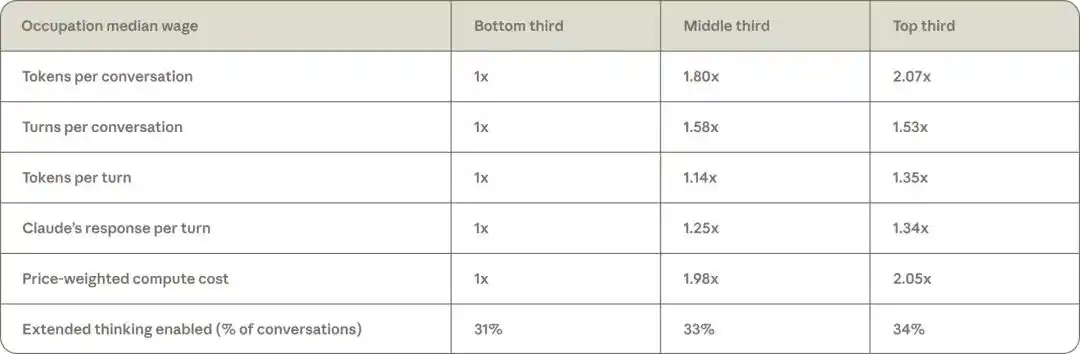
Thus, a pattern emerged: Conversations for high-salary professions consume more tokens.
Conversations associated with Marketing Managers ($80/hour) use about 2.5 times the tokens of those for Editors ($37/hour).
A conversation to build a website consumes over 3 times the median token count. An explanation uses only one-fifth of the median.
And high-income users don't simply "throw tasks at AI."
They output more per turn (1.34x), have more interaction turns (1.53x), and use the deep thinking feature more frequently (34% vs. 31%).
Claude isn't slacking, and neither are the people using it.
Of course, Claude not only works more but also works "higher."
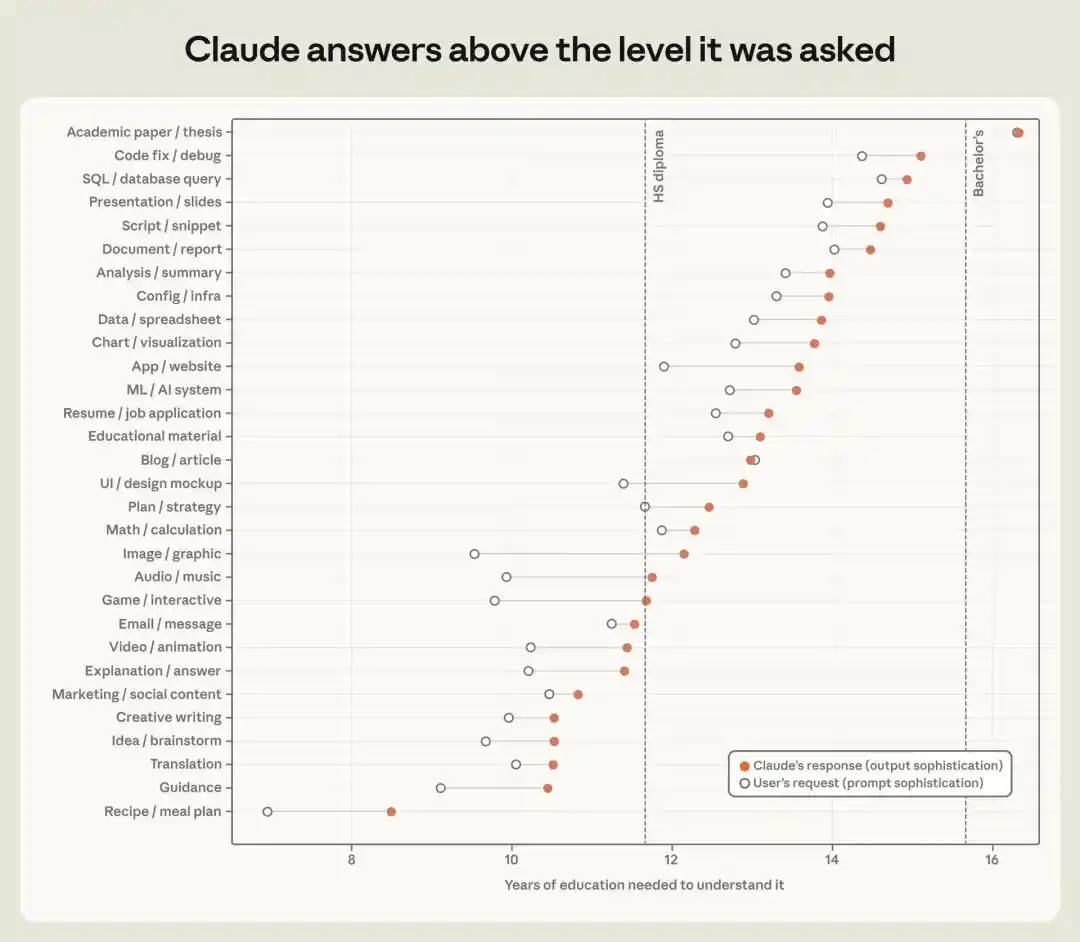
Its responses generally have a higher reading level than user prompts, averaging about one year more of education.
The largest gaps are in Images & Graphics (+2.6 years), Games (+1.9 years), and Websites/Apps (+1.7 years).
But for audience-facing writing, the gap almost disappears: Blogs (-0.1 years), Academic Papers (+0.0 years), Emails (+0.3 years).
The reason is that prompts for such tasks often include text samples at the same level as the desired output. If you ask it to help write an email, you've likely already drafted a version yourself, so the reading levels are similar.
A Diary You Never Intended to Write
This so-called "rhythm" is simply you opening a dialog box every day, asking a few questions, and taking what you need.
But when these conversations are sliced hourly, outputs are divided into over 30 categories, and each interaction is matched to an occupation and salary bracket, the fragments form a picture.
Insomnia at 5 a.m., dinner anxiety at 6 p.m., sudden entrepreneurial thoughts on weekends, and emotional lows flooding in late at night.
Viewed individually, these are just hundreds of unrelated questions. But strung together, they become a person's schedule, emotional cycles, and days.
You might not have fully shared these things with people around you. But you've entrusted them all to a dialog box.
93% of conversations produced something. Conversely, 93% of conversations also left a trace of you.
Anthropic says this report aims to see how AI integrates into economic life. But once data becomes precise to the hour, what it reflects is more than just economics.
By day, Claude is your work buddy. At 5 a.m., only it knows you're still awake.
References:
https://x.com/AnthropicAI/status/2070528961235575278
https://www.anthropic.com/research/economic-index-june-2026-report
This article is from the WeChat public account "新智元" (New Zhiyuan), author: ASI启示录 (ASI Apocalypse)



















