Analyst Reveals The Chances Of Bitcoin Price Crashing Again

bitcoinistPublished on 2026-04-18Last updated on 2026-04-18

Abstract

Analyst Sykodelic argues that the probability of Bitcoin experiencing another significant price crash has substantially decreased. This conclusion is based on a key technical indicator: the weekly Relative Strength Index (RSI) has broken above a descending trendline after falling to historic lows in Q1 2026, a rare event that has only occurred three times in Bitcoin's history. This bullish RSI breakout suggests the chances of Bitcoin revisiting new price lows are now very slim. This technical signal is supported by multiple converging bottom indicators and broader market data. Bitcoin exchange reserves have dropped to seven-year lows, while large investors are accumulating over $2 billion worth of BTC. Furthermore, spot Bitcoin ETFs have seen strong net inflows in March and April 2026. Despite this optimistic outlook, the analyst emphasizes the importance of watching how Bitcoin closes the current week. At the time of writing, Bitcoin is trading around $75,818.

Bitcoin’s recent price behavior has kept traders split between those expecting another leg down and those calling that a bottom is already in. That tension is now feeding different technical analyses, with one analyst arguing that the probability of a deeper crash has dropped significantly based on long-term signals.

Chance Of Bitcoin Making New Lows Is Very Small

Bitcoin has spent months testing the patience of its holders since its all-time high of $126,000 in 2025. According to crypto analyst Sykodelic, there is a compelling case that the drawdown is done and that the probability of Bitcoin revisiting new lows at this point has dropped massively.

Sykodelic’s rationale leans heavily on the behavior of the Relative Strength Index (RSI) on the weekly candlestick timeframe chart. According to his analysis posted on X, Bitcoin has just printed a powerful bullish break on the weekly RSI, and what makes this particular reading extraordinary is not just where it bounced from but how low it got before doing so.
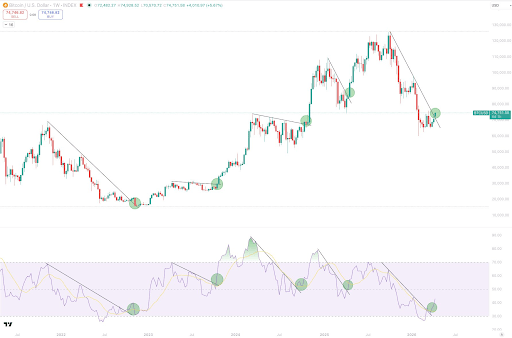
Source: Chart from Sykodelic on X

The weekly RSI has only fallen below 30 on three occasions in BTC’s history, with the most recent being Q1 2026. However, the RSI is now back into the normal zone, and it has broken above a descending trendline that touches lower highs. According to the analyst, this scenario means that the probabilities are now very slim for new lows of any kind.

The Bottom Signals Have Stacked Up

The RSI break did not arrive on its own. Sykodelic noted that multiple bottom indicators have converged simultaneously, a convergence he described as reaching a very high degree. According to him, about 12 important bottom indicators have fired, and Bitcoin is showing it here.

The broader data support his reading. Bitcoin exchange reserves have fallen to seven-year lows while whale wallets are now accumulating more than $2 billion worth of Bitcoin, their highest in over two months. Spot Bitcoin ETFs have recorded $954.05 million in net inflows so far in April, following a $1.32 billion inflow in March, which was the first positive month since October 2025.

Looking at the chart Sykodelic shared, the weekly price structure shows BTC breaking out of a descending trendline above $70,000, a pattern visible across both the price candles and the RSI panel below. Previous breakouts in 2022, 2023, and early 2025 were characterized by a similar RSI breakout of a descending trendline.

All of this contributes to a market environment where downside continuation becomes harder to sustain. Despite his conviction, Sykodelic stopped short of declaring an unconditional all-clear. The most important thing now is seeing how BTC closes the week. At the time of writing, Bitcoin is trading at $75,818, up by 1.4% in the past 24 hours.

BTC trading at $75,675 on the 1D chart | Source: BTCUSDT on Tradingview.com

Related Questions

QWhat is the main argument presented by analyst Sykodelic regarding Bitcoin's price crash probability?

ASykodelic argues that the probability of Bitcoin revisiting new lows has dropped massively, based on a powerful bullish break on the weekly RSI and the convergence of multiple bottom indicators.

QHow many times has Bitcoin's weekly RSI fallen below 30 in its history according to the analysis?

AThe weekly RSI has fallen below 30 on three occasions in Bitcoin's history, with the most recent being Q1 2026.

QWhat are some of the broader market data points that support the analyst's bullish reading?

ABitcoin exchange reserves have fallen to seven-year lows, whale wallets are accumulating over $2 billion worth of Bitcoin (their highest in over two months), and spot Bitcoin ETFs recorded significant net inflows in March and April.

QWhat key price level did Bitcoin break out of according to the weekly price structure chart?

ABitcoin broke out of a descending trendline above $70,000, a pattern visible in both the price candles and the RSI panel.

QWhat is the most important thing to watch now, according to Sykodelic, despite his conviction?

AThe most important thing now is seeing how Bitcoin closes the week, as the analyst stopped short of declaring an unconditional all-clear.

Related Reads

How to Do Research Well: Deliberately Practice the Real Skills That Matter

No one truly teaches you how to do research. You're often given a desk, a pre-selected problem, and vague instructions to "create something new." Consequently, many people reverse-engineer the job based on visible outputs—papers, posts, announcements—learning only how to *appear* like a researcher rather than how to *become* one. True research capability is built from stacking small, trainable skills, nearly all of which can be developed through deliberate practice. **Pick Your Own Problem:** Most researchers absorb problems from advisors or trends, lacking the underlying reasoning. Choosing a problem you genuinely care about, as John Schulman advises, leads to original work. Develop "taste" like a muscle: predict experiment outcomes, guess paper results from methods, and track which findings remain important over time. **Upgrade Your Inputs:** Relying on shared reading lists (arXiv hot lists, filtered group chats) leads to unoriginal conclusions. Undervalued old literature often holds crucial insights (e.g., MoE, LSTM, backpropagation). Richard Sutton's "The Bitter Lesson" or Claude Shannon's 1952 talk on creative thinking are more predictive than lengthy modern surveys. Breadth matters as much as depth: draw from neuroscience, mechanism design, hardware knowledge, and honest statistics. Read papers directly, especially appendices and limitations sections. **Write Everything Down:** As Paul Graham noted, writing exposes flaws in seemingly mature ideas. Writing is the cheapest defense against self-deception. Following Feynman's principle, Darwin programmatically wrote down facts contradicting his theory to combat memory bias. Maintain a detailed log of hypotheses, setups, predictions, results, and updated understandings. Reviewing past logs fosters essential humility.

marsbit52m ago

How to Do Research Well: Deliberately Practice the Real Skills That Matter

marsbit52m ago

Following US Ban on Fable 5, Zhipu AI's Stock Soars 47%

On June 15th, shares of Zhipu AI surged dramatically on the Hong Kong stock market, peaking at a 47.6% gain before closing 32.82% higher. This sharp increase was directly triggered by two recent industry events. On June 12th, Anthropic announced it was suspending global access to its latest flagship models, Claude Fable 5 and Claude Mythos 5, to comply with a U.S. government export control order. The next day, Zhipu AI announced it would open access to its latest open-source flagship model, GLM-5.2, under the permissive MIT license. The Anthropic incident highlighted a critical issue beyond raw model capability: the risk of sudden, unpredictable loss of access to advanced AI models, especially for developers and enterprises deeply integrated with them. This has shifted industry and market focus toward factors like stability, sustainable access, and controllability. Zhipu's move, promoting "frontier intelligence for all," positions its openly available model as a reliable and accessible alternative. The GLM-5.2 model emphasizes "Long Horizon Task" capabilities with a 1M context window, targeting complex, multi-step coding and engineering workflows where maintaining context is crucial. Analysts note this event exposes the risk of dependency on closed-source models subject to single jurisdictional controls, potentially accelerating a shift toward domestic base models and localized deployments. The market's reaction signals a new valuation dimension in AI: providers who can offer stable, long-term, and sustainably accessible AI capabilities are gaining strategic importance.

marsbit1h ago

Following US Ban on Fable 5, Zhipu AI's Stock Soars 47%

marsbit1h ago

Fully Entering the AI Era: Alipay Bets on Conversation, WeChat Holds Fast to Social

In May 2026, Alipay announced over 300 million AI payment transactions. Shortly after, WeChat opened its mini-programs for AI integration, sparking controversy by requiring developer source code access. This highlights their diverging approaches to AI integration. Alipay is testing "Project Treasure," an optional AI-native interface replacing traditional app grids with a conversational window. Users can command complex tasks (e.g., "book a ride and order coffee") handled end-to-end by AI. This shift follows an abandoned standalone AI app, focusing instead on enhancing its existing user base. For unmodified mini-programs, Alipay's AI uses "screen-reading" to simulate user interactions, bypassing the need for developer overhaul. It also introduced "Token Pay" for micro-transactions and "AI Wallets" for autonomous agent spending. WeChat, prioritizing its core social function, is taking an embedded approach. Its AI agent will operate within existing contexts like group chats and official accounts, assisting without a separate interface. To enable this, WeChat offers developers two paths: granting source code access for direct AI control ("Automatic Mode") or manually encapsulating services into standardized "Skills." Both place significant burden on developers. Key differences emerge in handling legacy services: WeChat demands developer cooperation (code or labor), while Alipay's screen-reading offers immediate, if potentially less stable, compatibility. Alipay's 3 billion AI transactions demonstrate user acceptance of AI-driven commercial actions. The divergent strategies may reshape mini-program ecosystems—Alipay passively "AI-fying" services, WeChat potentially favoring resource-rich developers—and set competing technical standards. Ultimately, the competition centers on where users entrust the command to "help me get things done."

marsbit1h ago

Fully Entering the AI Era: Alipay Bets on Conversation, WeChat Holds Fast to Social

marsbit1h ago

Trading

Spot
Futures

Hot Articles

What is $BITCOIN

DIGITAL GOLD ($BITCOIN): A Comprehensive Analysis Introduction to DIGITAL GOLD ($BITCOIN) DIGITAL GOLD ($BITCOIN) is a blockchain-based project operating on the Solana network, which aims to combine the characteristics of traditional precious metals with the innovation of decentralized technologies. While it shares a name with Bitcoin, often referred to as “digital gold” due to its perception as a store of value, DIGITAL GOLD is a separate token designed to create a unique ecosystem within the Web3 landscape. Its goal is to position itself as a viable alternative digital asset, although specifics regarding its applications and functionalities are still developing. What is DIGITAL GOLD ($BITCOIN)? DIGITAL GOLD ($BITCOIN) is a cryptocurrency token explicitly designed for use on the Solana blockchain. In contrast to Bitcoin, which provides a widely recognized value storage role, this token appears to focus on broader applications and characteristics. Notable aspects include: Blockchain Infrastructure: The token is built on the Solana blockchain, known for its capacity to handle high-speed and low-cost transactions. Supply Dynamics: DIGITAL GOLD has a maximum supply capped at 100 quadrillion tokens (100P $BITCOIN), although details regarding its circulating supply are currently undisclosed. Utility: While precise functionalities are not explicitly outlined, there are indications that the token could be utilized for various applications, potentially involving decentralized applications (dApps) or asset tokenization strategies. Who is the Creator of DIGITAL GOLD ($BITCOIN)? At present, the identity of the creators and development team behind DIGITAL GOLD ($BITCOIN) remains unknown. This situation is typical among many innovative projects within the blockchain space, particularly those aligning with decentralized finance and meme coin phenomena. While such anonymity may foster a community-driven culture, it intensifies concerns about governance and accountability. Who are the Investors of DIGITAL GOLD ($BITCOIN)? The available information indicates that DIGITAL GOLD ($BITCOIN) does not have any known institutional backers or prominent venture capital investments. The project seems to operate on a peer-to-peer model focused on community support and adoption rather than traditional funding routes. Its activity and liquidity are primarily situated on decentralized exchanges (DEXs), such as PumpSwap, rather than established centralized trading platforms, further highlighting its grassroots approach. How DIGITAL GOLD ($BITCOIN) Works The operational mechanics of DIGITAL GOLD ($BITCOIN) can be elaborated on based on its blockchain design and network attributes: Consensus Mechanism: By leveraging Solana’s unique proof-of-history (PoH) combined with a proof-of-stake (PoS) model, the project ensures efficient transaction validation contributing to the network's high performance. Tokenomics: While specific deflationary mechanisms have not been extensively detailed, the vast maximum token supply implies that it may cater to microtransactions or niche use cases that are still to be defined. Interoperability: There exists the potential for integration with Solana’s broader ecosystem, including various decentralized finance (DeFi) platforms. However, the details regarding specific integrations remain unspecified. Timeline of Key Events Here is a timeline that highlights significant milestones concerning DIGITAL GOLD ($BITCOIN): 2023: The initial deployment of the token occurs on the Solana blockchain, marked by its contract address. 2024: DIGITAL GOLD gains visibility as it becomes available for trading on decentralized exchanges like PumpSwap, allowing users to trade it against SOL. 2025: The project witnesses sporadic trading activity and potential interest in community-led engagements, although no noteworthy partnerships or technical advancements have been documented as of yet. Critical Analysis Strengths Scalability: The underlying Solana infrastructure supports high transaction volumes, which could enhance the utility of $BITCOIN in various transaction scenarios. Accessibility: The potential low trading price per token could attract retail investors, facilitating wider participation due to fractional ownership opportunities. Risks Lack of Transparency: The absence of publicly known backers, developers, or an audit process may yield skepticism regarding the project's sustainability and trustworthiness. Market Volatility: The trading activity is heavily reliant on speculative behavior, which can result in significant price volatility and uncertainty for investors. Conclusion DIGITAL GOLD ($BITCOIN) emerges as an intriguing yet ambiguous project within the rapidly evolving Solana ecosystem. While it attempts to leverage the “digital gold” narrative, its departure from Bitcoin's established role as a store of value underscores the need for a clearer differentiation of its intended utility and governance structure. Future acceptance and adoption will likely depend on addressing the current opacity and defining its operational and economic strategies more explicitly. Note: This report encompasses synthesised information available as of October 2023, and developments may have transpired beyond the research period.

364 Total ViewsPublished 2025.05.13Updated 2025.05.13

What is $BITCOIN

Discussions

Welcome to the HTX Community. Here, you can stay informed about the latest platform developments and gain access to professional market insights. Users' opinions on the price of BTC (BTC) are presented below.

活动图片















