An Eight-Year Investment Takes a Sharp Turn: Why Did Ethereum Suddenly Abandon Poseidon?

marsbitPublished on 2026-08-16Last updated on 2026-08-16

Abstract

On August 13, Ethereum researcher Justin Drake announced a significant shift in Ethereum's Layer-1 cryptographic roadmap: abandoning the SNARK-friendly hash function Poseidon in favor of traditional functions like SHA2 or BLAKE2. This decision ends eight years of research and investment, marking a major revision to the post-quantum security strategy. Poseidon, introduced in 2019, was highly efficient for zkRollups and zkVMs within SNARK circuits. However, its need for prolonged cryptanalysis and the pressing timeline for quantum resistance revealed limitations. Recent breakthroughs in SNARK design, specifically using binary fields, now enable traditional, battle-tested hash functions to perform as efficiently as Poseidon within SNARKs. Benchmarks show modern laptops can now verify over a million traditional hash calls per second. This change is partly driven by accelerated concerns over quantum computing threats. Reports warn that "Cryptographically Relevant Quantum Computers" could break current blockchain signatures like ECDSA by the early 2030s, risking trillions in assets. Ethereum's response focuses on hash-based post-quantum signature schemes, deemed more quantum-resistant than some lattice-based alternatives under pressure from AI cryptanalysis. Ethereum's updated post-quantum roadmap targets a production-ready "leanVM" for signature aggregation by 2027, with full deployment across consensus, execution, and data layers by 2028. The shift to mature hash functions lik...

On August 13th, Ethereum researcher Justin Drake posted on X, stating that the Ethereum Foundation has decided to abandon the SNARK-friendly hash algorithm Poseidon at the L1 layer in favor of traditional hash functions like SHA2 or BLAKE2.

This decision stems from eight years of research, tens of millions of dollars in investment, and a major revision to the post-quantum cryptography roadmap.

Since its introduction in 2019, Poseidon has been considered the ideal hash scheme for applications like zkRollups and zkVMs. Its structure makes it cheaper and more efficient in SNARK circuits compared to traditional hash functions based on binary operations. However, when post-quantum security became a hard requirement for Ethereum, Poseidon's limitations began to surface.

Justin Drake stated that this shift is thanks to breakthrough progress in SNARK design, specifically through a "binary field" operational approach. This makes the performance of traditional hash functions in SNARK circuits comparable to that of Poseidon, which was previously optimized for SNARKs. A single laptop can now verify about 1 million traditional hash invocations per second.

The article notes that since its 2019 launch, Poseidon has been a mainstream SNARK-friendly hash scheme, providing security for applications like zkRollups and zkVMs. Justin Drake mentioned that plans indicate a production-ready leanVM is expected by 2027, with deployment for the consensus, data, and execution layers targeted for 2028. The Ethereum Foundation's post-quantum team is also accelerating research related to binary fields.

Why Now?

Traditional hashes have long struggled to be incorporated into SNARKs, primarily due to computational language differences. SHA2, BLAKE2s, and Keccak heavily use Boolean operations like XOR and bit shifts. Traditional SNARKs typically operate over large prime fields, simulating each bit operation at a high constraint cost. Poseidon was designed directly around prime field arithmetic, achieving higher proving speed with fewer constraints at the cost of a shorter algorithm history, requiring ongoing cryptanalysis.

The binary field shifts the underlying mathematics to the smallest prime field containing only 0 and 1, using binary extension fields to handle larger data. Bit operations can thus enter the proof system directly. SNARKs are now adapting to traditional hashes, shifting the technical focus from designing SNARK-friendly hashes to designing hash-friendly SNARKs.

Binius, proposed by Jim Posen and Benjamin Diamond in 2023, demonstrated a path for SNARKs using binary tower fields. The Flock paper by Benedikt Bünz, Ron Rothblum, and William Wang was uploaded to arXiv on July 29, 2026. Its M4 Max benchmark showed single-core performance of 82,000 BLAKE3 compressions, 42,000 SHA-256 compressions, and 30,000 Keccak permutations per second. The 10-core BLAKE3 throughput exceeded 660,000 operations.

Drake noted that a laptop can now prove about 1 million traditional hash invocations per second, with an overhead roughly 100 times that of native CPU Boolean computation. SNARK.fast recently achieved 1.8 million BLAKE3 operations per second on an M3 Max.

leanVM in 2027, Three-Layer Deployment in 2028

Another key reason for abandoning Poseidon is the accelerating timeline for post-quantum security. The report "The Quantum Threat to Blockchains - 2026 Report" by Project Eleven points out that the rapid development of quantum computers poses a serious threat to blockchain security. Once a "cryptographically relevant quantum computer" (CRQC) emerges, Shor's algorithm could quickly break asymmetric encryption like ECDSA (used by Bitcoin and most public chains) and RSA. Q-Day (Quantum Decryption Day) is projected to arrive between 2030 and 2033, potentially putting trillions of dollars in on-chain assets at risk.

Since blockchain public keys are long-lived and static, and rollbacks are impossible, migration is extremely difficult. The report recommends immediately initiating Post-Quantum Cryptography (PQC) migration, including quantum-resistant signature schemes based on lattices and hashes, and transitioning gradually through hybrid schemes to avoid the full impact of the quantum threat.
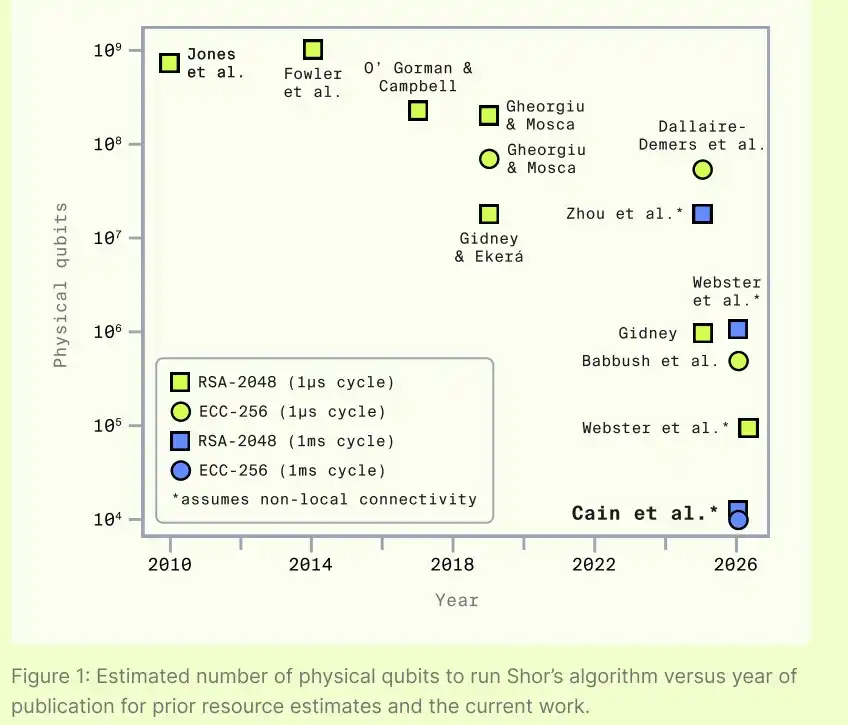
Justin Drake warned that the increasing capabilities of AI in cryptanalysis have already impacted lattice-based scheme HAWK and isogeny-based scheme SQIsign. This has forced the Ethereum Foundation to place its bets on hash-based schemes, which are considered more resistant to quantum attacks.

Previously, Ethereum announced its post-quantum roadmap, including deploying a production-ready leanVM in 2027 and completing deployment on the consensus, execution, and data availability layers by 2028. leanVM is a minimalistic zero-knowledge virtual machine specifically for post-quantum signature aggregation, seen as the core component of the entire strategy.

In March 2026, the Ethereum Foundation launched pq.ethereum.org as a post-quantum security resource center. Over 10 client teams have begun running weekly post-quantum interoperability devnets. The Foundation also established a $1 million Poseidon Prize and an equal Proximity Prize to advance post-quantum cryptography research. Vitalik Buterin himself has repeatedly emphasized that post-quantum security is a necessary condition for Ethereum's "walkaway test"—Ethereum cannot "ossify" unless it achieves quantum security.

The switch in hash functions does not alter the overall structure of Ethereum's post-quantum roadmap. The BLS signatures currently used by validators rely on elliptic curves. Future schemes will still be based on hash signatures like leanXMSS, with leanVM compressing a large number of signatures into a single small proof per block. A comparison previously provided on Ethereum's official page shows that a leanXMSS signature is about 3000 bytes, while a BLS signature is only 96 bytes. leanVM aims for a data compression target of about 250x.

SHA2 or BLAKE2s have longer histories of public analysis, allowing the EF to reduce the time spent waiting for Poseidon parameters to undergo years of cryptanalysis. Drake's suggested roadmap points to a production-ready leanVM in 2027 and deployment on the consensus, data, and execution layers in 2028.

Competition: Solana Chooses Falcon

Ethereum is not the only major public chain preparing for the post-quantum era. The Solana Foundation released its post-quantum security roadmap in April 2026. Its core developer teams, Anza and Jump Crypto's Firedancer, independently researched and converged on the same post-quantum signature scheme: Falcon.

Falcon is one of the NIST-standardized post-quantum signature schemes. Its signatures are compact, making it suitable for high-throughput blockchain environments like Solana.

The two major validator client development teams, Anza and Firedancer, after independent research, both selected the post-quantum digital signature scheme Falcon. They have publicly shared preliminary implementation code on GitHub. The current roadmap involves three steps: continuously evaluating Falcon and alternatives; adopting a post-quantum scheme for new wallets when the quantum threat materializes; and finally, migrating all existing wallets. Additionally, Blueshift's Solana Winternitz Vault has been operating within the ecosystem for over two years and was cited earlier this year as an industry-leading case in a Google Quantum AI whitepaper.

The Solana Foundation stated that a material threat from quantum computing is still years away, so immediate migration is not necessary. However, research, infrastructure, and ecosystem coordination are ready, allowing for a rapid start when the time comes. It is expected that this will not significantly impact network performance.

Starknet is currently the closest reference point to the EF's new direction. StarkWare's roadmap, announced on June 30th, is divided into three phases. The first phase will replace the Pedersen hash algorithm with BLAKE2 for state commitments, contract addresses, and network configurations, while also introducing post-quantum consensus signatures like Falcon-512. The second phase focuses on migration tools for traditional contracts. The final phase addresses remaining external dependencies still tied to Ethereum, including bridge system calls and blob data availability. The third phase depends on Ethereum's own migration path.

Compared to other public chains, Ethereum has chosen a path of "establishing standards first, then implementing code." Abandoning Poseidon in favor of SHA2/BLAKE2 is essentially a choice for more mature, widely-vetted cryptographic primitives in the post-quantum era.

Trending Cryptos

Related Questions

QWhy did the Ethereum Foundation decide to abandon the Poseidon hash algorithm after eight years of investment and research?

AThe Ethereum Foundation decided to abandon the Poseidon hash algorithm at the L1 layer primarily due to the evolving requirements for post-quantum security. While Poseidon was SNARK-friendly and efficient for applications like zkRollups, new SNARK design breakthroughs using binary fields have made traditional hash functions like SHA2 or BLAKE2 perform comparably well in SNARK circuits. Additionally, these traditional functions have a longer history of public cryptographic analysis, offering greater security assurance in the face of the quantum computing threat and advanced AI cryptanalysis.

QWhat technological breakthrough enabled traditional hash functions to become viable for use in SNARK circuits, challenging Poseidon's advantage?

AThe key breakthrough was the shift to using binary fields (fields with elements 0 and 1) in SNARK construction. Traditional hash functions like SHA2 rely heavily on bitwise operations (XOR, shifts), which were expensive to simulate in older SNARKs based on large prime fields. Binary field-based SNARKs can handle these bitwise operations natively and efficiently. This allows traditional hash functions to be proven in SNARKs with performance rivaling that of SNARK-optimized designs like Poseidon, as demonstrated by projects like Binius and Flock.

QWhat is the significance of the planned 'leanVM' in Ethereum's post-quantum roadmap, and when is it expected?

AThe 'leanVM' (a minimal zero-knowledge virtual machine for post-quantum signature aggregation) is a core component of Ethereum's post-quantum strategy. Its significance lies in compressing a large number of large post-quantum signatures (e.g., ~3000 bytes for leanXMSS) into a single, small proof per block (aiming for ~250x compression). This is crucial for maintaining blockchain scalability and efficiency. The production-ready leanVM is currently targeted for 2027, with full deployment across the consensus, execution, and data availability layers planned for 2028.

QHow does Solana's approach to post-quantum security differ from Ethereum's new direction, and what scheme did it choose?

ASolana's approach differs by focusing on a specific, compact post-quantum signature scheme suitable for its high-throughput environment. Both its major client development teams (Anza and Firedancer) independently selected Falcon, a NIST-standardized lattice-based signature scheme known for its small signature size. Solana's plan is more incremental: assess schemes, adopt for new wallets when needed, and eventually migrate existing wallets. In contrast, Ethereum is taking a broader 'standards-first' approach, opting for widely analyzed traditional hash functions (SHA2/BLAKE2) as base cryptographic primitives within its new SNARK framework to build its post-quantum ecosystem.

QAccording to the article, what major external factor is accelerating the need for post-quantum cryptography in blockchain?

AThe major external factor is the rapid advancement of quantum computing and the growing threat it poses to current cryptographic systems. Reports like 'The Quantum Threat to Blockchains - 2026' warn of a potential 'Q-Day' (when quantum computers can break current encryption) between 2030 and 2033. Quantum computers running Shor's algorithm could crack the elliptic-curve cryptography (like ECDSA and BLS) that secures billions in blockchain assets. Furthermore, enhanced AI cryptanalysis has already compromised some post-quantum candidates (like HAWK and SQIsign), increasing urgency and pushing projects like Ethereum towards hash-based schemes considered more quantum-resistant.

Related Reads

Semiconductor Mid-Game Check-in: How Much Left in the Tail-End Rally?

Semiconductor Mid-Game Review: How Much is Left in the Rally? This analysis compares the current semiconductor market trend to NVIDIA's trajectory in 2024, drawing lessons on identifying market tops and bottoms. In July-August 2024, NVIDIA's stock fell 33%, triggered by a combination of "fundamental rumors" (Blackwell delays, antitrust probes) and "macro-driven asset selling" (BOJ rate hike leading to carry-trade unwinding). The low was marked by extreme panic selling across global markets. Key characteristics of a TOP include: Technical patterns like double tops or failure to break highs; Overcrowded and leveraged positioning (e.g., excessive retail and ETF inflows into a single stock like NVDA); High fragility where even a minor fundamental disappointment (e.g., a slight margin dip in stellar earnings) triggers a sharp correction. The practical action is to reduce exposure upon seeing technical warning signs combined with crowded trades. Key characteristics of a BOTTOM include: Technical reversal signals like a high-volume bullish engulfing pattern after a steep drop; Panic indicators hitting extremes (e.g., record VIX, major index crashes) signaling selling exhaustion; The downturn being driven by macro or systemic shocks unrelated to the company's core business fundamentals, creating a mispricing that quality companies eventually recover from. The conclusion is that while the current semiconductor rally may be in its later stages ("fish tail"), understanding these patterns—where tops form from crowded optimism and bottoms from panic unrelated to fundamentals—can help navigate remaining volatility.

marsbit11m ago

Semiconductor Mid-Game Check-in: How Much Left in the Tail-End Rally?

marsbit11m ago

New Insider Trading in Prediction Market Exposed: It's Impossible to Lose When You Sit in That Position

PolyBeats reported on August 19 about a user who achieved a 120% return in just 89 seconds by betting that Russia would capture Konstantynivka on a prediction market platform, where the probability (and price) surged from 43% to 92%. This trade was notably the 14th in a series of perfect predictions related to the Russia-Ukraine war by this account, with a total profit of approximately $17,500. Eleven of these trades saw the probability jump to near 100% within five minutes of the purchase. The article suggests these consistent gains point to potential insider knowledge. The key is that these prediction markets on Polymarket settle based not on real-time battlefield events, but on whether the Institute for the Study of War (ISW) updates its official interactive map to show an area as controlled by Russia. Therefore, profiting reliably doesn't require military intelligence, but merely advance knowledge of when and where ISW will update its map. This mirrors a prior incident in November 2025, where an unauthorized, temporary edit to the ISW map regarding Myrnohrad allowed a trader to make over a 10,000% return before the edit was reversed. While ISW has since added safeguards like "pending review" statuses and duration requirements for map changes, the article argues the 14-trade winning streak indicates someone with access to the map update process—like an ISW staffer—could exploit the time gap between an internal decision and its public release, turning administrative knowledge into nearly guaranteed profits.

marsbit46m ago

New Insider Trading in Prediction Market Exposed: It's Impossible to Lose When You Sit in That Position

marsbit46m ago

Trading

Spot

Hot Articles

Discussions

Welcome to the HTX Community. Here, you can stay informed about the latest platform developments and gain access to professional market insights. Users' opinions on the price of ETH (ETH) are presented below.

活动图片