Amid the AI Layoff Wave, OpenAI Opens "Iron Rice Bowl" for Salespeople

比推Published on 2026-03-24Last updated on 2026-03-24

Abstract

Amid widespread AI-driven layoffs across the tech industry—with companies like Block, Pinterest, and Dow Chemical cutting thousands of jobs—OpenAI is expanding its workforce by hiring 3,500 new employees, primarily in sales, partnership management, and technical ambassador roles. While AI is replacing standardized, task-based jobs (e.g., coding, customer service), OpenAI’s recruitment focuses on roles that require human interaction: convincing enterprise clients to adopt AI, integrating systems, and providing tailored solutions. Despite ChatGPT’s massive user base, monetization remains challenging, with significant losses per user. Enterprise clients, crucial for profitability, are increasingly choosing competitors like Anthropic’s Claude. OpenAI’s shift reflects a broader trend: AI excels at clearly defined tasks but struggles with ambiguous, relationship-driven work like sales and customization. The company is even exploring partnerships with private equity firms to support AI implementation. The key differentiator between replaced and valued roles is whether the job can be easily described—if so, it’s vulnerable to AI automation. Roles requiring nuanced, human-driven problem-solving remain in demand.

Author: Curry

Original Title: AI Leads to Layoffs, But OpenAI Is Hiring Salespeople


Companies building AI are massively recruiting "field promoters"—the shovels are made, but someone still needs to teach others how to dig.

Recently, a wave of AI-induced unemployment anxiety has swept across the internet in both the East and the West.

Block laid off 4,000 people, with the CEO saying AI can do your job; Pinterest cut 15% of its employees, redirecting funds to AI initiatives; Dow Chemical laid off 4,500 people, citing a shift toward automation...

Domestically, things aren’t quiet either: NetEase was rumored to be replacing outsourced workers with AI, iFlytek denied rumors of large-scale layoffs, and ByteDance was reported to be optimizing 20% of non-AI departments every six months...

According to statistics, in the first three months of 2026, the global tech industry has already seen over 45,000 layoffs, with nearly 10,000 explicitly attributed to AI.

Against this backdrop, last Friday, the Financial Times reported that OpenAI plans to expand its workforce from 4,500 to 8,000 by the end of the year.

3,500 new positions. The company building AI actually says it doesn’t have enough people?
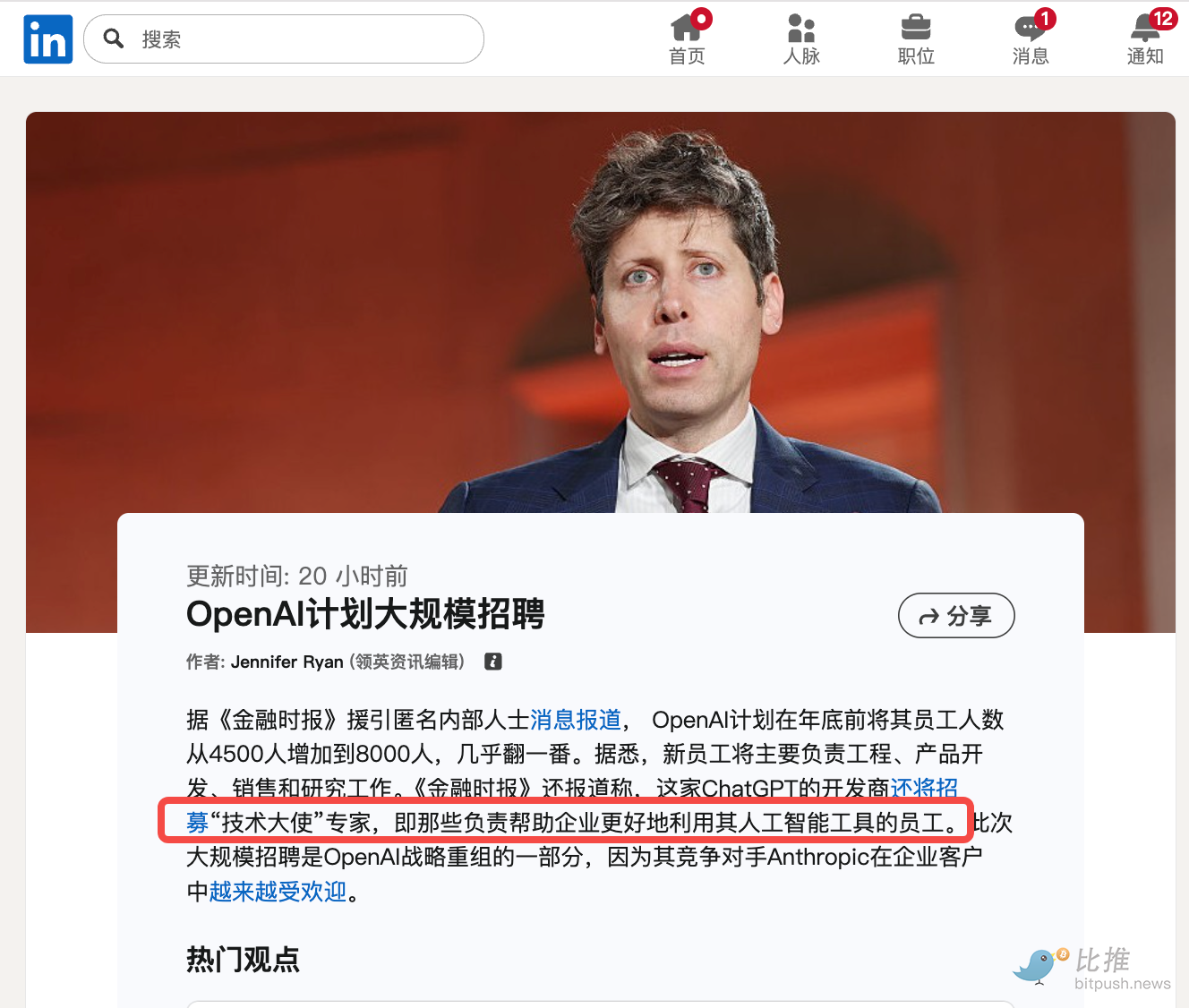
Take a look at OpenAI’s recruitment page: engineers and researchers are, of course, being hired, but equally prominent are another category of roles: partnership managers, enterprise sales, GTM (go-to-market strategy) teams, and a new role mentioned in the report called "technical ambassadorship," which translates to:

Technical Ambassador, specifically tasked with helping enterprise clients learn how to use AI.

So, OpenAI isn’t hiring people to make AI stronger; it’s hiring people to make others willing to pay for AI.

Winning Clients Trumps Winning Models

ChatGPT has 900 million weekly active users, but most don’t pay.

Even paying consumers are being served at a loss for OpenAI: the computing cost per heavy user exceeds the $20 monthly fee. Projected revenue for this year is $25 billion, with an expected loss of $14 billion.

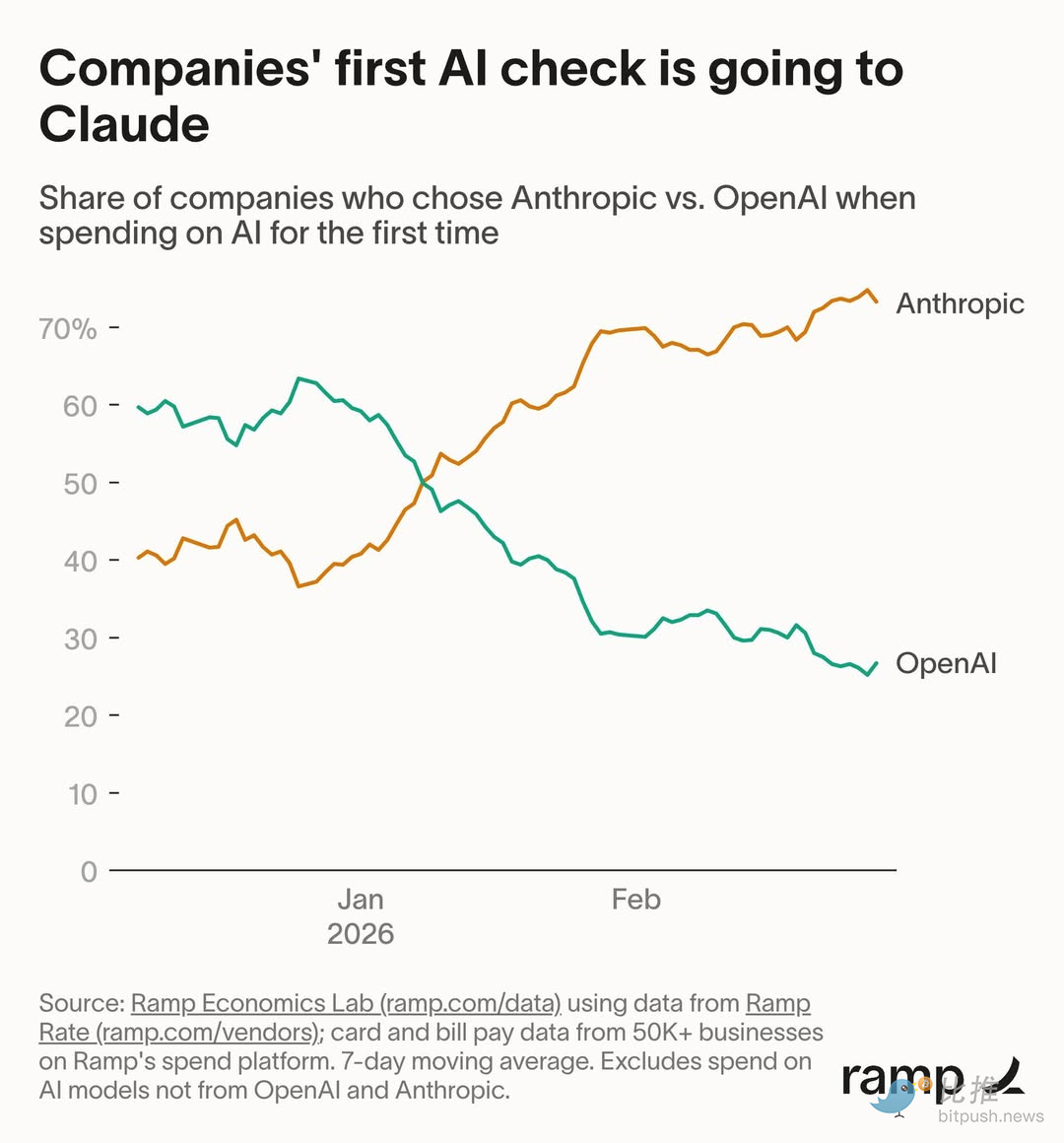
Consumers support traffic; enterprise clients support profits. And enterprise clients are running toward Anthropic’s Claude.

Data from Ramp shows that among enterprises making their first AI tool purchase, Anthropic captured 73% of the share. Ten weeks ago, this data was split evenly between the two.
In December of last year, Altman sent a "code red" memo to all staff, pausing all non-core projects like advertising and shopping assistants, and concentrating all company resources on the ChatGPT experience.

The immediate trigger was Google’s Gemini 3 outperforming ChatGPT in multiple tests, but the underlying anxiety lies on the enterprise side: Anthropic is embedding Claude into customers’ codebases and workflows. Once set up, migration costs begin to snowball.

Models can be iterated, but customers who leave won’t come back on their own. Chasing customers can’t rely on AI suggestions; it requires real people to knock on doors.

The Shovel Can’t Sell Itself

AI can write code, handle customer service, and perform data analysis, but there’s one thing it can’t do:

Persuade a company’s technical lead to sign an annual contract to buy me.

For individuals using AI, downloading an app is enough; dissatisfaction leads to uninstalling. Enterprise use of AI is another matter. Data security reviews, internal process changes, compatibility with existing systems, employee training—any single hurdle can stall a project.

This isn’t a problem solvable by model benchmarks; it requires someone to sit in the client’s conference room to push things forward.

OpenAI clearly gets it. It’s not just hiring salespeople; the FT reported it’s in talks with private equity firms like TPG and Brookfield about joint ventures specifically to help enterprises implement AI. The essence of this business is still about sending people on-site.

Block’s story tells the same tale.

Less than three weeks after laying off 4,000 people, the company started calling people back. A design engineer was told it was a "mistaken layoff"; a technical lead found that after his entire team was cut, no one could handle critical business, threatening to quit, prompting the company to rehire some people.

Dorsey himself preemptively noted in the layoff letter: We might have cut the wrong some people...

AI is indeed causing layoff anxiety, but cutting the lifeblood arteries of a company due to AI is clearly an overcorrection. Even in a company where the CEO publicly states AI can replace most employees, there are still links in the chain that AI can’t handle.

AI is best at replacing tasks that can be clearly defined, but "convincing an organization it needs AI, then helping it use it" is something that precisely cannot be clearly defined.

Every technological revolution has someone saying "the shovel sellers make the most money." This round of AI is no different, with consensus being that infrastructure companies are safe bets, regardless of who wins or loses.

But OpenAI’s current situation shows that once the shovels are made, someone still needs to teach others how to use them. And this "teaching" process恰恰 cannot be accomplished by the shovel itself.

Field Promotion: The Iron Rice Bowl in AI Anxiety

Looking at the people laid off and those hired in this wave, a dividing line emerges.

A large portion of the 4,000 people cut from Block were engineering and operations roles expanded during the pandemic, doing work that could be standardly described. The bulk of OpenAI’s new 3,500 hires are in sales, customer success, partnership management—work that can’t be written into process documentation.

What OpenAI is doing now has a very old name: field promotion (地推).

Sending people to client offices, sitting down, listening to needs, integrating systems, overseeing implementation. Whether it’s called a Technical Ambassador or a Partnership Manager, stripped of the English, it’s essentially no different from Meituan sending people door-to-door a decade ago to convince restaurant owners to install POS machines during the O2O wars.

This line doesn’t just appear in these two companies.

Shopify’s CEO told employees this year that future requests for more staff must first prove AI can’t do the job. Klarna laid off 700 customer service reps two years ago saying AI was sufficient, then quietly hired people back last year, with the CEO admitting they "moved too fast" on AI.

What’s the difference between those laid off and those hired back?

Layoff-prone roles share a common trait: the work content can be broken down into clear inputs and outputs. Writing a piece of code, replying to a support ticket, generating a report—clear boundaries, something AI excels at.

The characteristics of field promotion are the exact opposite. Helping a financial client integrate AI into a compliance system versus helping a gaming company use AI for content generation—no two projects are the same. The person sitting across the table differs, so the solution differs. This cannot be written into a prompt.

AI isn’t eliminating all jobs; it’s repricing work. What can be explained in one sentence is getting cheaper; what can’t is getting more expensive.

The company that could change the world with one research paper three years ago now needs to hire thousands of people to knock on doors one by one.

If you’re anxious about whether AI will replace you, the answer might not depend on your industry, but on whether your job can be explained in one sentence.

The part that can be explained clearly is already not very safe.


Twitter:https://twitter.com/BitpushNewsCN

Bitpush TG Discussion Group:https://t.me/BitPushCommunity

Bitpush TG Subscription: https://t.me/bitpush

Original link:https://www.bitpush.news/articles/7622926

Related Questions

QWhat is the main reason OpenAI is hiring 3500 new employees, according to the article?

AOpenAI is hiring 3500 new employees, primarily in roles like sales, customer success, and partnership management, to help sell and implement its AI technology with enterprise clients, rather than just focusing on making the models stronger.

QWhy is OpenAI focusing on enterprise clients instead of individual consumers for profitability?

AWhile ChatGPT has 900 million weekly active users, most do not pay, and even paying consumers are served at a loss due to high computational costs. Enterprise clients are crucial for profitability, as they provide sustainable revenue through contracts and integration into business workflows.

QWhat does the term 'technical ambassadorship' refer to in the context of OpenAI's hiring?

A'Technical ambassadorship' refers to a role at OpenAI where employees help enterprise clients learn how to use and implement AI technology effectively, acting as intermediaries to teach and support customers in adopting AI solutions.

QHow does the article contrast the jobs being cut at companies like Block with those being hired at OpenAI?

ACompanies like Block are cutting jobs that involve standardized, clearly defined tasks (e.g., engineering and operations), which AI can handle, while OpenAI is hiring for roles like sales and customer success that require human interaction, customization, and persuasion—tasks that cannot be easily automated or clearly defined.

QWhat is the key takeaway regarding AI's impact on job security, as stated in the article?

AAI is not eliminating all jobs but is repricing them: jobs with clear, definable tasks are becoming cheaper and less secure, while roles that require human nuance, such as sales and client management, are becoming more valuable and secure because they cannot be easily replaced by AI.

Related Reads

KOL's Perspective: Why Is SOL Set to Rise from This Point?

**Summary: Why SOL is Positioned for Growth at This Level** The article argues that SOL is poised for an upward move from its current price point, citing several key factors. Primarily, SOL has just broken out of a 4-month consolidation phase. This breakout signals a return of risk appetite to the broader crypto market, as SOL is seen as a key indicator of overall crypto health. The token's ownership has reportedly shifted from short-term traders and tourists to long-term accumulators, leading to low volume. Any meaningful increase in trading activity could thus trigger significant upward momentum. Fundamental strengths include strong institutional adoption, integration with DeFi and RWAs (Real-World Assets), and the potential benefits from the Clarity Act. Despite its high volatility—having dropped 70% from its all-time high but still up 12x from its bear market low—SOL is highlighted as one of the few tokens from the last cycle to reach new highs. It boasts a robust ecosystem of applications, users, and protocols. Future catalysts include the expected influx of AI developers following the Miami Accelerate conference, which focused on AI on Solana. Furthermore, Solana is positioned as the premier chain for memecoin activity, a trend expected to continue and drive network usage and fees. The article concludes that recent price action reflects a healthy transfer to long-term holders, setting the stage for growth.

marsbit32m ago

KOL's Perspective: Why Is SOL Set to Rise from This Point?

marsbit32m ago

Those Pre-Bitcoin PoW Protocols Have Recently Been Reimplemented

This article details a recent surge in replicating pre-Bitcoin Proof-of-Work (PoW) protocols, specifically focusing on Hal Finney's 2004 RPOW (Reusable Proofs of Work). Within five days in May 2026, multiple independent builders in the Bitcoin/cypherpunk community launched projects inspired by this early electronic cash proposal. The initiative began with Fred Krueger's `rpow2.com`, a centralized but auditable system that replaced RPOW's original IBM 4758 hardware with Ed25519 signatures. Initially a faithful replica, it later adopted Bitcoin-like features (21M supply cap, difficulty adjustment) and a controversial 5.24% founder allocation. This sparked rapid forks, including `rpow4.com` which incorporated full Bitcoin parameters, a prediction market (`rpowmarket.com`), and a DEX (`rpow2swap.com`). Concurrently, Mike In Space created a prototype of Wei Dai's 1998 b-money proposal (`b-money.replit.app`), pushing the historical exploration even further back. The article contrasts these centralized, server-dependent experiments with Bitcoin's core innovation of decentralized, trustless consensus. It also highlights a parallel development: the `HASH` project on Ethereum, which uses smart contract hooks to enable a purely fair-launch, browser-mineable PoW token with 0% allocations to team or VCs. The collective activity is framed as a meme-driven, educational exploration of cypherpunk history rather than a serious financial movement, with all projects heavily disclaiming any investment value.

marsbit37m ago

Those Pre-Bitcoin PoW Protocols Have Recently Been Reimplemented

marsbit37m ago

South Korean Exchanges 'Battle' Regulators, Challenging the Boundaries of Enforcement and Legislation

South Korea's cryptocurrency industry is engaged in a rare, direct confrontation with regulators. The Financial Intelligence Unit (FIU), the primary anti-money laundering (AML) watchdog, has recently imposed heavy penalties on major exchanges like Upbit and Bithumb for alleged violations involving unregistered overseas VASPs and AML procedures. However, exchanges are now actively challenging these actions in court and through industry associations. In a significant shift, the Seoul Administrative Court ruled in favor of Upbit's operator, Dunamu, overturning part of an FIU-ordered business suspension. The court found the FIU's penalty criteria and justification insufficiently clear. Similarly, the court suspended the enforcement of a six-month business suspension against Bithumb pending a final ruling, citing potential irreversible harm to the exchange. Beyond legal battles, the industry is contesting proposed legislative amendments. The Digital Asset eXchange Alliance (DAXA) strongly opposes a draft rule that would mandate Suspicious Transaction Reports (STRs) for all crypto transfers over 10 million KRW (~$6,800). DAXA argues this "poison pill" clause violates legal principles and would overwhelm the STR system, increasing reports from 63,000 to an estimated 5.45 million annually for major exchanges, thereby crippling effective AML monitoring. This conflict highlights a structural tension in South Korea's crypto governance: comprehensive digital asset laws are still developing, while regulators rely heavily on AML enforcement. The industry's move from passive compliance to active legal and legislative challenges signifies a new phase, pressing for clearer rules and more proportionate enforcement. While short-term disputes may intensify, this clash could ultimately lead to a more mature and sustainable regulatory framework for South Korea's vibrant crypto market.

marsbit1h ago

South Korean Exchanges 'Battle' Regulators, Challenging the Boundaries of Enforcement and Legislation

marsbit1h ago

After 50x Storage Surge, Justin Sun Always Looks to the Next Decade

Sun Yuchen, known for his controversial stunts like a $30 million lunch with Warren Buffett (canceled due to a kidney stone) and eating a $6.2 million duct-taped banana, is often overshadowed by a significant fact: his decade-long track record of spotting major investment trends. In 2016, he famously advised young people to invest in Bitcoin, Nvidia, Tesla, and Tencent instead of buying property. A hypothetical $20,000 investment in Nvidia and Tesla from that list would now be worth over 50 million RMB. His latest major call was on November 6, 2025, predicting a "50x storage opportunity" tied to the AI boom, which materialized with Sandisk's stock surging nearly 50-fold by 2026. Looking ahead, Sun now focuses on the next frontier: Physical AI. He identifies four key areas: 1. **Embodied AI/Robotics**: He sees this reaching its "iPhone moment," with companies like UBTech and Galaxy General leading in commercialization. 2. **Drones**: Viewed as the first commercially viable form of Physical AI, revolutionizing sectors from warfare (e.g., AeroVironment's Switchblade) to logistics. 3. **Spatial Computing**: Beyond VR, it's about AI understanding physical space, a foundational technology for robotics and autonomous systems, exemplified by Apple's Vision Pro. 4. **Space Exploration**: After a 2025 suborbital flight with Blue Origin, Sun advocates for space as the ultimate frontier, discussing blockchain's potential role in space asset management and data transactions. His investment philosophy involves betting on entire, inevitable trends rather than single companies. For robotics, he sees Tesla (the body/manufacturer) and Nvidia (the brain/AI platform) as complementary plays. In defense drones, he highlights companies making tanks obsolete (AeroVironment) and those augmenting fighter jets (Kratos). For space, he participated in Blue Origin's flight and anticipates SpaceX's potential IPO to redefine the sector's valuation. Sun Yuchen's vision frames the next two decades not as a revolution in information flow (like the internet), but in the fundamental operation of the physical world through AI-powered robots, autonomous systems, and spatial intelligence, ultimately extending human and AI activity into space. While many still focus on conventional assets, he continues to look toward the next technological horizon.

marsbit2h ago

After 50x Storage Surge, Justin Sun Always Looks to the Next Decade

marsbit2h ago

Trading

Spot
Futures

Hot Articles

Discussions

Welcome to the HTX Community. Here, you can stay informed about the latest platform developments and gain access to professional market insights. Users' opinions on the price of AI (AI) are presented below.

活动图片















