After National Intervention: The Reshaping of the 2025 Cryptocurrency Crime Landscape

比推Published on 2026-01-12Last updated on 2026-01-12

Abstract

State-level actors significantly increased cryptocurrency-related activities in 2025, marking a new phase of maturity for illegal on-chain ecosystems. Illicit addresses received at least $154 billion, a 162% year-over-year increase, largely driven by a 694% surge in transactions involving sanctioned entities. Stablecoins dominated illegal transactions, accounting for 84% of the total. North Korean hackers stole a record $2 billion, including a historic $1.5 billion attack on Bybit. Russia launched the rubleksandrovich (A7A5) token to evade sanctions, processing over $93.3 billion in transactions within a year. Iranian proxy networks and China-based money laundering groups also expanded operations, offering specialized criminal services like fraud, terror financing, and sanctions evasion. Illegal infrastructure providers now offer full-stack services—domain registration, hosting, and technical support—enabling both cybercriminals and state actors to scale malicious activities. Cryptocurrency is increasingly linked to real-world violence, including human trafficking and coerced asset transfers. Despite illicit activity growing, it remains below 1% of all traceable cryptocurrency transactions. Collaboration among law enforcement, regulators, and crypto firms is critical to address these evolving threats.

Written by: Chainalysis

Compiled by: Chopper, Foresight News

Original Title: National-Level Players Enter the Scene, Deciphering the Loss of Control and Transformation of Cryptocurrency Crime in 2025


In 2025, we observed a significant increase in cryptocurrency-related activities at the national level, marking a new mature phase in the development of the illegal on-chain ecosystem. Over the past few years, the professionalization within the cryptocurrency crime sphere has deepened; illegal organizations have now established large-scale on-chain infrastructure to support transnational criminal networks in procuring goods and services and laundering proceeds from crypto crimes. Against this backdrop, national governments have also begun to venture into this domain. On one hand, they leverage these mature professional service providers, and on the other, they are building customized, exclusive infrastructure to evade sanctions on a large scale. As governments tap into this illicit cryptocurrency supply chain originally created for cybercriminals and organized crime groups, government agencies, compliance, and security teams now face severe challenges in terms of consumer rights protection and national security.
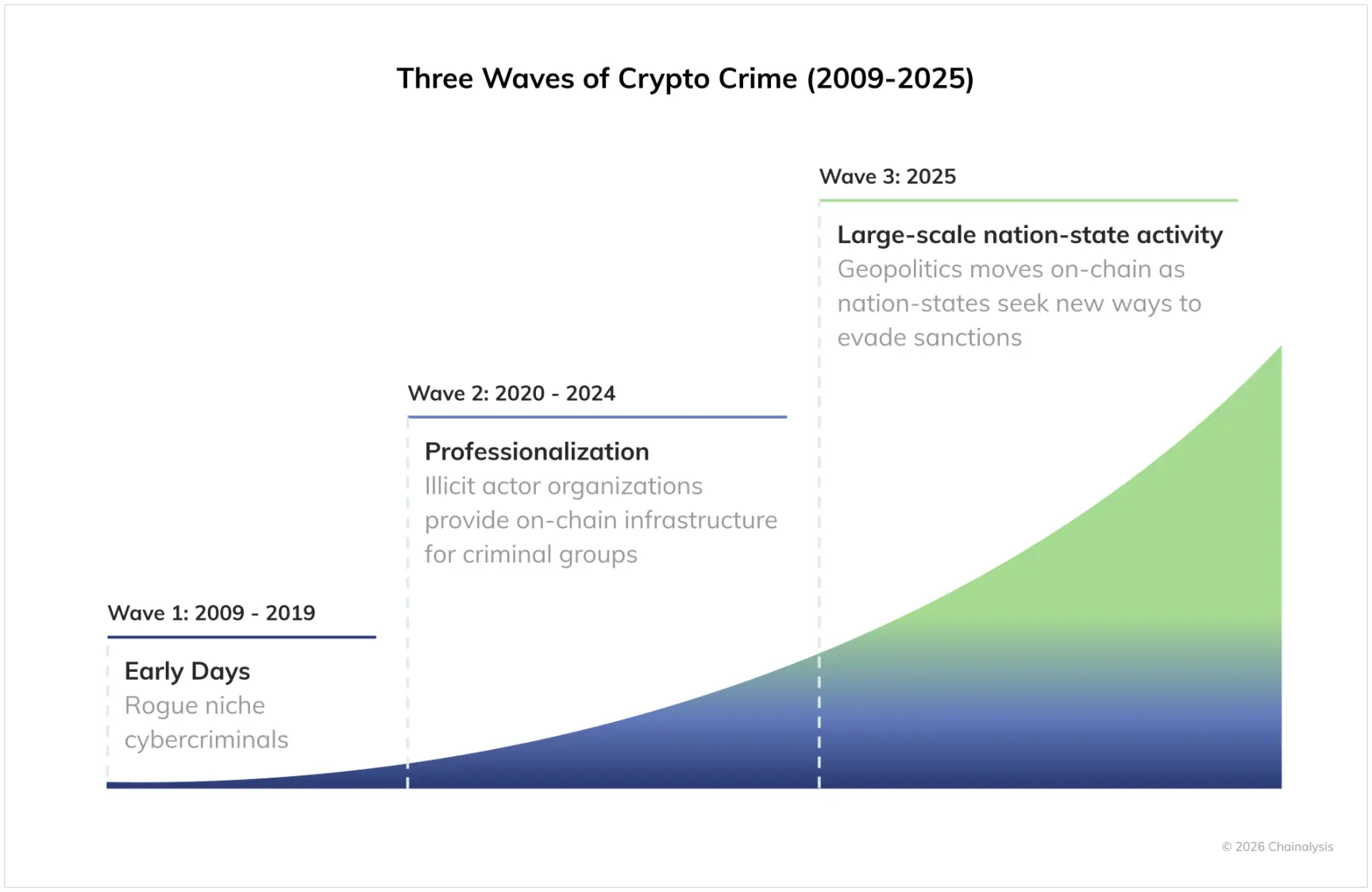
What are the specific on-chain manifestations of these developments and other industry changes? Next, we will analyze them by combining data with macro trends.
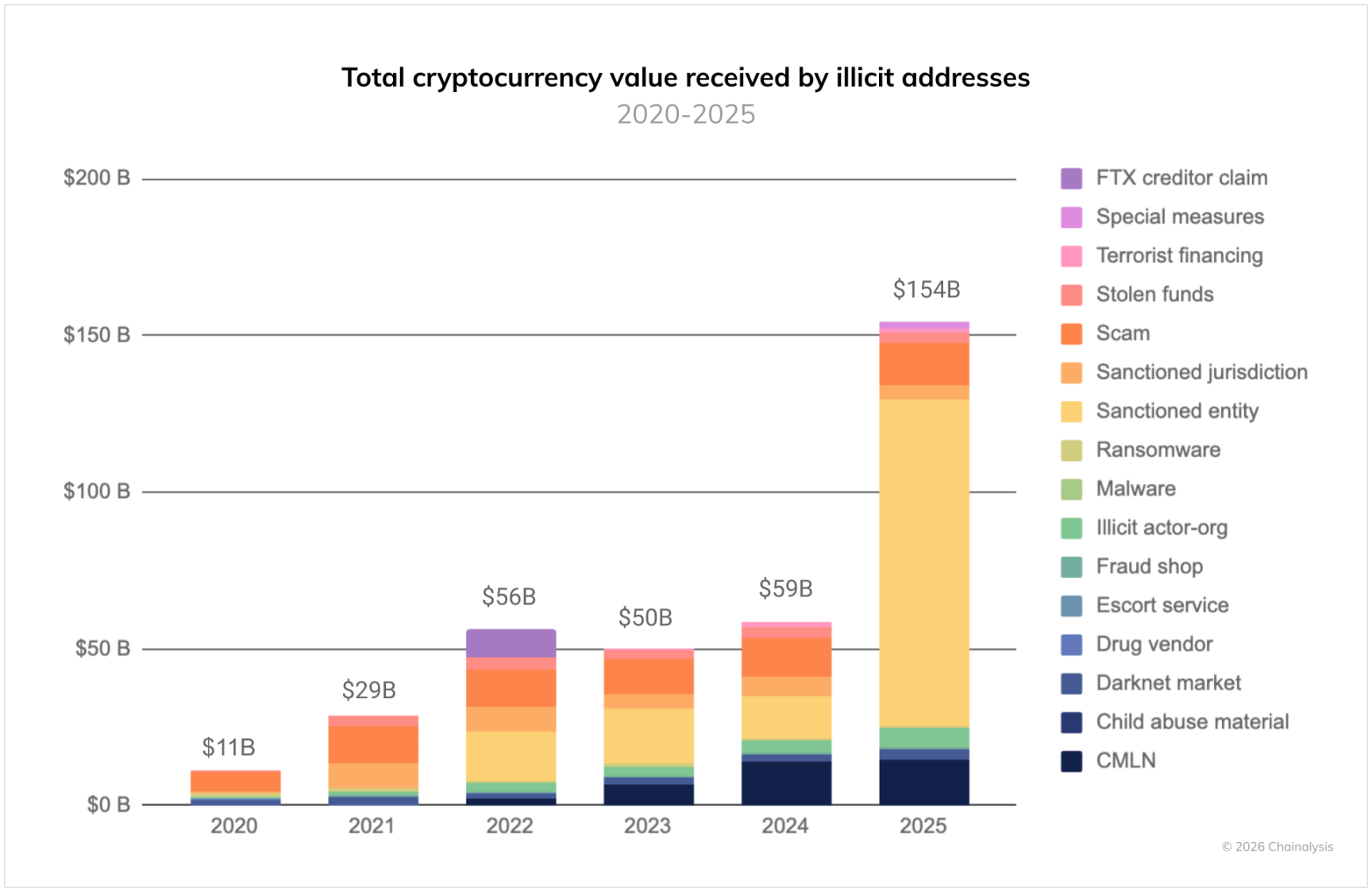
According to our monitoring data, the scale of funds flowing into illegal cryptocurrency addresses in 2025 reached at least $154 billion, a sharp increase of 162% year-on-year. This growth was primarily driven by a surge in fund inflows to sanctioned entities, which skyrocketed by 694% year-on-year. However, even after excluding the growth from sanctioned entities, 2025 still stands as a record year for cryptocurrency crime, as the scale of most illegal activity categories saw growth.

Nevertheless, the scale of these illegal transactions still pales in comparison to the overall cryptocurrency economy, where the main body of transactions remains legitimate. We estimate that although the proportion of illegal transactions in the total traceable cryptocurrency transaction volume in 2025 increased slightly compared to 2024, it remains below 1%.

As shown in the figure below, we also observed a continuous shift in the types of assets involved in cryptocurrency crimes.
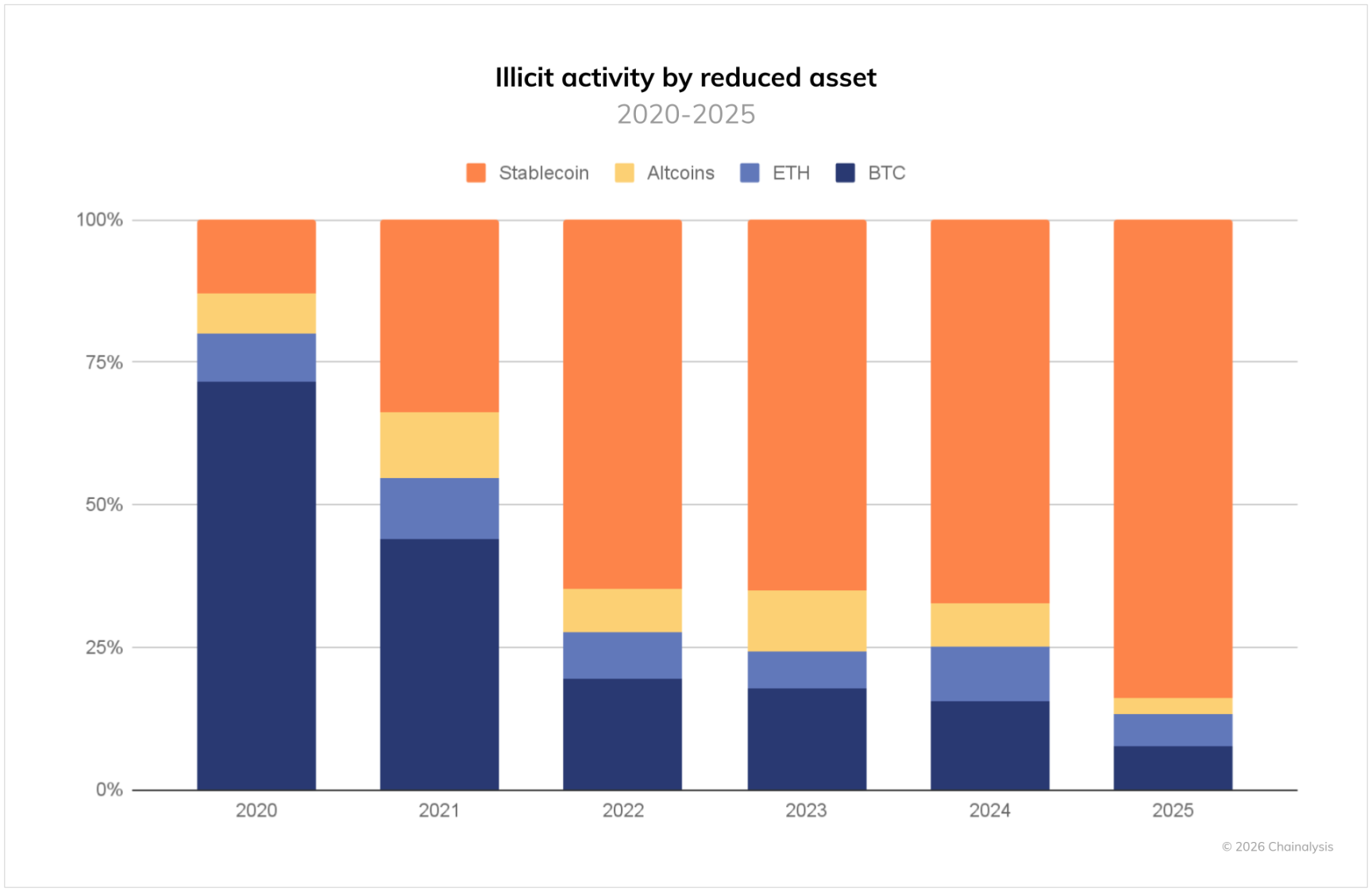
Over the past few years, stablecoins have gradually become the dominant asset in illegal transactions, currently accounting for 84% of the total illegal transaction volume. This trend aligns with the overall development characteristics of the cryptocurrency ecosystem: with advantages such as convenience for cross-border transfers, low volatility, and wide application scenarios, the share of stablecoins in the entire cryptocurrency transaction volume continues to expand.

The following sections will delve into the core trends that defined the 2025 cryptocurrency crime landscape, trends that will remain important to focus on in the future.

National-Level Threats Drive Transaction Volume: North Korean Thefts Hit Record High, Russia's A7A5 Token Facilitates Large-Scale Sanction Evasion

In 2025, stolen funds remained a major threat to the cryptocurrency ecosystem, with hacking groups linked to North Korea alone stealing $2 billion. This figure was primarily driven by several highly destructive large-scale hacking incidents, the most notable being the attack on the Bybit exchange in February. This incident involved nearly $1.5 billion, making it the largest digital asset theft in the history of cryptocurrency. Although North Korean hackers have long been a major force threatening the cryptocurrency ecosystem, the past year saw record highs both in the amount stolen and in the sophistication of their intrusion and money laundering methods.

Particularly noteworthy is that the scale of on-chain activities reached unprecedented levels in 2025. Russia introduced relevant legislation in 2024 to use cryptocurrency to evade sanctions, and this measure was formally implemented in February 2025. The country launched the ruble-backed token A7A5, which saw its transaction volume exceed $93.3 billion in less than a year since its launch.

Meanwhile, over the past few years, Iran's proxy networks have conducted money laundering, illegal oil trading, and bulk commodity procurement for weapons on-chain through verifiable wallet addresses that have been placed on sanctions lists, with a cumulative transaction volume exceeding $2 billion. Despite suffering multiple military strikes, terrorist groups supported by Iran, such as Hezbollah, Hamas, and the Houthis, continue to use cryptocurrency on an unprecedented scale.

In 2025, Chinese money laundering networks emerged as a dominant force in the illegal on-chain ecosystem. These organizations operate with sophisticated models, greatly promoting the diversification and professionalization of cryptocurrency crime, offering various specialized criminal services including "money laundering services." Building upon early illegal operation models like "Huiyin Guarantee," these networks have established full-service criminal enterprises, covering businesses in multiple areas such as fraud, scams, laundering proceeds from North Korean hacker thefts, sanction evasion, and terrorism financing.

Full-Stack Illegal Infrastructure Providers Fuel Malicious Cyber Activities

While governments increase their use of cryptocurrency, traditional cybercrime activities remain rampant: ransomware operators, child sexual abuse and cybercrime platforms, malware distributors, scammers, and illegal marketplaces still rely on vast support networks to maintain operations. Illicit actors and national governments are increasingly dependent on on-chain infrastructure providers that offer full-stack services, including domain registrars, secure and reliable hosting services, and other technical infrastructure that can be used to carry out malicious cyber activities.

These infrastructure providers have evolved into comprehensive infrastructure platforms capable of resisting platform takedowns, abuse complaints, and sanction enforcement. As the scale of these services continues to expand, they may become a key force driving economic crime and state-supported entities to expand the scope of malicious cyber activities.

Growing Correlation Between Cryptocurrency and Violent Crime

In the perception of many, cryptocurrency crime is still confined to the virtual world. The masterminds are merely anonymous figures hiding behind keyboards, not posing a threat in the real world. But in fact, the connection between on-chain activities and violent crime is deepening. Human trafficking gangs are using cryptocurrency for transactions more and more; at the same time, disturbingly, the number of violent coercion attack cases has risen significantly, where criminals use violent means to force victims to transfer crypto assets, and such assaults often occur during peak cryptocurrency price periods.

Looking ahead, collaboration between law enforcement agencies, regulatory bodies, and cryptocurrency companies will be key to addressing these complex, evolving, and interconnected threats. Although the proportion of illegal transactions in the legitimate cryptocurrency transaction volume remains limited, maintaining the integrity and security of the cryptocurrency ecosystem has never been more important.


Twitter:https://twitter.com/BitpushNewsCN

Bitpush TG Discussion Group:https://t.me/BitPushCommunity

Bitpush TG Subscription: https://t.me/bitpush

Original link:https://www.bitpush.news/articles/7601752

Related Questions

QWhat was the total value of illicit cryptocurrency transactions in 2025, and what was the primary driver of this growth?

AThe total value of illicit cryptocurrency transactions in 2025 reached at least $154 billion, a 162% year-over-year increase. This growth was primarily driven by a 694% surge in inflows to sanctioned entities.

QWhich asset has become the dominant currency for illicit transactions, and what percentage of the total illicit volume does it represent?

AStablecoins have become the dominant asset for illicit transactions, representing 84% of the total illicit transaction volume.

QWhich country's state-sponsored groups set a new record for cryptocurrency theft in 2025, and what was the most notable attack?

ANorth Korean hacking groups set a new high for cryptocurrency theft in 2025, stealing $2 billion. The most notable attack was the February hack of the Bybit exchange, which resulted in a loss of nearly $1.5 billion, making it the largest digital asset theft in cryptocurrency history.

QWhat new token did Russia launch in 2025 to facilitate large-scale sanctions evasion, and what was its trading volume?

ARussia launched the ruble-backed token A7A5 in 2025 to facilitate large-scale sanctions evasion. Its trading volume surpassed $93.3 billion in less than a year.

QAccording to the article, what is an emerging and concerning trend regarding the link between cryptocurrency and real-world crime?

AAn emerging and concerning trend is the increasing link between on-chain activity and violent crime. This includes human trafficking networks using crypto for transactions and a significant rise in violent coercion attacks, where victims are forced under duress to transfer crypto assets, often during periods of peak cryptocurrency prices.

Related Reads

380,000 Apps Exposed, 2,000+ Apps Leaked Secrets: AI Programming Turns 'Intranet' into Public Internet

Israeli cybersecurity firm RedAccess uncovered a severe data exposure trend linked to "vibe coding" or AI-powered software development tools. Their research found approximately 38,000 publicly accessible web applications built with platforms like Lovable, Base44, Netlify, and Replit. Of these, an estimated 2,000 apps exposed sensitive corporate and personal data, including medical records, financial information, internal strategic documents, and customer chat logs. In some cases, access even granted administrative privileges. The core issue stems from default privacy settings that make applications public by default, combined with a lack of built-in security controls (like authentication) in the AI-generated code. This allows employees without security expertise—"citizen developers"—to easily create and deploy applications that bypass standard corporate security reviews. The exposed apps, often indexed by search engines, are trivially discoverable. While some platform providers (Replit, Lovable, Wix/Base44) argue that security configuration is the user's responsibility and question the validity of some findings, security researchers confirm the widespread reality of such exposures. This pattern, also noted in prior studies, highlights a critical security gap as AI democratizes app creation, potentially leading to massive, unintentional data leaks.

marsbit9m ago

380,000 Apps Exposed, 2,000+ Apps Leaked Secrets: AI Programming Turns 'Intranet' into Public Internet

marsbit9m ago

Attracting Global Capital, Asia's New 'Super Cycle' Is Unfolding

Investors are turning to Asia as the next frontier for global equity growth, with a new "super cycle" unfolding across the region. Driven by the AI revolution, Asian markets, particularly South Korea, have seen significant rallies. According to Morgan Stanley analysis, the underlying drivers of Asia's industrial cycle are shifting from traditional sectors like real estate and manufacturing to massive investments in AI infrastructure, energy security and transition, and supply chain resilience. Fixed asset investment in Asia is projected to grow from around $11 trillion in 2025 to $16 trillion by 2030, with a 7% annual growth rate from 2026-2030. The AI wave is a primary catalyst, driving immense capital expenditure for chips, servers, data centers, and power systems. Asia is central to this hardware supply chain. In China, AI investment is focused on building a full-system domestic capability, with the local AI chip market potentially reaching $86 billion by 2030. Beyond AI, China's export story is expanding from EVs and batteries to robotics. The country already captures about half of new global industrial robot demand and over 90% of humanoid robot shipments. This growth phase mirrors the early stages of China's EV export boom. Simultaneously, energy security investments, spurred by AI's massive power needs, are rising, with China benefiting from its leadership in solar, batteries, and EVs. Regional defense spending is also increasing structurally, supporting demand for advanced manufacturing. The main beneficiaries are China, South Korea, and Japan, positioned in core supply chain areas. However, risks remain, including potential overcapacity, profit margin pressures from competition, persistent technological restrictions, geopolitical friction, and workforce displacement due to AI-driven automation. Market volatility is also expected to increase as investor expectations diverge on the realization of these capital investment and export themes.

marsbit9m ago

Attracting Global Capital, Asia's New 'Super Cycle' Is Unfolding

marsbit9m ago

Funding Weekly Report | 14 Public Funding Events, Kalshi Completes $10B New Funding Round at $220B Valuation Led by Coatue Management

Weekly Funding Roundup: 14 Deals and $10.49B+ in Total Funding, Led by Kalshi's $1B Round Last week (5.4-5.10) saw 14 notable funding events in the global blockchain ecosystem, raising over $10.49 billion in total. Key highlights include Kalshi, a prediction market platform, securing a $1 billion round led by Coatue Management, reaching a $22 billion valuation. The platform now boasts ~2 million MAUs and $178B in annualized trading volume. In DeFi, regulated on-chain reinsurer OnRe raised $5 million in Series A funding, and Bitcoin-backed credit protocol Saturn Credit completed a $2 million seed round. For Infrastructure & Tools, OpenTrade raised $17 million to expand its stablecoin yield infrastructure, and RWA platform Balcony secured $12.7 million to deploy its property settlement service in the US. Centralized Finance saw one deal: AI-driven trading platform Stockcoin.ai completed a seed round led by Amber Group. In the prediction market sector alongside Kalshi, AI-powered platform Elastics raised $2 million. Other notable deals include SC Ventures' strategic investment in crypto market maker GSR and Centrifuge securing a "seven-figure" investment from Coinbase to become a core RWA partner for Base. On the investor side, Haun Ventures raised a new $1 billion fund targeting crypto and AI, and Multi Investment raised ~$616 million to focus on blockchain and Web3 investments.

marsbit1h ago

Funding Weekly Report | 14 Public Funding Events, Kalshi Completes $10B New Funding Round at $220B Valuation Led by Coatue Management

marsbit1h ago

Trading

Spot
Futures
活动图片