a16z: Three Major AI Trends for 2026

marsbitPublished on 2026-01-12Last updated on 2026-01-12

Abstract

a16z: Three AI Trends for 2026 1. AI Takes on Substantial Research Tasks: AI models are evolving to handle complex, abstract instructions and assist in research, particularly in reasoning. They are beginning to solve difficult problems and foster a new "generalist" research style that focuses on connecting ideas and making inferences from hypothetical answers. This requires new "nested agent" workflows where models collaborate and refine each other's outputs, though better model interoperability and compensation methods (potentially via blockchain) are needed. 2. The Shift from KYC to KYA (Know Your Agent): The bottleneck in the agent economy is shifting from intelligence to identity verification. With non-human identities vastly outnumbering humans in finance, there's a critical need for a "Know Your Agent" infrastructure. Agents require cryptographically signed credentials to transact, linking them to their principals, constraints, and liabilities. 3. Solving the Open Web's "Invisible Tax": AI agents are disrupting the economic foundation of the open web by extracting data from ad-supported sites (the context layer) while bypassing their revenue models. This creates an "invisible tax" that threatens content creation. Solutions are needed to automatically reward content creators, moving from static licensing to real-time compensation systems using technologies like nanopayments and attribution standards, potentially blockchain-enabled.

Author:a16z crypto

Compiled by: Deep Tide TechFlow

This Year, AI Will Take on More Substantial Research Tasks

As a mathematical economist, back in January 2025, I struggled to get consumer-grade AI models to understand my workflow; however, by November 2025, I could give abstract instructions to AI models as I would to a PhD student... and sometimes they even returned novel and correct answers. Beyond my personal experience, AI is being more widely applied in research, especially in the field of reasoning. These models not only directly assist the discovery process but can also autonomously solve difficult problems like the Putnam exam (perhaps the world's most challenging university math test).

It's still uncertain in which areas this research assistance will be most helpful and how exactly it will be implemented. But I predict that this year, AI research will promote and reward a new style of "generalist" research: one that focuses more on conceptualizing the relationships between various ideas and can quickly infer from more hypothetical answers.

These answers may not be entirely accurate, but they can still guide research in the right direction (at least within a certain topological structure). Ironically, this is somewhat like harnessing the power of model "hallucination": when models are "smart enough," giving them abstract space to brainstorm may still produce some nonsensical results—but sometimes it leads to breakthrough discoveries, much like how humans can be most creative when not thinking linearly or following explicit directions.

Reasoning in this way requires a new style of AI workflow—not just simple "agent-to-agent" interactions, but a complex collaborative model of "nested agents." In this model, different layers of models assist researchers in evaluating the proposals of earlier models and gradually refining the essence. I already use this method to write papers, while others are using it for patent searches, inventing new forms of artistic works, and even (regrettably) discovering new smart contract attack methods.

However, operating these nested reasoning agent combinations for research still requires better interoperability between models and a way to identify and appropriately compensate each model's contributions—issues that blockchain technology may help solve.

—Scott Kominers(@skominers), a16z crypto research team member, Harvard Business School professor

From "Know Your Customer" (KYC) to "Know Your Agent" (KYA): The Shift in Identity Verification

The bottleneck in the agent economy is shifting from intelligence to identity verification. In financial services, the number of "non-human identities" now exceeds human employees by 96 times—yet these "identities" remain "ghosts" unable to access banking services.

The key missing infrastructure here is "Know Your Agent" (KYA). Just as humans need credit scores to obtain loans, agents need cryptographically signed credentials to conduct transactions—credentials link the agent to its principal, constraints, and liabilities. Until this infrastructure is established, merchants will continue to block these agents at the firewall.

The industry that built KYC infrastructure over the past decades now has only a few months to figure out how to implement KYA.

—Sean Neville(@psneville), Co-founder of Circle, Architect of USDC; CEO of Catena Labs

Solving the "Invisible Tax" on Open Networks: Economic Challenges in the AI Era

The rise of AI agents is imposing an "invisible tax" on open networks, fundamentally disrupting their economic foundation. This disruption stems from the growing mismatch between the internet's "context layer" and "execution layer": currently, AI agents extract data from ad-supported websites (the context layer) to provide convenience to users while systematically bypassing the revenue sources that support the content (such as ads and subscriptions).

To prevent the gradual decline of open networks (and protect the diverse content that fuels AI), we need to deploy technical and economic solutions on a large scale. These solutions may include next-generation sponsored content models, micro-attribution systems, or other new funding models. However, existing AI licensing agreements have proven financially unsustainable, often compensating content providers for only a fraction of the revenue lost due to AI traffic diversion.

The web urgently needs a new techno-economic model that allows value to flow automatically. The key shift in the coming year will be from static licensing models to compensation mechanisms based on real-time usage. This means testing and scaling systems—possibly leveraging blockchain-enabled nanopayments and complex attribution standards—to automatically reward every entity that contributes information to the successful completion of an AI agent's task.

—Liz Harkavy(@liz_harkavy), a16z crypto investment team

Related Questions

QWhat are the three major AI trends predicted by a16z for 2026?

A1. AI will undertake more substantive research tasks, enabling a new 'generalist' research style. 2. A shift from 'Know Your Customer' (KYC) to 'Know Your Agent' (KYA) for identity verification in the agent economy. 3. Addressing the 'invisible tax' on the open web's economy caused by AI agents, requiring new techno-economic models for real-time compensation.

QHow is AI expected to change the research process according to the article?

AAI is expected to push and reward a new 'generalist' research style that focuses on conceptualizing relationships between ideas and quickly inferring from hypothetical answers. It will involve 'nested agent' workflows where different layers of models assist researchers in evaluating early model proposals and refining them, sometimes leading to novel and correct answers or even breakthrough discoveries.

QWhat is the 'invisible tax' that AI agents are imposing on the open web?

AThe 'invisible tax' refers to the economic disruption caused by AI agents systematically extracting data from ad-supported websites (the context layer) to provide user convenience, while bypassing the revenue sources (like ads and subscriptions) that support the content. This undermines the financial foundation of the open web.

QWhat infrastructure is needed for the 'agent economy' as mentioned in the article?

AThe key missing infrastructure is 'Know Your Agent' (KYA), which involves cryptographically signed credentials that link agents to their principals, constraints, and liabilities. This is analogous to credit scores for humans and is necessary for agents to transact and gain access to services, preventing them from being blocked by firewalls.

QWhat solutions are proposed to address the economic challenges AI poses to the open web?

AProposed solutions include deploying next-generation sponsored content models, micro-attribution systems, or other novel funding models. There is a need to shift from static licensing agreements to real-time usage-based compensation mechanisms, potentially using blockchain-enabled nanopayments and sophisticated attribution standards to automatically reward entities that contribute information for AI agent tasks.

Related Reads

Circle CEO's Seoul Visit: No Korean Won Stablecoin Issuance, But Met All Major Korean Banks

Circle CEO Jeremy Allaire's recent activities in Seoul indicate a strategic shift for the company, moving away from issuing a Korean won-backed stablecoin and instead focusing on embedding itself as a key infrastructure provider within Korea’s financial and crypto ecosystem. Despite Korea accounting for nearly 30% of global crypto trading volume—with a market characterized by high retail participation and altcoin dominance—Circle has chosen not to compete for the role of stablecoin issuer. Instead, Allaire met with major Korean banks (including Shinhan, KB, and Woori), financial groups, leading exchanges (Upbit, Bithumb, Coinone), and tech firms like Kakao. This approach reflects a broader industry transition: the core of stablecoin competition is shifting from issuance rights to systemic positioning. With Korean regulators still debating whether banks or tech companies should issue stablecoins, Circle is avoiding regulatory uncertainty by strengthening its role as a service and technology partner. The company is deepening integration with trading platforms, building connections, and promoting stablecoin infrastructure. This positions Circle to benefit regardless of which entity eventually issues a won stablecoin. Allaire also noted the potential for a Chinese yuan stablecoin in the next 3–5 years, underscoring a regional trend of stablecoins becoming more regulated and integrated with traditional finance. Ultimately, Circle’s strategy highlights that future influence in the stablecoin market will belong not necessarily to the issuers, but to the foundational infrastructure layers that enable cross-system transactions.

marsbit5m ago

Circle CEO's Seoul Visit: No Korean Won Stablecoin Issuance, But Met All Major Korean Banks

marsbit5m ago

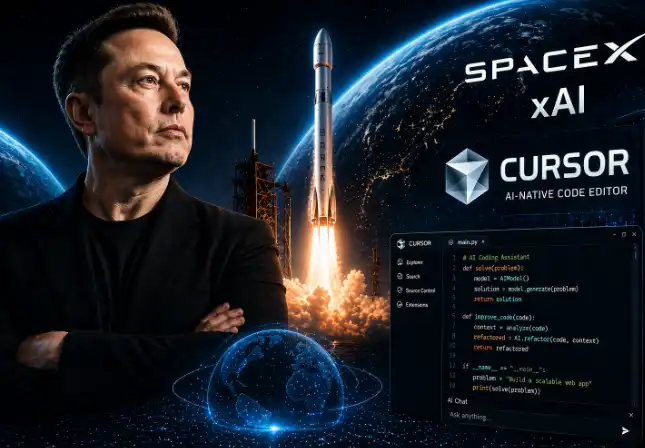
SpaceX Ties Up with Cursor: A High-Stakes AI Gambit of 'Lock First, Acquire Later'

SpaceX has secured an option to acquire AI programming company Cursor for $60 billion, with an alternative clause requiring a $10 billion collaboration fee if the acquisition does not proceed. This structure is not merely a potential acquisition but a strategic move to control core access points in the AI era. The deal is designed as a flexible, dual-path arrangement, allowing SpaceX to either fully acquire Cursor or maintain a binding partnership through high-cost collaboration. This "option-style" approach minimizes immediate regulatory and integration risks while ensuring long-term alignment between the two companies. At its core, the transaction exchanges critical AI-era resources: SpaceX provides its Colossus supercomputing cluster—one of the world’s most powerful AI training infrastructures—while Cursor contributes its AI-native developer environment and strong product adoption. This synergy connects compute power, models, and application layers, forming a closed-loop AI capability stack. Cursor, founded in 2022, has achieved rapid growth with over $1 billion in annual revenue and widespread enterprise adoption. Its value lies in transforming software development through AI agents capable of coding, debugging, and system design—positioning it as a gateway to future software production. For SpaceX, this move is part of a broader strategy to evolve from a aerospace company into an AI infrastructure empire, integrating xAI, supercomputing, and chip manufacturing. Controlling Cursor fills a gap in its developer tooling layer, strengthening its AI narrative ahead of a potential IPO. The deal reflects a shift in AI competition from model superiority to ecosystem and entry-point control. With programming tools as a key battleground, securing developer loyalty becomes crucial for dominating the software production landscape. Risks include questions around Cursor’s valuation, technical integration challenges, and potential regulatory scrutiny. Nevertheless, the deal underscores a strategic bet: controlling both compute and software development access may redefine power dynamics in the AI-driven future.

marsbit45m ago

SpaceX Ties Up with Cursor: A High-Stakes AI Gambit of 'Lock First, Acquire Later'

marsbit45m ago

Trading

Spot
Futures

Hot Articles

Discussions

Welcome to the HTX Community. Here, you can stay informed about the latest platform developments and gain access to professional market insights. Users' opinions on the price of AI (AI) are presented below.

活动图片