A Robotic Version of MicroStrategy Has Arrived! Can Ordinary People Invest in Giants in the Robotics Sector?

marsbitPublished on 2026-05-21Last updated on 2026-05-21

Abstract

Andrew Kang, a prominent former crypto investor, has shifted his focus to AI and robotics, taking on the role of CEO at RoboStrategy. This publicly traded closed-end fund, inspired by MicroStrategy's capital model, aims to give retail investors access to early-stage robotics investments, a sector traditionally dominated by institutional capital. RoboStrategy recently listed on NASDAQ under the ticker "BOT" and secured a $2 billion equity financing commitment. Kang, co-founder of Mechanism Capital, began investing in robotics two years ago, with a notable early investment in Figure AI. RoboStrategy's portfolio now includes several robotics companies across hardware and software. The fund differentiates itself through permanent capital, a team of industry experts, and strong marketing capabilities. Its core strategy, termed R.I.S.E., involves raising capital when its share price trades at a premium to Net Asset Value (NAV), investing in high-conviction private robotics companies, scaling those investments, and using the resulting NAV growth to attract further capital—creating a potential flywheel effect. However, risks include its current high share price premium over NAV, the subjective valuation and illiquidity of its private holdings, and the inherent volatility of a closed-end fund structure.

Author: Nancy, PANews

Andrew Kang, a star investor once active in the crypto market, is shifting his focus to the AI and robotics sectors. On May 20, Andrew Kang announced his official appointment as CEO of RoboStrategy, responsible for the company's strategic direction and investment portfolio management.

As an innovative fund inspired by the capital model of the crypto DAT company Strategy, RoboStrategy recently officially launched on Nasdaq and secured up to $20 billion in equity financing commitments, quickly drawing market attention.

From Crypto to Robotics, Already Invested in Star Companies Like Figure

RoboStrategy is a public closed-end fund focused on robotics and embodied AI, co-founded by Andrew Kang and Marc Weinstein in 2025. Its goal is to open up early-stage robotics investment opportunities, previously accessible only to a few institutional investors, to a broader base of ordinary investors.

Andrew Kang and Marc Weinstein are also co-founders of the crypto investment firm Mechanism Capital. Since its establishment in 2020, Mechanism Capital has invested in over a hundred crypto projects, including well-known protocols and platforms such as Arbitrum, Pendle, Near, Deribit, and 1inch. However, based on public information, Mechanism Capital has rarely disclosed new crypto investment activities since October 2025. Andrew Kang recently admitted that he has not been closely following the crypto market for the past few months.

In contrast, he has been dedicating more effort to the robotics field. According to Andrew Kang, he began researching the robotics industry two years ago, but at that time, most VCs advised against entering this sector. In the market environment back then, robotics companies generally faced fundraising difficulties. The industry lacked mature, large-scale success stories, and there were many doubts from the outside world regarding their commercialization paths, technology implementation capabilities, and potential market size.

In his view, however, the acceleration of embodied AI development will completely transform the entire industry. Humanoid robots are one of the few directions with the potential to go "from zero to a multi-trillion dollar market," similar to the developmental stage of Bitcoin in 2013, but with a larger long-term market space. Particularly as manufacturing, logistics, and service industries continue to face labor shortages, embodied AI and robotics technologies are accelerating their entry into real industrial scenarios.

Therefore, in February 2024, Andrew Kang completed his first significant investment in robotics, investing $19 million in Figure AI. Today, Figure AI has become one of the world's highest-valued humanoid robotics companies, with a latest valuation of $39 billion, compared to its pre-money valuation of approximately $2 billion in February 2024. (Related reading:The Entrepreneur from the Farm: After Building Flying Cars, Gambles on a $39 Billion Giant in the Robotics Sector)

However, Andrew Kang also realized that the future development of the robotics industry will heavily rely on massive long-term capital, which is difficult to sustain through individuals or traditional funds alone. Meanwhile, robotics startups also need a long-term capital platform that truly understands industry demands to help them secure continuous financing, industrial resources, and market recognition support. More importantly, current robotics innovation is mainly concentrated in the private market, making it difficult for most ordinary investors to participate.

Based on this, Andrew Kang co-founded RoboStrategy. Currently, RoboStrategy has invested in robotics companies including Figure AI, Apptronik, Dyna Robotics, Dexmate, Standard Bots, and Path Robotics, covering multiple areas from hardware and infrastructure to software, with an average investment size per round of approximately $7 million.

In Andrew Kang's view, compared to traditional VCs, RoboStrategy possesses several differentiated advantages. First, as a closed-end fund, its capital is permanent, free from the fund term limitations of traditional VCs, allowing it to adopt an extremely long-term perspective in deploying in the robotics and embodied AI industry. Second, the team brings together multiple seasoned professionals from the robotics industry, including long-time founders or operators, making it regarded by many startups as one of the "most professional and knowledgeable investment institutions in the robotics industry." Additionally, leveraging the team's strengths in digital marketing and social media, RoboStrategy not only has stronger fund distribution capabilities but is also more adept at expanding market influence and industry awareness, thereby helping its portfolio companies gain more attention, talent, and resources.

Launched on Nasdaq, Attempting to Replicate the Strategy Capital Flywheel

As the first closed-end fund specifically designed for public market investors, RoboStrategy officially began trading on Nasdaq on May 11, under the ticker symbol "BOT." As of now, the BOT stock price is around $28.2, having declined approximately 21.58% since listing.

Public information shows that RoboStrategy board member Jason Zhao purchased 400,000 shares of the company at $10 per share in October last year; subsequently, Andrew Kang also purchased 246,000 shares at the same price. Meanwhile, the investment advisory firm FP Strategies LLC continued to increase its holdings by 290,000 shares at $10 per share in April this year, currently holding a cumulative total of approximately 390,000 shares.

In terms of capital operation logic, RoboStrategy draws inspiration from Strategy's Bitcoin treasury model. The latter continuously issues stocks and convertible bonds in the public capital market to obtain low-cost funds for consistently increasing its Bitcoin holdings, leveraging stock price premiums to form a capital flywheel. This model has been emulated by numerous companies.

RoboStrategy attempts to replicate this logic in the robotics sector. The fund's core idea is to use three main financing instruments—CEF, PIPE, and ATM—to continuously raise funds when the fund's stock price trades at a premium relative to its Net Asset Value (NAV), then deploy that capital into high-growth private robotics and embodied AI companies, thereby constructing the R.I.S.E capital compound interest flywheel.
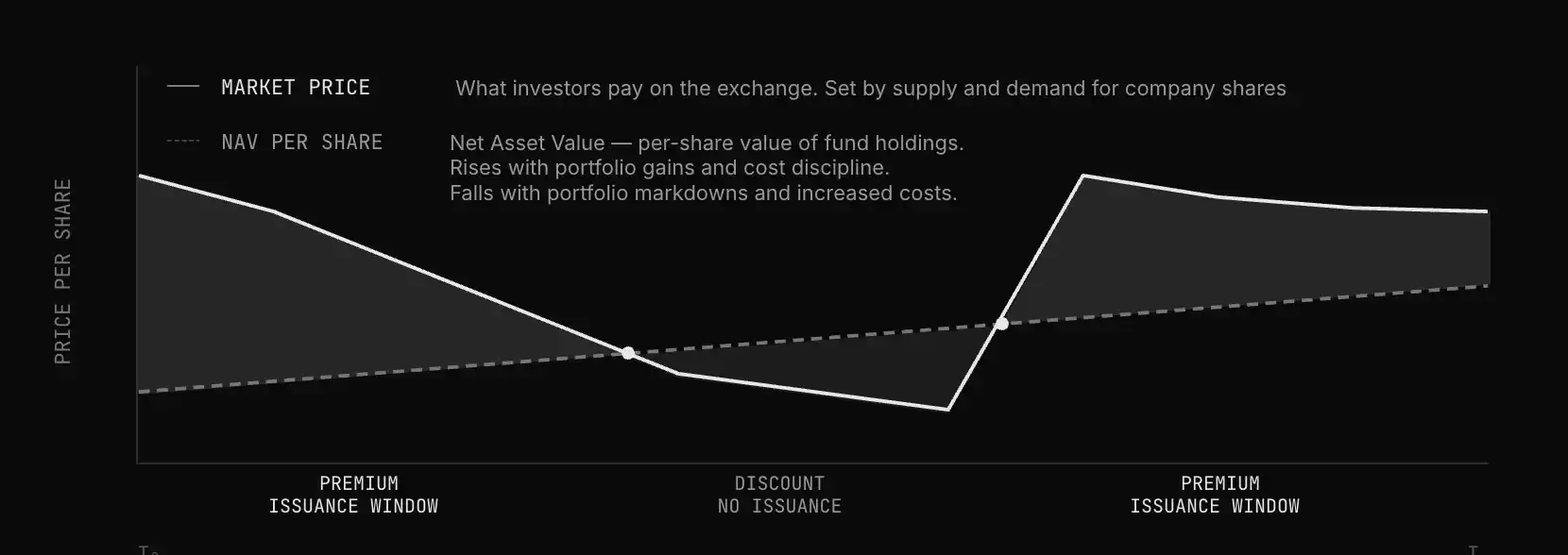
The so-called R.I.S.E represents four stages:

· Raise: Issue shares at a premium when the market price is above NAV to obtain more cash.

· Invest: Through deep due diligence, allocate funds to high-conviction robotics projects.

· Scale: Portfolio companies use the new capital to accelerate expansion, driving fund NAV growth.

· Expand: As NAV increases and industry enthusiasm rises, further attract investors and new capital, expanding the fund's scale and influence.

This model essentially utilizes the dual pricing mechanism of closed-end funds (market price vs. net asset value), aiming to achieve compound growth in NAV per share over the long term, while replacing the multi-layered fee structure of traditional private equity funds with a single public fund structure.

Earlier this month, RoboStrategy signed a $20 billion Committed Equity Financing (CEF) agreement with Roth Principal Investments, a subsidiary of Roth Capital Partners, to support its strategic growth plans.

However, just as most crypto DAT companies' treasury stories are difficult to sustain, RoboStrategy also faces risks that cannot be ignored.

As of March 31, 2026, RoboStrategy's NAV was approximately $7.31 per share, with total net assets around $145.5 million. Based on the current stock price, the market's valuation premium for it is close to 3 times. But a high premium does not mean discount risk will not materialize. Meanwhile, since the fund's investment targets are mostly unlisted robotics companies, their asset valuations themselves are highly subjective and have limited liquidity. Exit paths heavily rely on IPO or M&A markets. Once the capital environment cools down, these assets may face valuation adjustment pressure.

Furthermore, the closed-end fund structure means investors cannot redeem shares at any time like with open-end funds; they can only trade on the secondary market. Therefore, price volatility is often amplified.

Whether RoboStrategy can sustain its high premium and market enthusiasm in the long term remains to be verified by the market.


Related Questions

QWhat is RoboStrategy, and what is its primary goal?

ARoboStrategy is a publicly traded, closed-end fund focused on robotics and embodied AI. Its primary goal is to open up early-stage investment opportunities in the robotics sector, traditionally available only to institutional investors, to the broader public market.

QWho founded RoboStrategy, and what is Andrew Kang's background?

ARoboStrategy was co-founded by Andrew Kang and Marc Weinstein in 2025. Andrew Kang is a former star investor in the crypto market and a co-founder of the crypto investment firm Mechanism Capital. He has now shifted his focus to the AI and robotics sector and serves as the CEO of RoboStrategy.

QHow is RoboStrategy's capital model inspired by MicroStrategy?

ARoboStrategy's capital model is inspired by MicroStrategy's Bitcoin treasury strategy. It aims to create a capital flywheel by issuing shares at a premium when its market price exceeds its Net Asset Value (NAV). The raised capital is then invested in high-growth private robotics companies, aiming to increase the fund's NAV and attract more capital, similar to MicroStrategy's approach with Bitcoin.

QWhat does the R.I.S.E. strategy stand for in the context of RoboStrategy?

AR.I.S.E. is RoboStrategy's four-stage capital strategy: Raise (issuing shares at a premium), Invest (allocating capital to high-conviction robotics projects), Scale (helping portfolio companies grow to increase NAV), and Expand (attracting more investors and capital as NAV and industry interest rise).

QWhat are some key risks associated with investing in RoboStrategy?

AKey risks include: 1) Potential discount to NAV if market sentiment cools. 2) Subjective and illiquid valuations of its private company investments. 3) High dependence on favorable IPO or M&A markets for exits. 4) Price volatility amplified by its closed-end fund structure, which prevents direct redemptions, forcing trades on the secondary market.

Related Reads

Wang Chuan: When the neighbor Lao Wang earned thirty times from investing in memory storage stocks, how can you still avoid anxiety (6) - The trap of homogeneous products

The article, "Wang Chuan: How to Remain Unanxious After Neighbor Lao Wang's Thirty-Fold Gain on Storage Stocks (Part 6) - The Trap of Commoditized Goods," analyzes the cyclical and perilous nature of the data storage industry through historical and current case studies. It begins with the example of Iomega, whose Zip drives led to a stock surge of over 160x in the mid-1990s before collapsing over 97% from its peak due to competition from cheaper CD-R technology. This pattern is characteristic of storage, where products like DRAM are highly commoditized, leading to extreme price volatility. The sector has seen prices crash over 80% multiple times, with companies often facing bankruptcy. The core dynamic is "elastic demand facing heavy-asset, long-cycle, rigid supply." High prices attract new capacity, but the long lead time means supply eventually overshoots, causing sharp price corrections. The current AI-driven boom, exemplified by surging demand for High-Bandwidth Memory (HBM), has led to skyrocketing prices and profit margins for companies like SanDisk and Micron, despite relatively flat production volumes. However, the author warns this high-margin environment is self-defeating. The high profits are already triggering massive new capacity investments (hundreds of billions starting 2026), with supply expected to ramp up by late 2027. When supply catches up, total revenue and profits may fall even as more units are sold. Long-term supply agreements offer little protection, as buyers can find ways to renegotiate if market prices drop, similar to fragile political treaties. Key risks include economic downturns, cuts in AI spending, faster-than-expected capacity expansion (especially from Chinese firms), and innovations in chip/algorithm design that reduce memory needs. A critical trap is that at the cycle's peak, storage stocks often appear cheap with low P/E ratios, luring value investors just before an impending downturn where profits evaporate. The conclusion cautions that for commoditized goods like storage, high margins inevitably destroy themselves, and the current asymmetry favors downside risk over further upside. The neighbor's dream of easy wealth from storage stocks is portrayed as a precarious illusion.

链捕手17m ago

Wang Chuan: When the neighbor Lao Wang earned thirty times from investing in memory storage stocks, how can you still avoid anxiety (6) - The trap of homogeneous products

链捕手17m ago

AI PCs Are Here, Going Toe-to-Toe with 120B Models Locally! NVIDIA Redefines the "Personal AI Computer" Foundation with RTX Spark

NVIDIA has redefined the "AI PC" standard with the launch of the RTX Spark super chip at GTC 2026. Boasting 1 petaflop (1000 TOPS) of AI performance, it dwarfs the 45-50 TOPS NPUs in current AI PCs. The SoC features a Blackwell GPU, a 20-core Arm CPU co-designed with MediaTek, and crucially, up to 128GB of unified memory shared between CPU and GPU. This architectural shift enables local execution of 120-billion-parameter large language models with million-token context windows, a massive leap from the 9B-40B models typical on current consumer hardware. Beyond AI, use cases include 12K video editing and high-fps ray-traced gaming. Key to enterprise adoption is a security collaboration with Microsoft. Windows security is upgraded, and NVIDIA's OpenShell sandbox runtime is integrated to safely contain AI agent actions. Major software support comes from Adobe, which announced a deep,底层-level rewrite of Photoshop and Premiere to leverage the unified memory for up to 2x performance gains. Six OEMs, including Dell, HP, Lenovo, and Microsoft Surface, will release RTX Spark-based轻薄本 and compact desktops this fall. However, questions remain about real-world performance,功耗, thermal management in laptops, pricing, and the actual impact of the OpenShell sandbox. The RTX Spark represents a fundamental power shift in the PC industry, moving from an x86 CPU-centric model to a GPU-centric SoC platform, but its ultimate success hinges on the upcoming product rollouts and ecosystem validation.

marsbit31m ago

AI PCs Are Here, Going Toe-to-Toe with 120B Models Locally! NVIDIA Redefines the "Personal AI Computer" Foundation with RTX Spark

marsbit31m ago

Jensen Huang: Vera Rubin Full Mass Production, AI Agent a Key Focus, Challenging Intel to Target the Next-Generation AI PC Gateway

NVIDIA CEO Jensen Huang delivered the keynote speech at GTC Taipei 2026, announcing several major product launches and strategic directions. The company's Vera Rubin architecture is now in full-scale production, with OpenAI, Anthropic, and SpaceX among the first customers. NVIDIA highlighted AI Agent as a key future focus, introducing the Vera CPU designed for AI agents and the Vera BlueField-4 STX for secure, chip-level AI storage processing. A significant move involves challenging Intel in the PC market. NVIDIA, in collaboration with MediaTek, is developing the RTX SPARK PC chip (manufactured by TSMC) for Windows systems, set to launch this fall for laptops and desktops. This signals NVIDIA's push into the next-generation AI PC arena, aiming to provide a vertically integrated core computing platform for the entire Windows ecosystem, similar to Apple's approach. Other announcements include the new Nemotron 3 Ultra AI model and the NVIDIA DSX platform, described as a complete "playbook" for building AI factories, allowing performance simulation and validation before physical deployment. In automotive, the DRIVE Hyperion platform was positioned as a global robotaxi platform, with major Chinese automakers like BYD, Geely, Zeekr, Xiaomi, and Pony.ai already adopting or developing autonomous driving solutions based on it. The Alpamayo 2 super open inference model for robotaxis was also introduced. For robotics, NVIDIA unveiled the Isaac GR00T humanoid robot reference platform for academic research and a large open-source agent tools and skills suite for Physical AI. The company plans to collaborate with global humanoid robot manufacturers, including China's Unitree, whose H2 Plus robot served as the reference hardware for the GR00T platform demonstration.

marsbit58m ago

Jensen Huang: Vera Rubin Full Mass Production, AI Agent a Key Focus, Challenging Intel to Target the Next-Generation AI PC Gateway

marsbit58m ago

Running MoE on Mobile Phones? Meta Proposes MobileMoE, Speeding Up iPhone 16 Pro by 3.8x

Meta's MobileMoE, a mobile-optimized Mixture-of-Experts (MoE) language model architecture, enables efficient on-device large language model (LLM) inference for the first time on commercial smartphones. Designed for decoder-only Transformers, it replaces dense feed-forward layers with MoE layers. Key design choices include 8 experts with granularity g=8, top-4 routing, and a shared expert. The model undergoes a four-stage training process: pre-training, intermediate training, supervised fine-tuning, and quantization-aware training. Results show MobileMoE models, with similar memory footprint, achieve equal or higher average accuracy across 14 foundational benchmarks while using only 1/2 to 1/4 of the FLOPs compared to dense baselines. After INT4 quantization, they remain competitive. Notably, on an iPhone 16 Pro, MobileMoE-S demonstrates significant speedups: up to 3.8x faster in the prompt phase and 2.2-3.4x faster in per-token generation compared to a dense counterpart, with lower peak memory usage. While MobileMoE establishes a new Pareto frontier for on-device LLMs in accuracy-compute trade-offs, particularly excelling in code and math tasks, it currently lags behind models like Qwen3.5 2B in advanced instruction following and knowledge reasoning. Future work includes improving post-training techniques, exploring NPU deployment, and managing the runtime memory sensitivity of MoE models to varying inputs.

marsbit1h ago

Running MoE on Mobile Phones? Meta Proposes MobileMoE, Speeding Up iPhone 16 Pro by 3.8x

marsbit1h ago

Trading

Spot
Futures

Hot Articles

How to Buy PEOPLE

Welcome to HTX.com! We've made purchasing ConstitutionDAO (PEOPLE) simple and convenient. Follow our step-by-step guide to embark on your crypto journey.Step 1: Create Your HTX AccountUse your email or phone number to sign up for a free account on HTX. Experience a hassle-free registration journey and unlock all features.Get My AccountStep 2: Go to Buy Crypto and Choose Your Payment MethodCredit/Debit Card: Use your Visa or Mastercard to buy ConstitutionDAO (PEOPLE) instantly.Balance: Use funds from your HTX account balance to trade seamlessly.Third Parties: We've added popular payment methods such as Google Pay and Apple Pay to enhance convenience.P2P: Trade directly with other users on HTX.Over-the-Counter (OTC): We offer tailor-made services and competitive exchange rates for traders.Step 3: Store Your ConstitutionDAO (PEOPLE)After purchasing your ConstitutionDAO (PEOPLE), store it in your HTX account. Alternatively, you can send it elsewhere via blockchain transfer or use it to trade other cryptocurrencies.Step 4: Trade ConstitutionDAO (PEOPLE)Easily trade ConstitutionDAO (PEOPLE) on HTX's spot market. Simply access your account, select your trading pair, execute your trades, and monitor in real-time. We offer a user-friendly experience for both beginners and seasoned traders.

6.9k Total ViewsPublished 2024.03.29Updated 2025.03.21

How to Buy PEOPLE

Discussions

Welcome to the HTX Community. Here, you can stay informed about the latest platform developments and gain access to professional market insights. Users' opinions on the price of PEOPLE (PEOPLE) are presented below.

活动图片