A 140% Surge in Valuation in One Year: Who's Writing Checks for Defense AI?

marsbitPublished on 2026-03-27Last updated on 2026-03-27

Abstract

In March 2026, military AI company Shield AI raised $2 billion in funding round, led by Advent International and J.P. Morgan, with additional participation from Blackstone. Its valuation surged 140% to $12.7 billion within a year. Similarly, competitor Anduril is reportedly seeking new funding at a $60 billion valuation. Both companies have seen valuations grow fourfold in just over two years, far outpacing revenue growth, indicating that the market is pricing them based on future platform potential rather than current earnings. This trend is mirrored in the public market, where Palantir’s market cap grew to over $420 billion by late 2025. Shield AI’s products include the MQ-35 V-BAT drone and the upcoming X-BAT autonomous fighter, while its Hivemind AI engine was selected by the U.S. Air Force for the Collaborative Combat Aircraft (CCA) program. A key driver is the structural shift in defense tech funding. Private equity firms like Advent, KKR, and Carlyle are increasingly investing in long-term defense infrastructure, moving beyond traditional venture capital. In 2025, global defense tech VC deals reached $49.1 billion, with 87% going to late-stage companies. The U.S. Department of Defense’s FY2026 budget request allocated $13.4 billion specifically for AI and autonomous systems, with $9.4 billion dedicated to aerial drones—directly aligning with Shield AI and Anduril’s offerings. This clear demand signal, combined with institutional capital moving into defense infrast...

On March 26, military AI company Shield AI announced the completion of a $20 billion financing round, with its valuation soaring from $53 billion a year ago to $127 billion, a 140% increase. The lead investors were not Silicon Valley venture capitalists but global PE giant Advent International and J.P. Morgan's Security & Resilience Investment division, which jointly contributed $15 billion in equity financing. According to Bloomberg, Blackstone Group injected an additional $500 million in preferred stock and committed to a $250 million delayed draw term loan facility.

The $20 billion financing itself is not the key point; what matters is who is writing this check. This is a snapshot of the ongoing shift in the capital structure of defense technology.

Placing Shield AI and its competitor Anduril on the same timeline reveals a clear trend. In October 2023, Shield AI's Series F valuation was $2.7 billion. Anduril's Series E in late 2022 was valued at approximately $8.5 billion. By March 2026, Shield AI's valuation rose to $12.7 billion, while Anduril, according to TechBuzz AI, is seeking a new funding round at a $60 billion valuation. Both companies have achieved more than a fourfold increase in valuation in just over two years.
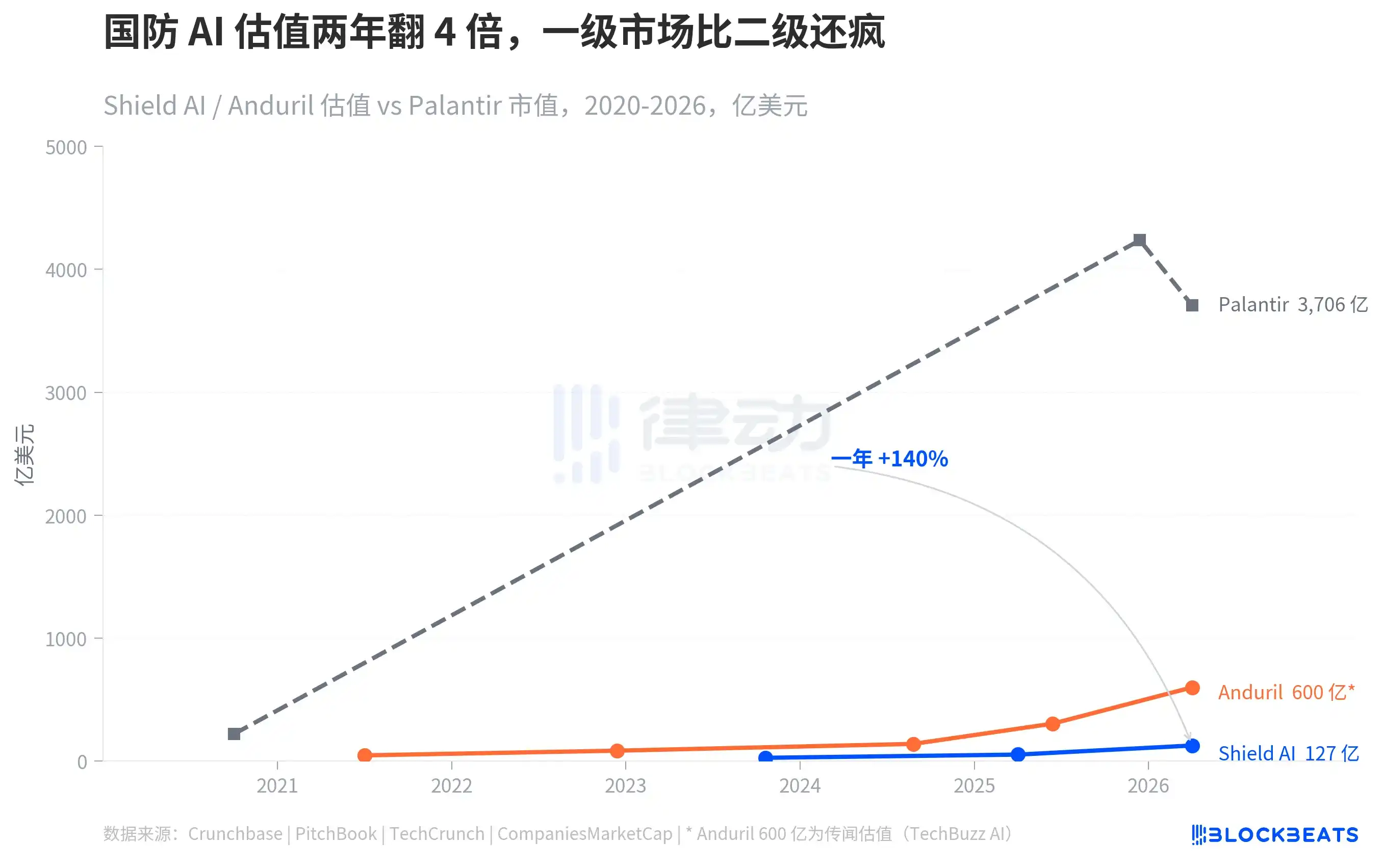
The slope of this curve steepened significantly in 2025. According to Sacra estimates, Anduril's revenue reached $2.1 billion in 2025, a 110% year-on-year increase, with a 2026 revenue forecast of $4.3 billion. Although Shield AI has not disclosed its revenue, Tracxn data shows its cumulative financing has exceeded $3 billion. The valuation growth far outpaces revenue growth, indicating that the pricing of defense AI companies has shifted to a "platform expectation" model—valuations are based not on current revenue but on their anticipated position in future military procurement systems.

As a reference, Palantir, the only publicly listed company in the AI defense sector, had a market capitalization of approximately $22 billion at its IPO in September 2020. According to its Q4 earnings report, Palantir's Q4 2025 revenue reached $1.41 billion, a 70% year-on-year increase, with full-year FY2026 revenue guidance of $7.18 billion to $7.20 billion. By the end of 2025, its market capitalization ballooned to over $420 billion. The primary and secondary markets are telling the same story, but the valuation curve in the primary market is even steeper than Palantir's post-IPO trajectory.

Valuation surges are not solely driven by capital expectations. Shield AI has tangible product lines: the MQ-35 V-BAT vertical takeoff and landing reconnaissance drone, already in service, and the next-generation autonomous fighter X-BAT, announced in October 2025. According to DroneXL, the X-BAT costs approximately $27 million per unit, less than a quarter of the price of an F-35, with a range of 2,300 miles. It requires no runway and can take off from a trailer, with mass production planned for 2029.

In February 2026, Shield AI's core AI engine, Hivemind, was selected by the U.S. Air Force to provide mission autonomy for Anduril's Fury drone (designated YFQ-44A) in the Collaborative Combat Aircraft (CCA) program. According to The Defense Post, flight demonstrations are expected in the coming months. In the same funding round, Shield AI also acquired flight simulation software company Aechelon Technology. Aechelon's simulation technology was previously used to train U.S. military pilots. Post-acquisition, Shield AI now controls three key components: training data generation, autonomous flight algorithms, and hardware platforms.

However, what truly steepened the valuation curve is the structural change in funding sources. Shield AI's earlier funding rounds were led by venture capitalists and strategic investors like Andreessen Horowitz and L3Harris. This round's lead investors were replaced by PE giants Advent International and J.P. Morgan, with Blackstone providing preferred stock and debt financing. This is not an isolated case.

According to Bisnow, the U.S. Army has awarded contracts for the construction of two military base data centers to Carlyle and KKR-affiliated CyrusOne, with each project valued at $2 billion and lease terms of up to 50 years. According to S&P Global data, in the first two and a half months of 2025 alone, global PE/VC deal volume in the aerospace and defense sector reached $4.27 billion, with 83% flowing into North America. PE giants are no longer making mere financial investments in the military sector; they are beginning to treat defense infrastructure as a long-term asset class.
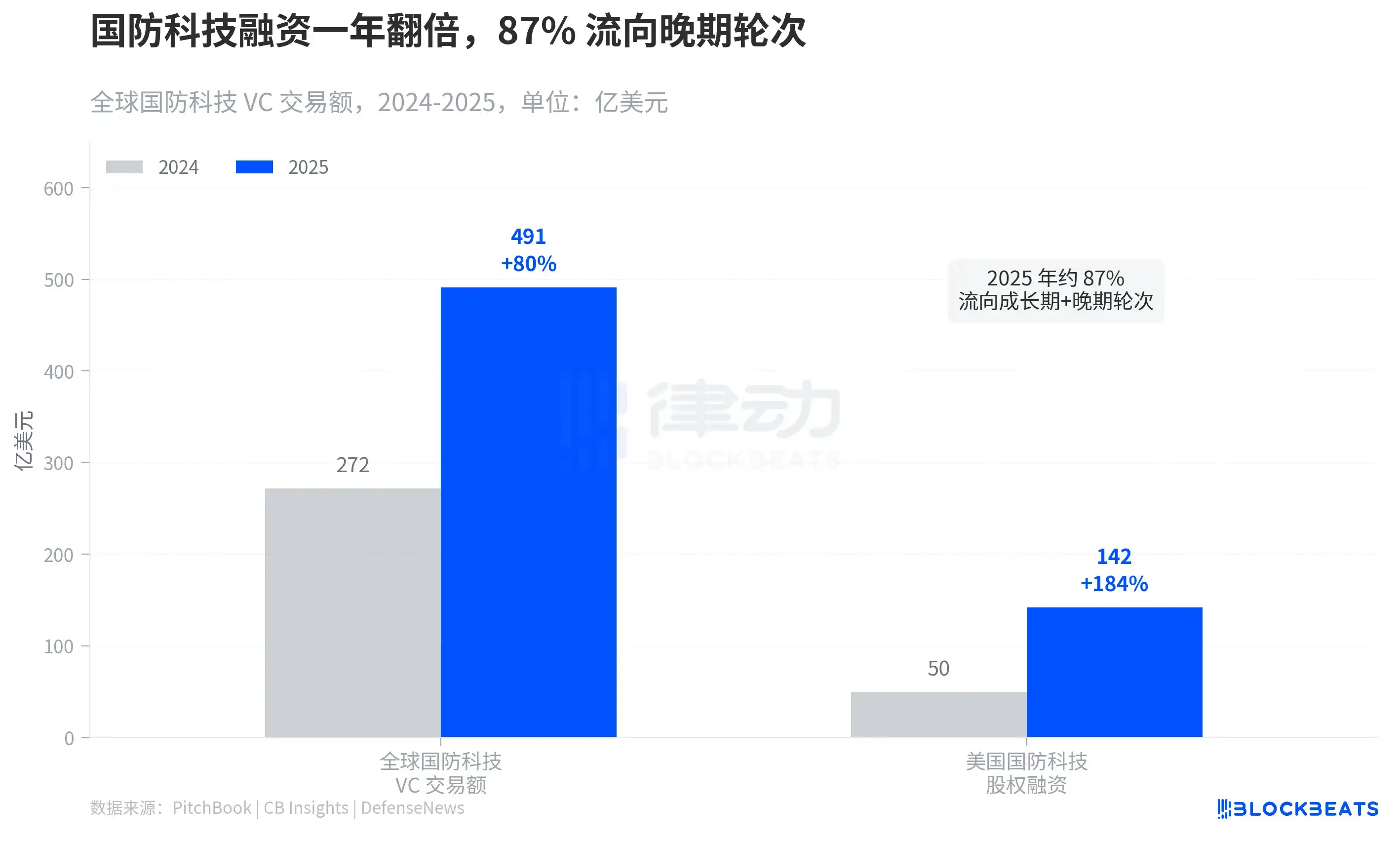
According to PitchBook data, global defense tech VC deal volume reached $49.1 billion in 2025, nearly doubling from $27.2 billion in 2024. According to DefenseNews, domestic defense tech equity financing in the U.S. surged from $5 billion in 2024 to $14.2 billion, an increase of almost threefold. Approximately 87% of this capital flowed into growth and late-stage rounds. Funds are no longer directed at experimental prototypes but toward companies ready for mass production and delivery. According to J.P. Morgan estimates, global defense tech has absorbed approximately $130 billion in venture capital since 2021.

Behind this influx of capital lies a clear buyer signal.

According to the U.S. Department of Defense's FY2026 budget request, the Pentagon has, for the first time, established an independent budget line for AI and autonomous systems, totaling $13.4 billion. Of this, aerial drones account for $9.4 billion, over 70%. Maritime autonomous platforms receive $1.7 billion, software and cross-domain integration $1.2 billion, and underwater systems $730 million. This is a dedicated AI allocation within the FY2026 total budget of $1.01 trillion. Previously, the U.S. military never categorized AI and autonomous systems as independent budget items.

In an AI strategy memorandum released in January 2026, Defense Secretary Pete Hegseth explicitly stated that the U.S. military would become an "AI-first combat force" and listed seven FY2026 priority projects, including autonomous drone swarms and AI-driven kill chain execution systems.
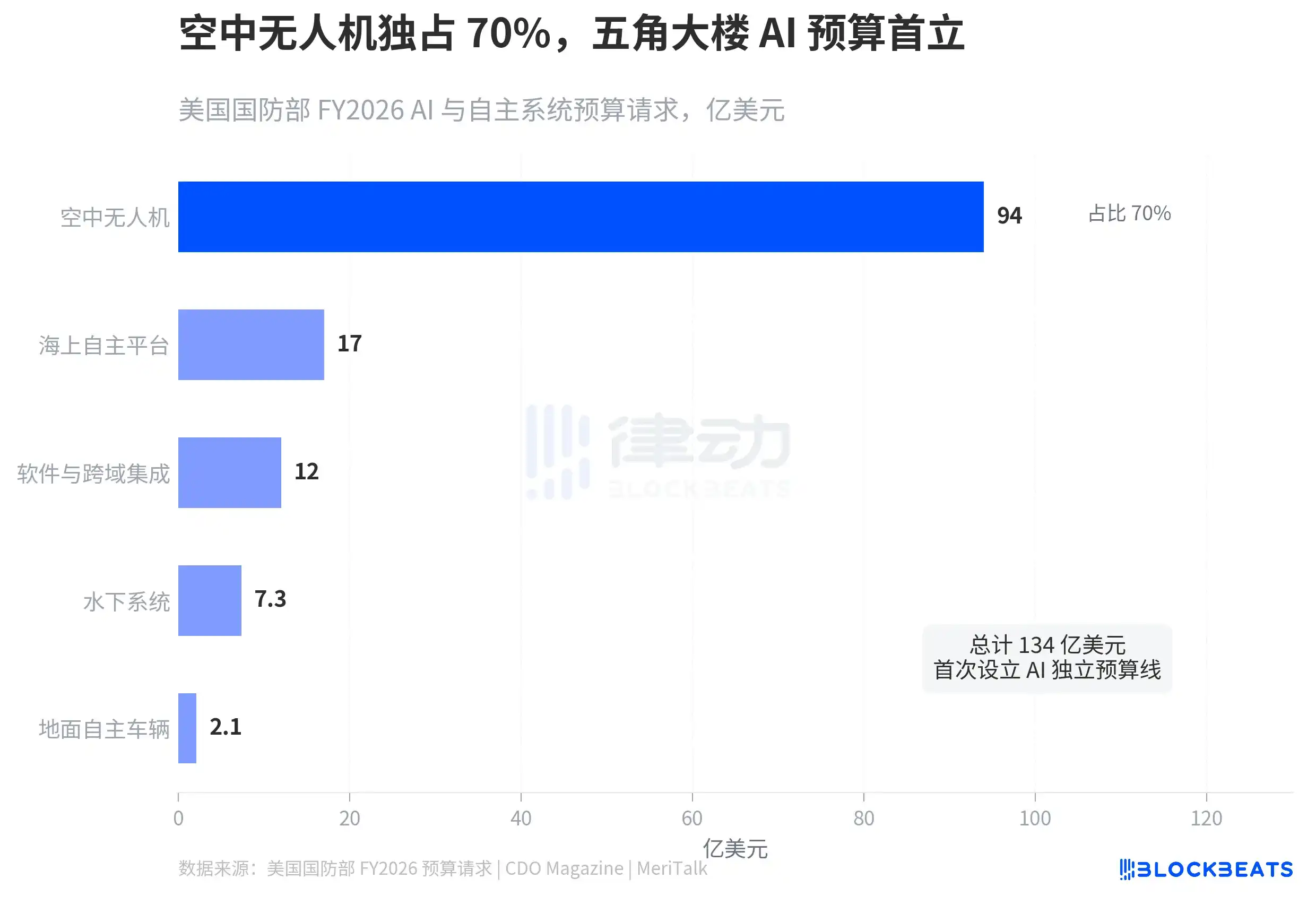
The $9.4 billion budget for aerial drones corresponds precisely to the core product lines of Shield AI and Anduril. The Pentagon is not "exploring" military applications of AI; it is procuring them. The U.S. Air Force's CCA program plans to make its first mass production decisions in FY2026.

When the Pentagon paves the way for AI drone orders with a $13.4 billion budget, and when PE firms treat military bases as infrastructure with 50-year leases, the capital logic of defense technology has shifted from venture capital-style bets on sectors to infrastructure-level asset allocation.


Related Questions

QWhat is the significance of the $2 billion funding round for Shield AI, and which major firms led this investment?

AThe $2 billion funding round for Shield AI, led by Advent International and J.P. Morgan's Security and Resilience investment arm, with additional participation from Blackstone, signifies a major shift in defense tech capital structure. It highlights that private equity giants, rather than traditional Silicon Valley VCs, are now leading large-scale investments, treating defense infrastructure as a long-term asset class.

QHow does the valuation growth of Shield AI and Anduril compare, and what does this trend indicate about market expectations?

AShield AI's valuation surged from $2.7 billion in October 2023 to $12.7 billion by March 2026, while Anduril grew from around $8.5 billion in late 2022 to reportedly seeking a $60 billion valuation in 2026. This rapid growth, outpacing revenue increases, indicates the market is pricing these companies based on 'platform expectations'—their future position in military procurement systems—rather than current revenues.

QWhat key products and capabilities does Shield AI possess that contributed to its valuation increase?

AShield AI's key products include the operational MQ-35 V-BAT vertical takeoff and landing reconnaissance drone and the next-generation autonomous fighter X-BAT, which is cost-effective and requires no runway. Its core AI engine, Hivemind, was selected by the U.S. Air Force for the Collaborative Combat Aircraft (CCA) program. The acquisition of Aechelon Technology also added simulation and training data generation capabilities.

QWhat role are private equity firms playing in the defense technology sector beyond venture capital?

APrivate equity firms like Advent, Blackstone, Carlyle, and KKR are moving beyond traditional financial investments. They are engaging in long-term infrastructure projects, such as building and leasing military data centers with 50-year contracts, and providing large-scale debt and equity financing. This reflects a shift towards treating defense assets as stable, long-term infrastructure investments.

QHow is the U.S. Department of Defense's budget and strategy driving investment in AI and autonomous systems?

AThe DoD's FY2026 budget request includes a dedicated $13.4 billion line for AI and autonomous systems, with $9.4 billion allocated specifically for aerial drones. This separate budget category, along with the Defense AI Strategy memo prioritizing AI-first warfare and autonomous systems, signals a clear procurement intent rather than mere exploration, creating a guaranteed demand that attracts massive capital inflows.

Related Reads

From Survival to Accelerated Growth: The Journey of Zcash's Three-Year Rise as Told by the Founder of ZODL

**From Survival to Accelerated Growth: Zcash Founder Details the 3-Year Rise** Three years ago, Zcash (ZEC) was a struggling pioneer in privacy technology, with a price near $30, low shielded supply (11%), and a community mired in governance disputes. Today, ZEC trades around $600, with over 31% of its supply (~$3B) in user-controlled shielded pools. This transformation resulted from breaking key constraints. First, **governance shackles were removed**. The old model guaranteed funding to two entities (ECC and ZF) regardless of performance, creating a monopoly. In 2024, ECC rejected further direct funding, forcing a change. The NU6 upgrade ended direct funding, allocating 8% to community grants and 12% to a protocol-controlled treasury for retroactive rewards, expiring in 2028 unless renewed by overwhelming consensus. The entities also relinquished their trademark-based veto power, freeing community governance. Second, the **product focus shifted** from pure cryptography to user growth. Previously, engineering excelled at privacy tech but failed to attract users. In early 2024, the team (later ZODL) pivoted to building products users wanted, like the Zodl wallet (default privacy, hardware support, cross-asset swaps). This drove shielded supply to grow over 400% in ZEC terms, with 86.5% of recent transactions being shielded, representing real user adoption. Third, the **narrative evolved** from the limiting "privacy coin" label to "unstoppable private money." This clarified Zcash's value proposition: a Bitcoin-like monetary policy with verifiable private payments via advanced cryptography. This structural narrative—protocol (Zcash), asset (ZEC), gateway (Zodl)—enabled broader exchange listings, institutional interest, and ETF filings. Finally, **organizational constraints were broken**. In early 2026, the ECC team left its non-profit structure after disputes over control, forming Zcash Open Development Lab (ZODL). ZODL raised $25M from top VCs (Paradigm, a16z, etc.), gaining the capital and agility of a startup to scale consumer products. Current metrics show strong momentum: social discussion volume for ZEC surged 15,245% in a year, with 81% positive sentiment. The focus is now on enhancing user experience (Zodl wallet), scalability (Tachyon project targeting Visa-level throughput with 25-second blocks), and post-quantum security (quantum-recoverable wallets coming soon). Zcash is positioned to become faster, more usable, scalable, and quantum-resistant.

marsbit9m ago

From Survival to Accelerated Growth: The Journey of Zcash's Three-Year Rise as Told by the Founder of ZODL

marsbit9m ago

Five Counterparty Risk Architectures: A Settlement-Layer Methodology for Classifying TradFi Models in Crypto Exchanges

**Summary:** This companion piece reframes the five TradFi-on-crypto exchange architectures, previously classified by "architectural fingerprint," through the lens of counterparty risk. The core question is: whose balance sheet bears the loss first in a stress scenario, and has it historically done so? Each of the five models corresponds to a distinct risk holder with its own documented failure modes. * **Model 1 (Stablecoin-Settled CEX Perpetuals):** Risk is held by the stablecoin issuer (e.g., reserve composition, bank connectivity) and the CEX's own book. History includes Tether's banking disconnections (2017) and reserve misrepresentations (CFTC 2021 Order). * **Model 2 (CFD Brokers):** Risk resides on the broker's balance sheet (B-book model). Regulatory differences (e.g., ESMA's mandatory negative balance protection vs. Mauritius FSC's lack thereof) define loss allocation rules, as seen in the 2015 SNB event (Alpari UK insolvency). * **Model 3 (Off-Chain Custody & Transfer Agent Chain):** Risk lies with the off-chain custodian/platform. User asset recovery depends on Terms of Use and corporate structure, exemplified by the Celsius bankruptcy ruling (2023) where Earn Account assets were deemed property of the estate. * **Model 4 (DEX Perpetual Protocols):** No single balance sheet bears risk. Loss absorption relies on a protocol's insurance fund and Auto-Deleveraging (ADL) mechanism, as demonstrated in the GMX V1 (2022) and dYdX v3 YFI (2023) incidents. * **Model 5 (Regulated CCP - DCM-DCO-FCM):** The most institutionalized model concentrates risk in the Central Counterparty (CCP). However, history shows CCPs can employ non-standard tools under extreme stress, such as mass trade cancellation (LME Nickel, 2022) or enabling negative price settlements (CME WTI, 2020). The report argues that regulatory choices and counterparty risk structures are co-extensive, not in an upstream-downstream relationship. It concludes with five separate observation checklists (not predictions) for monitoring the structural vulnerabilities of each risk model.

marsbit26m ago

Five Counterparty Risk Architectures: A Settlement-Layer Methodology for Classifying TradFi Models in Crypto Exchanges

marsbit26m ago

Trading

Spot
Futures

Hot Articles

Discussions

Welcome to the HTX Community. Here, you can stay informed about the latest platform developments and gain access to professional market insights. Users' opinions on the price of AI (AI) are presented below.

活动图片














