A $117 Million XRP Deal Just Happened, And No One Knows Who Did It

bitcoinistPublished on 2026-02-20Last updated on 2026-02-20

Abstract

A staggering $117 million worth of XRP (81 million tokens) was transferred between two unidentified wallets on the Ripple blockchain, drawing significant attention due to its scale and anonymity. Crypto analyst Ripple Bull Winkle shared on-chain data confirming the transaction but noted that the identities of the sender and receiver remain unknown. The lack of exchange involvement and wallet labels has led to speculation that a whale may be accumulating XRP ahead of a potential market shift or acting on insider information. The transfer occurred amid a broader decline in XRP’s price, which has fallen from 2025 highs above $3 to under $1.50. Market analyst Crypto Tony described the current trend as "most certainly bearish," suggesting further downside toward $1.38. Commenters are divided on whether the move signals upcoming selling or is merely a routine operational transfer.

A staggering $117 million worth of XRP has just shifted hands on the Ripple blockchain in a transaction that has left even seasoned crypto watchers wondering about the wallets involved. According to data publicly shared by crypto analyst Ripple Bull Winkle, on-chain records include timestamps, exact amounts, hashes, and transaction fees, but nothing about the identities of the sender or receiver.

Analyst Reveals Under-The-Radar XRP Transfer

A massive 81 million XRP, valued at roughly $117 million, was transferred on the Ripple network, and the identities behind it remain unknown. Ripple Bull Winkle revealed the move in a post on X, sharing screenshots of on-chain data from Whale Alert showing millions of the token shifting between two crypto wallets with no labels, no exchange involvement, and no public trace.

Notably, the large-scale transfer took place on Tuesday, February 17, drawing the crypto community’s attention for its sheer scale and anonymity. According to Ripple Bull Winkle, transactions of this size never happen by accident. He suggested that the movement was deliberate, hinting at strategic positioning rather than a routine transfer.
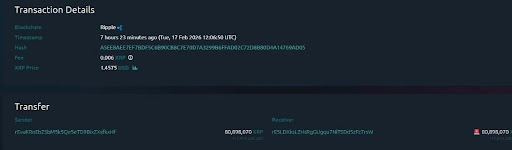
Source: Chart from Ripple Bull Winkle on X

The analyst also noted that the lack of identifiable wallets also fuels speculation that a whale may be accumulating XRP ahead of an event or market shift, though nothing is certain yet. He further remarked that “someone knows something,” implying that insiders or large holders may be acting on information not yet visible to the broader crypto market.

Interestingly, Ripple’s blockchain logs confirm the transfer and provide the wallet addresses involved, but reveal nothing about who orchestrated the substantial transfer. The timing of the transaction amid the broader decline in the XRP price adds another layer of intrigue. Notably, the altcoin has been in a pronounced downtrend for months, dropping from 2025 highs above $3 to under $1.5 at the time of writing. This steep decline has been driven by a combination of market factors, including sell-side pressure.

Commenters on Ripple Bull Winkle’s post have speculated that the 81 million XRP transfer could signal upcoming selling. At the same time, they also caution that the move may have no deeper significance and could simply be a wallet-to-wallet transfer for security or operational purposes.

The Trend Remains Largely Bearish

In a more price-focused analysis, market analyst Crypto Tony stated that XRP’s current trend is “most certainly bearish.” This assessment comes as the cryptocurrency continues to break key support zones and trade below former resistance levels.

Crypto Tony indicated that the altcoin’s price could continue its downtrend, potentially declining further toward $1.38. At its current price of 1.42, this would represent a significant correction of approximately 2.8%. Notably, the analyst has highlighted a resistance level above $1.5 on his accompanying chart, suggesting XRP could revisit this area if it regains bullish momentum.

XRP trading at $1.41 on the 1D chart | Source: XRPUSDT on Tradingview.com

Related Questions

QWhat was the total value of the XRP transaction that occurred on the Ripple blockchain, as mentioned in the article?

AThe total value of the XRP transaction was $117 million.

QAccording to the article, which crypto analyst first revealed and shared on-chain data about the large XRP transfer?

AThe crypto analyst Ripple Bull Winkle first revealed and shared the on-chain data about the transfer in a post on X.

QWhat reason did Ripple Bull Winkle suggest for the large, anonymous transfer of 81 million XRP?

ARipple Bull Winkle suggested the movement was deliberate, hinting at strategic positioning, and that a whale may be accumulating XRP ahead of an event or market shift.

QWhat is the current bearish price target for XRP mentioned by market analyst Crypto Tony?

AMarket analyst Crypto Tony indicated that XRP's price could continue its downtrend, potentially declining further toward $1.38.

QWhat key piece of information is missing from the on-chain data regarding this large XRP transaction?

AThe on-chain data is missing the identities of the sender and receiver; the wallets involved have no labels and the transfer had no exchange involvement.

Related Reads

The Value Distribution of Stablecoins

**Summary: The Value Distribution of Stablecoins** The article argues that stablecoins are evolving from mere trading tools into broader channels for dollar access. It divides the stablecoin ecosystem into four layers to analyze how value is distributed: 1. **Issuance Layer:** Mints stablecoins, holds reserve assets, and captures the spread between reserve yield and user costs (e.g., Tether, Circle). This layer currently earns the largest profit margin. 2. **Infrastructure Layer:** Connects stablecoins to the traditional financial system, handling fiat on/off-ramps, banking integration, compliance (KYC/AML), and asset management (e.g., Bridge, BVNK). This is the "unglamorous" but critical work, building the essential bridges between crypto and real-world finance. 3. **Acquiring/Distribution Layer:** Integrates stablecoins into merchant systems, manages payment flows, and provides enterprise financial software (e.g., Stripe, Coinbase). They act as the access point for businesses. 4. **Application Layer:** The end-users and businesses that ultimately use stablecoins for payments, settlements, or as a store of value. They benefit from convenience but have little pricing power. The core thesis is that while the issuance layer currently dominates profits, the often-overlooked **infrastructure layer holds significant long-term potential**. The real challenge and barrier to mass adoption is not the on-chain transfer of stablecoins (which is simple), but the complex "last mile" integration into existing business workflows, banking systems, and regulatory frameworks across different countries. Companies in this layer are currently in a "land grab" phase, investing heavily to build networks, secure bank partnerships, and establish compliance pathways. While their position is currently pressured by the profitable issuers above and distribution platforms below, the article suggests that if stablecoins become a default financial rail for businesses, the infrastructure providers who have done the hard work of integration will ultimately gain strong pricing power and become entrenched, essential players.

marsbit3h ago

The Value Distribution of Stablecoins

marsbit3h ago

The Value Distribution of Stablecoins

The Value Distribution of Stablecoins The article argues that stablecoins are evolving from a mere trading tool into a broad "dollar channel." It analyzes the industry's value chain through four layers: 1. **Issuance Layer (e.g., Tether, Circle):** The top layer that mints stablecoins, holds reserve assets, and captures the thickest interest rate spread. 2. **Infrastructure Layer (e.g., Bridge, BVNK):** Connects stablecoins to the traditional financial system, handling critical but complex "dirty work" like fiat on/off-ramps, banking integration, compliance (KYC/AML), and cross-border settlement. 3. **Acquiring/Distribution Layer (e.g., Stripe, Coinbase):** Embeds stablecoins into merchant systems, manages payment flows, and integrates with enterprise software. 4. **Application Layer:** End-users and businesses that ultimately use stablecoins for payments, settlement, or storing value. The author posits that while the issuance layer currently captures the most profit, the most overlooked and potentially critical layer is infrastructure. The core challenge for stablecoin adoption isn't the on-chain transfer (which is simple), but bridging the gap between blockchain and the real-world financial system. This involves solving practical problems for businesses: fiat conversion, reconciliation, tax handling, and user onboarding. Infrastructure companies are currently in a difficult "land-grab" phase—building networks, securing banking relationships, and achieving compliance country-by-country. They face pressure from both the profitable issuance layer above and distribution platforms below. However, the author suggests this layer is building a crucial moat. Once stablecoins become a default business rail, the infrastructure players who have done the hard work of integration may gain significant, durable value and pricing power.

链捕手3h ago

The Value Distribution of Stablecoins

链捕手3h ago

How to Do Research Well: Deliberately Practice the Real Skills That Matter

No one truly teaches you how to do research. You're often given a desk, a pre-selected problem, and vague instructions to "create something new." Consequently, many people reverse-engineer the job based on visible outputs—papers, posts, announcements—learning only how to *appear* like a researcher rather than how to *become* one. True research capability is built from stacking small, trainable skills, nearly all of which can be developed through deliberate practice. **Pick Your Own Problem:** Most researchers absorb problems from advisors or trends, lacking the underlying reasoning. Choosing a problem you genuinely care about, as John Schulman advises, leads to original work. Develop "taste" like a muscle: predict experiment outcomes, guess paper results from methods, and track which findings remain important over time. **Upgrade Your Inputs:** Relying on shared reading lists (arXiv hot lists, filtered group chats) leads to unoriginal conclusions. Undervalued old literature often holds crucial insights (e.g., MoE, LSTM, backpropagation). Richard Sutton's "The Bitter Lesson" or Claude Shannon's 1952 talk on creative thinking are more predictive than lengthy modern surveys. Breadth matters as much as depth: draw from neuroscience, mechanism design, hardware knowledge, and honest statistics. Read papers directly, especially appendices and limitations sections. **Write Everything Down:** As Paul Graham noted, writing exposes flaws in seemingly mature ideas. Writing is the cheapest defense against self-deception. Following Feynman's principle, Darwin programmatically wrote down facts contradicting his theory to combat memory bias. Maintain a detailed log of hypotheses, setups, predictions, results, and updated understandings. Reviewing past logs fosters essential humility.

marsbit6h ago

How to Do Research Well: Deliberately Practice the Real Skills That Matter

marsbit6h ago

Trading

Spot
Futures

Hot Articles

How to Buy ONE

Welcome to HTX.com! We've made purchasing Harmony (ONE) simple and convenient. Follow our step-by-step guide to embark on your crypto journey.Step 1: Create Your HTX AccountUse your email or phone number to sign up for a free account on HTX. Experience a hassle-free registration journey and unlock all features.Get My AccountStep 2: Go to Buy Crypto and Choose Your Payment MethodCredit/Debit Card: Use your Visa or Mastercard to buy Harmony (ONE) instantly.Balance: Use funds from your HTX account balance to trade seamlessly.Third Parties: We've added popular payment methods such as Google Pay and Apple Pay to enhance convenience.P2P: Trade directly with other users on HTX.Over-the-Counter (OTC): We offer tailor-made services and competitive exchange rates for traders.Step 3: Store Your Harmony (ONE)After purchasing your Harmony (ONE), store it in your HTX account. Alternatively, you can send it elsewhere via blockchain transfer or use it to trade other cryptocurrencies.Step 4: Trade Harmony (ONE)Easily trade Harmony (ONE) on HTX's spot market. Simply access your account, select your trading pair, execute your trades, and monitor in real-time. We offer a user-friendly experience for both beginners and seasoned traders.

3.9k Total ViewsPublished 2024.03.29Updated 2026.06.02

How to Buy ONE

Discussions

Welcome to the HTX Community. Here, you can stay informed about the latest platform developments and gain access to professional market insights. Users' opinions on the price of ONE (ONE) are presented below.

活动图片