Overnight, GPT-5.6 Sol Was Accelerated 14x by OpenAI

marsbitPublished on 2026-08-14Last updated on 2026-08-14

Abstract

OpenAI, in collaboration with chipmaker Cerebras, has unveiled a limited preview of an "Ultrafast Mode" for its flagship GPT-5.6 Sol model. This new service tier reportedly achieves output speeds of up to 750 tokens per second—a 14x increase over the standard mode's baseline of ~53 tokens/s—without any loss in quality. Key to this acceleration is Cerebras's wafer-scale architecture (WSE-3), which houses model parameters entirely in on-chip SRAM to eliminate the memory bandwidth bottlenecks typical of traditional GPU clusters. In benchmark testing on the challenging "Humanity's Last Exam" (HLE), GPT-5.6 Sol in Ultrafast Mode answered all 2500 questions in 11 hours and 11 minutes, compared to over 78 hours for a competitor model, while maintaining similar accuracy. The speed boost also translated to a 5.6x faster end-to-end performance on the GDP-Val benchmark for economically valuable knowledge work. OpenAI highlights several potential applications for such rapid inference, including real-time event response and reliability analysis, dynamic financial research and security, complex customer support, interactive shopping assistance, and accelerated research and experimentation workflows that enable multiple iterative cycles within a single workday. This advancement may allow users to deploy the highest-tier models for tasks previously requiring slower secondary models, significantly compressing multi-step agent workflows from hours to minutes.

Is AI starting to leverage information asymmetry?

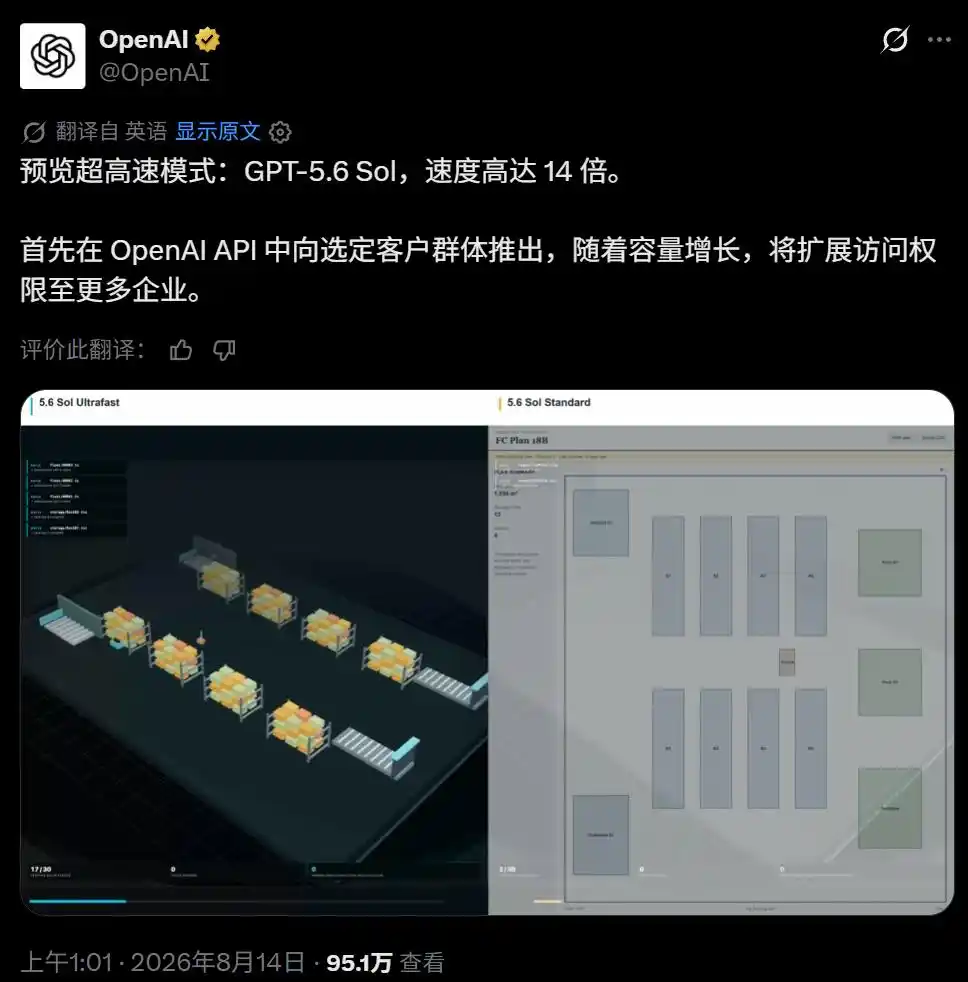
In the early hours of August 14th, OpenAI, in partnership with AI chip manufacturer Cerebras, officially previewed a new service tier called "Ultrafast Mode" for its flagship model GPT-5.6 Sol.

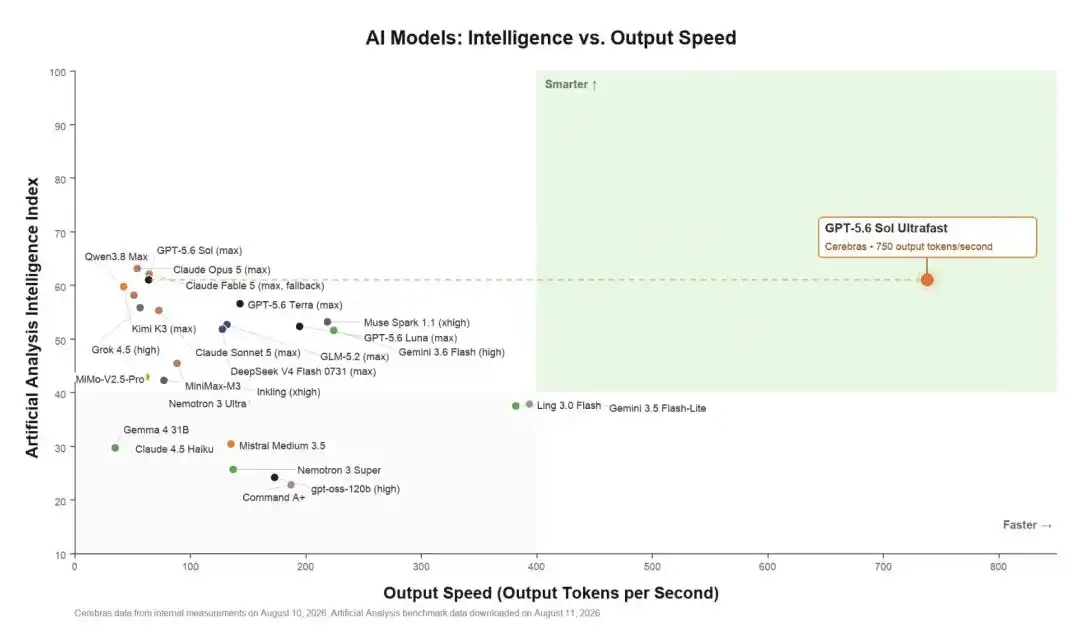
In this mode, the output speed of GPT-5.6 Sol can reach up to 750 tokens/s. Compared to the baseline inference speed of about 53 tokens/s in the current Standard mode, this represents a speed increase of up to 14 times, with no reduction in quality. For perspective, the accelerated GPT-5.6 Sol is 11 times faster than Fable 5 and 5 times faster than Opus 4.8 in its Fast mode.

The Ultrafast mode will be launched first in the OpenAI API and is currently available in a limited preview to some customers.
For this, OpenAI and Cerebras also created a comparison table showing the current speed and intelligence of leading AI large models. GPT-5.6 Sol Ultrafast holds an absolutely leading position:
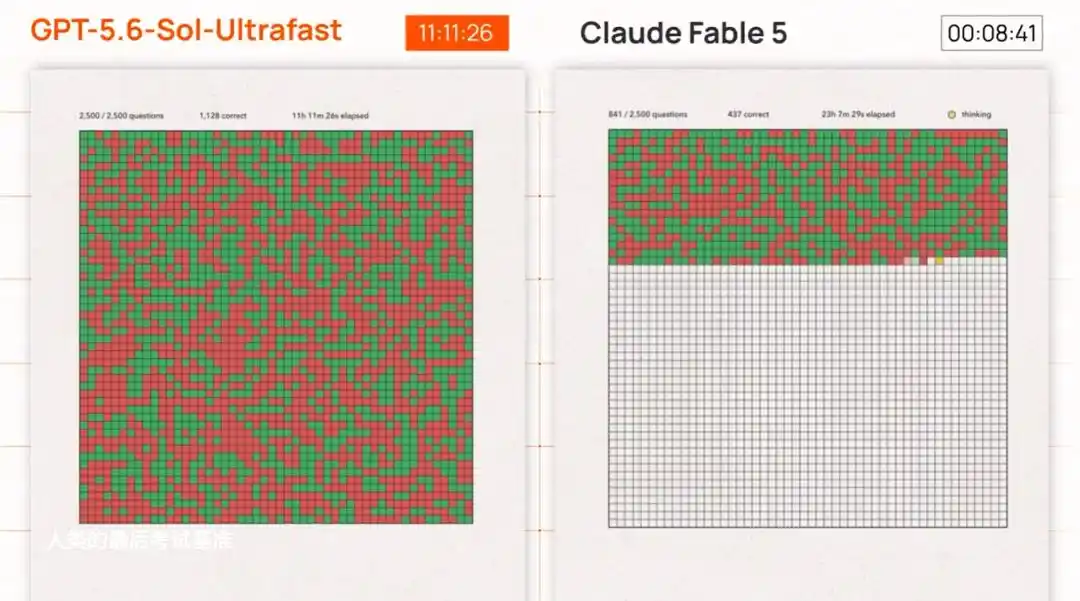
In Cerebras's blog, engineers described tests conducted on the "Humanity's Last Exam" (HLE) benchmark, where they compared the Ultrafast-accelerated model with direct competitors. As we know, HLE is a challenging model benchmark containing 2500 questions, typically only solvable by Ph.D.s in fields like chemistry, economics, and literature.

GPT-5.6 Sol in Ultrafast mode answered all questions in just 11 hours and 11 minutes. In contrast, Claude Fable 5 required 78 hours and 27 minutes—over three days of continuous computation—to reach the same conclusions. GPT's Ultrafast mode completed the frontier of human knowledge in a single workday, achieving nearly 7 times the speed of Claude Fable while maintaining similar accuracy.
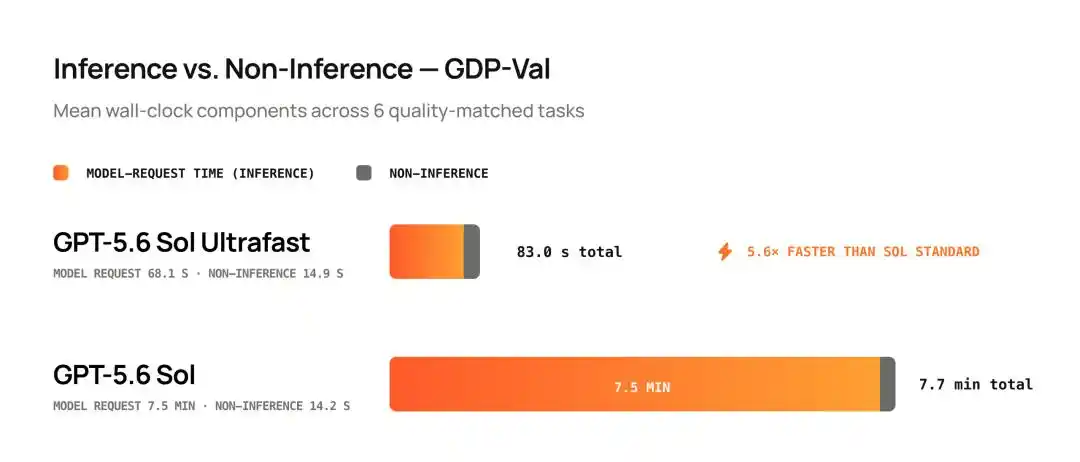
As model capabilities continue to improve, the application scope of fast inference will also expand. GPT-5.6 Sol is OpenAI's best-performing model to date for legal documents, financial models, and engineering reports. On the GDP-Val benchmark (which measures economically valuable knowledge work tasks), Ultrafast achieved a 5.6x end-to-end speed improvement without any drop in quality, fully demonstrating how faster reasoning speeds can accelerate economically valuable work.
Faster AI processing adds significant possibilities to emerging workflows. People can now deploy agents onto the critical path of problems. OpenAI lists some application scenarios for you:

  • Incident response and reliability: When critical systems fail, AI analyzes application logs, recent code changes, and engineer reports to identify potential causes and help prepare fixes while the incident is still ongoing.
  • Financial research and security: Analyzing market signals, evaluating trades, and identifying suspicious activities in rapidly changing market conditions.
  • Customer support and voice: Resolving complex customer issues in real-time, even when finding answers requires multiple steps or systems, without interrupting the conversation.
  • Commerce: Answering product questions, checking inventory, personalizing recommendations, and resolving checkout issues while shoppers are still deciding, preventing hesitation from turning into abandoned carts.
  • Real-time research and experimentation: Transforming research that previously required overnight processing into interactive work sessions, allowing teams to test ideas, check results, adjust methods, and run another experiment without breaking their workflow.

Internally at OpenAI, developers tested GPT-5.6 Sol in Ultrafast mode. Incident response is an example of using Ultrafast. When an alert triggers, engineers need to build an accurate picture of the incident while systems and evidence are still changing. With Sol-level intelligence, teams can quickly read logs, analyze traces, summarize conversations, determine the next steps for investigation, and assist in preparing or verifying fixes. Ultrafast mode reduces the delay between observing a signal, verifying hypotheses, and choosing the next action, while engineers remain responsible for judgment and deployment.

In research, the OpenAI team uses Ultrafast to quickly search knowledge bases, query data, and rapidly gather, organize, and summarize information from various tools. A common research workflow used to involve team members launching a batch of experiments overnight and reviewing results the next morning. With Ultrafast, the discovery process can be shortened, supporting multiple iterations within a single workday.

The breakthrough of Ultrafast mode lies in breaking the memory bandwidth bottleneck of traditional GPU clusters during the autoregressive decoding stage of large models. Its implementation primarily relies on Cerebras's wafer-scale hardware architecture.
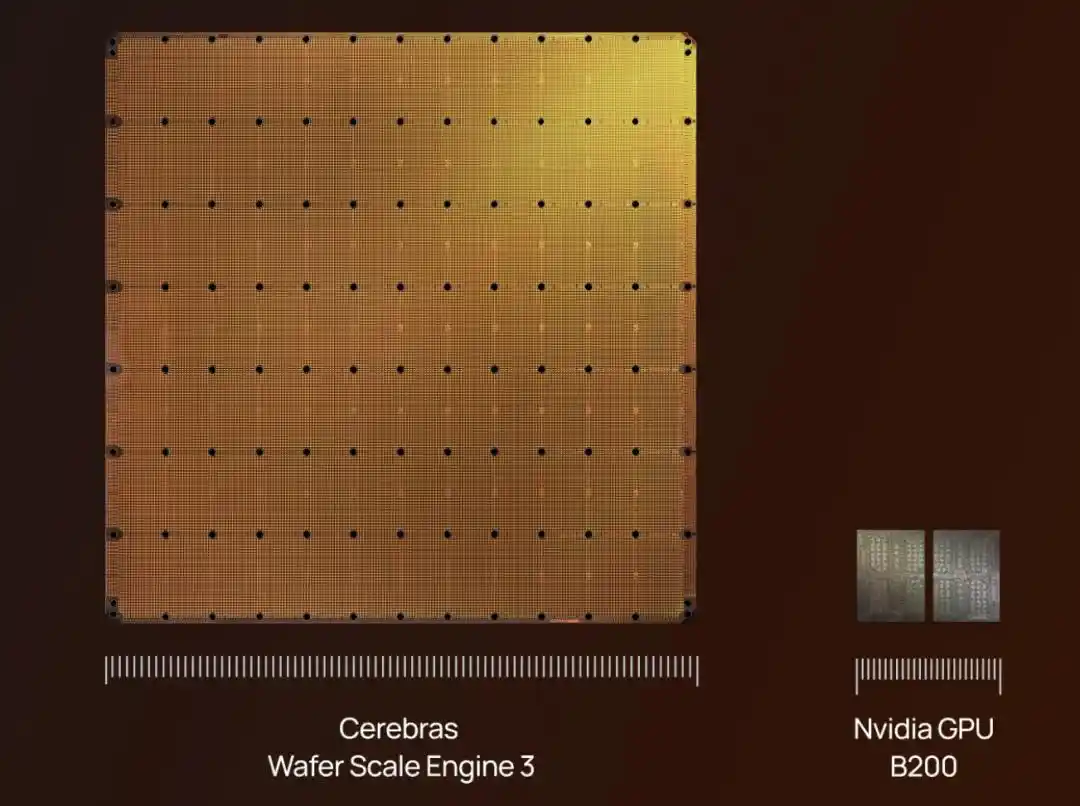
Among AI chip manufacturers, Cerebras's solution is unique: its successive chip generations are manufactured from entire silicon wafers, integrating vast numbers of computing cores and ultra-high-speed interconnection networks on a single die.

Traditional GPUs, when running autoregressive token generation for large models, are limited by memory bandwidth, requiring constant transfer of massive model weights between off-chip HBM and computing cores. Additionally, multi-card partitioning introduces communication delays across chips (via PCIe/NVLink).

In contrast, each of Cerebras's latest wafer-scale chips (WSE-3) integrates 4 trillion transistors, delivers 125 petaflops of AI compute power, and features up to 44 GB of on-chip high-speed SRAM. Model parameters reside directly in the high-bandwidth on-chip SRAM, eliminating the wait time associated with repeatedly loading weights from off-chip memory.

Of course, as a cutting-edge flagship model, the full parameter count of GPT-5.6 Sol obviously far exceeds the chip's capacity. Cerebras also has a "Pipelined across wafers" mechanism. This distributes the various network layers of the model across multiple wafers, with each layer's parameters residing in the SRAM of its respective chip, allowing tokens to seamlessly flow between wafers in a pipeline.

For many large model users, a 14x speedup for the flagship model means that many tasks that previously required switching to secondary models (like Luna and Terra) can now be confidently run at full power. For Agent tasks requiring multi-round tool use, code generation/debugging, and complex chain-of-thought reasoning, processes that used to take hours can be compressed into minutes.

Faster speeds might also mean a shift in how we use AI:

Within the AI community, people are already looking forward to Ultrafast mode versions for Luna and Terra. The only question is whether Cerebras's chips will be sufficient.

References:

https://openai.com/index/previewing-ultrafast/

https://www.cerebras.ai/blog/accelerating-gpt-5-6-sol-ultrafast-with-openai

This article is from the WeChat public account "Almost Human" (ID: almosthuman2014), by the machinehearts team focused on large models.


Trending Cryptos

Related Questions

QWhat is the key feature of OpenAI's newly previewed 'Ultrafast Mode' for GPT-5.6 Sol, and what is its claimed performance improvement?

AThe key feature is a 14x increase in output speed, reaching up to 750 tokens per second (tokens/s), compared to the Standard mode baseline of approximately 53 tokens/s, without any reduction in quality.

QWhich AI chip manufacturer did OpenAI partner with to achieve the speed boost for GPT-5.6 Sol's Ultrafast Mode?

AOpenAI partnered with the AI chip manufacturer Cerebras to achieve the speed boost for the Ultrafast Mode.

QAccording to the article, in what major test did GPT-5.6 Sol Ultrafast demonstrate a significant speed advantage over its competitor Claude Fable 5?

AIn the 'Humanity's Last Exam' (HLE) benchmark test, GPT-5.6 Sol Ultrafast answered all 2500 questions in 11 hours and 11 minutes, while Claude Fable 5 took 78 hours and 27 minutes, making it almost 7 times faster.

QWhat is the fundamental technical reason mentioned for the speed breakthrough in Ultrafast Mode, addressing a limitation of traditional GPU clusters?

AThe breakthrough comes from Cerebras's wafer-scale hardware architecture, which keeps the entire model's parameters in the chip's high-bandwidth on-chip SRAM. This eliminates the memory bandwidth bottleneck and the latency caused by repeatedly loading weights from external memory (like HBM in GPUs) and cross-chip communication.

QWhat are two potential application scenarios for Ultrafast AI models listed in the article?

ATwo potential application scenarios are: 1) Event response and reliability: Analyzing logs and reports in real-time to help diagnose and fix critical system failures as they occur. 2) Real-time research and experimentation: Turning overnight research processes into interactive sessions, allowing teams to iterate on ideas and test results multiple times within a single workday.

Related Reads

Unitree is Not Worth Its Current Valuation

Unitree's recent IPO pricing at 150.80 yuan per share, valuing the company at 60.99 billion yuan, has sparked intense market speculation. The valuation metrics appear stretched, with a P/E ratio of 219.23x—nearly six times the industry average—earning it the nickname "dream valuation." Off-exchange platforms like Hyperliquid have seen even more extreme pre-market prices, implying valuations up to four times the IPO level. The core concern is the mismatch between this valuation and the company's current business reality. Unitree's revenue breakdown reveals that over 73% of its humanoid robot sales in the first nine months of 2025 came from research and education, with another 17% from commercial exhibitions. Only 9% was classified as industrial application, and within that small slice, approximately 70% was for enterprise tours and guest reception—essentially advanced display items. Consequently, revenue from actual industrial tasks like manufacturing, inspection, and logistics accounted for less than 3% of total humanoid robot sales. Financially, growth is showing signs of strain. While Q1 2026 revenue grew 68.49% year-over-year, this represents a sharp slowdown from the 332.64% growth seen in Q1 2025. More notably, net profit (non-GAAP) halved, dropping 52.55%, attributed to surging R&D and marketing expenses. The company has also updated its risk disclosures, highlighting the threat of competition from Tesla's Optimus, which plans mass production. Analysts and institutional investors express caution. Some point out that current industry orders are largely for validation, not scalable commercial deployment. One estimate suggests only about 250 of Unitree's 2025 shipments were for genuine industrial use. The high valuation is seen as fueled by global humanoid robot hype and retail investor frenzy. For it to be sustained, Unitree must achieve explosive growth in industrial demand, maintain market share against powerful rivals, and preserve its high gross margins—a challenging set of conditions. While short-term structural factors might support the stock price, the consensus is that the valuation will eventually need to reconcile with fundamental business performance.

Odaily星球日报9m ago

Unitree is Not Worth Its Current Valuation

Odaily星球日报9m ago

Stablecoins and Agentic Commerce Can't Make It into Visa's Earnings Report

**Title: Stablecoins and Agentic – Not Yet on Visa's Financial Statements** **Summary:** On July 16, Visa announced the Visa Stablecoin Platform (VSP), a platform for managing stablecoin issuance and movement, starting with OpenUSD. However, 12 days later, in its FY2026 Q3 earnings call, CEO Ryan McInerney detailed VSP but mentioned no revenue model, timing, or clients. CFO Christopher Suh's financial report did not mention VSP. Analysts' questions largely ignored stablecoins, focusing instead on cross-border growth and core metrics. The article examines Visa's business model using a "highway" analogy: Visa builds the payment network (the road), sets rules, and collects "tolls." Its revenue comes from four main streams: Service Revenue, Data Processing Revenue, International Transaction Revenue, and Other Revenue. After client incentives, Visa's net take-rate has remained stable at ~29 basis points. Currently, Visa's only meaningful revenue from stablecoins comes from "U Cards" – cards linked to stablecoin wallets. In these transactions, stablecoins are converted to fiat *before* entering Visa's network, so they are processed as regular card transactions, contributing to the standard 29 bps fee. Visa's other stablecoin initiatives—settlement pilots (converting *Visa's own* net obligations to stablecoins) and the new VSP platform—do not yet generate revenue; they are operational improvements or future commercial offerings. Regarding Agentic Commerce, Visa's products (Agent Score, Token Assurance Framework) are "devices" allowing AI agents to use the *existing* payment network. They are billed as value-added services. Visa views agentic commerce primarily as AI agents acting on behalf of humans in traditional commerce (replacement), not the potentially new market of machine-to-machine transactions (creation). Strategically, CEO McInerney listed stablecoins and agentic as a *fourth-tier* investment priority, behind core areas like consumer payments and value-added services. They are components within existing strategies, not standalone growth engines with defined addressable markets. In contrast, Mastercard took a different approach by acquiring BVNK for ~$1.8B to gain immediate scale in stablecoin payment processing. Visa's strategy appears conservative: building optionality without major bets. Its core moat is its decades-old dispute resolution and consumer protection infrastructure. The market values Visa for its current robust consumer spending, growing value-added services, and share buybacks—not for its stablecoin or AI agent initiatives. The narrative hype around these topics exceeds their current financial significance for the company.

marsbit19m ago

Stablecoins and Agentic Commerce Can't Make It into Visa's Earnings Report

marsbit19m ago

This Investor Day, SanDisk's 'Stunning Numbers' Shook the Market

SanDisk's Investor Day Shocks Market with "Explosive" Long-Term Targets SanDisk stunned the market at its 2026 Investor Day by unveiling an extremely aggressive long-term financial model. The company targets **mid-to-high double-digit revenue growth** for fiscal years 2028-2030. More impressively, it forecasts non-GAAP gross margins of approximately **80%** and operating margins around **75%** during that period, with an adjusted free cash flow margin of about 50%. A key strategic shift is SanDisk's focus on profitability over sheer output volume. The company clarified it will **flexibly adjust salable bit output based on profit optimization needs**, not simply chase bit shipment growth. This approach aims to avoid oversupply, especially during technology node transitions. SanDisk also committed to returning **100% of excess cash to shareholders** after funding business growth. Confidence in these targets is bolstered by new business model (NBM) agreements with eight major clients, covering roughly **50% of FY2027 and two-thirds of FY2028 bit shipments**, aiming to reduce cyclical volatility. The company sees massive tailwinds from AI, particularly the shift from training to inference, which is reshaping data center memory hierarchies. It estimates the enterprise flash TAM could reach **1.2 zettabytes by 2030**. SanDisk is advancing technologies like its CMOS Bonded Array (CBA) strategy and High Bandwidth Flash (HBF) for AI inference workloads. The announcement triggered a sharp rally, with SanDisk's stock soaring nearly 18% intraday and lifting the broader storage sector.

marsbit20m ago

This Investor Day, SanDisk's 'Stunning Numbers' Shook the Market

marsbit20m ago

Trading

Spot

Hot Articles

Discussions

Welcome to the HTX Community. Here, you can stay informed about the latest platform developments and gain access to professional market insights. Users' opinions on the price of SOL (SOL) are presented below.

活动图片