UK Crypto Regulation Enters Countdown: What Changes Are in the FCA's New Rules?

Foresight NewsPublished on 2026-07-02Last updated on 2026-07-02

Abstract

UK Crypto Regulation Enters Countdown: Key Changes in FCA's New Rules The UK Financial Conduct Authority (FCA) has published its final crypto asset regulatory policy, marking a shift from consultation to implementation. The new regime, set to fully expand from October 25, 2027, moves crypto businesses from registration to authorisation. A critical window from September 30, 2026, to February 28, 2027, allows existing firms to apply for transitional provisions, enabling them to continue operating while their authorisation is reviewed. Existing registrations will not automatically convert. The rules cover a broad range of activities including stablecoin issuance, custody, trading platform operation, arranging deals, staking, and lending. Authorised firms must meet new prudential capital requirements, with permanent minimum capital ranging from £750,000 for proprietary trading to £75,000 for arranging deals. They must also hold a basic liquid asset buffer for operational resilience. Market integrity rules now apply to trading platforms and intermediaries, covering areas like insider trading and requiring best execution checks against at least three UK-authorised venues. Custodians face enhanced client asset protection rules (CASS 17), focusing on ownership, reconciliation, and private key management. For stablecoins, issuers must provide full backing from issuance and allow redemption at par value within a T+1 timeframe. Reserve assets are categorised into core (e.g., demand...


Written by: KarenZ, Foresight News


A countdown clock is rewriting the UK crypto market.


If a platform helps users buy crypto, facilitates trading, custodies assets, or issues stablecoins in the UK, the core questions it faces next are straightforward: does its business fall under the FCA's new regulatory scope? Does it need to apply for authorization? Can it continue operating during the application review period?


At the end of June 2026, the UK Financial Conduct Authority (FCA) issued a set of crypto asset regulatory policy statements covering stablecoin issuance, custody, trading platforms, intermediaries, staking, lending, market abuse, disclosure, prudential capital, and the applicability of the FCA Handbook.


According to the FCA's Crypto Roadmap, this marks the transition of UK crypto regulation from years of consultation to the final rule-making stage.


From Registration to Authorization


The UK has previously regulated the crypto industry, but its scope was relatively limited. Since January 2020, crypto asset trading service providers and custodian wallet providers operating in the UK have needed to register with the FCA under anti-money laundering regulations; in 2023, financial promotion rules began to apply to crypto asset marketing.


This change goes further. The FCA stated that the UK Parliament passed the *Financial Services and Markets Act 2000 (Cryptoassets) Regulations 2026* on February 4, 2026, bringing a broader range of crypto asset activities into the FCA's regulatory perimeter for the first time. Under the new regime, the full scope of regulated activities will be extended from October 25, 2027.


This regime covers a significant number of entities. The relevant activities listed by the FCA include: issuing qualifying stablecoins, custodying crypto assets, operating qualifying crypto asset trading platforms, trading qualifying crypto assets (as principal or agent), arranging qualifying crypto asset trading services (including crypto lending), arranging qualifying crypto asset staking services, and more.


In other words, regarding crypto-specific regulation, the UK regulator is not targeting just one segment. Issuance, trading, matching, brokerage, custody, staking, lending—if an activity falls within the definitions of the new regime, it will likely need to enter the FCA's authorization system.


The Most Critical Window, Determining Whether Business Can Continue During Review


For crypto companies already operating in the UK market, the period from September 30, 2026, to February 28, 2027, is the most crucial to watch.


The FCA stated that if a firm wishes to rely on the *savings provisions*, which are transitional grandfathering clauses, the application window is planned to open on September 30, 2026, and close on February 28, 2027. Eligible companies that submit applications within this window can continue to carry out specified activities before the FCA makes its decision.


This is not a mere date reminder. It determines whether existing firms can continue operating while awaiting authorization review. Missing the window may cause a company to lose the protection to continue relevant business during the transition period.


The FCA also explicitly stated that existing registrations will not be automatically converted. Firms currently registered under the *Financial Services and Markets Act 2000 (FSMA)* or the *Money Laundering Regulations*, authorized under payment service or electronic money rules, or relying on FSMA s.21 approval for financial promotions—if their business falls within the scope of the new regulated crypto asset activities—will still need to obtain the corresponding authorization.


This will force many companies to re-evaluate their business boundaries. Models that were sufficient under anti-money laundering registration or financial promotion rules may no longer suffice under the new regime. Companies must first determine if they fall within the regulatory scope, then prepare authorization applications, capital arrangements, risk control systems, and client asset protection mechanisms.


Beyond Authorization: Capital and Risk Control Thresholds


Obtaining authorization is not the only challenge. This time, the FCA has broken down many compliance requirements that were previously easily relegated to slogans into more concrete rules.


Regarding prudential capital, PS26/12 sets out the permanent minimum capital requirements for different businesses. Firms trading qualifying crypto assets as principal: £750,000; issuing qualifying stablecoins: £350,000; custodying crypto assets, providing qualifying crypto asset staking services, operating qualifying crypto asset trading platforms: £150,000; trading as agent and arranging trades: £75,000.
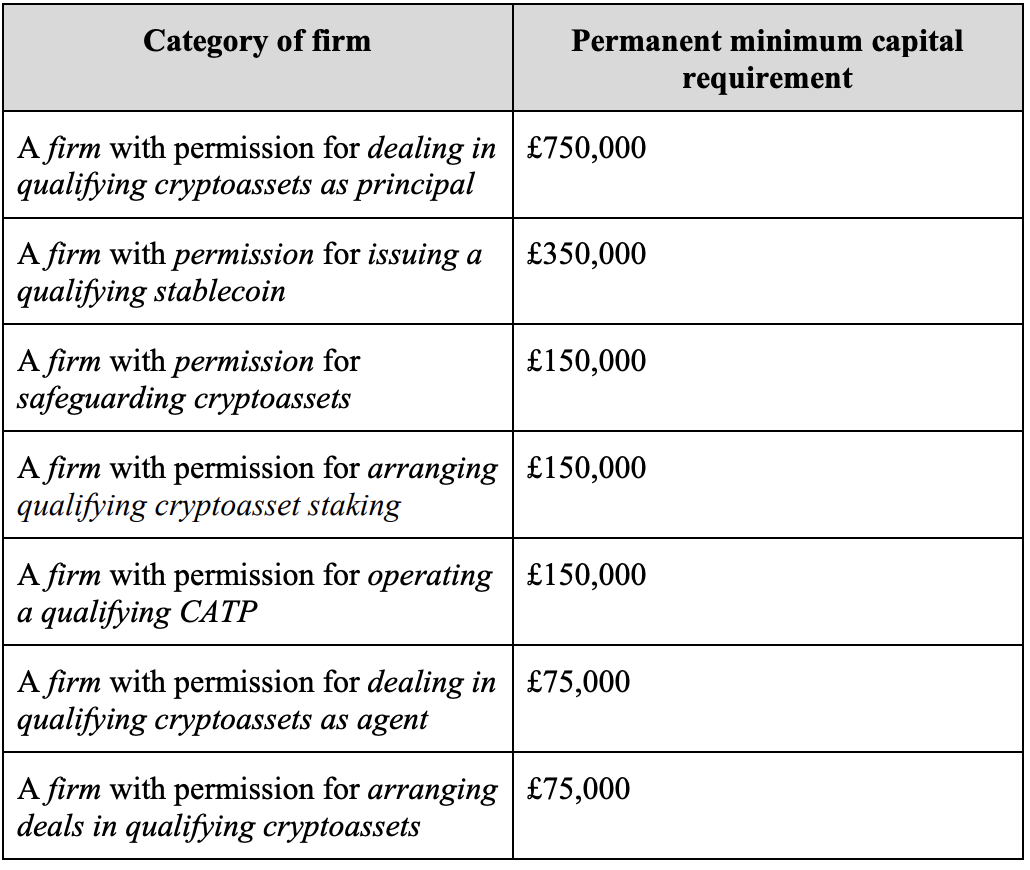


These figures may not seem high, but they are just the baseline. The FCA explained that a firm's minimum own funds requirement is the highest of three values: the permanent minimum capital requirement, the fixed overheads requirement, and the K-factor requirement. The permanent minimum capital is the baseline, while the K-factor is further calculated based on the scale of business activities and risk exposure. The FCA also emphasized that the permanent minimum capital is an authorization threshold; firms cannot obtain authorization first and then gradually meet the requirement in phases afterwards.


The FCA has also introduced a basic liquid asset requirement. Relevant firms must hold core liquid assets amounting to one-third of the fixed overheads requirement plus 1.6% of the total value of client guarantees. The purpose of this liquidity buffer is pragmatic: firms cannot meet capital requirements only on paper; they must also have sufficient liquid assets to support operations, orderly wind-down, or handling client-related obligations under stress scenarios.


Trading platforms and intermediaries also face more detailed market conduct rules. In its press release, the FCA stated that the new framework will introduce market integrity rules covering areas like insider trading and market manipulation; in the regime overview, the FCA also included trading platforms and intermediaries within the scope of activity rules in PS26/11, specifically mentioning requirements such as best execution and price checks across multiple execution venues. PS26/11 further stipulates that relevant firms need to establish client order handling procedures to ensure client orders are executed promptly, fairly, and expeditiously, and to reference prices from at least 3 reliable UK authorized execution venues for price checks where possible.


If there are fewer than 3 UK authorized venues where the order can be executed, existing available venues should be checked. The FCA simultaneously emphasized that this is not a mechanical price comparison for each trade, nor does it require orders to be executed only at the 3 venues checked. It requires firms to use reliable price sources to validate their execution policies and be able to demonstrate that the execution outcomes delivered to clients are at least as good as those that would have been achieved in comparable circumstances at these UK authorized venues.


The focus for custody businesses is client asset protection. In PS26/11, the FCA confirmed that CASS 17 protection requirements will apply to client crypto assets, with rule focuses including ownership, record keeping, asset reconciliation, and private key management. In short, platforms cannot merely state that "assets are transparent on-chain"; they must also prove they know which assets belong to which clients, whether their ledgers match on-chain assets, and that private key control will not be compromised due to internal processes or external attacks.


The FCA's cost-benefit analysis provides a more tangible figure: it estimates that custody protection rules could prevent approximately £60 million in consumer losses annually.


Lending and staking are also brought into a more detailed consumer protection framework. For crypto lending, the FCA retains core protection requirements for retail clients, including enhanced disclosure, client consent, appropriateness tests, record keeping, over-collateralization, and negative balance protection. Negative balance protection means that a retail client's losses in a crypto borrowing arrangement should not exceed the market value of the collateral they have specifically provided for that borrowing.


For staking services, the FCA retains requirements for disclosure, contract terms, client consent, and record keeping, but makes adjustments for automatic staking arrangements, allowing clients to consent to ongoing staking covering current and future holdings, provided relevant conditions are met and annual notifications are given.


Stablecoins Placed Beside Payment Ambitions


Stablecoins are a category of activity treated separately within this regulatory framework.


The FCA stated that qualifying stablecoins issued in the UK will be required to be fully backed and redeemable at par value, to support their use as "money-like instruments."


The core of PS26/10 is to require stablecoin issuers to establish an auditable mechanism around backing assets, redemption, disclosure, and asset protection. The FCA's final rules require UK stablecoin issuers to provide full backing for their stablecoins from the moment they are minted, including tokens held by the issuer itself; tokens that have been permanently destroyed no longer require backing asset coverage. The FCA's reasoning is direct: stablecoins are liquid, and if unsupported tokens enter the market, it could undermine confidence in their 1:1 peg.


Regarding redemption, the FCA requires UK stablecoin issuers to provide the right to redeem at par value and complete redemptions within a T+1 timeframe. However, the final rules adjust the starting point: T+1 no longer starts from the submission of a complete redemption request, but from when the issuer receives the stablecoins to be redeemed into its wallet. This allows AML/KYC checks to be completed before T+1, avoiding squeezing anti-money laundering reviews into the redemption timeline.


Regarding backing assets, the FCA divides stablecoin reserves into two tiers: core backing assets and expanded backing assets.


Core backing assets include demand deposits and short-term government debt instruments; expanded backing assets include longer-term government debt instruments, shares in public debt CNAV money market funds, and repo or reverse repo arrangements with government debt instruments as the underlying and a maturity not exceeding 7 days.


The FCA sets two liquidity requirements: First, issuers must meet the On-demand Deposit Requirement (ODDR), meaning they must hold at least 5% of the backing asset pool as demand deposits. Second, issuers must also meet the Core Backing Asset Requirement (CBAR), meaning they must hold an additional percentage of core backing assets, with the percentage being the higher of 5% and the highest single-day redemption ratio over the past 180 redemption days. Demand deposits used to meet the ODDR cannot also be used to meet the CBAR.


The focus of this design is to prevent issuers from allocating more to long-term or complex assets for yield, yet being unable to provide sufficient high-liquidity assets during concentrated user redemptions.


Beyond this, there is a larger regulatory division of labor. The FCA and the Bank of England issued a joint statement on the same day explaining the regulatory pathway for systemic stablecoin issuers. "General UK stablecoin issuers" are regulated by the FCA; if a UK stablecoin issuer is designated by HM Treasury as having "systemic importance," it may transition from sole FCA regulation to joint regulation by the FCA and the Bank of England.


PS26/10 also mentions that in the Bank of England's draft rules, the backing asset composition for systemic stablecoins may shift to a maximum of 70% UK sovereign debt with a remaining maturity of less than 6 months, and a minimum of 30% central bank deposits; individual stablecoins may also be subject to a provisional issuance cap of £40 billion and required to offer T+0 redemption.


This indicates that the UK does not view stablecoins solely as exchange-denominated tools. As long as they continue to approach payment and settlement scenarios, regulatory focus will expand from investment risk to reserve safety, redemption stability, and financial infrastructure reliability.


Summary


The FCA still cautions that the vast majority of crypto assets are highly speculative, and consumers may lose all their principal. The new rules do not eliminate such risks, nor do they endorse crypto assets. What they change is another matter: the UK is beginning to address crypto business using more comprehensive financial regulatory language.


Under the new framework, crypto-related companies must also demonstrate whether capital is sufficient, how client assets are protected, whether trade execution is fair, if stablecoins can be redeemed according to rules, and who is responsible if risks get out of control.


By October 25, 2027, when the countdown ends, those that truly remain will be the companies that can clearly articulate their business boundaries, client assets, capital buffers, and risk responsibilities.

Trending Cryptos

Related Questions

QWhat is the most crucial application window for existing crypto firms under the new UK FCA regime, and what does it allow?

AThe most crucial window is from September 30, 2026, to February 28, 2027. Firms that submit their applications during this period and meet the conditions can rely on the 'savings provisions' (transitional arrangements). This allows them to continue their designated crypto-related activities while the FCA processes their application for authorization.

QWill a firm's existing registration with the FCA (e.g., for AML purposes) automatically convert into a full authorization under the new crypto regime?

ANo. Existing registrations under the Money Laundering Regulations, authorizations under the Payment Services or E-money rules, or financial promotions approvals will NOT automatically convert to authorization. Any firm whose activities fall within the scope of the new regulated crypto asset business must apply for and obtain the appropriate FCA authorization.

QWhat are the key new regulatory requirements for a crypto asset custodian under the FCA's final rules (PS26/11)?

AKey requirements for custodians under PS26/11 include: Client Asset (CASS 17) protection rules focused on client asset segregation, accurate record-keeping, regular reconciliation of holdings on and off-chain, and secure private key management. The rules aim to ensure firms can prove which assets belong to which client and that private keys are not at risk from internal failures or external attacks.

QHow does the FCA's new framework (PS26/10) structure the reserve assets for 'Qualifying Stablecoin' issuers?

AThe FCA structures stablecoin reserves into two tiers. 'Core backing assets' include demand deposits and short-term government debt instruments. 'Expanded backing assets' include longer-term government debt, CNAV money market fund shares, and short-term repos (≤7 days). Issuers must also meet specific liquidity buffers: a 5% On-demand Deposit Requirement (ODDR) and a Core Backing Asset Requirement (CBAR) based on peak redemption history.

QWhat is the potential regulatory path for a stablecoin issuer deemed 'systemically important' in the UK?

AA stablecoin issuer designated by HM Treasury as 'systemically important' would move from being regulated solely by the FCA to a dual-regulatory regime with joint supervision by the FCA and the Bank of England (BoE). The BoE's proposed rules for such issuers could include stricter reserve asset requirements (e.g., up to 70% in short-term UK sovereign debt and at least 30% in central bank deposits) and a potential T+0 redemption timeframe.

Related Reads

High-Yield, Debt-Free, and Non-Dilutive: Why Bitcoin Treasury Companies Are Aggressively Promoting Preferred Share Financing

Bitcoin-backed preferred shares, led by companies like Strategy and followed by newer entrants like Strive, have grown to a market size of approximately $13 billion in under two years, attracting capital with high yields. A 2026 report from BitcoinTreasuries.net and Apyx projects this segment could grow from nearly 1% to 3-5% of the global $1.3 trillion preferred share market by 2030, with long-term potential reaching 10%. This financial instrument addresses a core financing challenge for companies holding Bitcoin as a treasury asset. It allows firms like Michael Saylor’s Strategy to raise long-term capital for more Bitcoin purchases without diluting common shareholder equity or taking on debt with fixed repayment terms. Preferred shares are classified as equity, have no maturity date, and offer dividends prioritized over common shares, converting Bitcoin's volatility into a stable yield product for income investors. Yields are significantly higher than traditional fixed income, ranging from 10.8% to 15.2% for top issuers. Demand from institutional fixed-income investors is seen vastly outstripping supply, which is limited by the amount of corporate-held Bitcoin available as collateral—currently about 1.26 million BTC ($83 billion), with Strategy holding 67%. A key safety feature is the high collateral coverage ratio of 3.8x to 4.5x, meaning each dollar of preferred equity is backed by $3.8-$4.5 in Bitcoin. Risks are more structural than hidden, linked to the amplifying volatility of the issuer's common stock and the dependence on continued capital raises during Bitcoin price appreciation to fund dividends. Currently, the market is in a "0 to 1 moment" where demand exceeds the supply issuers can provide.

Foresight News48m ago

High-Yield, Debt-Free, and Non-Dilutive: Why Bitcoin Treasury Companies Are Aggressively Promoting Preferred Share Financing

Foresight News48m ago

Trading

Spot

Hot Articles

What is DOGE M

Doge Matrix ($doge m): The New Breed of Community-Driven Cryptocurrency Introduction In the ever-evolving landscape of cryptocurrency, new projects constantly emerge, each aiming to capture the interest of investors and enthusiasts alike. One of the latest entrants to this domain is Doge Matrix, represented by the ticker symbol $doge m. This project has attracted attention thanks to its roots in the popular meme culture surrounding Dogecoin, establishing its place within the web3 space. This article aims to provide a comprehensive analysis of Doge Matrix, covering its overview, creator, investors, functionality, timeline, and notable aspects. What is Doge Matrix ($doge m)? Doge Matrix is a community-driven cryptocurrency project that seemingly builds upon the widespread appeal of Dogecoin, a digital currency known for its Shiba Inu mascot and its meme origins. While the overarching objectives of Doge Matrix are not extensively defined, it is characterised by a commitment to harnessing community involvement and support. Unlike traditional cryptocurrencies that often emphasise utility or intrinsic value through underlying technologies, Doge Matrix positions itself within a space that embraces the cultural phenomenon of cryptocurrencies, particularly appealing to those who resonate with the ethos of meme-based assets. Drawing on the strengths of the Dogecoin community, Doge Matrix operates as part of a broader ecosystem, inviting participation and engagement from users who share an interest in cryptocurrency and the digital landscape. Who is the Creator of Doge Matrix ($doge m)? The identity of the creator of Doge Matrix remains unknown. This lack of transparency is not an uncommon occurrence in the cryptocurrency space, where some projects are launched without revealing the identities of their founders. The absence of information regarding the founding team can raise questions among potential investors about the project’s accountability and direction. Who are the Investors of Doge Matrix ($doge m)? As it stands, there is no publicly available information detailing the investors or investment foundations that back Doge Matrix. The project appears to rely primarily on community support rather than institutional investment. This model aligns with the community-driven nature of the initiative, fostering an environment where the direction of the project is shaped by its participants rather than being dictated by a select few financial backers. How Does Doge Matrix ($doge m) Work? The specifics regarding the operational mechanisms of Doge Matrix are somewhat vague, reflecting a broader trend of projects in the meme coin space where innovative functionalities are not always clearly articulated. Nonetheless, Doge Matrix seems designed to tap into the existing cryptocurrency ecosystem by encouraging user participation while tapping into the familiar cultural references associated with Dogecoin. Its potentially unique characteristics derive from community interactions rather than technological advancements, emphasising shared experiences and collaboration among token holders. While the exact innovations have not been explicitly outlined, the project appears to create a space where community members can engage, share ideas, and propel the project's potential forward. Timeline of Doge Matrix ($doge m) Reflecting on the project’s timeline reveals notable events that have defined its journey thus far: November 25, 2024: Doge Matrix reached its all-time high value, marking a significant milestone in its early history. January 1, 2025: Conversely, Doge Matrix hit its all-time low value, illustrating the volatility often associated with cryptocurrencies, especially in the early stages of a project's lifecycle. Ongoing: The project continues to be actively traded and supported by its community, although specific future milestones or objectives have yet to be disclosed. Key Points About Doge Matrix ($doge m) Community Focus At the heart of Doge Matrix is a commitment to community engagement. The project thrives on the premise of collaboration and shared objectives among its members, emphasising the importance of collective effort. Unlike centralised projects that often have a defined leadership structure, Doge Matrix at present showcases a more fluid approach to governance, where every community member's voice matters. Volatility The cryptocurrency market is notorious for its volatility, and Doge Matrix is no exception. Its price history reflects significant fluctuations between high and low values, which is typical of many new cryptocurrencies but underscores the risks associated with investment in emerging tokens. Lack of Detailed Information One of the most striking features about Doge Matrix is the scarcity of detailed information regarding its technological underpinnings and operational mechanisms. This ambiguity necessitates that potential investors conduct thorough due diligence before engaging with the project. Conclusion In summary, Doge Matrix ($doge m) illustrates a new wave of cryptocurrency projects that lean heavily on community engagement and cultural relevance. While lacking in certain specifics—such as clear leadership, defined objectives, and detailed functionality—the project has managed to generate interest within the crypto community, leveraging the established appeal of meme culture. As with any investment in the cryptocurrency space, understanding the inherent risks and conducting comprehensive research is essential for potential participants. Doge Matrix stands as a reminder of the dynamic, sometimes unpredictable nature of the crypto industry, marked by constant evolution and enthusiasm for community-driven initiatives.

536 Total ViewsPublished 2025.02.03Updated 2025.02.03

What is DOGE M

What is $M

Understanding Mantis ($M): A New Era in Cross-Chain Interoperability In the continually evolving landscape of Web3 and cryptocurrency, new projects strive to offer innovative solutions aimed at enhancing the user experience and expanding functional possibilities within the decentralised financial ecosystem. One such project garnering attention is Mantis ($M), a pioneering protocol founded on the principles of cross-chain interoperability and intent-based settlements. This article delves into the essential aspects of Mantis, including its core functionality, creators, investment backing, innovative features, and critical milestones. What is Mantis ($M)? Mantis is described as a multi-domain intent settlement protocol that simplifies cross-chain interactions, enabling users to execute complex financial transactions across various blockchain platforms seamlessly. The protocol operates through three primary layers: Intent Expression: Users can articulate their transaction goals using natural language facilitated by the DISE LLM, an advanced AI language model. For instance, a user might express a desire to swap Ethereum (ETH) for Solana (SOL) with a specific slippage tolerance of 1%. Execution: This layer employs a network of solvers that compete to fulfil user intents. Transactions are executed using mechanisms such as Coincidence of Wants (CoWs) and Order Flow Auctions (OFAs), which ensure that user demands are met optimally. Settlement: Leveraging the Inter-Blockchain Communication (IBC) protocol, Mantis enables atomic cross-chain transactions, allowing users to operate across various supported chains, including Ethereum, Solana, and Cosmos. Mantis is engineered to introduce native yield generation for idle assets, employing cryptographic proofs to maintain the integrity of transactions throughout the entire process. Creators & Development Team Mantis was conceived by the Composable Foundation, a research-driven organisation notable for its emphasis on blockchain interoperability solutions. This foundation collaborates with esteemed academic institutions, including Harvard University and the University of Lisbon, contributing to extensive research and development efforts that inform Mantis's architecture and functionality. The Composable Foundation’s commitment to fostering innovation in the blockchain space positions Mantis as a robust solution for the growing demand for interoperability among multiple blockchain networks. Investors & Backing While specific details about individual investors have not been publicly disclosed, Mantis enjoys substantial backing from various entities, including: Ecosystem grants from IBC-enabled chains, which support the protocol's growth and integration within decentralised finance ecosystems. Strategic partnerships with infrastructure providers that enhance Mantis's network capabilities and deployment strategies. Funding through the Composable Foundation's treasury, ensuring sustained financial support for ongoing development and operational costs. These collaborative efforts reflect a consensus among stakeholders about the importance of enhancing cross-chain functionality and the potential utility of Mantis's infrastructural innovations. Key Innovations Mantis sets itself apart through several pioneering innovations that enhance its functionality and utility: Chain-Agnostic Intents: Users can initiate transactions from any supported chain while settling on another. This flexibility empowers users, driving increased interaction among different platforms. AI-Powered Interface: The integration of DISE LLM allows users to conduct complex DeFi operations using natural language, thereby simplifying interactions and making blockchain technology accessible to a broader audience. Cross-Domain MEV Capture: Mantis creates an internal market for maximal extractable value (MEV) through competitions among solvers. This innovative approach allows for greater efficiency and value extraction in complex transactions. Modular Settlement Layer: The protocol supports various verification methods, including zero-knowledge proofs and optimistic rollups, providing a versatile framework that can adapt to emerging blockchain technologies. Historical Timeline Mantis's development is marked by several critical milestones that chart its trajectory and growth: | Year | Milestone | |————|————————————————————————-| | 2022 | Initial concept development within the Composable Foundation's research division. | | Q3 2024 | Launch of the testnet with bridging capabilities between Solana and Ethereum. | | Q1 2025 | Anticipated Token Generation Event (TGE) alongside the mainnet launch. | | Q2 2025 | Expected integration of DISE LLM and expansion of cross-chain capabilities. | | 2025 H2 | Planned support for over 15 chains through further IBC upgrades. | This timeline outlines Mantis's evolution, from conceptual discussions to active implementation and future growth phases. Ecosystem Growth Strategy Mantis's strategy for ecosystem growth includes several initiatives designed to encourage user participation and developer engagement: Credits System: Users can earn protocol credits by providing liquidity and engaging in referral programmes. These credits are redeemable for incentives in the future, fostering a robust user community. Modular Software Development Kit (SDK): This toolkit empowers developers to create applications based on intent-driven models utilising Mantis's infrastructure, thus promoting innovation within its ecosystem. Governance Model: As the protocol matures, $M token holders will have a voice in protocol governance, allowing them to vote on proposed upgrades and changes, thereby enhancing community engagement and decentralisation. Mantis represents a significant advancement in the realm of cross-chain architecture. By seamlessly integrating advanced AI algorithms with a robust settlement framework, Mantis seeks to tackle the problems of fragmentation within multi-chain ecosystems. Its innovative approach prioritises improved user experiences while adhering to the foundational principles of decentralisation and security, setting a new standard for the future interoperability of blockchain technologies. As Mantis continues its journey of growth and implementation, it promises to be a project to watch closely in the competitive landscape of Web3 and decentralised finance. With its focus on crossing boundaries and elevating user engagement, Mantis is poised to be an integral part of the future developments in the cryptocurrency space.

65 Total ViewsPublished 2025.03.18Updated 2025.03.18

What is $M

Discussions

Welcome to the HTX Community. Here, you can stay informed about the latest platform developments and gain access to professional market insights. Users' opinions on the price of M (M) are presented below.

活动图片