Markets eye Bank of Japan meeting on Friday as yen repeats 40-year US dollar lows

cointelegraphPublished on 2026-07-28Last updated on 2026-07-28

Abstract

The Japanese yen is nearing new 40-year lows against the US dollar, with USD/JPY approaching 164, as markets focus on the Bank of Japan's (BoJ) upcoming interest rate meeting on July 31. Current rates stand at 1%, their highest since 1995, with near-certain expectations for a hold. The yen's role as a major global funding currency means BoJ policy has significant worldwide impact. Analysts warn that the persistent yen weakness risks a sudden unwind of the massive yen carry trade—a key source of liquidity for markets, including crypto. Such an unwind, potentially triggered by BoJ policy shifts aimed at stabilizing the currency, could spark a rapid liquidity crunch, echoing a disruptive event from 2024. The BoJ has indicated future rate hikes are likely to continue, noting that exchange rate movements now have a greater potential to affect inflation and consumer prices.

Japan’s central bank is in focus this week as its next interest-rate meeting comes amid new 40-year yen lows against the US dollar.

Key points:

  • The Japanese yen is approaching new 40-year lows against the US dollar, nearly beating its latest record from last week.
  • The Bank of Japan will decide on interest-rate changes on July 31, with rates already at 1%, their highest since September 1995.
  • Analysts have been warning that the yen carry trade could unwind again, repeating a major crypto headwind from 2024.

Dollar-yen seeks to reclaim 40-year record

Data from TradingView showed USD/JPY approaching 164 on Tuesday, just a fraction below new 40-year highs seen last week.
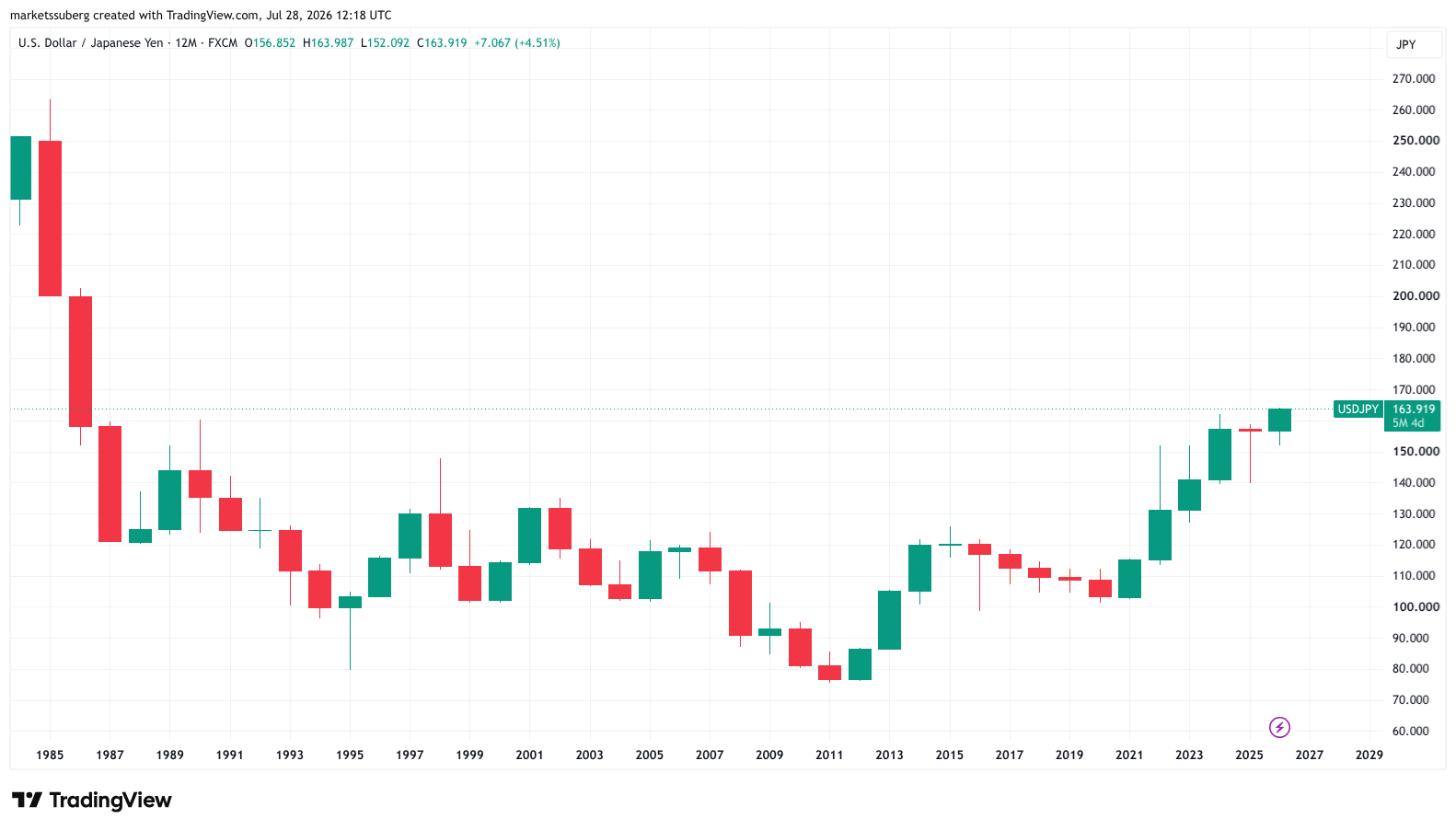
USD/JPY 12-month chart. Source: Cointelegraph/TradingView

The yen’s status as a funding currency is making BoJ monetary policy have an outsized influence on global markets. Japan’s currency markets are characterized by minimal capital controls and unmatched liquidity among non-dollar currencies.

Japan’s persistent current account and trade surpluses in earlier decades along with systemically low interest rates have made JPY the most important global funding currency. However, since Japanese inflation picked up in 2022, this has created the risk of carry trade unwinds accompanied by a liquidity crunch.

On Thursday and Friday, the Bank of Japan (BoJ) will decide on whether to adjust its benchmark rate, which at 1.0% is currently at its highest since 1995.

Markets expect rates to stay the same, with market-implied probabilities of a rate hold at 98%, given that policymakers enacted their latest raise in June. Prediction service Polymarket puts the odds of no change at 99% as of Tuesday.

At the time, however, the BoJ suggested that fresh hikes would come later. In a summary from the June meeting, it referenced inflationary trends in the form of the Consumer Price Index (CPI), coupled with historically low rates in place for the past three decades, as grounds for the change.

“As for the future conduct of monetary policy, given that underlying CPI inflation has been approaching 2% and financial conditions have been accommodative, it is appropriate for the Bank to continue to raise the policy interest rate and adjust the degree of monetary accommodation, in response to developments in economic activity and prices as well as financial conditions,” BoJ said.

Since then, a concurrent headwind, the weakening of the yen, has gathered pace, staying above the key 160 level against the dollar despite a dip following the June rate hike.

The BoJ previously noted the potential for a weaker yen to weigh on CPI growth, constricting consumer spending power.

“Attention should also be paid to the point that, with firms’ behavior shifting more toward raising wages and prices recently, exchange rate developments are, compared to the past, more likely to affect prices, and that such moves could affect underlying CPI inflation through changes in inflation expectations,” its Outlook for Economic And Prices document, issued after its April meeting, read.

Yen carry trade unwind risks global spread

For crypto traders, developments in the yen are of key importance. The yen carry trade, which can act as a liquidity source for crypto markets, is heavily influenced by BoJ moves to stabilize the yen’s exchange rate against the dollar. As Cointelegraph reported, interventions in August 2024 sparked a snap “unwinding” of the carry trade, with an immediate detrimental impact on Bitcoin and altcoins.

Related: Rate path still divides investors: Five things to know in Bitcoin this week

Now, with USD/JPY building on new 40-year highs, concerns of a repeat are growing.

“That trade only works if two conditions remain intact. Japanese interest rates remain exceptionally low. The yen remains broadly stable or continues depreciating,” analyst Ricky Ho wrote in his latest X commentary on Monday.

Ho said that carry-trade unwinds are “rarely gradual” thanks to high amounts of leverage deployed by participants.

He warned that any changes in BoJ policy could thus have wider-reaching consequences for a global economy already accustomed to the Japanese economic status quo.

“Ultimately, we think investors remain too focused on whether the BOJ hikes in September, October or December. The more important issue is that the direction of policy has fundamentally changed,” Ho said.


Trending Cryptos

Related Questions

QWhat are the main reasons for the Japanese yen approaching new 40-year lows against the US dollar mentioned in the article?

AThe article cites the yen's status as a global funding currency due to historically low interest rates in Japan, combined with the recent pickup in Japanese inflation since 2022. This situation creates pressure and risk for the yen carry trade. Additionally, the Bank of Japan's monetary policy, even with rates at their highest since 1995, and the persistent weakening of the yen which has stayed above the key 160 level against the dollar, are key factors.

QWhat is the market's expectation for the Bank of Japan's upcoming interest rate decision on July 31, and why?

AMarkets overwhelmingly expect the Bank of Japan to keep interest rates unchanged. Market-implied probabilities of a rate hold are at 98%, and prediction service Polymarket puts the odds at 99%. This expectation is primarily because the BoJ just enacted its latest rate hike in June, and policymakers at that time suggested that any further hikes would come later.

QAccording to the article, why are developments in the Japanese yen particularly important for crypto traders?

ADevelopments in the yen are crucial for crypto traders because the yen carry trade acts as a significant source of liquidity for cryptocurrency markets. Moves by the Bank of Japan to stabilize the yen's exchange rate can trigger a rapid 'unwinding' of this carry trade. The article notes that a similar intervention in August 2024 had an immediate detrimental impact on Bitcoin and altcoins.

QWhat are the two conditions that analyst Ricky Ho states must remain intact for the yen carry trade to work?

AAnalyst Ricky Ho stated that the yen carry trade only works if two conditions remain intact: 1) Japanese interest rates remain exceptionally low, and 2) The yen remains broadly stable or continues depreciating against other currencies like the US dollar.

QWhat potential global risk does the article associate with a possible unwind of the yen carry trade?

AThe article warns that an unwind of the yen carry trade poses a risk of spreading globally. Analyst Ricky Ho notes that such unwinds are 'rarely gradual' due to the high leverage used by participants. Any change in BoJ policy could therefore have wider-reaching consequences for a global economy that has become accustomed to the longstanding Japanese economic status quo of low rates and a weak yen.

Related Reads

Behind the 67,000 Semiconductor Talent Shortage: U.S. Industrial Policy Game and Implications for China

The U.S. push to reshore semiconductor manufacturing faces a core challenge: a significant talent shortage. While over $770 billion in investments are planned across 160 projects, a key hurdle is finding enough people to run the new fabs. According to industry projections, the U.S. could face a shortage of approximately 67,000 technicians, engineers, and computer scientists by 2030. This shortage is multi-faceted. It includes not only high-level chip design engineers requiring advanced degrees but also a substantial need for technicians to operate and maintain fab equipment. Technician roles, while often requiring less formal education, are hard to fill due to factors like shift work, factory locations, and local community infrastructure. Conversely, for high-end engineers, the issue is less about salary—which is already competitive—and more about intense competition for specialized skills from other tech sectors and the long lead time to develop such expertise. The geographic dispersion of new investments complicates recruitment, as fabs need large numbers of local, stable employees. In response, U.S. policy emphasizes building workforce development as critical infrastructure. Strategies include expanding community college programs for technician training, fostering industry-education partnerships, and pursuing immigration reforms for high-skilled talent, aiming to balance immediate needs with long-term domestic pipeline development. For China, the key takeaway is the need to integrate talent supply planning with factory construction from the outset. This involves requiring companies to submit workforce plans, strengthening vocational education aligned with industry needs, and building supportive local ecosystems to retain talent. Ultimately, a sustainable semiconductor industry depends not just on building fabs, but on cultivating a continuous, local talent pipeline capable of keeping them running and advancing.

marsbit3m ago

Behind the 67,000 Semiconductor Talent Shortage: U.S. Industrial Policy Game and Implications for China

marsbit3m ago

Trading

Spot

Hot Articles

What is $BANK

Bank AI: A Revolutionary Step in the Future of Banking Introduction In an era marked by rapid advancements in technology, Bank AI stands at the intersection of artificial intelligence (AI) and banking services. This innovative project seeks to redefine the financial landscape, enhancing operational efficiency, security measures, and customer experiences through the power of AI. As we embark on this exploration of Bank AI, we will delve into what the project entails, its operational dynamics, its historical context, and significant milestones. What is Bank AI? At its core, Bank AI represents a transformative initiative aimed at integrating artificial intelligence into various banking operations. This project harnesses the capabilities of AI to automate processes, improve risk management protocols, and enhance customer interaction through personalised services. The primary objectives of Bank AI include: Automation of Banking Functions: By leveraging AI technologies, Bank AI aims to automate routine tasks, reducing the burden on human resources and enhancing efficiency. Enhanced Risk Management: The project utilises AI algorithms to predict and identify risks, thereby fortifying security measures against fraud and other threats. Personalisation of Banking Services: Bank AI focuses on offering tailored financial products and services by analysing customer data and behaviours. Improving Customer Experience: The implementation of AI-driven solutions, such as chatbots and virtual assistants, aims to provide users with more human-like interactions, revolutionising the way customers engage with banks. With these goals, Bank AI positions itself as a crucial player in rendering banking more efficient, secure, and user-centric. Who is the Creator of Bank AI? Details regarding the creator of Bank AI remain unknown. As such, no specific individual or organisation has been identified in the available information. The anonymity surrounding the project's inception raises questions but does not detract from its ambitious vision and objectives. Who are the Investors of Bank AI? Similar to the project's creator, specific information regarding the investors or supporting organisations of Bank AI has not been disclosed. Without this information, it is challenging to outline the financial backing and institutional support that might be propelling the project forward. Nevertheless, the importance of having a robust investment foundation is pivotal for sustaining development in such an innovative field. How Does Bank AI Work? Bank AI operates on several innovative fronts, focusing on unique factors that differentiate it from traditional banking frameworks. Below are key operational features: Automation: By applying machine learning algorithms, Bank AI automates various manual processes within banks. This results in reduced operational costs and allows human workers to redirect their efforts towards more strategic activities. Advanced Risk Management: The integration of AI into risk management practices equips banks with tools to accurately predict potential threats such as fraud, ensuring that customer information and assets remain secure. Tailored Financial Recommendations: Through continuous learning from customer interactions, the AI systems develop a nuanced understanding of user needs, enabling them to offer tailored advice on financial decisions. Enhanced Customer Interactions: Utilizing chatbots and virtual assistants powered by AI, Bank AI enables a more engaging customer experience, allowing users to have their queries resolved quickly, thus reducing wait times and improving satisfaction levels. Together, these operational features position Bank AI as a pioneer in the banking sector, establishing new benchmarks for service delivery and operational excellence. Timeline of Bank AI Understanding the trajectory of Bank AI requires a look at its historical context. Below is a timeline highlighting important milestones and developments: Early 2010s: The conceptualisation of AI integration into banking services began to gain attention as banking institutions recognised the potential benefits. 2018: A marked increase in the implementation of AI technologies occurred when banks started using AI tools like chatbots for basic customer service and risk management systems for improved security handling. 2023: The sophistication of AI continued to advance, with generative AI being introduced for more complex tasks such as document processing and real-time investment analysis. This year marked a significant leap in the capabilities afforded to banks by AI technology. 2024-Current Status: As of this year, Bank AI is on an upward trajectory, with ongoing research and developments poised to further enhance capabilities in banking operations. Continued exploration of AI applications hints at exciting developments yet to come. Key Points About Bank AI Integration of AI in Banking: Bank AI focuses on adopting artificial intelligence to streamline banking processes and improve user experiences. Automation and Risk Management Focus: The project strongly emphasises these areas, aiming to shift the burden of routine tasks while enhancing security frameworks through predictive analytics. Personalised Banking Solutions: By harnessing customer data, Bank AI enables tailored banking services that cater to individual user needs. Commitment to Development: Bank AI remains committed to ongoing research and development efforts, ensuring its adaptability and ongoing relevance as technology continues to evolve. Conclusion In summary, Bank AI exemplifies a crucial step forward in the banking industry, leveraging artificial intelligence to reshape operational paradigms, enhance security, and promote customer satisfaction. Despite gaps in information surrounding the creator and investors, the clear objectives and functional mechanisms of Bank AI provide a strong foundation for its ongoing evolution. As AI technology continues to advance and merge with the banking sector, Bank AI is well-positioned to significantly impact the future of financial services, enhancing the way we understand and interact with banking.

218 Total ViewsPublished 2024.04.06Updated 2024.12.03

What is $BANK

Discussions

Welcome to the HTX Community. Here, you can stay informed about the latest platform developments and gain access to professional market insights. Users' opinions on the price of BANK (BANK) are presented below.

活动图片