From a Loss of 19.2 Billion to a Profit of 7.1 Billion, ChangXin Technology States 'Downturn Cycle Remains a Concern'

marsbitPublished on 2026-07-17Last updated on 2026-07-17

Abstract

Changxin Technology, China's leading domestic DRAM manufacturer, is nearing its IPO on the STAR Market. After reporting significant net losses of -192.25 billion yuan and -90.51 billion yuan in 2023 and 2024 respectively, the company achieved a net profit of 71.44 billion yuan in 2025. This turnaround is attributed to an AI-driven surge in DRAM demand and tight industry supply, leading to a 33.69% increase in average selling prices alongside reduced unit costs. Despite the improved profitability, with gross margins rising from -1.93% in 2023 to 40.99% in 2025, Chairman Zhu Yiming cautions that the strongly cyclical DRAM industry remains vulnerable. Risks include potential macroeconomic shifts, uncertain AI demand, and new capacity expansions that could trigger another downturn. The company still faces high fixed costs, with depreciation reaching 246.8 billion yuan in 2025. Changxin plans to raise 29.5 billion yuan through its IPO to fund technology upgrades, DRAM advancement, and R&D. While its capacity ranks fourth globally, its 7.67% Q4 2025 market share lags behind leaders Samsung, SK Hynix, and Micron. Analysts note the company must now prove its ability to achieve stable mass production with high yields and low cost-per-bit, especially for advanced products. Its growth currently relies on transitioning from DDR4/LPDDR4X to DDR5/LPDDR5X and increasing domestic substitution. Successfully developing and commercializing high-value AI products like HBM is seen as crucial fo...

The much-anticipated first domestic DRAM (Dynamic Random-Access Memory, a core requirement for servers and mobile devices where data is lost upon power loss) company, ChangXin Technology, is on the verge of entering the capital market.

Since its IPO application was accepted on the Science and Technology Innovation Board in December 2025, ChangXin Technology has completed review, registration, and issuance preparation in approximately seven months, officially initiating online and offline IPO subscriptions on July 16, significantly accelerating its listing process.

This company, bearing the hopes of breakthroughs in domestic memory chips, has also delivered a starkly different financial performance report on the eve of its listing.

The prospectus shows net profits for 2023 to 2025 were -19.225 billion yuan, -9.051 billion yuan, and 7.144 billion yuan, respectively. For a memory chip company that has long relied on capital investment to catch up with overseas giants, this may signal that its domestic DRAM business has entered a stage of commercialization.

However, whether this round of profit growth can be sustained is the market's primary concern.

ChangXin Technology's Chairman, Zhu Yiming, stated at an investor exchange meeting on July 15 to Phoenix WEEKLY Finance that since the second half of 2025, the company's performance growth has benefited from the AI-driven DRAM demand surge and tight industry supply and demand. However, the DRAM industry is highly cyclical with significant price fluctuations, and the development of AI introduces uncertainty regarding market demand. If adverse changes occur in the macroeconomy, AI demand falls short of expectations, or new production capacity is concentrated for release, the industry could still return to a downturn cycle.

"The industry cycle is responsible for lighting the fire, but the company's capabilities are responsible for turning that fire into profit." Said Huang Lichong, President of Huisheng International Capital, stating that judging the sustainability of profit changes requires looking beyond this year's memory prices and continuously observing unit costs, the proportion of revenue from advanced products, and operating cash flow.

Having Achieved Profitability, Can It Shake Off Cyclical Impacts?

The memory chip industry is capital-intensive and extremely cyclical. The DRAM market has long been dominated by a few oligopolies like Samsung, SK Hynix, and Micron. Industry profitability heavily depends on supply-demand dynamics and product mix, with high-end DDR5 and HBM currently being the core profit drivers.

ChangXin is the only domestic manufacturer achieving mass production of DRAM. Initially starting domestic substitution with DDR4, it now primarily produces DDR5 and LPDDR5X, simultaneously advancing HBM R&D while gradually phasing out older DDR4 products.

In recent years, the global memory chip market experienced a deep adjustment, with price declines and high inventory being pressures shared across the industry, also affecting ChangXin Technology.

The prospectus shows that as of December 31, 2025, its cumulative unrecovered losses reached 36.65 billion yuan. The reasons include the scale-oriented nature of the DRAM industry requiring continuous capacity expansion, alongside high pressure from fixed asset investment and depreciation associated with wafer fab construction.

With the memory cycle reversal, ChangXin Technology's profitability has rapidly recovered.

The prospectus indicates that its 2025 revenue growth mainly stemmed from two aspects: first, an increase in DRAM product prices, and second, expanded production/sales scale and optimized product mix. Specifically, the average selling price of ChangXin's main DRAM products rose by 33.69% year-on-year.

"The industry cycle is merely an external factor for profit improvement; the enhancement of the company's own capabilities determines whether profits can be truly realized." Huang Lichong believes that if there was only price increase without improvements in product, capacity, and cost capabilities, profits wouldn't have been released so quickly.

The prospectus shows that in 2025, while the unit price of ChangXin's DDR products increased by 61%, the unit cost decreased by 26.26%; for LPDDR products, the unit price rose by 24.46% while the unit cost fell by 22.85%. ChangXin's comprehensive gross margin improved from -1.93% in 2023 to 40.99% in 2025, approaching levels of overseas manufacturers like Samsung and Micron.

In Huang Lichong's view, this indicates that economies of scale, yield improvements, lean production, and product mix upgrades are taking effect. The rapid expansion of high-margin DDR5 products is also a key factor in the profit improvement.
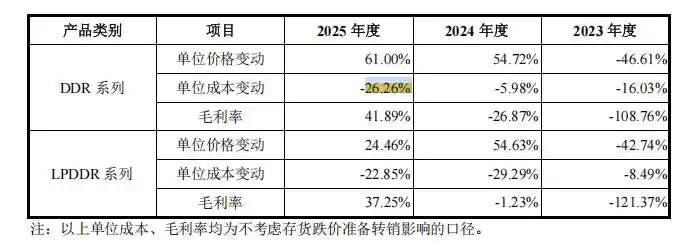
Screenshot of gross margin change analysis for main products

However, improved profitability does not mean ChangXin Technology can completely escape cyclical impacts.

The DRAM industry experiences severe price volatility, and companies face high fixed cost pressures. The prospectus shows that from 2023 to 2025, ChangXin Technology's fixed asset depreciation was 10.555 billion yuan, 14.875 billion yuan, and 24.68 billion yuan, respectively.

"Navigating cycles does not mean maintaining high profits every year, but rather losing less and avoiding severe financial bleeding during industry troughs, maintaining R&D continuity, and being able to release profits faster than in the previous cycle during recovery." Huang Lichong stated.

Crossing "From Zero to One," Gaps Remain with Samsung and Micron

The prospectus shows ChangXin Technology intends to raise 29.5 billion yuan through its Sci-Tech Innovation Board IPO. Of this, 7.5 billion yuan is for wafer manufacturing mass production line technology upgrades, 13 billion yuan for DRAM technology upgrades, and 9 billion yuan for forward-looking technology R&D.

This signifies that the listing is not merely a financing event but an important milestone for ChangXin Technology to further catch up with overseas giants.
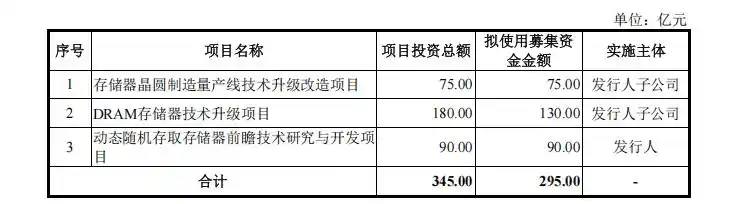
Screenshot of ChangXin Technology's use of raised funds

At the July 15 investor exchange meeting, Chairman Zhu Yiming stated that ChangXin Technology's production capacity scale already ranks first in China and fourth globally, with three 12-inch DRAM wafer fabs in Hefei and Beijing. As DDR5 and LPDDR5/5X products accelerate penetration into downstream markets, coupled with the continuous development of servers, mobile devices, personal computers, smart cars, and other diverse application scenarios, DRAM market demand continues to grow, giving the fundraising projects favorable development prospects.

But looking at the global market, ChangXin Technology remains in a catch-up phase.

Data shows that in Q4 2025, ChangXin Technology's share of global DRAM sales revenue was approximately 7.67%, while Samsung, SK Hynix, and Micron held 33.96%, 34.48%, and 23.41%, respectively.

Guolian Minsheng Securities believes that through its planned 29.5 billion yuan IPO for large-scale capacity expansion, there is a significant gap between ChangXin's current capacity scale and overseas giants. Its existing capacity is nearly fully utilized. With multi-base layout advancement in the medium to long term, Semianalysis predicts the company's global market share will reach 17% by 2028. Compared to the capacity scale of overseas majors, ChangXin has substantial room for subsequent capacity expansion.

Huang Lichong also pointed out that ChangXin Technology has crossed the "from zero to one" stage for domestic DRAM, but gaps remain compared to becoming a global leader. "Having technology without yield cannot generate commercial profit; having capacity with excessively high costs leads to massive losses during industry downturns."

In Huang Lichong's view, the most critical capability ChangXin needs to build in the next phase is the ability for large-scale, stable mass production using advanced processes, primarily reflected in yield and cost-per-bit (the cost required to produce 1 bit of data storage capacity). Simultaneously, ChangXin needs to enhance its high-end product portfolio, global customer resources, and advanced packaging capabilities.

Driven by AI, Need to Demonstrate High-End Competitive Capability

"Market share growth is not the sole goal; more importantly, market share growth must be accompanied by technological generation advancement." Huang Lichong stated.

With the rapid development of the AI industry, memory chips are becoming a new competitive focal point.

AI servers place higher demands on memory capacity, bandwidth, and low-power capabilities, driving demand growth for DDR5, high-performance memory, and related storage products. For memory companies, AI not only brings incremental demand but is also reshaping the industry's competitive landscape.

Indeed, overseas memory giants have been strategically deploying in the AI market through high-value-added products like HBM in recent years to mitigate impacts from traditional DRAM cycle fluctuations.

In contrast, ChangXin Technology is in a stage of breaking into the high-end memory market. The prospectus shows that currently, the proportion of its AI-related revenue remains relatively low, and it has not disclosed that HBM has generated scale revenue. Huang Lichong believes that for the foreseeable future, ChangXin's growth will still mainly rely on the DDR4 to DDR5 upgrade, the LPDDR4X to LPDDR5/5X upgrade, and increases in domestic substitution rates.

"AI determines the industry's ceiling, while traditional DRAM upgrades, process yield, and cost capabilities determine whether ChangXin can truly climb to that ceiling." In Huang Lichong's view, ChangXin Technology needs to further enhance its high-end product competitiveness while maintaining its scale manufacturing advantage to gain greater market space.

"The AI wave has significantly widened the growth space of the memory industry and reshaped its growth logic." Also stated by Zhang Yi, CEO of iiMedia Consulting Group, ChangXin Technology needs to rely on a "dual-line strategy" of traditional DRAM iteration and AI high-end storage R&D in the future: in the short term, stabilizing its foundation and improving profit quality through DDR5 product mix upgrades; in the medium to long term, promoting the industrialization of high-value-added AI storage products like HBM, which will become an important direction for the company to further narrow the gap with international leaders.

This article is from the WeChat public account "Phoenix WEEKLY Finance," author: Wang Han, editor: Cui Lupeng

Trending Cryptos

Related Questions

QWhat is ChangXin Technology's net profit performance from 2023 to 2025, and what does the CEO say about the sustainability of this profitability?

AChangXin Technology's net profit for 2023, 2024, and 2025 was -19.225 billion yuan, -9.051 billion yuan, and 7.144 billion yuan, respectively. Regarding sustainability, Chairman Zhu Yiming stated that while recent profit growth benefits from AI-driven DRAM demand and tight supply, the DRAM industry is highly cyclical. Profitability could be threatened if macroeconomic conditions worsen, AI demand falls short, or new production capacity floods the market.

QWhat are the main reasons for ChangXin Technology's profitability improvement in 2025, according to the article?

AThe profitability improvement in 2025 is attributed to two main factors: 1) A significant rise in the average selling price of its main DRAM products, which increased by 33.69% year-over-year. 2) Expansion in production and sales scale, along with product mix optimization, which involved shifting towards higher-margin products like DDR5.

QHow does ChangXin Technology's market share in the global DRAM market compare to the top three players as of Q4 2025?

AAs of the fourth quarter of 2025, ChangXin Technology held approximately 7.67% of the global DRAM sales market share. In comparison, the top three players were Samsung with 33.96%, SK Hynix with 34.48%, and Micron with 23.41%.

QWhat is the primary use of the 295 billion yuan ChangXin Technology aims to raise through its IPO?

AThe primary use of the 295 billion yuan IPO fundraising is for technology advancement and expansion. Specifically, 75 billion yuan is allocated for upgrading wafer manufacturing production lines, 130 billion yuan for DRAM technology upgrades, and 90 billion yuan for forward-looking technology research and development.

QWhat are the key challenges and strategic focuses for ChangXin Technology in the AI-driven storage market, according to analysts cited in the article?

AAnalysts highlight that ChangXin Technology's AI-related revenue is still relatively low, and it has not yet generated significant revenue from high-bandwidth memory (HBM). The key strategic focus is a 'dual-line layout': in the short term, stabilizing its foundation and improving profitability through the upgrade to DDR5 and LPDDR5/5X products; in the long term, industrializing high-value AI storage products like HBM to close the gap with international leaders.

Related Reads

The Price of DeFi Mass Adoption: Understanding the Profit Distribution and Hidden Risks of Aave Stable Vaults

**Title:** The Price of DeFi Mass Adoption: Understanding Aave Stable Vaults' Profit Distribution and Hidden Risks **Summary:** Aave Labs' new "Stable Vaults" product aims to simplify DeFi for mainstream users by offering fixed yields, a rarity in crypto. The model inserts a middleman layer between users and Aave's underlying lending pools. This layer, often a fintech app or digital bank, absorbs interest rate volatility, guaranteeing users a pre-set stable return while capturing any excess yield from Aave's underlying pools. In exchange for this predictable "peace of mind" and services like customer support and simplified onboarding, users sacrifice potential higher yields and take on new counterparty risks from the operating entity and its infrastructure. The article illustrates this with the example of payroll provider Rise, which transparently passes through most Aave yield, versus the higher profit margins possible through Stable Vaults. While a rational trade-off for many non-expert users prioritizing simplicity and security, the system centralizes risk and obfuscates true market yields. Aave benefits by attracting sticky, non-speculative capital crucial for its long-term economic model, highlighting the industry's shift towards catering to fundamental human preferences for convenience over complex, self-managed financial systems.

Foresight News9m ago

The Price of DeFi Mass Adoption: Understanding the Profit Distribution and Hidden Risks of Aave Stable Vaults

Foresight News9m ago

Stripe's $53.4 Billion Acquisition of PayPal: The Final Piece of the Stablecoin Empire Puzzle

Stripe has reportedly made a $53.4 billion acquisition offer for PayPal, a move that could signal a major shift in the stablecoin landscape from a "technology race" to a "customer war." Over recent years, Stripe has been quietly building nearly every layer of a stablecoin empire: acquiring the issuance platform Bridge, wallet provider Privy, co-incubating the payments-focused Layer 1 network Tempo with Paradigm, and joining the Open USD (OUSD) alliance stablecoin initiative. What it lacks, however, is a massive direct consumer user base. PayPal, with its hundreds of millions of active accounts, the Venmo app, and its own PYUSD stablecoin, would provide exactly that. The acquisition could create a closed-loop system where Stripe handles the merchant side, PayPal/Venmo serve consumers, and transactions are settled via stablecoins on a blockchain like Tempo, potentially bypassing traditional card networks and their fees. While the deal is not yet finalized and may face hurdles—including potential resistance from PayPal's board or a higher bid—the mere offer suggests Stripe's strategic focus may have evolved. It indicates that having superior infrastructure alone may not be enough; distribution and user access are critical battlegrounds. Questions remain about how PYUSD, OUSD, and Venmo would integrate with Stripe's stack, and whether private equity co-investor Advent International would prioritize such crypto experiments. If successful, this acquisition could significantly boost Tempo's position in the competitive public blockchain space and further push crypto-based payments into the mainstream, potentially fulfilling PayPal's original vision of an internet-native currency through a new, crypto-native infrastructure.

marsbit22m ago

Stripe's $53.4 Billion Acquisition of PayPal: The Final Piece of the Stablecoin Empire Puzzle

marsbit22m ago

Hyperliquid's "Stock Price" for ChangXin Memory Tech Hits $8.64: How Was This Price Determined Before the IPO?

Title: Hyperliquid's "Stock Price" for CXMT Hits $8.64: How is This Pre-IPO Price Determined? Summary: On Hyperliquid, a derivative contract tracking the pre-IPO value of Chinese chipmaker Changxin Xinqiao (CXMT) has been trading, with its price reaching $8.64. This price is not a real stock price or a direct IPO valuation, but the result of a specific market mechanism. Trade.xyz deployed this "Pre-IPO Perpetual" (IPOP) contract via Hyperliquid's HIP-3 framework. It tracks the expected USD value of one Changxin A-share post-listing. The contract started with an artificial "discretionary reference price" of $5 set by Trade.xyz. Subsequent trading prices are primarily determined by supply and demand on Hyperliquid's on-chain order book. Since there's no tradable现货 before the IPO, the contract price isn't forced to align with the official IPO price of 8.66 RMB (~$1.28). Key mechanics shape the price: 1. **Order Book-Driven**: The actual成交价 comes from limit orders matched on-chain. 2. **Internal Oracle & Smoothing**: An internal oracle, run by Trade.xyz, calculates a smoothed price based on the order book's "impact price" using a 30-minute exponential moving average (EWMA). This oracle price influences funding rates. 3. **Mark Price for Risk**: A separate Mark Price, derived from the median of the internal oracle and other inputs, is used for calculating profit/loss and liquidation. 4. **Discovery Bound (Price护栏)**: A 20% "Discovery Bound" limits how far the price can move from the current reference point. However, if the price hits the bound, the reference price can be re-anchored upward (or downward) up to 7 times. This explains the阶梯状 jumps to $6, $7.2, and $8.64. 5. **Low Funding Rate**: A minimal funding rate (0.005 multiplier) allows positions to be held with low cost before the IPO, but it provides a weak anchor. Post-IPO, the contract is expected to convert to a standard stock perpetual, with its oracle switching to the actual A-share price converted to USD. This transition could cause price jumps and potential liquidations if there's a significant gap between the pre-IPO contract price and the real market price. In essence, the $8.64 price is a composite of: a人为设定的起点 + on-chain order book supply/demand +内部 oracle 平滑 + low funding rate damping + a moving price护栏. It represents a collective bet by specific market participants on the future public market valuation, not the company's current or official IPO price.

marsbit23m ago

Hyperliquid's "Stock Price" for ChangXin Memory Tech Hits $8.64: How Was This Price Determined Before the IPO?

marsbit23m ago

Prices From the Future Fool the Oracle, Ostium Drained of $24 Million in Five Minutes

Ostium, a perpetual trading platform, suffered a security incident on July 15, resulting in significant losses from its public liquidity vault. Initial analyses from Blockaid, Cyvers, and PeckShield estimate losses of up to $24 million. The exploit occurred over a five-minute window. According to security firms, the core issue was not a missing signature, but a data integrity failure: a registered price oracle (PriceUpKeep) submitted authorized price reports with manipulated future timestamps, creating false trading profits. The protocol’s verification process confirmed the signatures as authorized but did not enforce price sanity checks or timestamp boundaries, allowing the manipulated data to be accepted for settlement. This caused the liquidity vault to pay out on these fraudulent profits. Ostium’s co-founder confirmed the team paused trading within an hour and is collaborating with law enforcement and security experts. The extracted funds were reportedly swapped for ETH, with a portion moved to Tornado Cash. The incident highlights risks in DeFi oracle designs where cryptographic signature verification is insufficient without additional safeguards for data validity, timestamp freshness, and price reasonableness. Ostium's response and planned fixes—including stricter timestamp validation, independent price checks, and circuit breakers—will be critical to preventing similar exploits.

marsbit45m ago

Prices From the Future Fool the Oracle, Ostium Drained of $24 Million in Five Minutes

marsbit45m ago

Trading

Spot

Hot Articles

How to Buy CORE

Welcome to HTX.com! We've made purchasing CORE (CORE) simple and convenient. Follow our step-by-step guide to embark on your crypto journey.Step 1: Create Your HTX AccountUse your email or phone number to sign up for a free account on HTX. Experience a hassle-free registration journey and unlock all features.Get My AccountStep 2: Go to Buy Crypto and Choose Your Payment MethodCredit/Debit Card: Use your Visa or Mastercard to buy CORE (CORE) instantly.Balance: Use funds from your HTX account balance to trade seamlessly.Third Parties: We've added popular payment methods such as Google Pay and Apple Pay to enhance convenience.P2P: Trade directly with other users on HTX.Over-the-Counter (OTC): We offer tailor-made services and competitive exchange rates for traders.Step 3: Store Your CORE (CORE)After purchasing your CORE (CORE), store it in your HTX account. Alternatively, you can send it elsewhere via blockchain transfer or use it to trade other cryptocurrencies.Step 4: Trade CORE (CORE)Easily trade CORE (CORE) on HTX's spot market. Simply access your account, select your trading pair, execute your trades, and monitor in real-time. We offer a user-friendly experience for both beginners and seasoned traders.

5.8k Total ViewsPublished 2024.03.29Updated 2026.06.02

How to Buy CORE

Discussions

Welcome to the HTX Community. Here, you can stay informed about the latest platform developments and gain access to professional market insights. Users' opinions on the price of CORE (CORE) are presented below.

活动图片