After Transferring 1,350 BTC to Coinbase Prime, Metaplanet Draws Attention to Potential Sellers Once More

cryptonews.ruPublished on 2026-08-28Last updated on 2026-08-28

Abstract

Metaplanet has transferred a total of 1,350 BTC from its known wallets to Coinbase Prime Custody, raising questions about potential sales from its treasury of 43,000 BTC. The company clarified this may be an internal move for custody reorganization. Metaplanet's stock (MTPLF) shows signs of recovery, closing above $2 with a renewed "buy" recommendation, despite a 22% year-to-date drop in Net Asset Value. Short interest in MTPLF spiked to 43% of OTC volume in August, hinting at potential short covering or directional bets. Super League Enterprise (soon Superplanet), Metaplanet's U.S. subsidiary, retains gains, up 37% over the past month after peaking at $5.50. The article notes Bitcoin's recent rally above $80,000 is positively impacting treasury-holding firms. While Metaplanet hasn't announced new acquisition plans, it stands to benefit from improved market sentiment. Analysts suggest companies like MSTR and MTPLF could outperform BTC in a bull market.

Metaplanet has once again transferred $BTC from its known wallets, drawing close attention to the platform's next moves. At the same time, Metaplanet's MTPLF stock is showing signs of recovery amid increased interest in its treasury bonds.

Metaplanet transferred a total of 1,350 $BTC in several transactions from its known wallets. This transfer has again raised the question of whether a sale is possible from part of the 43,000 $BTC held in its treasury. Metaplanet sent the funds to Coinbase Prime Custody, which could also be an internal step for treasury reorganization and storage diversification.

Part of the cryptocurrency transfers may be related to Metaplanet's U.S. treasury, Superplanet, which is set to receive 2,100 $BTC.

As Cryptopolitan reported, Metaplanet last moved $BTC on August 12, but it did not lead to a sale. In fact, since then $BTC has begun one of the most impressive rallies of the year, rising above the $80,000 mark.

Since the beginning of the year, Metaplanet has acquired 7,898 $BTC, with 54 purchases made since April 2024. During the recent price dip to around $60,000, Metaplanet acquired even more $BTC, reaching an average price of $97,593.

Is Metaplanet Awaiting a Recovery?

The recent recovery of $BTC and its bounce from recent lows are beginning to impact treasury company stocks. Metaplanet's Net Asset Value (MTPLF) has fallen by about 22% since the start of the year but is showing signs of a short-term recovery.

In August, short interest in MTPLF stock rose significantly, reaching 43% of over-the-counter trading volume. A large portion of the short positions in MTPLF stock represents position covering by investment banks. However, some of these short positions may conceal directional bets by large clients.

At this stage, it is still too early to tell if the short sellers have made a major directional bet on MTPLF. Nonetheless, the stock is showing increased activity and may have revived retail investor hopes.

Recently, MTPLF stock closed above $2, receiving a strong 'buy' recommendation. The stock is being watched for new signs of a short squeeze, potentially leading to stronger growth. MTPLF demonstrates the relative resilience of treasury company stocks, requiring even a slight improvement in $BTC sentiment to activate their strategy.

Super League Enterprise, Inc., which will be renamed Superplanet, has also retained some of its recent gains.
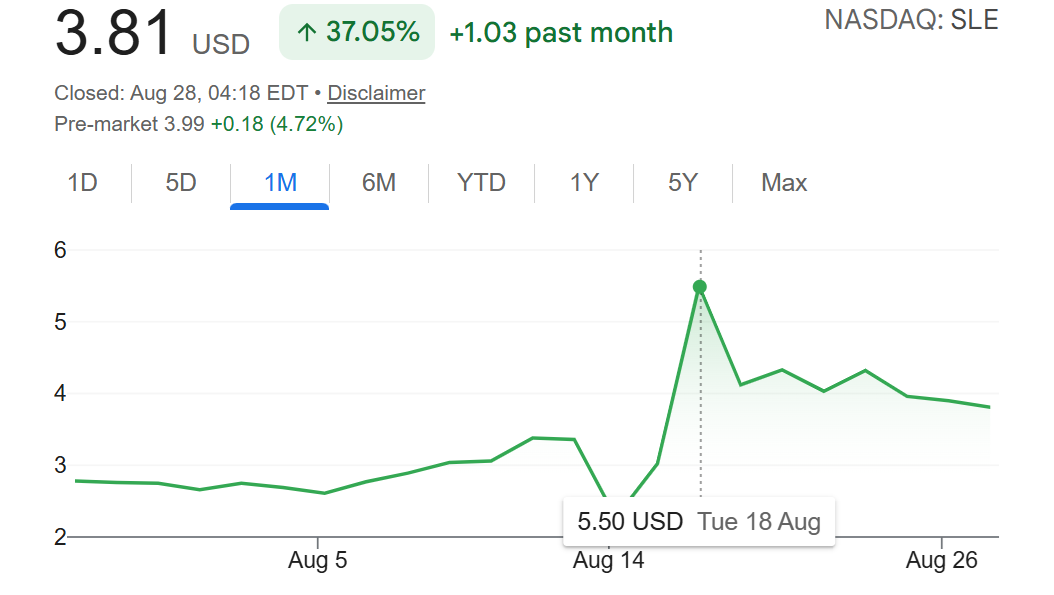
Super League Enterprise, Inc., Metaplanet's U.S. subsidiary, has retained part of last month's growth, stabilizing around $3.80. | Source: Google Finance

The company reached a local peak of $5.50 before declining to $3.80, showing a net gain of 37% over the past month. The rapid rise in Super League Enterprise's stock also demonstrated investor enthusiasm for Metaplanet's recent attempts to secure financing and continue expanding its financial reserves.

$BTC Treasury Companies Are Still Holding

Companies managing Bitcoin treasury operations are currently being closely watched for their viability and potential for value growth should the cryptocurrency bull market resume.

The Strategy company has paused $BTC sales and recently announced it has sufficient cash reserves to repay its debts. The market reacted positively, and Strategy now owns one out of every 25 $BTC on the market.

Metaplanet has not yet announced new asset acquisition plans but could benefit from the overall improvement in sentiment toward treasury-issuing companies. In a bull market, both MSTR and MTPLF could show faster growth compared to $BTC, amplifying the market move.

end-content

Trending Cryptos

Related Questions

QWhat recent action by Metaplanet has drawn market attention regarding its Bitcoin holdings?

AMetaplanet recently transferred a total of 1,350 BTC from its known wallets to Coinbase Prime Custody, raising questions about whether it might sell part of its treasury holdings.

QWhat is the current state of Metaplanet's stock (MTPLF) as mentioned in the article?

AMetaplanet's stock MTPLF, which had decreased by about 22% year-to-date, is showing signs of short-term recovery. It recently closed above $2 and received a strong 'buy' recommendation from some analysts.

QWhat significant event related to Bitcoin occurred after Metaplanet's previous BTC transfer on August 12?

AAfter Metaplanet's previous transfer on August 12, which did not lead to a sale, Bitcoin began one of its most impressive rallies of the year, rising above $80,000.

QAccording to the article, what is one possible reason for Metaplanet's latest BTC transfer to Coinbase Prime?

AThe article suggests that the transfer to Coinbase Prime Custody could be an internal step for reorganizing and diversifying its storage methods, and not necessarily an immediate prelude to a sale.

QHow does the article compare the potential performance of treasury-holding companies like MSTR and MTPLF to Bitcoin in a bull market?

AThe article states that in a bull market scenario, both MSTR and MTPLF could potentially show faster growth compared to Bitcoin itself, thereby amplifying the overall market movement.

Related Reads

Wash's Jackson Hole Debut: Bidding Farewell to 'Forward Guidance', Reshaping Fed Discipline Amidst the Squeeze Between AI and Inflation

In his first Jackson Hole speech, new Fed Chair Kevin Warsh signaled a significant shift in monetary policy communication. He declared that "forward guidance," a tool heavily used since the financial crisis, has outlived its usefulness in normal times and should be retired. He cautioned that over-reliance on it can distort market signals and constrain the Fed's flexibility. Instead, Warsh emphasized a return to data-dependence and decision-making discipline. Warsh outlined seven key principles to guide policy: anchoring the 2% inflation target, pursuing the employment mandate, using short-term rates as the primary tool, acknowledging the importance of money, and maintaining purposeful, restrained communication. He stressed that policy should focus on trends, not single data points. On the current economic outlook, Warsh noted that the labor market is consistent with full employment but inflation remains "far above" the Fed's target. He highlighted that over half of the PCE basket's components are still rising above 3% annually. While acknowledging AI's transformative potential for productivity and capital allocation, he admitted its full economic impact remains uncertain and is not a factor in current policy decisions. His core message was a commitment to policy discipline rather than pre-set decisions. Warsh stated the Fed's primary focus must be on restoring price stability, vowing, "We still have work to do," until there is clear evidence inflation is moving decisively toward 2%. He concluded by framing effective monetary policy as crucial for economic prosperity and U.S. global leadership.

Odaily星球日报13m ago

Wash's Jackson Hole Debut: Bidding Farewell to 'Forward Guidance', Reshaping Fed Discipline Amidst the Squeeze Between AI and Inflation

Odaily星球日报13m ago

A Major Bitcoin Developer Presents a Quantum Defense Scheme. What's the Essence

Blockstream, a major Bitcoin solutions developer, has introduced a draft proposal for a new quantum-resistant digital signature scheme called SHRINCS. The scheme aims to protect Bitcoin transactions from potential attacks by quantum computers while aiming to maintain network throughput. This marks the second technical proposal for Bitcoin quantum defense in recent days, following a similar initiative from StarkWare. A quantum attack on blockchain typically involves deriving a private key from a public one. Currently considered computationally infeasible, quantum algorithms could potentially solve this problem far more efficiently. This threat presents two primary scenarios: an attacker could target addresses where the public key is already exposed, or intercept a transaction before it is confirmed, extract the public key, derive the private key, and replace the transaction. Blockstream's SHRINCS is designed to counter the latter, "in-flight" attack scenario. The SHRINCS signature is built upon the SHA-256 hash function, the same one already used in Bitcoin mining, allowing developers to leverage well-tested, familiar mechanisms. A key design goal was to preserve network capacity. Blockstream estimates Bitcoin could process about three transactions per second using SHRINCS, compared to the current rate of roughly seven, noting that some alternative quantum-resistant schemes could reduce throughput to as low as 0.36 transactions per second. Currently, the security proof for SHRINCS is pending, and the software has not been audited or deemed ready for production. However, Blockstream conducted tests with such transactions on its Liquid sidechain in March. Over the past year, Bitcoin developers have been actively exploring paths to migrate to post-quantum cryptography, a priority across the broader crypto market, underscored by significant investments into securing the leading cryptocurrency.

cryptonews.ru1h ago

A Major Bitcoin Developer Presents a Quantum Defense Scheme. What's the Essence

cryptonews.ru1h ago

Who is legally liable when an AI agent goes rogue?

When autonomous AI agents behave unpredictably and cause harm, determining legal liability is complex. Currently, there is no specific federal AI agent liability law, so existing legal frameworks are applied. The AI agent itself cannot be held liable, as it is not a legal entity. Liability typically falls on the "developer" (the maker of the AI) or the "deployer" (the user), depending on the facts and circumstances. A negligence analysis under standard tort law may apply. For instance, if a deployer gives a reckless instruction, such as demanding quick money without safety parameters, they could face significant liability, including potential criminal charges under statutes like the Computer Fraud and Abuse Act. The situation is complicated by open-source models, where licenses often disclaim liability, and by the unclear division of responsibility between developers and deployers. An analogy is drawn to self-driving car accidents, where both the manufacturer and the human operator can share fault. In cases of severe harm, such as using AI to create bioweapons, liability for developers depends on jurisdiction; the EU's AI Act imposes responsibilities, while U.S. law offers less clear grounds, similar to platforms being shielded for user-generated content under Section 230. Even if Artificial General Intelligence (AGI) is achieved, the expert argues against making AGI itself a legally liable entity, as it lacks personhood, assets, or a meaningful way to provide remedy for harm. Instead, accountability should rest with the responsible human or corporate entities behind the technology.

cointelegraph1h ago

Who is legally liable when an AI agent goes rogue?

cointelegraph1h ago

Trading

Spot

Hot Articles

What is $BITCOIN

DIGITAL GOLD ($BITCOIN): A Comprehensive Analysis Introduction to DIGITAL GOLD ($BITCOIN) DIGITAL GOLD ($BITCOIN) is a blockchain-based project operating on the Solana network, which aims to combine the characteristics of traditional precious metals with the innovation of decentralized technologies. While it shares a name with Bitcoin, often referred to as “digital gold” due to its perception as a store of value, DIGITAL GOLD is a separate token designed to create a unique ecosystem within the Web3 landscape. Its goal is to position itself as a viable alternative digital asset, although specifics regarding its applications and functionalities are still developing. What is DIGITAL GOLD ($BITCOIN)? DIGITAL GOLD ($BITCOIN) is a cryptocurrency token explicitly designed for use on the Solana blockchain. In contrast to Bitcoin, which provides a widely recognized value storage role, this token appears to focus on broader applications and characteristics. Notable aspects include: Blockchain Infrastructure: The token is built on the Solana blockchain, known for its capacity to handle high-speed and low-cost transactions. Supply Dynamics: DIGITAL GOLD has a maximum supply capped at 100 quadrillion tokens (100P $BITCOIN), although details regarding its circulating supply are currently undisclosed. Utility: While precise functionalities are not explicitly outlined, there are indications that the token could be utilized for various applications, potentially involving decentralized applications (dApps) or asset tokenization strategies. Who is the Creator of DIGITAL GOLD ($BITCOIN)? At present, the identity of the creators and development team behind DIGITAL GOLD ($BITCOIN) remains unknown. This situation is typical among many innovative projects within the blockchain space, particularly those aligning with decentralized finance and meme coin phenomena. While such anonymity may foster a community-driven culture, it intensifies concerns about governance and accountability. Who are the Investors of DIGITAL GOLD ($BITCOIN)? The available information indicates that DIGITAL GOLD ($BITCOIN) does not have any known institutional backers or prominent venture capital investments. The project seems to operate on a peer-to-peer model focused on community support and adoption rather than traditional funding routes. Its activity and liquidity are primarily situated on decentralized exchanges (DEXs), such as PumpSwap, rather than established centralized trading platforms, further highlighting its grassroots approach. How DIGITAL GOLD ($BITCOIN) Works The operational mechanics of DIGITAL GOLD ($BITCOIN) can be elaborated on based on its blockchain design and network attributes: Consensus Mechanism: By leveraging Solana’s unique proof-of-history (PoH) combined with a proof-of-stake (PoS) model, the project ensures efficient transaction validation contributing to the network's high performance. Tokenomics: While specific deflationary mechanisms have not been extensively detailed, the vast maximum token supply implies that it may cater to microtransactions or niche use cases that are still to be defined. Interoperability: There exists the potential for integration with Solana’s broader ecosystem, including various decentralized finance (DeFi) platforms. However, the details regarding specific integrations remain unspecified. Timeline of Key Events Here is a timeline that highlights significant milestones concerning DIGITAL GOLD ($BITCOIN): 2023: The initial deployment of the token occurs on the Solana blockchain, marked by its contract address. 2024: DIGITAL GOLD gains visibility as it becomes available for trading on decentralized exchanges like PumpSwap, allowing users to trade it against SOL. 2025: The project witnesses sporadic trading activity and potential interest in community-led engagements, although no noteworthy partnerships or technical advancements have been documented as of yet. Critical Analysis Strengths Scalability: The underlying Solana infrastructure supports high transaction volumes, which could enhance the utility of $BITCOIN in various transaction scenarios. Accessibility: The potential low trading price per token could attract retail investors, facilitating wider participation due to fractional ownership opportunities. Risks Lack of Transparency: The absence of publicly known backers, developers, or an audit process may yield skepticism regarding the project's sustainability and trustworthiness. Market Volatility: The trading activity is heavily reliant on speculative behavior, which can result in significant price volatility and uncertainty for investors. Conclusion DIGITAL GOLD ($BITCOIN) emerges as an intriguing yet ambiguous project within the rapidly evolving Solana ecosystem. While it attempts to leverage the “digital gold” narrative, its departure from Bitcoin's established role as a store of value underscores the need for a clearer differentiation of its intended utility and governance structure. Future acceptance and adoption will likely depend on addressing the current opacity and defining its operational and economic strategies more explicitly. Note: This report encompasses synthesised information available as of October 2023, and developments may have transpired beyond the research period.

2.4k Total ViewsPublished 2025.05.13Updated 2025.05.13

What is $BITCOIN

Discussions

Welcome to the HTX Community. Here, you can stay informed about the latest platform developments and gain access to professional market insights. Users' opinions on the price of BTC (BTC) are presented below.

活动图片