Bitcoin and gold decline together – ‘Haven’t seen before,’ says strategist

ambcryptoPublished on 2026-06-29Last updated on 2026-06-29

Abstract

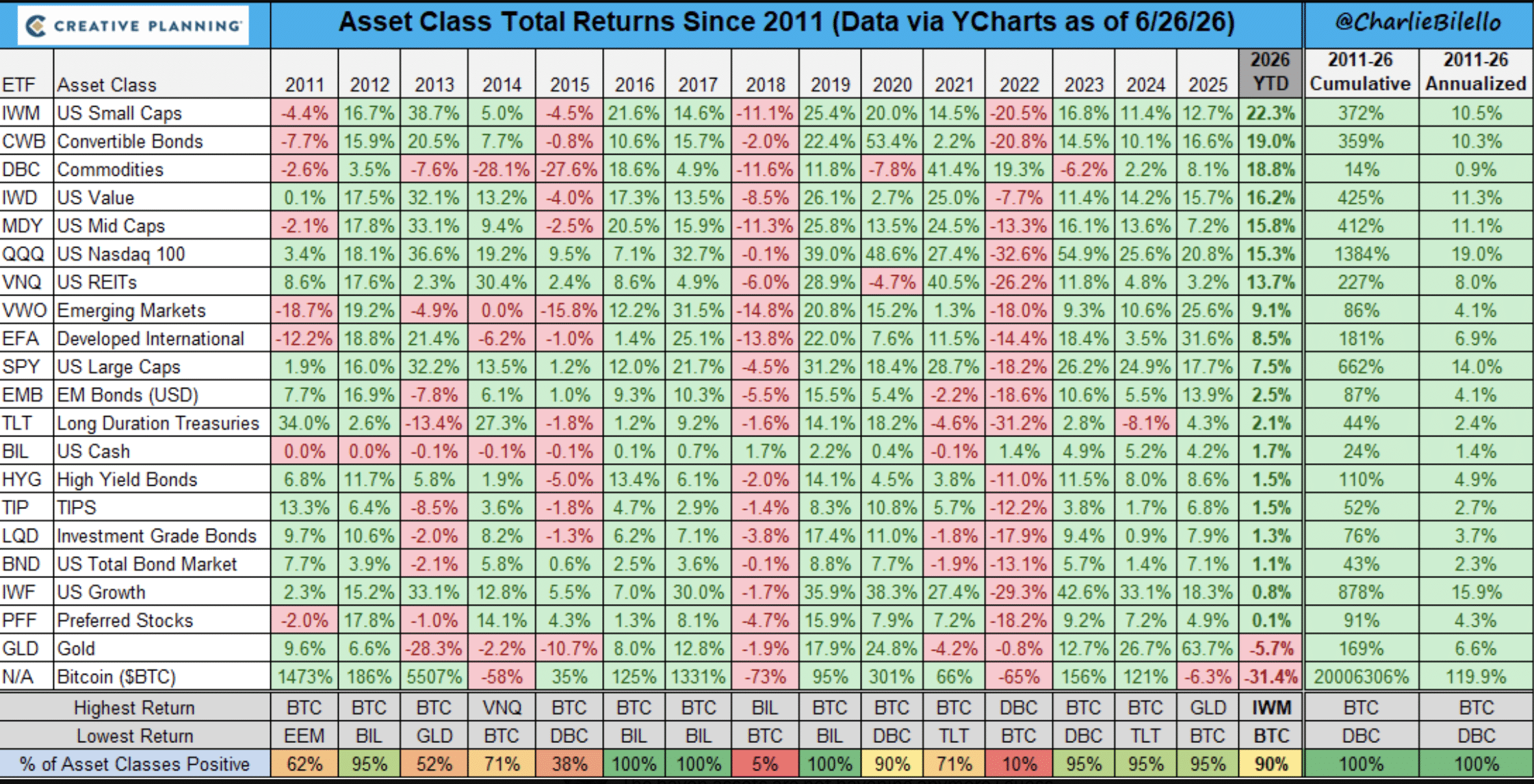
Market strategist Charlie Bilello notes that 2026 has been a historically unique year, with both Bitcoin and gold declining significantly—Bitcoin down 31% and gold down 6%—making them the worst-performing major asset classes. This simultaneous drop, not observed in any previous calendar year, suggests investors are reducing exposure to both traditional and alternative stores of value. The trend is attributed to a mix of factors including sustained high interest rates, geopolitical conflicts, and increased crypto hacks. Bitcoin's price fell 43% over the past year to around $60,237, while gold saw a 33% increase to about $4,072. The correlation between the two assets, which was low or negative for much of the period, turned strongly positive by June 2026 as gold also began to decline. Historically, Bitcoin and gold have often moved inversely during market stress, but 2026 shows a break from that pattern, with both assets under significant pressure.

According to a revelation made by market strategist Charlie Bilello, Bitcoin [BTC] and gold have fallen 31% and 6%, respectively, making them the two worst-performing major asset classes in 2026 thus far.

Needless to say, this combination is unusual in history.
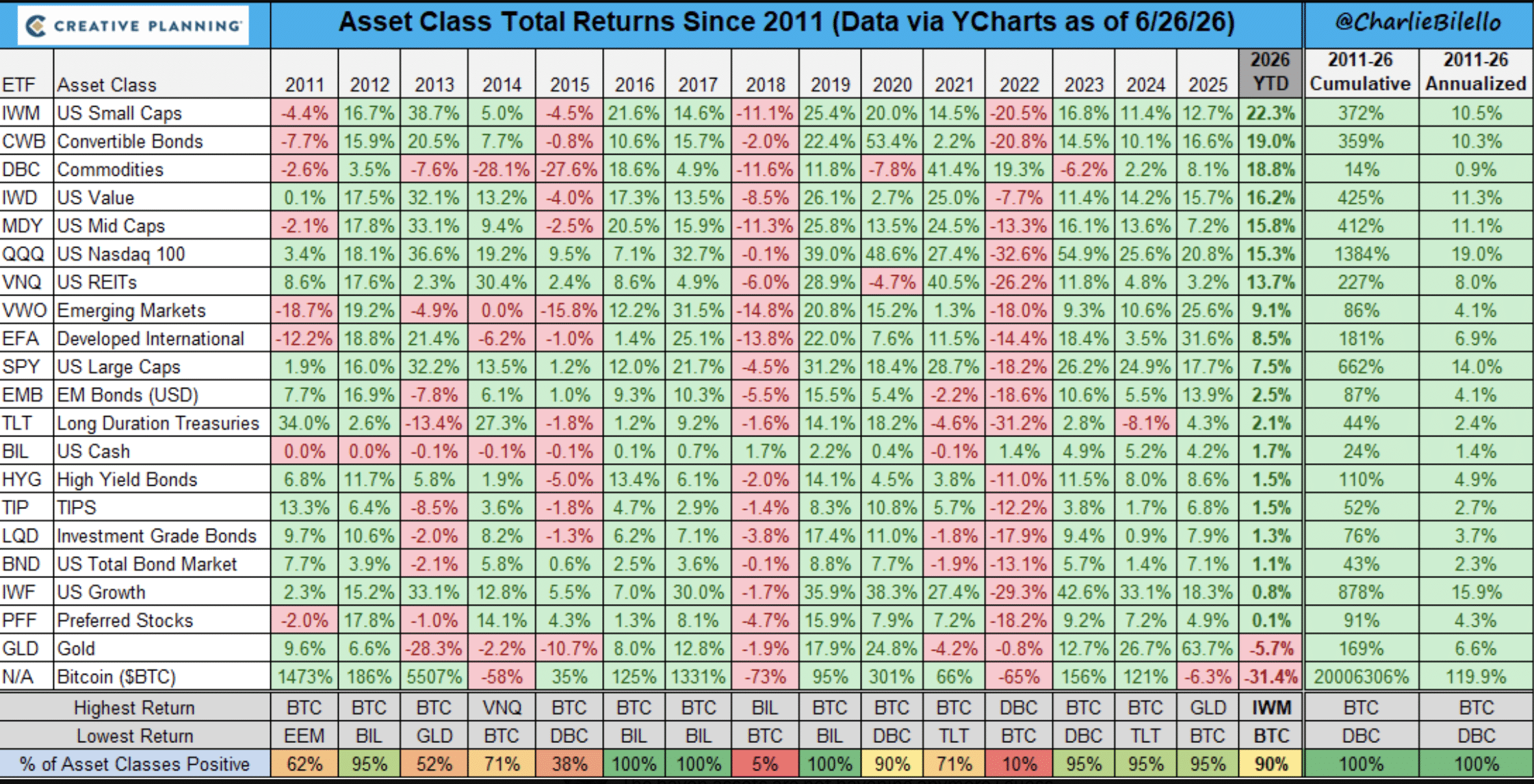
Source: X

2026 becomes a unique year for Bitcoin and Gold

Naturally, this suggests that investors have been lowering their exposure to both conventional and alternative value stores.

As a result, money has mostly moved into other asset classes that have produced higher returns, making 2026 the first year that both gold and Bitcoin have been among the major assets with the worst performance.

Remarking on the same, Bilello added,

This is something we haven’t seen before in any calendar year.

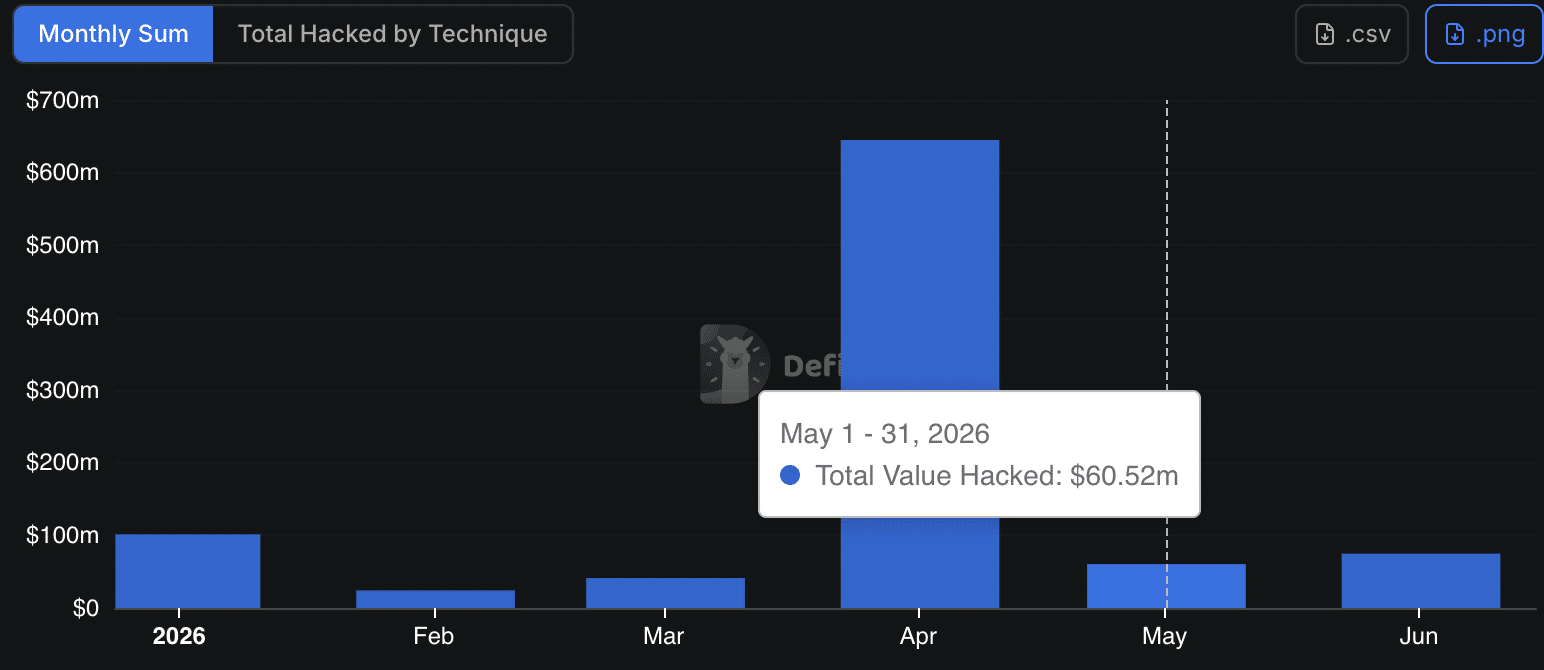
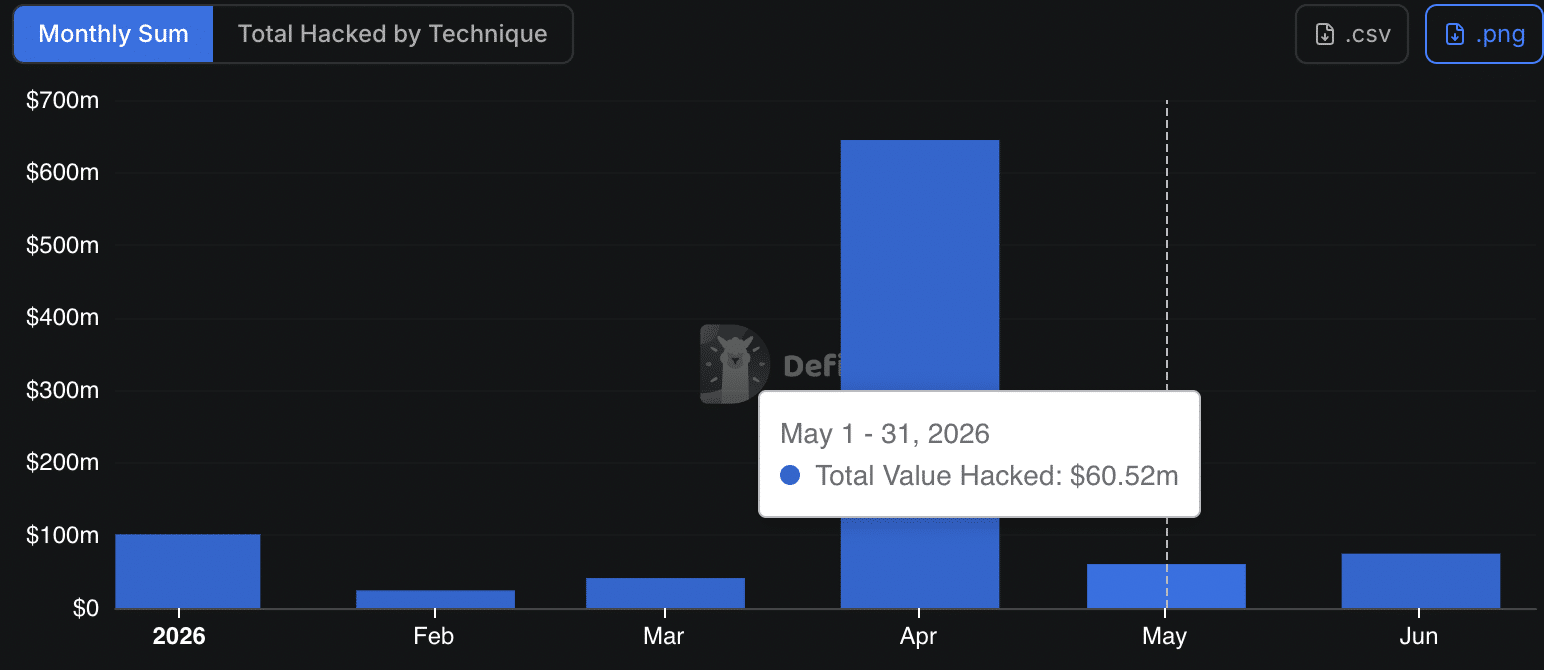
That said, all this might be because of a combination of macroeconomic and geopolitical factors, such as extended high-interest rates, intensifying geopolitical conflicts in Q1 2026, and increased numbers of hacks and exploits.
Source: DeFiLlama

Bitcoin and gold both flag signs of concerns

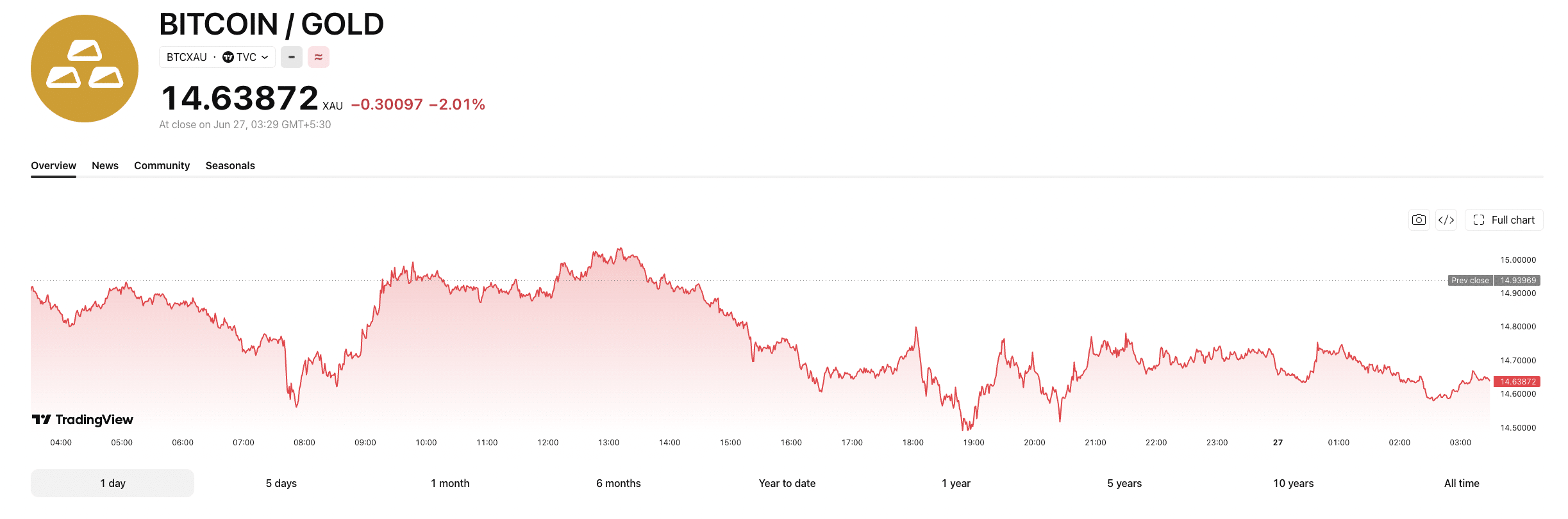
This coincided with the price of Bitcoin trading at $60,237.04 at the time of writing, following a 43% drop in a year. Meanwhile, the price of gold was at $4,071.95 following a 33% increase during the same period. Meanwhile, the Bitcoin to Gold ratio was at 14.63872, down 2.01% from the day before.
Source: Trading View

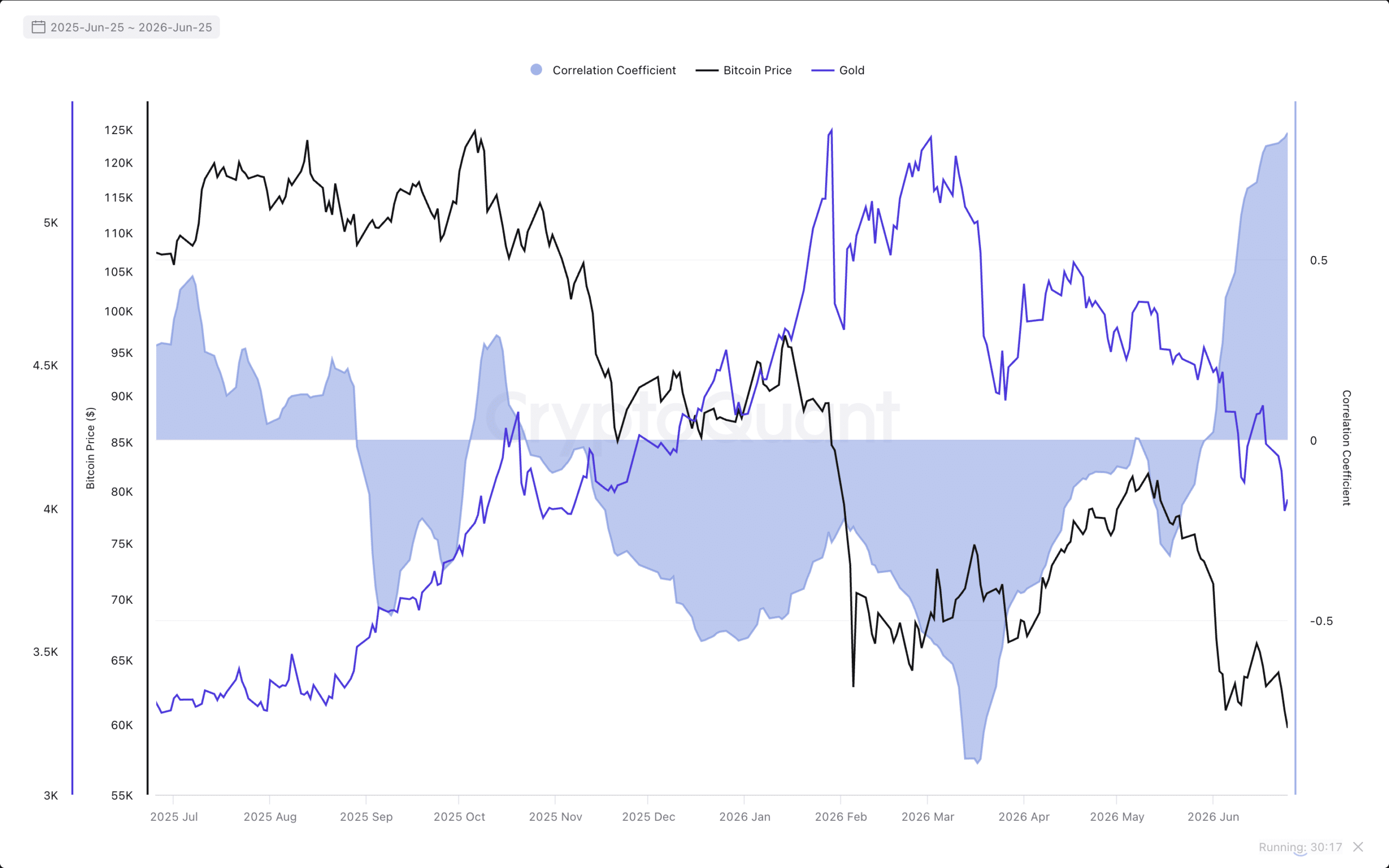
Additionally, a significant difference between June 2025 and June 2026 was also shown by the Bitcoin and Gold Price Correlation. The graph shows how the two assets’ correlation fluctuated throughout the year, often moving between positive and negative areas.
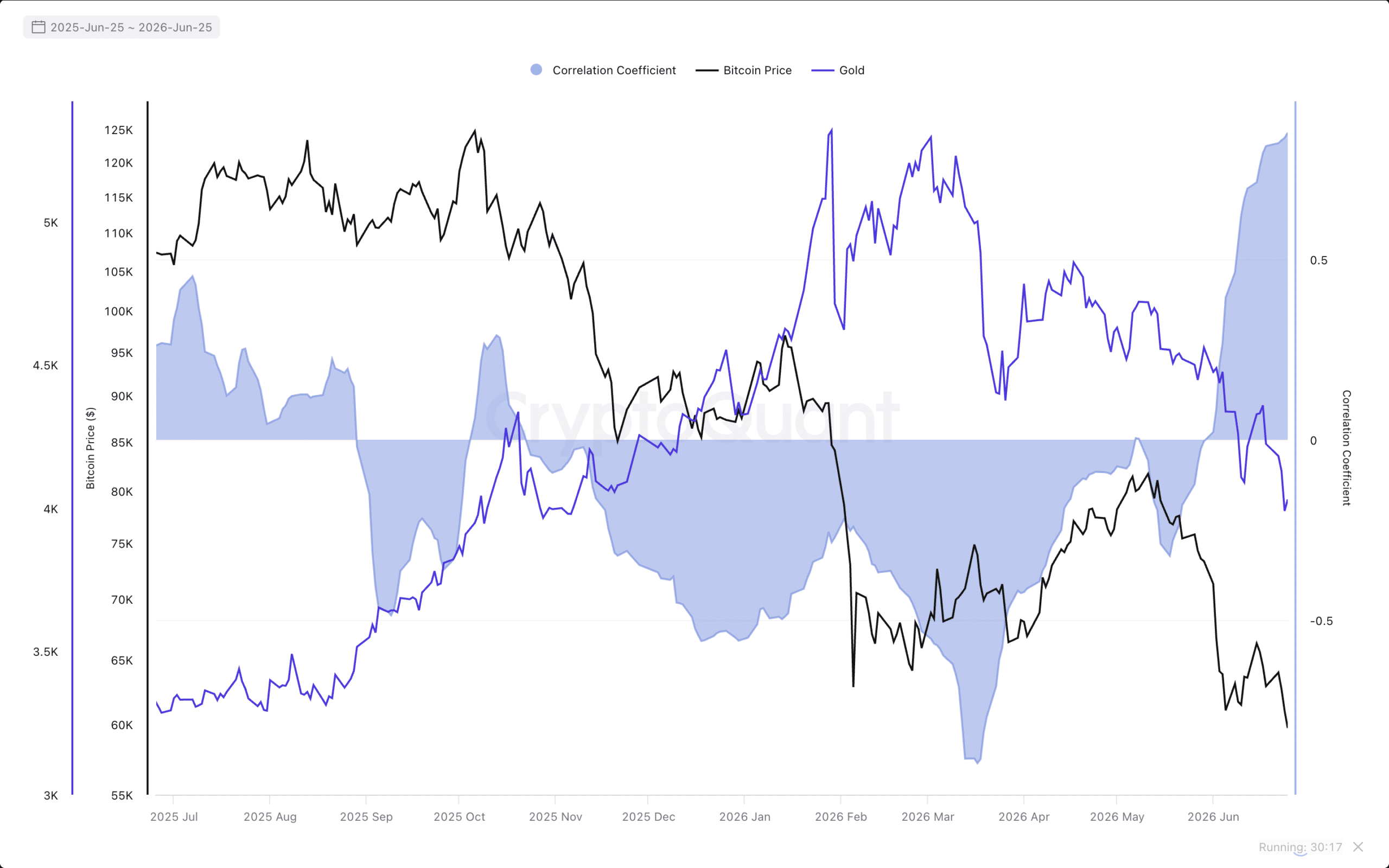
Source: CryptoQuant

Though their price movements were only marginally related, Bitcoin traded above $110,000 in the second half of 2025 while gold steadily gained ground.

At first, gold held up well, reflecting its long-standing appeal during times of market turbulence, even as Bitcoin entered a steep decline starting in February 2026, dropping from about $90,000 to almost $60,000. However, the correlation coefficient jumped into strongly positive territory by June 2026 as gold also started to decline.

Regarding this, Bitcoin expert Adam Livingston had recently pointed out,

2026 is officially the most oversold year for Bitcoin versus gold ever recorded.

What happened in previous years?

That said, throughout history, Bitcoin and gold have often moved in opposing directions during periods of market stress.

According to a previous report by AMBCrypto, during the March COVID-19 outbreak, Bitcoin rose 21% while the S&P 500 and gold increased 2% and 3%, respectively.

Similar trends were seen in the Russia-Ukraine war, the U.S. banking crisis, and the U.S.-Iran war in 2026.


Final Summary

  • Both Bitcoin and gold, which usually move in opposite directions, have already declined this year.
  • Bitcoin to Gold ratio and the price correlation between the 2 assets further flag signs of stress.


Trending Cryptos

Related Questions

QWhat unusual phenomenon regarding Bitcoin and gold in 2026 is highlighted by strategist Charlie Bilello?

ACharlie Bilello highlighted that Bitcoin and gold have both declined significantly in 2026, with Bitcoin down 31% and gold down 6%, making them the two worst-performing major asset classes for the year so far—a combination not seen before in any calendar year.

QAccording to the article, what are some potential reasons for the simultaneous decline of Bitcoin and gold in 2026?

AThe article suggests the decline could be due to a combination of macroeconomic and geopolitical factors, including extended high-interest rates, intensifying geopolitical conflicts in Q1 2026, and an increased number of hacks and exploits.

QHow did the correlation between Bitcoin and gold's price movements change from 2025 to mid-2026?

AIn the second half of 2025, Bitcoin traded above $110,000 while gold steadily gained, showing only a marginal correlation. However, by June 2026, after Bitcoin entered a steep decline and gold also started to fall, the correlation coefficient jumped into strongly positive territory.

QWhat is the historical pattern for Bitcoin and gold movements during periods of market stress, according to the article?

AHistorically, during periods of market stress such as the March COVID-19 outbreak, the Russia-Ukraine war, the U.S. banking crisis, and the 2026 U.S.-Iran war, Bitcoin and gold have often moved in opposing directions.

QWhat statement did Bitcoin expert Adam Livingston make about 2026 concerning Bitcoin versus gold?

ABitcoin expert Adam Livingston stated that '2026 is officially the most oversold year for Bitcoin versus gold ever recorded.'

Related Reads

Latest Interview with Cyber Godfather Tibo: Dedicated Physical Button for Resets, 'I Reset Whenever I Want'

Tibo, the head of OpenAI's Codex project, recently discussed AI's future and OpenAI's strategy in an interview. He revealed that Codex and ChatGPT are set to merge into a single, highly personalized AGI that adapts its interface to individual users. The future of AI Agents, he believes, lies in making complex mechanisms like skill management "disappear," creating a seamless partner that understands context and goals. As models grow more powerful, local hardware will become a bottleneck, pushing agents to the cloud for greater computational resources. He highlighted the upcoming "Ultra Fast" mode, which will significantly reduce response times, shifting workflows back to real-time interaction and "flow" states rather than constant context switching. OpenAI's focus, according to Tibo, isn't just on building the strongest models but on delivering powerful capabilities to as many people as possible, emphasizing broad distribution, community involvement, and lowering barriers to use. Tibo also touched on OpenAI's culture of rapid iteration and empowerment, contrasting it with his past experience at Google. He confirmed that OpenAI is already practicing "recursive self-improvement," using powerful models to optimize infrastructure, creating a feedback loop of increasing capability and efficiency. The interview concluded with his thoughts on future human-AI interaction, which he envisions as increasingly natural, multimodal, and voice-first, adapting to human communication styles rather than the reverse. He also humorously noted the existence of a physical "reset" button for user quotas, symbolizing OpenAI's user-centric approach of compensating users during service issues.

marsbit8m ago

Latest Interview with Cyber Godfather Tibo: Dedicated Physical Button for Resets, 'I Reset Whenever I Want'

marsbit8m ago

IOSG | EIP-8363 Quantitative Review: Slashing Staking 'Subsidies'—What Does Ethereum Want in Return?

**Title: IOSG | EIP-8363 Quantitative Review: Cutting Staking "Subsidies"—What Does Ethereum Aim to Gain?** **Summary:** EIP-8363 proposes a mechanism to progressively destroy a larger portion of validator rewards as the staking ratio increases, reaching 100% destruction when 50% of ETH supply is staked. This analysis models its impact on issuance, yield, and staking equilibrium, investigates whether ETH's yield truly explains its price, quantifies the on-chain economy's dependence on this yield, and presents conclusions. Key findings: 1. EIP-1559's fee-burn mechanism has become largely ineffective, with burn rates down 98% since 2022. Issuance policy is now Ethereum's primary remaining lever over ETH supply. 2. At the current staking level (~35% of supply), EIP-8363 would cut issuance by ~58.6% and staking APR by ~56.4%, not eliminate it entirely. The mechanism is self-limiting; under reasonable yield thresholds, the system would stabilize at 26–34% staking with 0.3–0.5% annual issuance. 3. No statistically significant correlation exists between historical staking yield changes and ETH price movements. The natural 37% yield decline since 2023 showed no detectable price impact. 4. The on-chain economy's direct dependence on this yield is limited. Liquid staking tokens (LSTs) like wstETH are crucial as collateral (e.g., 34.2% in major lending markets), but their utility persists as long as yield is positive. Staking-focused ETFs represent a tiny fraction (0.19% of supply) of current demand. 5. The debate is essentially a zero-sum wealth redistribution: cutting ~$1.55B in annual issuance transfers value from concentrated staker/intermediary interests (35% of holders) to the diffuse majority of non-staking holders (65%). The proposal is economically rational but faces high political hurdles due to this concentrated opposition. Verdict: The proposal is mildly bullish for ETH (reducing a structural sell-pressure) but bearish for staking intermediaries/protocols. However, its passage is unlikely due to governance dynamics favoring concentrated, organized opposition over diffuse benefits.

marsbit8m ago

IOSG | EIP-8363 Quantitative Review: Slashing Staking 'Subsidies'—What Does Ethereum Want in Return?

marsbit8m ago

BTC Returns to $80,000, Crypto-Related Stocks Finally Stand Tall

Bitcoin Breaches $80,000 Mark, Boosting Crypto-Related Stocks With the crypto market heating up, Bitcoin has surged back above the $80,000 level after more than a hundred days, posting nearly a 30% gain in a week. This rally has ignited bullish sentiment across the board. Concurrently, crypto-related stocks, which had been experiencing a months-long slump, are staging a powerful comeback, led by key players in digital asset treasuries, exchanges, and trading platforms. Many of these stocks have seen substantial rebounds from their recent lows. Leading the charge is MicroStrategy (MSTR), a major Bitcoin treasury company, whose stock has rebounded nearly 50% from its 52-week low. Close behind is Bitmine (BMNR), the largest public Ethereum treasury, with a staggering 88.6% rebound. Other notable performers include the stablecoin issuer Circle (CRCL), up 75.5%, and the Ethereum-focused company Sharplink (SBET), up 83.7%. While the "crypto market proxy" Coinbase (COIN) has rebounded 29%, its unique position has faced some dilution from new market entrants. Robinhood (HOOD), bolstered by strong Q2 earnings and its expanding crypto ecosystem, has risen 63.2%. The exchange Bullish (BLSH) is up 45.8%. Perhaps the most dramatic rebound belongs to Hyperliquid Strategies (PURR), linked to the Hyperliquid ecosystem, which has skyrocketed over 254% from its low. The analysis highlights that most of these stocks hit their lows around late June, marking a market bottom. It emphasizes the strategy of focusing on leading companies and notes that while the rebound is strong, many stocks remain significantly below their yearly highs. Ultimately, these public companies serve as leveraged proxies for underlying crypto assets like Bitcoin and Ethereum in the current market upswing.

Odaily星球日报19m ago

BTC Returns to $80,000, Crypto-Related Stocks Finally Stand Tall

Odaily星球日报19m ago

Trading

Spot

Hot Articles

What is $BITCOIN

DIGITAL GOLD ($BITCOIN): A Comprehensive Analysis Introduction to DIGITAL GOLD ($BITCOIN) DIGITAL GOLD ($BITCOIN) is a blockchain-based project operating on the Solana network, which aims to combine the characteristics of traditional precious metals with the innovation of decentralized technologies. While it shares a name with Bitcoin, often referred to as “digital gold” due to its perception as a store of value, DIGITAL GOLD is a separate token designed to create a unique ecosystem within the Web3 landscape. Its goal is to position itself as a viable alternative digital asset, although specifics regarding its applications and functionalities are still developing. What is DIGITAL GOLD ($BITCOIN)? DIGITAL GOLD ($BITCOIN) is a cryptocurrency token explicitly designed for use on the Solana blockchain. In contrast to Bitcoin, which provides a widely recognized value storage role, this token appears to focus on broader applications and characteristics. Notable aspects include: Blockchain Infrastructure: The token is built on the Solana blockchain, known for its capacity to handle high-speed and low-cost transactions. Supply Dynamics: DIGITAL GOLD has a maximum supply capped at 100 quadrillion tokens (100P $BITCOIN), although details regarding its circulating supply are currently undisclosed. Utility: While precise functionalities are not explicitly outlined, there are indications that the token could be utilized for various applications, potentially involving decentralized applications (dApps) or asset tokenization strategies. Who is the Creator of DIGITAL GOLD ($BITCOIN)? At present, the identity of the creators and development team behind DIGITAL GOLD ($BITCOIN) remains unknown. This situation is typical among many innovative projects within the blockchain space, particularly those aligning with decentralized finance and meme coin phenomena. While such anonymity may foster a community-driven culture, it intensifies concerns about governance and accountability. Who are the Investors of DIGITAL GOLD ($BITCOIN)? The available information indicates that DIGITAL GOLD ($BITCOIN) does not have any known institutional backers or prominent venture capital investments. The project seems to operate on a peer-to-peer model focused on community support and adoption rather than traditional funding routes. Its activity and liquidity are primarily situated on decentralized exchanges (DEXs), such as PumpSwap, rather than established centralized trading platforms, further highlighting its grassroots approach. How DIGITAL GOLD ($BITCOIN) Works The operational mechanics of DIGITAL GOLD ($BITCOIN) can be elaborated on based on its blockchain design and network attributes: Consensus Mechanism: By leveraging Solana’s unique proof-of-history (PoH) combined with a proof-of-stake (PoS) model, the project ensures efficient transaction validation contributing to the network's high performance. Tokenomics: While specific deflationary mechanisms have not been extensively detailed, the vast maximum token supply implies that it may cater to microtransactions or niche use cases that are still to be defined. Interoperability: There exists the potential for integration with Solana’s broader ecosystem, including various decentralized finance (DeFi) platforms. However, the details regarding specific integrations remain unspecified. Timeline of Key Events Here is a timeline that highlights significant milestones concerning DIGITAL GOLD ($BITCOIN): 2023: The initial deployment of the token occurs on the Solana blockchain, marked by its contract address. 2024: DIGITAL GOLD gains visibility as it becomes available for trading on decentralized exchanges like PumpSwap, allowing users to trade it against SOL. 2025: The project witnesses sporadic trading activity and potential interest in community-led engagements, although no noteworthy partnerships or technical advancements have been documented as of yet. Critical Analysis Strengths Scalability: The underlying Solana infrastructure supports high transaction volumes, which could enhance the utility of $BITCOIN in various transaction scenarios. Accessibility: The potential low trading price per token could attract retail investors, facilitating wider participation due to fractional ownership opportunities. Risks Lack of Transparency: The absence of publicly known backers, developers, or an audit process may yield skepticism regarding the project's sustainability and trustworthiness. Market Volatility: The trading activity is heavily reliant on speculative behavior, which can result in significant price volatility and uncertainty for investors. Conclusion DIGITAL GOLD ($BITCOIN) emerges as an intriguing yet ambiguous project within the rapidly evolving Solana ecosystem. While it attempts to leverage the “digital gold” narrative, its departure from Bitcoin's established role as a store of value underscores the need for a clearer differentiation of its intended utility and governance structure. Future acceptance and adoption will likely depend on addressing the current opacity and defining its operational and economic strategies more explicitly. Note: This report encompasses synthesised information available as of October 2023, and developments may have transpired beyond the research period.

2.1k Total ViewsPublished 2025.05.13Updated 2025.05.13

What is $BITCOIN

Discussions

Welcome to the HTX Community. Here, you can stay informed about the latest platform developments and gain access to professional market insights. Users' opinions on the price of BTC (BTC) are presented below.

活动图片