Solana Validators Approve Proposal to Accelerate SOL Disinflation

cryptonews.ruPublished on 2026-08-28Last updated on 2026-08-28

Abstract

Solana validators have approved a proposal to accelerate the network's disinflation by doubling the annual disinflation rate from 15% to 30%, while keeping the long-term target inflation rate at 1.5%. The measure, known as SGP-0002 or "Double Disinflation," passed with 67% support from the voting stake. This change means Solana is expected to reach its final inflation target in roughly 2.8 years instead of 5.7 years, potentially reducing future SOL issuance by about 18.9 million over the next six years. This will decrease dilution for SOL holders but also lower staking rewards for validators and delegators. The vote was part of Solana's first mandatory governance process. Major validators were divided, with Figment voting against and Helius and Jupiter strongly in favor. Kraken changed its position during the voting period, ultimately supporting the proposal. The governance decision comes as U.S.-listed Solana ETFs continue to see strong investor interest, with Bitwise's Solana ETF recently surpassing $1 billion in assets under management.

Solana validators have approved a proposal to double the network's annual disinflation rate, reducing the future supply of $SOL.

According to the finalized voting results, the proposal received 67% support: 25.16% voted against, and 7.84% abstained. In total, participation reached 60.7% of the eligible staking volume.

The proposal, known as SGP-0002 or Double Disinflation, increases Solana's annual disinflation rate from 15% to 30%, while the network's long-term target inflation rate of 1.5% remains unchanged.

Under the new schedule, Solana is expected to reach its final 1.5% inflation rate in about 2.8 years versus about 5.7 years under the old schedule, Solana Compass reported. As a result, approximately 18.9 million fewer $SOL could be issued over the next six years, reducing dilution for $SOL holders but also decreasing staking rewards for validators and delegators.
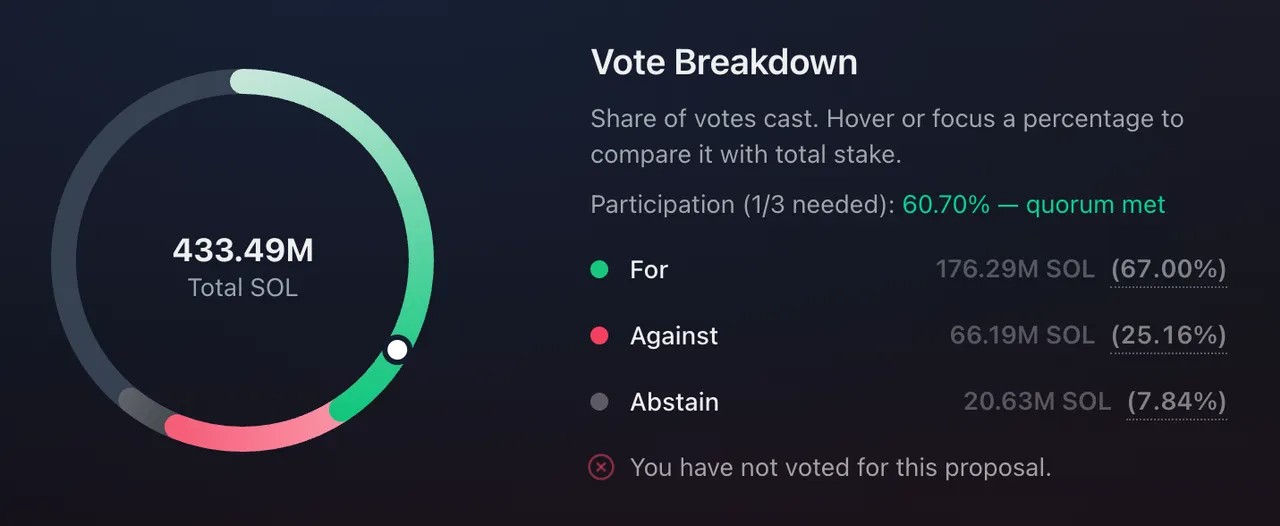
SGP-0002 passed with 67% support and 60.7% participation. Source: Solana Governance

The vote was part of Solana's first mandatory governance process, which also saw the proposed Solana Constitution approved and a separate proposal on resource and inclusion fees rejected.

Some of the largest participants were split on SGP-0002. Figment, the largest voting participant listed in the finalized governance data with 17.1 million $SOL staked, voted entirely against the measure, whereas Helius and Jupiter overwhelmingly supported it.

Kraken was one of the entities that changed its position during the vote. The U.S.-based crypto exchange initially voted against SGP-0002 at 12:33 UTC, temporarily pushing support below the required threshold. By the vote's conclusion, over 90% of its roughly 8.9 million $SOL of voting stake supported the proposal.
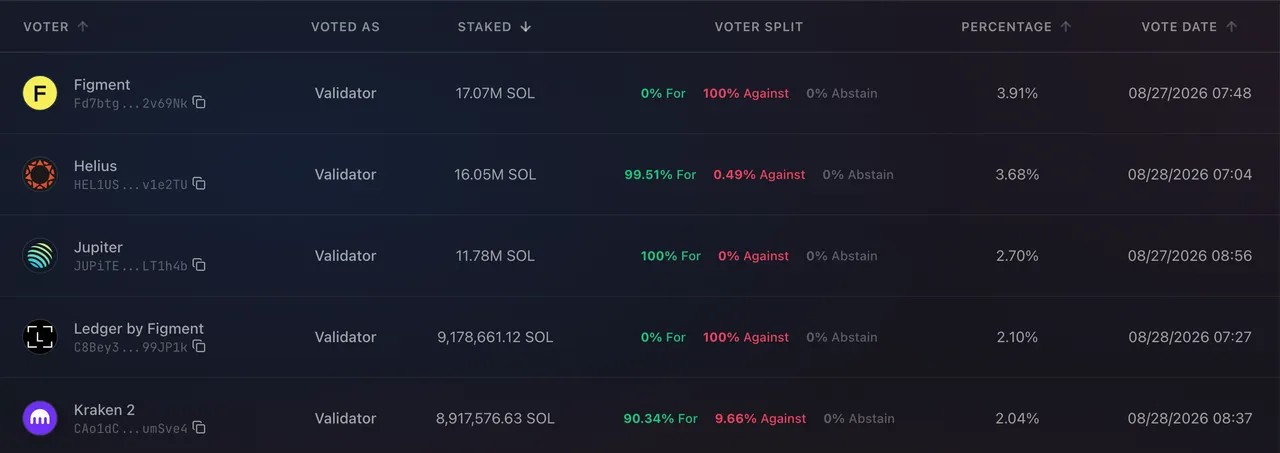
The largest voting participants were split on SGP-0002. Source: Solana Governance

Related: Solana Transactions Hit Record 4.2B as $SOL Rallies 40%

Solana ETF Assets Top $1 Billion

The governance vote took place as investor capital continues to flow into U.S.-listed Solana investment products, despite $SOL's weaker performance earlier this year.

According to a Friday post on X by Bloomberg ETF analyst Eric Balchunas, Bitwise's Solana ETF recently surpassed $1 billion in assets, becoming the first Solana ETF to reach that milestone.

Balchunas said on Friday that the aggregate net inflow into U.S. Solana ETFs has been roughly $1.7 billion, with sustained outflows being minimal since their launch.
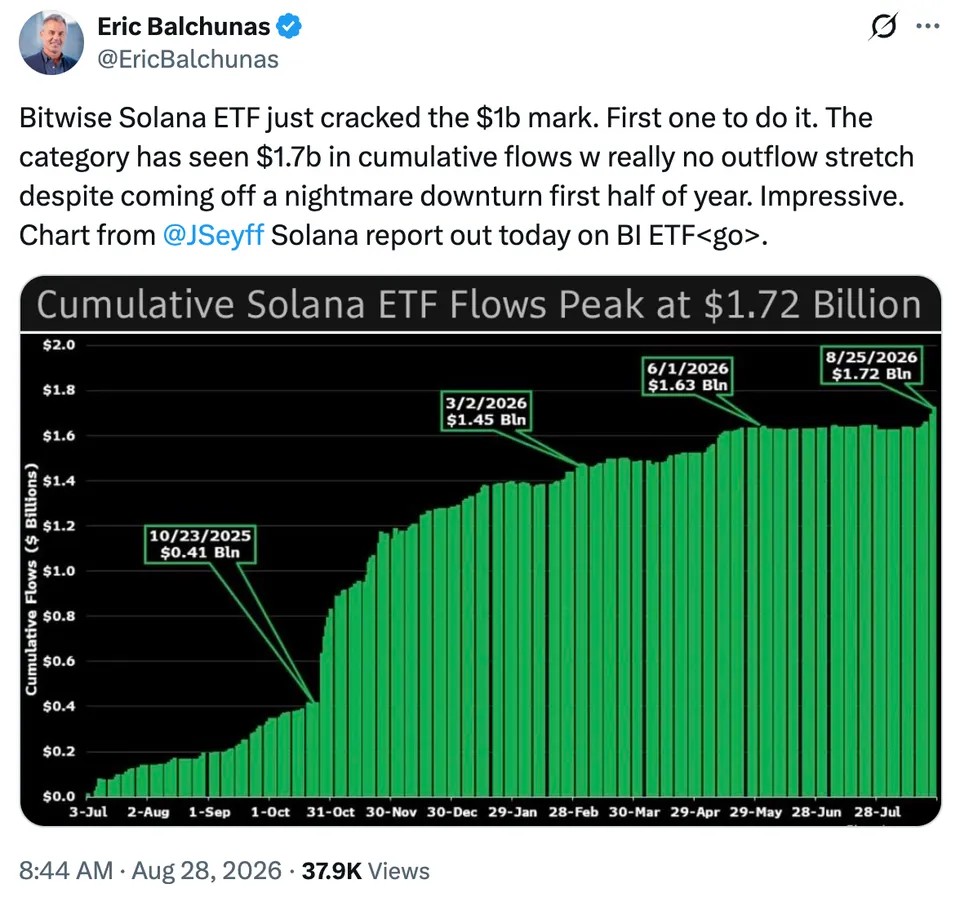
Source: Eric Balchunas

Magazine: Hugging Face hack reveals the open-weight AI cybersecurity paradox

Trending Cryptos

Related Questions

QWhat proposal was approved by Solana validators, and what is its main impact on SOL issuance?

ASolana validators approved proposal SGP-0002 (Double Disinflation), which doubles the network's annual disinflation rate from 15% to 30%. This will accelerate the reduction of future SOL issuance, leading to 18.9 million fewer SOL being issued over the next six years and reducing dilution for holders.

QWhat were the final voting results for the 'Double Disinflation' proposal SGP-0002?

AThe proposal received 67% support in the finalized vote. 25.16% voted against it, and 7.84% abstained. Voter participation reached 60.7% of the staking volume eligible to vote.

QHow did the stance of major participants like Figment, Helius, and Kraken differ regarding the SGP-0002 proposal?

AFigment, the largest voting participant, voted entirely against the measure. Helius and Jupiter overwhelmingly supported it. Kraken initially voted against but ultimately switched, with over 90% of its voting stake supporting the proposal by the end of the vote.

QAccording to the article, what milestone was recently achieved by a Solana ETF, and what was the related capital inflow?

ABitwise's Solana ETF recently surpassed $1 billion in assets, becoming the first Solana ETF to reach that milestone. According to Bloomberg analyst Eric Balchunas, the aggregate net inflow into U.S. Solana ETFs has been approximately $1.7 billion, with minimal sustained outflows after their launch.

QHow will the approved disinflation change affect the time it takes for Solana to reach its long-term target inflation rate?

AWith the new schedule, Solana is expected to reach its final inflation rate of 1.5% in approximately 2.8 years, compared to roughly 5.7 years under the previous schedule. This acceleration is a key outcome of the approved proposal.

Related Reads

Access to Active Sessions Instead of Databases: How the Shadow Market in Russia Has Changed

The Russian cybercriminal underground is shifting from selling massive, stolen corporate databases to trading active, short-term access to user accounts, according to a 2026 report. The value of information intercepted directly from infected devices by malware has risen nearly 13% in a year. Attackers now sell packets containing active session tokens (bypassing passwords and two-factor authentication), live email credentials, VPN and cloud storage logins, and corporate network access. A subscription for a steady stream of fresh data costs $250-$300 per month, far exceeding the value of outdated archives. While Russian regulators have successfully penalized companies for data leaks from centralized storage—with no repeat violations recorded after imposing turnover fines—this framework fails against the new threat model. Malware now steals data *after* it leaves the corporate perimeter and is on a user's personal device, a legal grey area. In 2026, 60% of studied web attacks aimed to steal keys for infiltrating corporate infrastructure. The situation mirrors global trends, akin to the Genesis Market shutdown in 2023, and highlights a structural risk: the demand for "fresh" data incentivizes botnet operators to maintain long-term control of infected devices for recurring revenue. This creates a persistent vulnerability layer between personal devices and corporate networks, currently outside the reach of existing regulatory protections.

cryptonews.ru2h ago

Access to Active Sessions Instead of Databases: How the Shadow Market in Russia Has Changed

cryptonews.ru2h ago

SlowMist Flags Fake Qwen 3.8 27B GitHub Repository Concealing StealC Information

SlowMist has identified a fake GitHub repository impersonating Alibaba's Qwen 3.8 27B AI model, which contains an information-stealing virus. The repository, created in August 2026, offered a download file of only 487 KB, far smaller than a legitimate 27-billion-parameter model (over 16 GB). The malicious ZIP file contained a Lua-based script disguised as a certificate, which deploys the StealC malware. Once executed, StealC harvests system data, takes screenshots, and steals browser credentials, cryptocurrency wallet information, and more, sending it to attacker-controlled servers. The malware also includes a backup system that can read new server addresses from the Polygon blockchain if the primary server is taken down. This incident is part of a broader campaign called FakeGit, active since March 2025, which has created thousands of malicious repositories. Approximately 800 of these specifically target AI tools using a method called AgentBaiting, sometimes tricking AI assistants into recommending them. Separate reports detail hundreds of other fake GitHub repositories spreading malware like BoryptGrab and campaigns like Megalodon that generate thousands of clones rapidly. Attackers copy legitimate projects, create convincing documentation, and even list them on public AI registries to appear trustworthy. The fake repositories exploit the high demand for open-source AI capabilities, putting users who run models locally at significant risk of data theft.

cryptonews.ru2h ago

SlowMist Flags Fake Qwen 3.8 27B GitHub Repository Concealing StealC Information

cryptonews.ru2h ago

Trading

Spot

Hot Articles

Discussions

Welcome to the HTX Community. Here, you can stay informed about the latest platform developments and gain access to professional market insights. Users' opinions on the price of SOL (SOL) are presented below.

活动图片