French Company Sequans Continues to Reduce Its Position in BTC, Reinvesting in IoT

cryptonews.ruPublished on 2026-08-04Last updated on 2026-08-04

Abstract

French semiconductor company Sequans Communications (NYSE: SQNS) significantly reduced its Bitcoin holdings in Q2 2026, selling 1,200 BTC to pay off convertible debt. Its remaining holdings fell to 314 BTC, valued at approximately $20 million. This strategic shift marks a retreat from its Bitcoin investment strategy initiated in July 2025, which once saw holdings peak above 3,300 coins. CEO Georges Karam refocused the company on its core IoT semiconductor business. In Q2, Sequans recorded a net profit of $5.3 million from these Bitcoin sales, a reversal from an $11.7 million loss in the previous quarter. The company's IoT business showed revenue growth of 23.2% sequentially, reaching $7.5 million. Excluding one-time payments from the prior year, revenue grew 84.2% year-over-year. Sequans ended the quarter debt-free with $21 million in cash. The company joins other firms like Marathon Digital and Riot Platforms in reducing Bitcoin assets recently.

French chipmaker Sequans Communications (NYSE: SQNS) reduced the volume of its Bitcoin bonds to 314 coins in the second quarter and wrote off convertible debt, the company reported on Tuesday, August 4. CEO Georges Karam is steering the company back to developing its semiconductor business for the Internet of Things.

According to preliminary results from the Paris-based company for the second quarter, as of the end of March it held 1514 $BTC worth $103.2 million.

How Much Bitcoin Did Sequans Communications Sell in Three Months?

According to available data, the company held 314 $BTC, which were valued at $18.4 million as of June 30. Sequans Communications had been constrained by collateral rules for several months.

In March, the company had 1217 $BTC worth $82.9 million locked as collateral for convertible bonds.

But now the company sold 1200 coins in the quarter, thus changing its calculations. The company recorded a net profit of $5.3 million from sales in the second quarter, a sharp change from the $11.7 million loss incurred in the first quarter when it offloaded coins onto a falling market.

Sequans ranks 73rd among public companies holding Bitcoin according to data from BitcoinTreasuries.net. Its 314 $BTC are now worth $20 million.
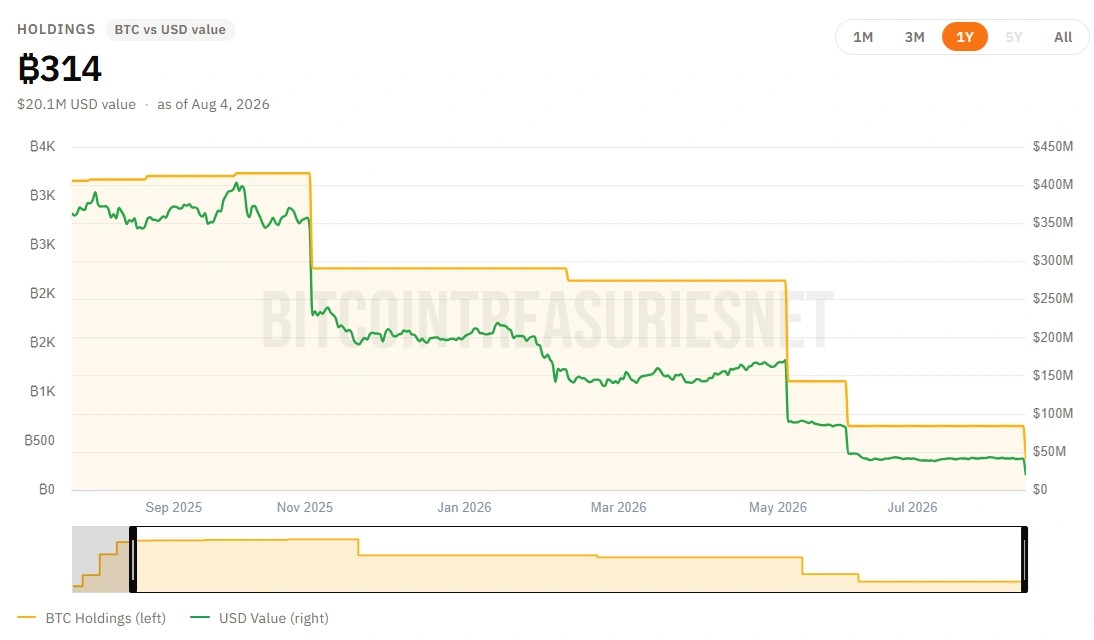
Sequans Company's Bitcoin Holdings. Source: BitcoinTreasuries.net

Why Did Sequans Communications Sell Its Bitcoin?

Karam shared information on the reasons for the asset sale, positioning it as capital structure optimization. Typically, a number of companies divesting their assets cite the need to sell part of the assets and refocus on another sector, with artificial intelligence and data centers becoming new priority areas. For Sequans, this meant focusing on its core IoT strategy.

Karam stated that in May they fully repaid their convertible debt and ended the quarter with $21 million in cash, compared to $10.6 million three months earlier, and with no debt on the balance sheet.

In the first quarter of 2026, Sequans had unrealized losses of $29.3 million on Bitcoin assets, leading to a net loss of $76.2 million. Losses in the second quarter were significantly smaller at $3.0 million.

Product Sales Were the Defining Factor This Quarter

The chip business, which Karam is now actively promoting, performed better in the last three months. Revenue reached $7.5 million, which is 23.2% higher than in the first quarter and exceeded the company's forecasts, although still 8.4% lower than a year ago, as the 2025 figure included one-time license fees from a deal with Qualcomm. Excluding this, revenue grew 84.2% year-over-year.

Karam said the bulk of the revenue came from product sales, which grew more than 80% compared to the previous year. He pointed to more than 40 development-approved projects now in serial production, accounting for 55% of a $300 million three-year product development plan, as well as a first customer for unmanned aerial vehicles using the company's RF transceiver technology.

Gross margin decreased to 32.9% from 37.7% in the previous quarter, which the company explained by an increase in the share of low-margin equipment in total sales.

Investors liked this information: on Tuesday in pre-market trading, SQNS shares traded at $2.87, up 17.62% from Monday's close, according to data from Google Finance, although the share price is still significantly below its 52-week high of $13.90.

From 370 Coins to Full Retreat

Sequans has now abandoned the strategy of investing in government bonds that it started just over a year ago. Karam began buying Bitcoin in July 2025 with 370 coins and gradually increased the number to a peak above 3300, previously stating a goal of 3000 coins funded by selling up to $200 million worth of shares.

The selling began in November 2025 when the company sold about 970 coins to repay half of its convertible debt. Another sale of 1025 coins followed in the first quarter of 2026.

Sequans is not the only company divesting a significant portion of its Bitcoin assets. MARA Holdings, Riot Platforms, Hut 8, and Cango, among others, have reduced their Bitcoin in recent months. Even Strategy, the largest corporate holder, sold 1638 coins for about $104.7 million at the end of July to fund dividends and replenish cash.

end-content

Trending Cryptos

Related Questions

QHow many Bitcoin did Sequans Communications own at the end of Q2, and what was their value?

AAt the end of the second quarter, Sequans Communications owned 314 Bitcoin, valued at $18.4 million as of June 30.

QWhat was the primary reason Sequans Communications sold a significant portion of its Bitcoin holdings?

AThe primary reason for selling Bitcoin was to optimize the company's capital structure and refocus on its core business strategy in the Internet of Things (IoT) semiconductor sector.

QHow did the sale of Bitcoin impact Sequans' financial results in Q2 compared to Q1?

AIn Q2, the company recorded a net gain of $5.3 million from Bitcoin sales, a sharp improvement from the $11.7 million loss incurred in Q1 when it sold coins in a falling market.

QWhat was the performance of Sequans' core chip business in the second quarter?

AThe core chip business revenue reached $7.5 million, a 23.2% increase from Q1. Excluding one-time license fees from a 2025 deal with Qualcomm, revenue grew 84.2% year-over-year.

QHow did Sequans' involvement with Bitcoin begin and evolve before the recent sell-off?

ACEO Georges Karam began buying Bitcoin in July 2025, starting with 370 coins and gradually increasing holdings to a peak above 3,300, initially targeting 3,000 coins funded by up to $200 million in stock sales.

Related Reads

Why Did Bitcoin's Price Remain Stable and Not Fall Despite the Recent Major Hack? Here's the Secret

The article discusses why Bitcoin's price remained stable despite a recent $100 million hack targeting individual cold wallets, citing insights from experts on "The Wolf of All Streets" channel. Analysts attribute this resilience to significant institutional shifts in the crypto market. Key points include: 1. **Market Maturation:** The crypto market has transitioned from being dominated by individual retail holders to institutional investors. Most new capital now enters via regulated channels like spot ETFs and custodial services (e.g., Coinbase, Anchorage), making vulnerabilities in individual cold wallets less impactful. 2. **Institutional Dominance:** Control over price dynamics has shifted from miners and crypto exchanges to Wall Street and institutional capital. These large players operate with long-term strategies, viewing price corrections as buying opportunities rather than reasons for panic. 3. **Increased Resilience:** Institutional involvement has reduced market sensitivity to negative news. Sellers are largely exhausted, and remaining holders are steadfast. Major financial institutions (e.g., Morgan Stanley, Wells Fargo) are incorporating crypto assets into portfolios, with research teams recommending allocations of 1–6% to Bitcoin. 4. **Risk Perception:** Bitcoin's integration into traditional financial indices has lowered perceived risk among professionals and institutions, further stabilizing its price against isolated security breaches.

cryptonews.ru38m ago

Why Did Bitcoin's Price Remain Stable and Not Fall Despite the Recent Major Hack? Here's the Secret

cryptonews.ru38m ago

Wells Fargo Joins Major US Banks in Creating Tokenized Deposit Network by 2027

Wells Fargo has joined major U.S. banks including JPMorgan, Bank of America, and Citigroup in a consortium to launch a shared network for tokenized deposits by the first half of 2027. The system, to be operated by The Clearing House, will enable the 24/7 exchange of digital versions of customer deposits on a blockchain platform. The initiative aims to provide instantaneous settlement, moving beyond traditional banking hours, with initial users expected to be large multinational corporations benefiting from enhanced liquidity for cross-border payments. While a specific blockchain partner has not yet been chosen, the network is seen as a way for banks to offer the speed and programmability of blockchain without ceding clients to crypto-native competitors. This move builds on existing bank projects, such as Wells Fargo's earlier pilot of a digital cash platform and JPMorgan's institutional tokenized deposit on Ethereum's Base network. It also comes amidst the growth of the stablecoin market and pending U.S. legislation that could allow stablecoin issuers to pay interest, posing potential competition to traditional bank deposits. Bank executives note that while customer demand for tokenized deposits is not yet overwhelming, the network prepares the industry for future adoption. The shared infrastructure, as opposed to individual bank systems, is intended to spread the benefits across the broader banking ecosystem.

cryptonews.ru2h ago

Wells Fargo Joins Major US Banks in Creating Tokenized Deposit Network by 2027

cryptonews.ru2h ago

Trading

Spot

Hot Articles

What is $BITCOIN

DIGITAL GOLD ($BITCOIN): A Comprehensive Analysis Introduction to DIGITAL GOLD ($BITCOIN) DIGITAL GOLD ($BITCOIN) is a blockchain-based project operating on the Solana network, which aims to combine the characteristics of traditional precious metals with the innovation of decentralized technologies. While it shares a name with Bitcoin, often referred to as “digital gold” due to its perception as a store of value, DIGITAL GOLD is a separate token designed to create a unique ecosystem within the Web3 landscape. Its goal is to position itself as a viable alternative digital asset, although specifics regarding its applications and functionalities are still developing. What is DIGITAL GOLD ($BITCOIN)? DIGITAL GOLD ($BITCOIN) is a cryptocurrency token explicitly designed for use on the Solana blockchain. In contrast to Bitcoin, which provides a widely recognized value storage role, this token appears to focus on broader applications and characteristics. Notable aspects include: Blockchain Infrastructure: The token is built on the Solana blockchain, known for its capacity to handle high-speed and low-cost transactions. Supply Dynamics: DIGITAL GOLD has a maximum supply capped at 100 quadrillion tokens (100P $BITCOIN), although details regarding its circulating supply are currently undisclosed. Utility: While precise functionalities are not explicitly outlined, there are indications that the token could be utilized for various applications, potentially involving decentralized applications (dApps) or asset tokenization strategies. Who is the Creator of DIGITAL GOLD ($BITCOIN)? At present, the identity of the creators and development team behind DIGITAL GOLD ($BITCOIN) remains unknown. This situation is typical among many innovative projects within the blockchain space, particularly those aligning with decentralized finance and meme coin phenomena. While such anonymity may foster a community-driven culture, it intensifies concerns about governance and accountability. Who are the Investors of DIGITAL GOLD ($BITCOIN)? The available information indicates that DIGITAL GOLD ($BITCOIN) does not have any known institutional backers or prominent venture capital investments. The project seems to operate on a peer-to-peer model focused on community support and adoption rather than traditional funding routes. Its activity and liquidity are primarily situated on decentralized exchanges (DEXs), such as PumpSwap, rather than established centralized trading platforms, further highlighting its grassroots approach. How DIGITAL GOLD ($BITCOIN) Works The operational mechanics of DIGITAL GOLD ($BITCOIN) can be elaborated on based on its blockchain design and network attributes: Consensus Mechanism: By leveraging Solana’s unique proof-of-history (PoH) combined with a proof-of-stake (PoS) model, the project ensures efficient transaction validation contributing to the network's high performance. Tokenomics: While specific deflationary mechanisms have not been extensively detailed, the vast maximum token supply implies that it may cater to microtransactions or niche use cases that are still to be defined. Interoperability: There exists the potential for integration with Solana’s broader ecosystem, including various decentralized finance (DeFi) platforms. However, the details regarding specific integrations remain unspecified. Timeline of Key Events Here is a timeline that highlights significant milestones concerning DIGITAL GOLD ($BITCOIN): 2023: The initial deployment of the token occurs on the Solana blockchain, marked by its contract address. 2024: DIGITAL GOLD gains visibility as it becomes available for trading on decentralized exchanges like PumpSwap, allowing users to trade it against SOL. 2025: The project witnesses sporadic trading activity and potential interest in community-led engagements, although no noteworthy partnerships or technical advancements have been documented as of yet. Critical Analysis Strengths Scalability: The underlying Solana infrastructure supports high transaction volumes, which could enhance the utility of $BITCOIN in various transaction scenarios. Accessibility: The potential low trading price per token could attract retail investors, facilitating wider participation due to fractional ownership opportunities. Risks Lack of Transparency: The absence of publicly known backers, developers, or an audit process may yield skepticism regarding the project's sustainability and trustworthiness. Market Volatility: The trading activity is heavily reliant on speculative behavior, which can result in significant price volatility and uncertainty for investors. Conclusion DIGITAL GOLD ($BITCOIN) emerges as an intriguing yet ambiguous project within the rapidly evolving Solana ecosystem. While it attempts to leverage the “digital gold” narrative, its departure from Bitcoin's established role as a store of value underscores the need for a clearer differentiation of its intended utility and governance structure. Future acceptance and adoption will likely depend on addressing the current opacity and defining its operational and economic strategies more explicitly. Note: This report encompasses synthesised information available as of October 2023, and developments may have transpired beyond the research period.

1.5k Total ViewsPublished 2025.05.13Updated 2025.05.13

What is $BITCOIN

Discussions

Welcome to the HTX Community. Here, you can stay informed about the latest platform developments and gain access to professional market insights. Users' opinions on the price of BTC (BTC) are presented below.

活动图片