Jito jumps 12% after JIP-38 buyback proposal – Can JTO reach $0.80?

ambcryptoPublished on 2026-07-21Last updated on 2026-07-21

Abstract

Jito (JTO) surged 12% following the introduction of JIP-38, a proposal to use Jito DAO's revenue from JTX Trade for programmatic JTO buybacks and burns for at least one year. The token's price rose to $0.6087 with market cap reaching $304.67 million, supported by increased trading volume and positive sentiment around Solana's ecosystem. Derivatives activity grew as Open Interest increased, indicating fresh capital entering the market. Spot market data also showed sustained buyer dominance. Technically, JTO rebounded from the $0.5332 support level, with the next key resistance at $0.65. A break above this level could pave the way for a move toward $0.80, while failure to hold support may lead to a retest of lower levels. The rally is viewed as driven by improving fundamentals and broader participation rather than mere speculation.

Jito [JTO] climbed 11.59% over the previous 24 hours to $0.6087 as of writing, while its market capitalization reached $304.67 million as investor interest strengthened. Trading activity also accelerated, with daily volume surging 142.17%, indicating that buyers returned aggressively after recent weakness.

The rally followed growing optimism surrounding JIP-38, a proposal that established Jito as a token-centric network by directing 100% of the Jito DAO’s revenue share from JTX Trade toward programmatic JTO buybacks and burns for at least one year.

Positive sentiment surrounding Solana’s [SOL] institutional adoption and capital rotation into Solana ecosystem tokens further supported the move. As a result, market participants increasingly viewed the proposal as a long-term value driver rather than a short-lived catalyst.

JTO’s leveraged traders return

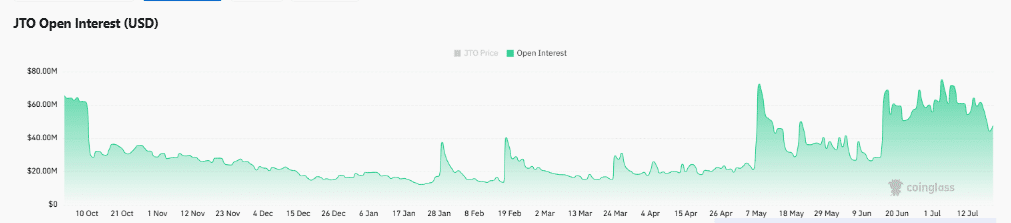
Derivatives traders also increased their exposure as Open Interest (OI) rose 14.53% to $52.05 million at press time, during the rally. The increase suggested that fresh positions entered the market instead of existing contracts simply closing.

Rising OI alongside double-digit price gains often reflected stronger market conviction because both spot and futures participants committed additional capital.

Unlike rallies driven by declining derivatives exposure, JTO‘s advance attracted broader participation across multiple trading segments. The combination suggested traders expected the bullish narrative surrounding JIP-38 to continue influencing price action.

However, expanding leveraged exposure also increased the probability of sharper volatility should sentiment reverse or profit-taking accelerate after the recent advance.
Source: CoinGlass

Buyers maintained control across spot markets

Spot market activity also favored buyers throughout the latest recovery.

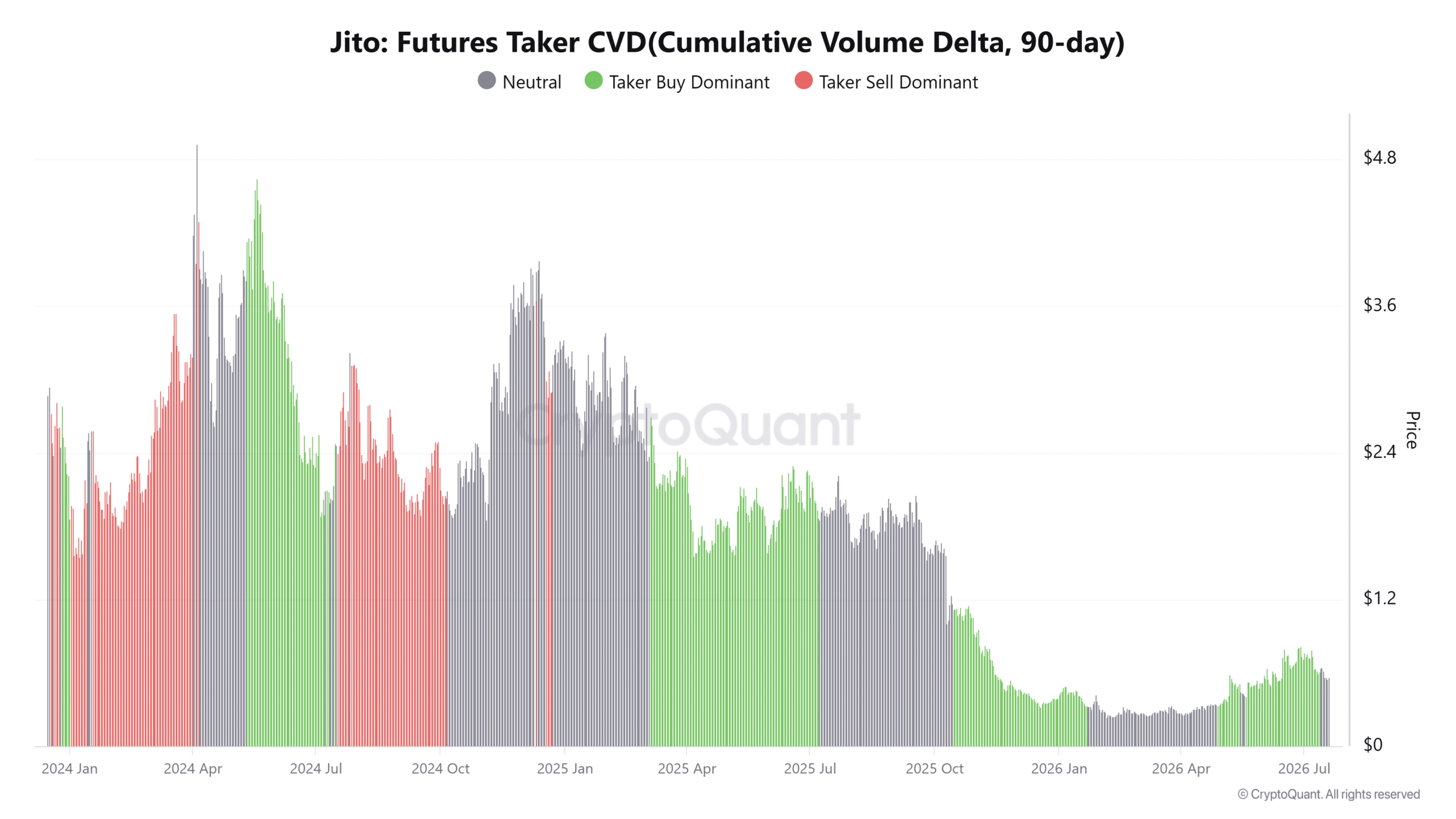
At the time of writing, the 90-day Futures Taker CVD remained buy dominant, showing that aggressive market buyers consistently absorbed available sell orders. The behavior aligned with the sharp increase in trading volume, which expanded 142.17% over the previous day.

Stronger buying pressure supported the price recovery instead of allowing sellers to regain control after recent weakness.

In addition, the sustained demand complemented improving sentiment surrounding Jito’s revised tokenomics and the broader Solana ecosystem. Although buyers held the advantage, continued demand would remain necessary to absorb future profit-taking as speculative participation increased across both spot and derivatives markets.
Source: CryptoQuant

Can JTO reclaim $0.80 next?

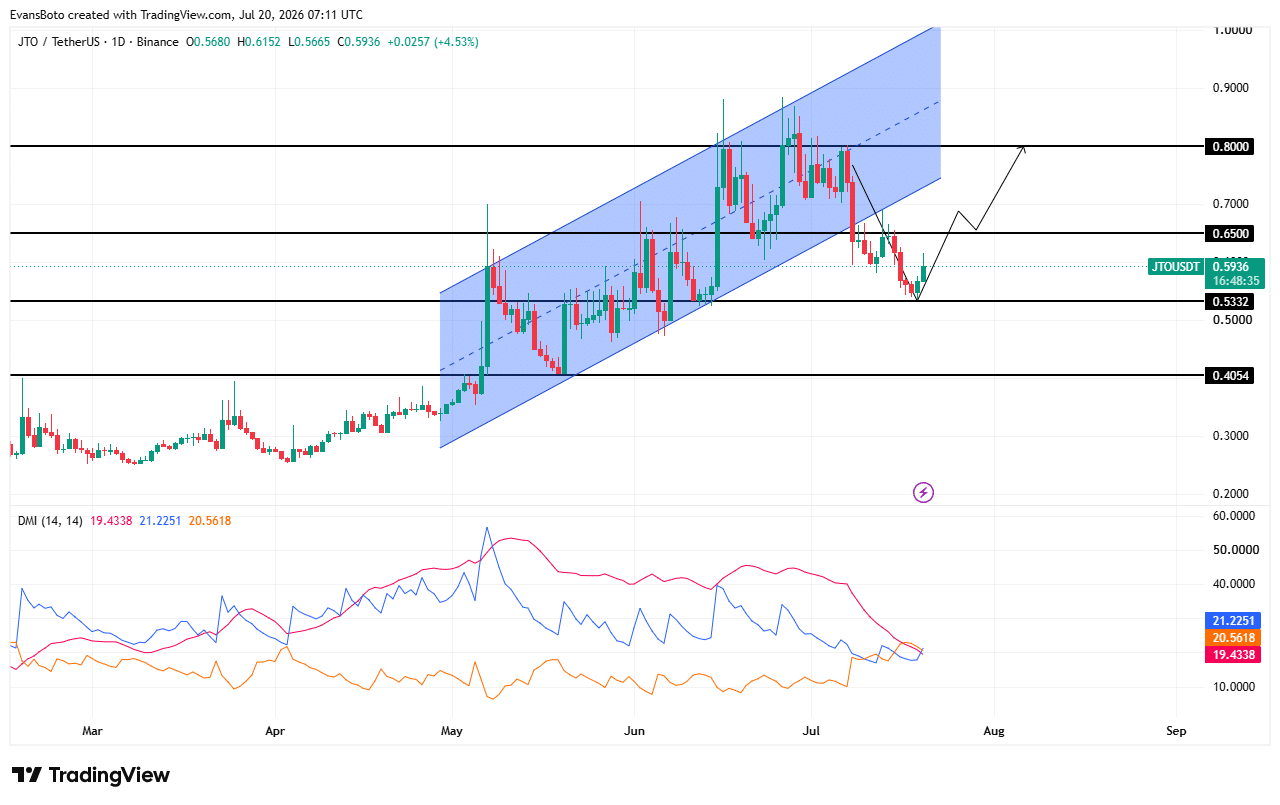
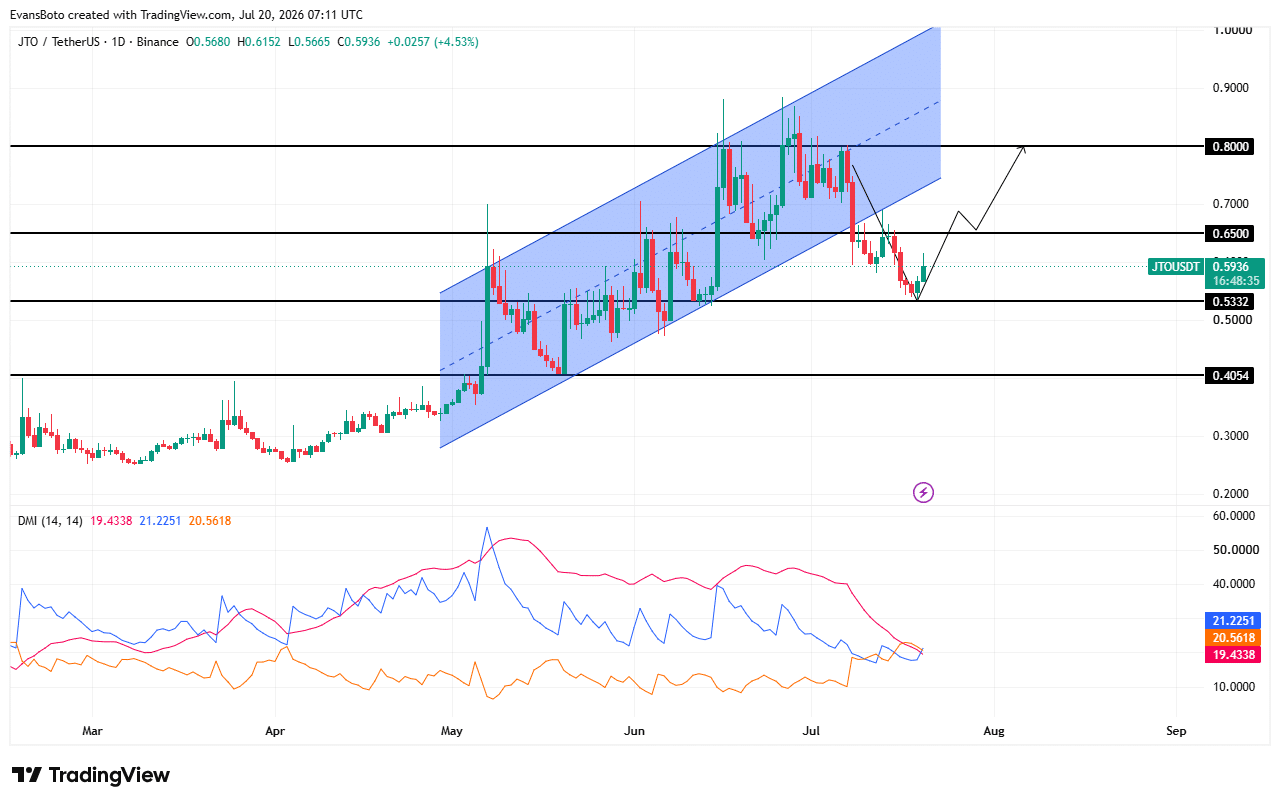
JTO rebounded from the $0.5332 support area after breaking below its broader ascending channel earlier.

Buyers pushed the token back toward $0.6500, which now represented the nearest resistance before a possible move toward $0.8000. The Directional Movement Index (DMI) also reflected improving conditions.

At press time, the +DI stood at 21.23, remaining above the -DI at 20.56, while the ADX measured 19.43, suggesting bullish strength had started improving but remained below the threshold associated with a strong trend.

If buyers reclaimed $0.6500, the chart suggested a retest of $0.8000 could follow. However, failure to hold above $0.5332 would likely expose JTO to another test of the $0.4054 support level.
Source: TradingView

Conclusively, JTO’s rally reflected improving fundamentals, stronger buying pressure, and increasing trader participation rather than a purely speculative bounce.

If buyers continue defending support and overcome the $0.6500 barrier, the token could challenge $0.8000 in the sessions ahead. However, weakening demand would likely delay that recovery and shift attention back toward the $0.5332 support zone.


Final Summary

  • JTO’s rally gained support from stronger buying activity and growing confidence after the JIP-38 proposal.
  • Rising Open Interest and steady spot demand kept bullish pressure intact, though $0.6500 remains the next key hurdle.


Trending Cryptos

Related Questions

QWhat is the JIP-38 proposal and how did it affect Jito (JTO)?

AThe JIP-38 proposal established Jito as a token-centric network by directing 100% of the Jito DAO's revenue share from JTX Trade toward programmatic JTO buybacks and burns for at least one year. This proposal sparked investor optimism, leading to a significant price rally for JTO, with the token climbing 11.59% in 24 hours as the market viewed it as a long-term value driver.

QWhat were the key indicators of increased trading activity and market conviction for JTO during the rally?

AThe key indicators were a surge in daily trading volume by 142.17% and a rise in Open Interest (OI) by 14.53% to $52.05 million. The increase in OI indicated the entry of fresh long positions rather than just the closing of old contracts, showing broader market participation and stronger conviction among both spot and derivatives traders.

QWhat does the 90-day Futures Taker CVD data indicate about the market sentiment for JTO?

AThe 90-day Futures Taker CVD data showed a buy-dominant trend, indicating that aggressive market buyers were consistently absorbing available sell orders. This behavior aligned with the sharp increase in trading volume and demonstrated sustained buying pressure, supporting the price recovery and indicating positive sentiment.

QAccording to the article, what are the key price levels JTO needs to overcome for a potential move towards $0.80?

AAccording to the article, the key resistance level JTO needs to overcome is $0.6500. If buyers successfully reclaim this level, a retest of the $0.8000 target could follow. However, failure to hold above the $0.5332 support level could lead to a test of the lower $0.4054 support.

QHow did the Directional Movement Index (DMI) reflect the market conditions for JTO at the time of writing?

AAt the time of writing, the DMI showed the +DI at 21.23, remaining above the -DI at 20.56, indicating bullish strength was improving. However, the ADX (Average Directional Index) measured 19.43, which is below the threshold commonly associated with a strong, established trend, suggesting the bullish momentum was present but not yet extremely strong.

Related Reads

Global Stock Market's Storm Center: South Korea's Stock Market De-leveraging Is Largely Complete

Storm's Eye: South Korean Market De-leveraging Nears Completion The recent sharp correction in South Korean equities, with the KOSPI index dropping 32% from its June high, has been a key trigger for global tech stock volatility. The core driver was not a fundamental shift but a forced de-leveraging process within the market's unique structure, which is now largely complete. Two main leverage channels amplified the sell-off: 1. **Leveraged ETFs:** Their size, proportionally four times larger than in the U.S., peaked near $50 billion. Their mandatory daily rebalancing mechanism created a vicious cycle of "price drop → forced selling → further drop." Approximately 75% of this excess has been unwound, shrinking to $26 billion, with regulatory curbs now blocking new inflows. 2. **Hedge Fund Leverage:** Using swaps to magnify exposure, hedge funds saw their net long positioning fall by over 50% from peak levels. The most intense phase of this institutional de-leveraging is over. In contrast, **retail margin debt** poses minimal systemic risk. At 0.5% of market cap, it is far lower than in the U.S. or China, lacks automatic triggers, and is concentrated in smaller stocks. The conclusion: the high-leverage structures most prone to "chain-reaction selling" have been substantially cleared. The market is transitioning from a liquidity-driven crash to one priced more on fundamentals. The article argues that the AI trend—centered on Korean memory chips—remains intact. This episode represents a painful but necessary clearing of crowded trades, not the end of the AI revolution. For investors, the key question is conviction in the long-term AI direction; if the trend is real, current volatility is a cost of entry, not a terminal risk.

链捕手44m ago

Global Stock Market's Storm Center: South Korea's Stock Market De-leveraging Is Largely Complete

链捕手44m ago

The Eternal Fragments of Money: Third-Party Payment Has No First Principle

"The Enduring Fragments of Money: Third-Party Payments Lack a First Principle" Stripe is reportedly attempting to acquire PayPal, marking a significant shift reminiscent of PayPal's merger with the original X.com 30 years ago. The article analyzes Stripe's strategic challenges and the broader payments industry landscape. Despite its initial success with a developer-friendly API model, Stripe missed its optimal IPO window during the pandemic and has since seen its valuation decline. Its attempts to expand through acquisitions and new ventures, particularly in stablecoins (like its OUSD project) and Agent-focused payments (ACP/MPP protocols), have faced headwinds. The author argues that the payment industry remains highly fragmented and is ultimately an adjunct to the traditional banking system. This structure limits the potential for any single player, including Stripe, to achieve complete dominance. While stablecoins and the future rise of autonomous Agent economies present potential growth avenues, they are not yet mainstream and still require integration with the existing financial system. For now, Agent-based transactions are largely used for speculative "volume boosting" rather than substantive business applications. Stripe's current move to acquire PayPal is seen as an attempt to bolster its weak consumer-facing (C-side) business after its stablecoin-focused strategies faltered. Meanwhile, PayPal is described as structurally outdated, unable to revive itself through new products like Venmo or PYUSD. The future of payments may lie not in payments themselves but in value-added services like more efficient settlement networks. The author suggests that companies like Stripe and Circle, which are building their own blockchains (Tempo, Arc) and stablecoins, are positioning themselves to eventually profit from high-efficiency settlement systems. These new networks could potentially bypass some traditional banking layers. In conclusion, the article posits that third-party payment is a perpetually fragmented battlefield where scale alone cannot ensure victory. Players must find new models, focusing on efficiency to compete with the entrenched banking system. Stripe's acquisition of PayPal represents a bet on this uncertain future.

链捕手1h ago

The Eternal Fragments of Money: Third-Party Payment Has No First Principle

链捕手1h ago

Trading

Spot

Hot Articles

How to Buy JTO

Welcome to HTX.com! We've made purchasing Jito (JTO) simple and convenient. Follow our step-by-step guide to embark on your crypto journey.Step 1: Create Your HTX AccountUse your email or phone number to sign up for a free account on HTX. Experience a hassle-free registration journey and unlock all features.Get My AccountStep 2: Go to Buy Crypto and Choose Your Payment MethodCredit/Debit Card: Use your Visa or Mastercard to buy Jito (JTO) instantly.Balance: Use funds from your HTX account balance to trade seamlessly.Third Parties: We've added popular payment methods such as Google Pay and Apple Pay to enhance convenience.P2P: Trade directly with other users on HTX.Over-the-Counter (OTC): We offer tailor-made services and competitive exchange rates for traders.Step 3: Store Your Jito (JTO)After purchasing your Jito (JTO), store it in your HTX account. Alternatively, you can send it elsewhere via blockchain transfer or use it to trade other cryptocurrencies.Step 4: Trade Jito (JTO)Easily trade Jito (JTO) on HTX's spot market. Simply access your account, select your trading pair, execute your trades, and monitor in real-time. We offer a user-friendly experience for both beginners and seasoned traders.

3.4k Total ViewsPublished 2024.03.29Updated 2026.06.02

How to Buy JTO

Discussions

Welcome to the HTX Community. Here, you can stay informed about the latest platform developments and gain access to professional market insights. Users' opinions on the price of JTO (JTO) are presented below.

活动图片