Bitcoin, Ethereum, and Solana Rise as Another $1 Billion Short Position is Liquidated

cryptonews.ruPublished on 2026-08-21Last updated on 2026-08-21

Abstract

Bitcoin, Ethereum, and Solana have seen significant gains as over $1 billion in short positions were liquidated. Bitcoin surged past $76,000, rising over 9% in 24 hours and 21% for the week, after trading around $64,100 just days prior. Short sellers incurred major losses, with roughly $1.2 billion in short positions liquidated over the past day, contributing to a two-day total exceeding $4 billion. This followed a record $3 billion in liquidations on Thursday, the largest single-day amount since 2021. The liquidations, triggered when leveraged bets move against traders, force buybacks that propel prices upward in a cascading effect. This rally distinguishes between demand-driven growth and mechanics-driven volatility, as forced buying does not reflect a belief in higher intrinsic value. Other major cryptocurrencies also advanced. Ethereum rose nearly 5% to $2,350, Solana gained over 5% to just under $90, and Dogecoin increased almost 9%. The rally was spurred by the U.S. Treasury doubling its long-term bond buyback to $4 billion, easing conditions in the $30 trillion Treasury market and boosting risk appetite. Additionally, Bitcoin broke past key resistance around $66,600, setting $76,000 as the next target. Political support also played a role, with President Trump urging Congress to advance the Digital Asset Market Clarity Act at a White House event attended by crypto industry leaders. Bitcoin's market cap now stands at $1.5 trillion, still about 40% below its October a...

On Friday morning during European trading, bitcoin rose above $76,000, gaining over 9% in 24 hours and 21% for the week. Two days ago, it was trading around $64,100.

Short sellers suffered further losses: according to CoinGlass, approximately $1.2 billion worth of short positions were liquidated in 24 hours out of a total of $1.4 billion, involving 156,211 traders.
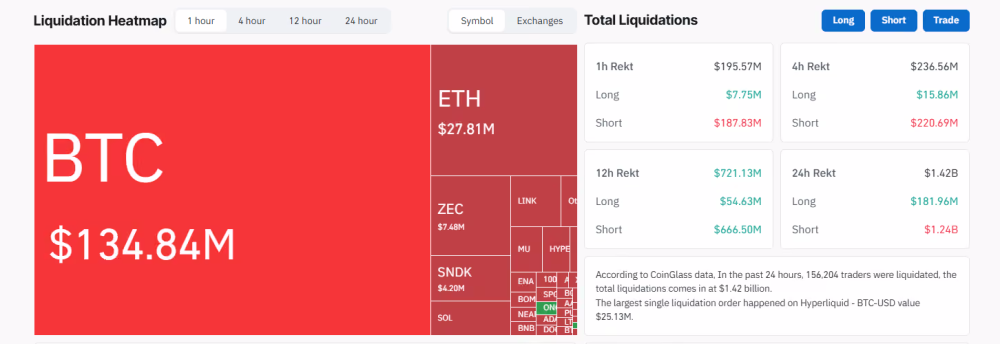
Short sellers have taken another hit. Source: Coinglass.

This came after $3 billion in short positions were closed on Thursday, marking the largest single-day figure on record since 2021, bringing the two-day total to over $4 billion. The largest single position closed in the latest session was $25.13 million in bitcoin on Hyperliquid.

Liquidation occurs when a trader borrows money to place a bet larger than their funds allow, the market moves against them, and the exchange automatically closes the position before losses exceed the amount they put up. Traders betting on the price falling were hit, and each forced closure pushed prices higher, creating a cascade of liquidations.

The size of this sum is significant because it distinguishes a rally based on demand from one based on mechanics. Traders forced to buy are not deciding bitcoin is worth more; they are closing a losing bet.

Meanwhile, Hyperliquid (HYPE) rose more than 4% to nearly $73 and leads major exchanges this week, up almost 27%. Ethereum gained almost 5% to $2,350 and is up 24.5% for the week. Dogecoin rose nearly 9% to just over 8 cents, and Solana gained over 5% to just under $90, both up 17% for the week.

BNB rose 6% to $660, up 8% for the week. Tron lagged, gaining 1.5% to just under 34 cents and remaining virtually unchanged for the week.

The rally began on Wednesday when the U.S. Treasury Department doubled the size of its long-term bond buyback from $2 billion to $4 billion per operation, easing conditions in the roughly $30 trillion Treasury market and boosting risk appetite.

Bitcoin then broke through resistance around $66,600, bringing the $76,000 level into view for traders as the next target.

Washington also contributed to the rise. At a White House event on Wednesday, President Donald Trump urged Congress to advance the Digital Asset Market Clarity Act, attended by executives from Coinbase, Gemini, Ripple, and Chainlink Labs.

Bitcoin's current market capitalization is $1.5 trillion, still roughly 40% below its record high of over $126,000 set last October.


Trending Cryptos

Related Questions

QWhat was the approximate amount of short positions liquidated over the last 24 hours as mentioned in the article?

AApproximately $1.2 billion worth of short positions were liquidated in the last 24 hours.

QAccording to the article, what specific action by the U.S. Treasury Department helped initiate the crypto market rally?

AThe rally began after the U.S. Treasury Department doubled the buyback amount of long-term bonds from $2 billion to $4 billion per operation.

QWhat percentage did Bitcoin's price increase over the week leading up to the article's writing?

ABitcoin's price increased by 21% over the week.

QWhich cryptocurrency exchange's token (HYPE) was leading among major exchanges for the week, according to the article?

AHyperliquid (HYPE) was leading among major exchanges for the week, with a gain of nearly 27%.

QWhat key resistance level did Bitcoin break through on Wednesday, according to the article, to set its sights on $76,000?

ABitcoin broke through resistance around $66,600 on Wednesday.

Related Reads

Robotic GPT-3 Moment Shakes Silicon Valley: Zero Lines of Code, Learns Instantly, with Investments from Jensen Huang and Fei-Fei Li

Generalist AI's newly released robot foundation model GEN-1.5 is being hailed as the "GPT-3 moment" for embodied AI. The model demonstrates remarkable one-shot and few-shot learning capabilities in physical manipulation tasks. By watching a single 3-12 second demonstration video (physical prompting) without any training or code, the robot can attempt the task with a 59% average success rate across 10 tasks. With just 5 minutes of demonstration data and minimal fine-tuning (10 gradient steps), the success rate jumps to 83%. The most significant breakthrough is the emergence of spontaneous, improvisational problem-solving abilities not present in the training data. For instance, after learning to sweep blocks with a brush, the robot can adapt to use a banana similarly or switch to a completely new "scoop-and-pour" strategy when given a dustpan. Other emergent behaviors include removing obstacles, correcting errors, and spontaneously sorting objects. These capabilities stem from over 8 months of large-scale pre-training on physical interaction data, suggesting the existence of a Scaling Law for embodied intelligence—where model generalization improves with more data and training time. This approach drastically reduces the cost and expertise needed to teach robots new skills, potentially democratizing robot programming. The release coincides with a surge in the humanoid robotics sector, marked by events like the World Robot Conference and significant investments. While the demonstrated tasks are still relatively simple, the scaling trend and emergent behaviors point toward a future where general-purpose robot "brains" could be easily adapted to various hardware "bodies," reshaping the industry's competitive landscape.

marsbit51m ago

Robotic GPT-3 Moment Shakes Silicon Valley: Zero Lines of Code, Learns Instantly, with Investments from Jensen Huang and Fei-Fei Li

marsbit51m ago

Semiconductor Industry Sees a New Wave of Price Hikes, with STMicroelectronics, Maxscend and Others Increasing Prices Intensively

The semiconductor industry is experiencing a new wave of price increases driven by supply-demand dynamics and rising costs. Throughout August, multiple international and domestic semiconductor companies have issued price adjustment notices to clients, with a focus on analog and RF chips. Key companies adjusting prices include STMicroelectronics, which is implementing its third price hike in 2026 effective August 23, citing sustained demand pressure and rising costs across the supply chain. Analog Devices, Inc. (ADI) has also announced a second price increase for 2026, effective September 13, due to "unprecedented" demand growth and escalating manufacturing costs. In China, RF chip leader Zhuosheng Microelectronics issued a price adjustment notice for its full RF product line, effective September 1, its first hike this year, attributing it to rising raw material and foundry costs. Additionally, Chinese MCU manufacturer Nations Technologies announced a 10-20% price increase for some products from October 1. This new round of price hikes has shifted its focus to mature process nodes (e.g., analog, RF, power, MCUs), partly due to AI computing demand consuming 8-inch wafer capacity. This contrasts with the first half of 2026, when the surge was led by AI memory chips like HBM and server DRAM. Analysts note that the long lead time for expanding analog/power semiconductor capacity (18-24 months) may sustain price resilience in the short term. However, downstream manufacturers' cost tolerance and fluctuating global demand could become constraints, potentially limiting further significant price increases. Companies have linked the hikes to ensuring future supply stability by funding capacity expansion.

marsbit55m ago

Semiconductor Industry Sees a New Wave of Price Hikes, with STMicroelectronics, Maxscend and Others Increasing Prices Intensively

marsbit55m ago

Trading

Spot

Hot Articles

Discussions

Welcome to the HTX Community. Here, you can stay informed about the latest platform developments and gain access to professional market insights. Users' opinions on the price of ETH (ETH) are presented below.

活动图片