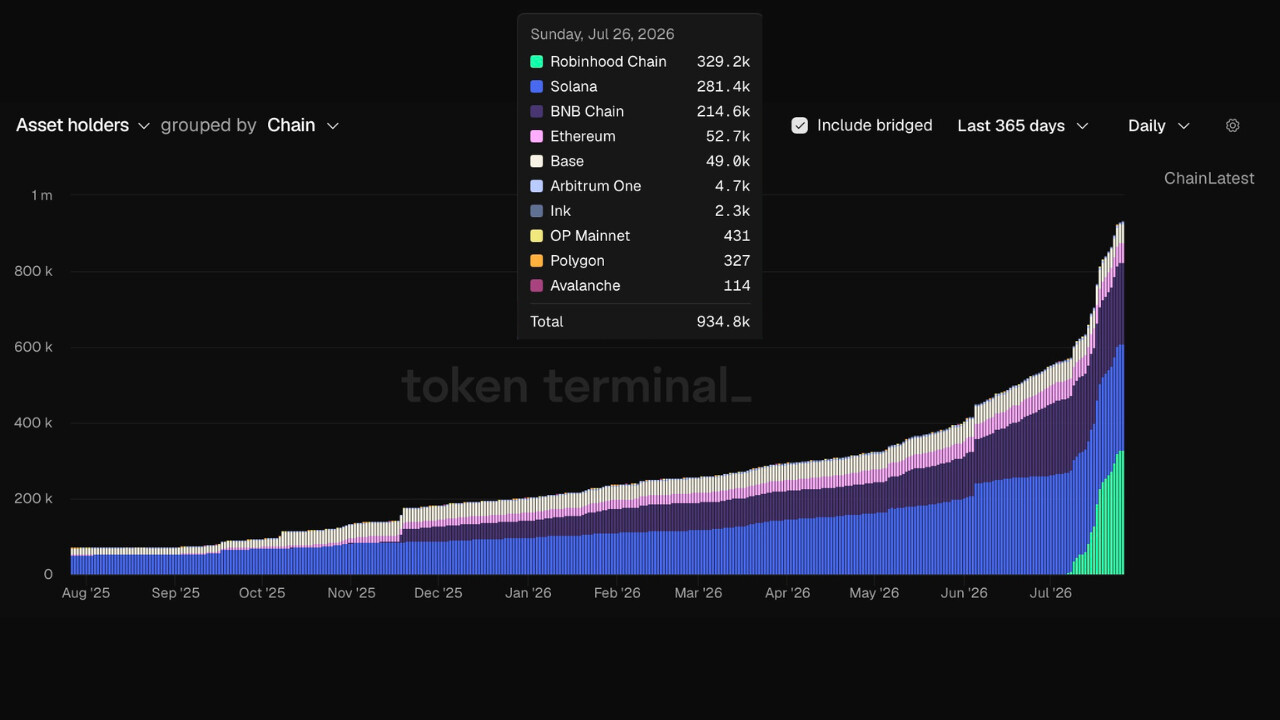
Since the beginning of the month, the number of tokenized stock holders has grown by approximately 68.5% — from 554.9 thousand to 934.8 thousand. The primary reason for this surge is the emergence of Robinhood Chain, which now has more tokenized stock holders than any other network. The latest data from Token Terminal shows that the network counts 329.2 thousand asset holders, surpassing long-time leaders in this category: Solana (281.4 thousand) and $BNB Chain (214.6 thousand). The main Robinhood Chain network launched on July 1st, and in less than four weeks it managed to overtake Solana, a network that held leading positions in this category for most of last year.
Source: Token Terminal
The chart above of token holders shows where the growth came from. Solana led the sector throughout last year and was the network, along with $BNB Chain and Ethereum, that gradually increased the base of tokenized stock holders. Then July arrives, and a green block appears almost vertically. Robinhood Chain now occupies almost a third of the entire sector in terms of token holders, starting from zero.
Victory Was Achieved by Distribution, Not the Network
Robinhood Chain's rapid growth did not occur because the company implemented more advanced infrastructure compared to other existing networks. It took the leading position by occupying the "front door." By "front door," we mean the huge existing user base under the Robinhood umbrella. Tokenized stocks were placed in the already existing brokerage app, which had about 28 million users, most of whom never had to think about a wallet, a bridge, or a transaction fee to ultimately receive a token.
Other networks in the tokenized stock market have to convince a large group of existing cryptocurrency users to buy stocks. Robinhood, on the contrary, only needed to convince stock users to click a button, and it would immediately be reflected on the blockchain as a holder number.
Owner of 35% of Shares, Holding $44 Million in Assets
The advantage is great, but at the same time, insignificant. Robinhood accounts for about 35% of tokenized stock holders, but according to DWF Labs, there are only about $44 million in assets. Ondo, for comparison, has about $857 million, with a significantly smaller number of wallets.
The calculations are not optimistic. The average asset volume per wallet on Robinhood Chain is just over $130. Retail investors opening small positions in tokenized assets of Tesla or Nvidia will show exactly this picture. Institutional and accredited investors, which Ondo aims for, show the opposite result. The number of holders is a distribution metric. It is not a capital metric, and at this stage, these two metrics rarely change together.
Meme Coins Still Lead in Trading Volume
At the beginning of this month, the main topic of discussion was meme coins and speculation, and this trend has not disappeared. Trading volume on Robinhood Chain is still largely focused on meme coins, and tokenized stocks are growing on this base, not replacing it. Both are true simultaneously. The speculative layer attracted initial liquidity and attention, and the stock layer gives the network a reason to exist beyond that.
The future of the cryptocurrency depends on whether average balances will grow. If holder balances remain at $130 per wallet, Robinhood will create a very large but very small user base, and asset metrics will still favor Ondo. However, if balances grow even slightly across 329,000 wallets, then the rating that matters will also start to change.
end-content