Bitcoin Once Again Surpasses the $65,500 Mark, But Volatility Persists Amid US Liquidity Growth to $5.92 Trillion

cryptonews.ruPublished on 2026-07-27Last updated on 2026-07-27

Abstract

Bitcoin is trading near $65,300 after recently breaching the $65,500 mark, though market volatility persists. U.S. spot Bitcoin ETFs saw significant two-day outflows totaling $465 million on July 23 and 24, ending a seven-session inflow streak that had brought nearly $1 billion the prior week. Despite this, net weekly inflows remained slightly positive at $33.79 million. Bitcoin's price remained relatively stable between $63,700 and $65,400 during this period. Analysts attribute recent corrections not to mass capital outflows but to forced liquidations of leveraged long positions, with long liquidations outpacing short ones by a 6-to-1 ratio in mid-July. Meanwhile, the macro picture shows U.S. net liquidity has grown to approximately $5.92 trillion, a level historically associated with softer financial conditions. The Federal Reserve's reverse repo facility, once a multi-trillion-dollar buffer, is now nearly empty, meaning excess liquidity is more likely to flow directly into risk assets like Bitcoin. The market's next major test is the U.S. Consumer Price Index (CPI) report for July, scheduled for August 12. Traders expect this data to be a key catalyst, as high inflation figures could pressure the Fed to maintain higher interest rates, potentially tightening the liquidity conditions that have supported markets.

Bitcoin is trading near the $65,300 mark, while US spot Bitcoin Exchange-Traded Funds (ETFs) recorded a combined outflow of $465 million on July 23 and 24. The redemption volume reached $225.1 million on the first day and $240.08 million on the second, ending a seven-session series that had brought in nearly $1 billion the previous week.

These outflows were insufficient to reverse the overall trend into negative territory. Despite a small net inflow of $33.79 million for the week as a whole, late sales erased most, but not all, of the previous momentum. Bitcoin itself weathered the fund outflows with relative calm, fluctuating between $63,700 and $65,400 during this period before stabilizing around $65,000.

Furthermore, it's worth noting that US spot Bitcoin ETFs have lost over 160,000 BTC since their peak in October 2025—the most significant annual reduction since these products launched in January 2024.

The Cause of the Decline Was Leverage Use, Not a Mass Exodus of Funds

Ethra Invest CEO Saeed Al-Marri commented on a similar dynamic earlier this month, telling Forbes that Bitcoin's corrections are caused by forced selling, not a mass capital outflow from the asset. He added:

"Long positions are currently being liquidated six times more frequently than short positions (a 6-to-1 ratio), indicating the liquidation of bullish bets, not a mass exodus from this asset."

The figures support his statement: The mid-July drop led to $73.15 million in Bitcoin position liquidations in a single day, with $62.63 million coming from longs and only $10.52 million from shorts. This ratio of roughly six to one aligns with Al-Marri's assessment.

The macroeconomic picture further complicates the "bearish" interpretation. US net liquidity—a measure of cash available for investment in risky assets after accounting for the Federal Reserve's balance sheet, the Treasury General Account, and Reverse Repo (RRP) operations—has risen to approximately $5.92 trillion, increasing by over 3% in the past 12 weeks.
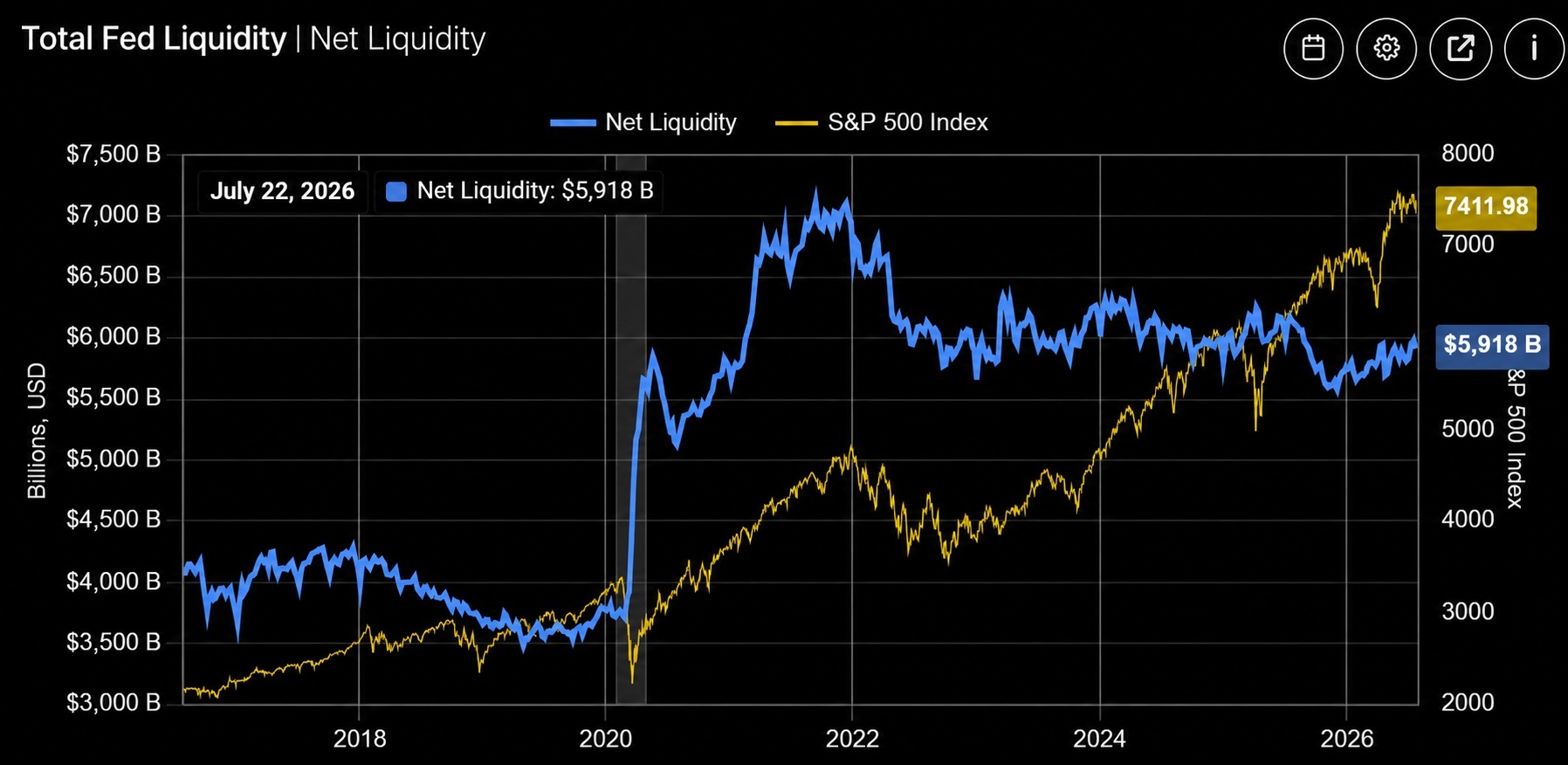
Image Source: Streetstats.finance

Analysts tracking this metric weekly place the current value in the 80th percentile of all weekly observations since 2003—a level historically associated with easier, not tighter, financial conditions.

The Reverse Repo facility, once a buffer capable of absorbing trillions in excess cash, is nearly depleted. Recent one-day RRP operation volumes have shrunk to a few hundred million dollars, a fraction of the facility's peak of $2.37 trillion recorded in September 2022. With this "cushion" gone, the additional liquidity now has nowhere to go but directly into markets, including Bitcoin and other risky assets, instead of sitting overnight at the Fed.

The next scheduled test for this position is on August 12, when the Bureau of Labor Statistics releases the Consumer Price Index (CPI) report for July. Traders note that this data is more likely to be the catalyst for Bitcoin's next real move, as high inflation readings would force the Federal Reserve to keep rates elevated for longer, tightening the very liquidity conditions that have been cushioning market pressure throughout this month.

end-content

Trending Cryptos

Related Questions

QWhat is the main reason provided in the article for Bitcoin's recent price corrections, according to Ethra Invest's CEO?

AAccording to Ethra Invest's CEO, Said Al-Mari, the recent Bitcoin price corrections are caused by forced liquidations (the liquidation of bullish positions using leverage), not by a mass capital outflow from the asset.

QHow did the net inflow/outflow of US spot Bitcoin ETFs evolve during the week discussed in the article?

AUS spot Bitcoin ETFs recorded a cumulative two-day outflow of $465 million on July 23rd and 24th, ending a seven-session inflow streak. Despite this, the week still finished with a small net inflow of $33.79 million, meaning the late outflows erased most, but not all, of the prior week's gains.

QWhat is the significance of the US net liquidity figure of approximately $5.92 trillion mentioned in the article?

AThe US net liquidity figure of approximately $5.92 trillion, which has grown over 3% in the past 12 weeks, represents money available for investment in risk assets. Analysts place this level in the 80th percentile historically, which is associated with easier, not tighter, financial conditions, potentially supporting risk assets like Bitcoin.

QWhat upcoming event is identified in the article as a potential catalyst for Bitcoin's next significant price move?

AThe article identifies the US Consumer Price Index (CPI) report for July, scheduled for release on August 12th, as the next potential catalyst for a significant Bitcoin price move, as high inflation data could pressure the Federal Reserve to maintain higher interest rates for longer.

QWhat has happened to the Reverse Repo (RRP) mechanism, and what is its implication for market liquidity according to the article?

AThe Reverse Repo (RRP) mechanism, which once absorbed trillions in excess cash, has nearly emptied. With this 'buffer' gone, the article argues that additional liquidity now has little choice but to flow directly into markets, including Bitcoin and other risk assets, instead of being parked overnight at the Fed.

Related Reads

A Serious Threat is Looming for Bitcoin (BTC) and Cryptocurrencies: They Could Be the First Target!

The rapid advancement of quantum computing poses a serious threat not only to cryptocurrencies but to the entire encryption system, including banking. However, experts warn that the cryptocurrency market might be the first sector to suffer from this transformation. As predictions of a 'Q-Day' approach, the slow governance processes of cryptocurrencies, rather than their cryptography, could become the biggest obstacle to defending against quantum attacks. Quantum Xchange CEO Eddy Zervigon has compared cryptocurrencies to "canaries in the coal mine," stating that the first successful quantum-powered cyberattack is likely to target decentralized blockchain networks. While a cryptographically relevant quantum computer capable of breaking the elliptic curve cryptography underlying Bitcoin's signatures and banking security does not yet exist, work by giants like Microsoft, IBM, and Google suggests the threat is nearer than previously thought. The industry consensus estimates such a computer could emerge around 2029. Supporting this view, recent Google research indicates the number of physical qubits needed to break the cryptographic systems protecting Bitcoin and Ethereum has decreased by about 20 times compared to prior estimates, highlighting the accelerated danger. Zervigon concludes that Bitcoin's greatest risk lies not in its current cryptographic system, but in the slow pace of implementing major network upgrades.

cryptonews.ru30m ago

A Serious Threat is Looming for Bitcoin (BTC) and Cryptocurrencies: They Could Be the First Target!

cryptonews.ru30m ago

Crypto Outperforming Stocks: How Digital Assets Are Withstanding Macroeconomic Pressure

Crypto Outperforms Stocks Amid Macro Pressure Trading firm QCP Capital's report analyzes the divergent performance of crypto and stock markets ahead of the July 29 FOMC meeting. While major US stock indexes showed mixed results, with tech weakness pressuring the Nasdaq, crypto assets like Bitcoin (up ~11.6% in July) and Ethereum (up ~24.6%) have outperformed despite a challenging macro backdrop, including rising Treasury yields and risk-off sentiment. Key focus points include the upcoming Fed decision and commentary from Chair Kevin Warsh, which could signal the regulator's stance on inflation and growth. Spot Bitcoin and Ethereum ETFs saw a net outflow of ~$311 million on July 24, ending a seven-day inflow streak, highlighting shifting institutional sentiment. Option market data reveals increased demand for downside protection, indicating caution, though constructive long-term positioning remains. Implied volatility for Ethereum trades at a premium to Bitcoin, and perpetual funding rates stay positive. The week's key events are the FOMC decision, Treasury yield movements, ETF flow trends, and US regulatory developments like the CLARITY Act. The market balances crypto's resilience against growing option market caution, with the Fed's decision poised to tip the scales. Analysis compares the current Fed pause to historical rate-cutting cycles, questioning whether crypto's strength can persist if monetary policy tightening persists.

cryptonews.ru40m ago

Crypto Outperforming Stocks: How Digital Assets Are Withstanding Macroeconomic Pressure

cryptonews.ru40m ago

Trading

Spot

Hot Articles

What is $BITCOIN

DIGITAL GOLD ($BITCOIN): A Comprehensive Analysis Introduction to DIGITAL GOLD ($BITCOIN) DIGITAL GOLD ($BITCOIN) is a blockchain-based project operating on the Solana network, which aims to combine the characteristics of traditional precious metals with the innovation of decentralized technologies. While it shares a name with Bitcoin, often referred to as “digital gold” due to its perception as a store of value, DIGITAL GOLD is a separate token designed to create a unique ecosystem within the Web3 landscape. Its goal is to position itself as a viable alternative digital asset, although specifics regarding its applications and functionalities are still developing. What is DIGITAL GOLD ($BITCOIN)? DIGITAL GOLD ($BITCOIN) is a cryptocurrency token explicitly designed for use on the Solana blockchain. In contrast to Bitcoin, which provides a widely recognized value storage role, this token appears to focus on broader applications and characteristics. Notable aspects include: Blockchain Infrastructure: The token is built on the Solana blockchain, known for its capacity to handle high-speed and low-cost transactions. Supply Dynamics: DIGITAL GOLD has a maximum supply capped at 100 quadrillion tokens (100P $BITCOIN), although details regarding its circulating supply are currently undisclosed. Utility: While precise functionalities are not explicitly outlined, there are indications that the token could be utilized for various applications, potentially involving decentralized applications (dApps) or asset tokenization strategies. Who is the Creator of DIGITAL GOLD ($BITCOIN)? At present, the identity of the creators and development team behind DIGITAL GOLD ($BITCOIN) remains unknown. This situation is typical among many innovative projects within the blockchain space, particularly those aligning with decentralized finance and meme coin phenomena. While such anonymity may foster a community-driven culture, it intensifies concerns about governance and accountability. Who are the Investors of DIGITAL GOLD ($BITCOIN)? The available information indicates that DIGITAL GOLD ($BITCOIN) does not have any known institutional backers or prominent venture capital investments. The project seems to operate on a peer-to-peer model focused on community support and adoption rather than traditional funding routes. Its activity and liquidity are primarily situated on decentralized exchanges (DEXs), such as PumpSwap, rather than established centralized trading platforms, further highlighting its grassroots approach. How DIGITAL GOLD ($BITCOIN) Works The operational mechanics of DIGITAL GOLD ($BITCOIN) can be elaborated on based on its blockchain design and network attributes: Consensus Mechanism: By leveraging Solana’s unique proof-of-history (PoH) combined with a proof-of-stake (PoS) model, the project ensures efficient transaction validation contributing to the network's high performance. Tokenomics: While specific deflationary mechanisms have not been extensively detailed, the vast maximum token supply implies that it may cater to microtransactions or niche use cases that are still to be defined. Interoperability: There exists the potential for integration with Solana’s broader ecosystem, including various decentralized finance (DeFi) platforms. However, the details regarding specific integrations remain unspecified. Timeline of Key Events Here is a timeline that highlights significant milestones concerning DIGITAL GOLD ($BITCOIN): 2023: The initial deployment of the token occurs on the Solana blockchain, marked by its contract address. 2024: DIGITAL GOLD gains visibility as it becomes available for trading on decentralized exchanges like PumpSwap, allowing users to trade it against SOL. 2025: The project witnesses sporadic trading activity and potential interest in community-led engagements, although no noteworthy partnerships or technical advancements have been documented as of yet. Critical Analysis Strengths Scalability: The underlying Solana infrastructure supports high transaction volumes, which could enhance the utility of $BITCOIN in various transaction scenarios. Accessibility: The potential low trading price per token could attract retail investors, facilitating wider participation due to fractional ownership opportunities. Risks Lack of Transparency: The absence of publicly known backers, developers, or an audit process may yield skepticism regarding the project's sustainability and trustworthiness. Market Volatility: The trading activity is heavily reliant on speculative behavior, which can result in significant price volatility and uncertainty for investors. Conclusion DIGITAL GOLD ($BITCOIN) emerges as an intriguing yet ambiguous project within the rapidly evolving Solana ecosystem. While it attempts to leverage the “digital gold” narrative, its departure from Bitcoin's established role as a store of value underscores the need for a clearer differentiation of its intended utility and governance structure. Future acceptance and adoption will likely depend on addressing the current opacity and defining its operational and economic strategies more explicitly. Note: This report encompasses synthesised information available as of October 2023, and developments may have transpired beyond the research period.

1.1k Total ViewsPublished 2025.05.13Updated 2025.05.13

What is $BITCOIN

Discussions

Welcome to the HTX Community. Here, you can stay informed about the latest platform developments and gain access to professional market insights. Users' opinions on the price of BTC (BTC) are presented below.

活动图片