Can Solana reverse its ‘worst quarter’ since 2023 as fees drop 78%?

ambcryptoPublished on 2026-07-11Last updated on 2026-07-11

Abstract

Solana's on-chain activity has hit its lowest point since late 2023, with network fees plummeting 78% year-over-year to $51 million in Q2 2026. This dramatic drop in user-paid fees signals a severe contraction in network usage, coinciding with a broader crypto market downturn that has diminished Solana's role as a speculative hub. Despite a projected market bottom and emerging positive signs in areas like stablecoins and tokenization, capital inflows into SOL remain weak. SOL's Realized Cap has fallen to $73 billion, indicating $24 billion in outflows since last year. While SOL's price recently recovered to $84, reclaiming a key support level of $75, its upside is capped near $92. A potential sell-off from $14.2 million in stolen SOL could further test this crucial support.

Solana on-chain activity has dropped to a level never seen since late 2023, further underscoring the structural factor that could derail a strong price recovery.

According to a recent DeFi Report, the Solana network did $51M in total fees in Q2 2026, marking a 43% drop from Q1 and 78% on a year-on-year (YoY) basis. Compared to past quarters, this was the lowest fees since Q4 2024.
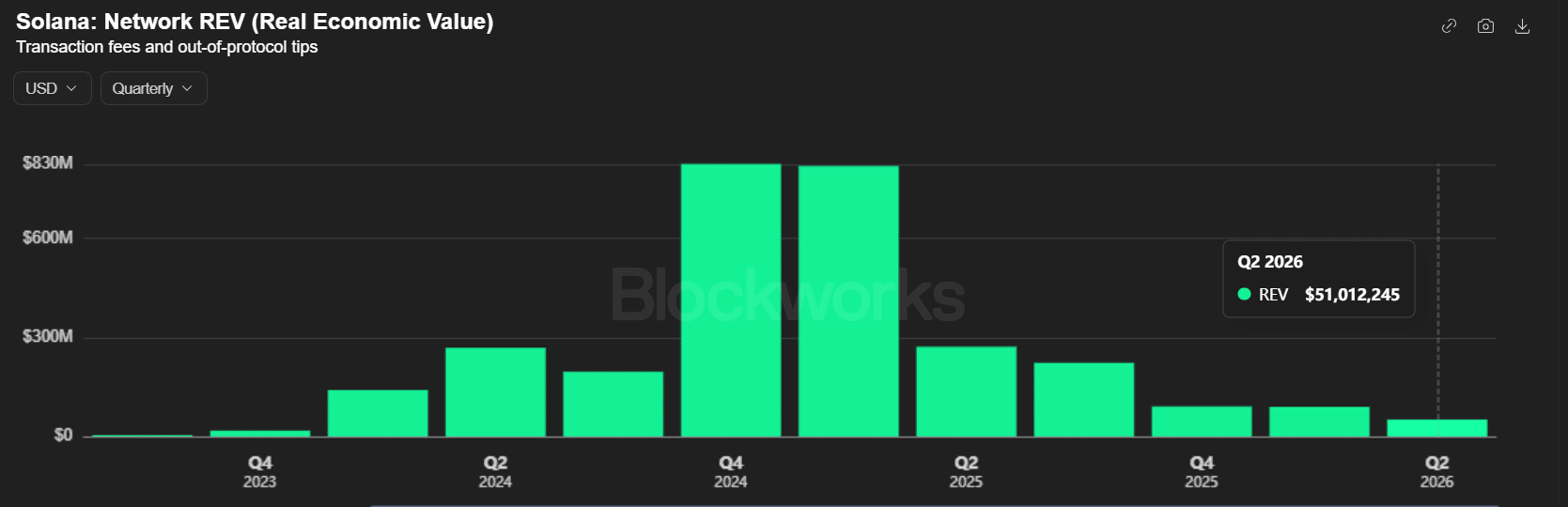
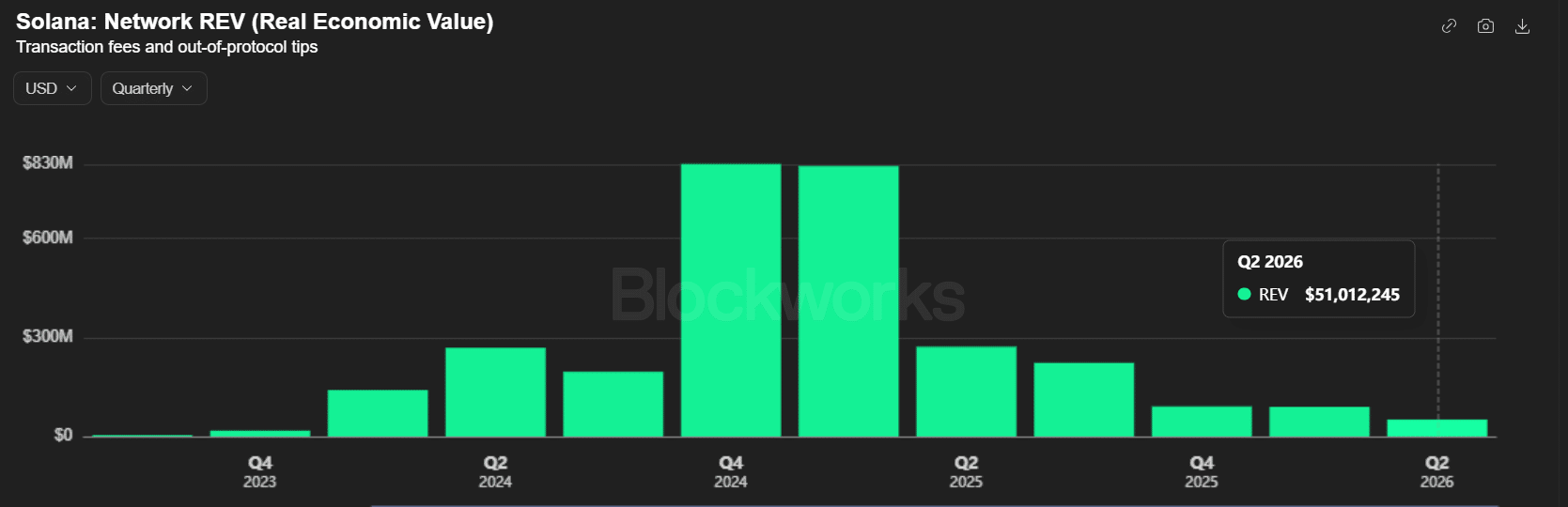
Source: Blockworks

Since fees track the value paid by users transacting on the chain, it meant the network activity had dropped too. This was not surprising given the broader crypto market downturn since last October.

With the downturn, Solana’s traction as a ‘homebase for speculation’ also contracted over the period. But the report projected that the bear market bottom may have bottomed out in Q2, citing stablecoin growth, tokenization, and perpetual volume surge.

However, it looks like this may have bottomed in Q2. We’re now beginning to see some green shoots within the ‘trenches.’

Despite the said recovery in new narratives, capital inflows into the SOL token were still at a two-year low.

Solana: Assessing SOL’s price recovery

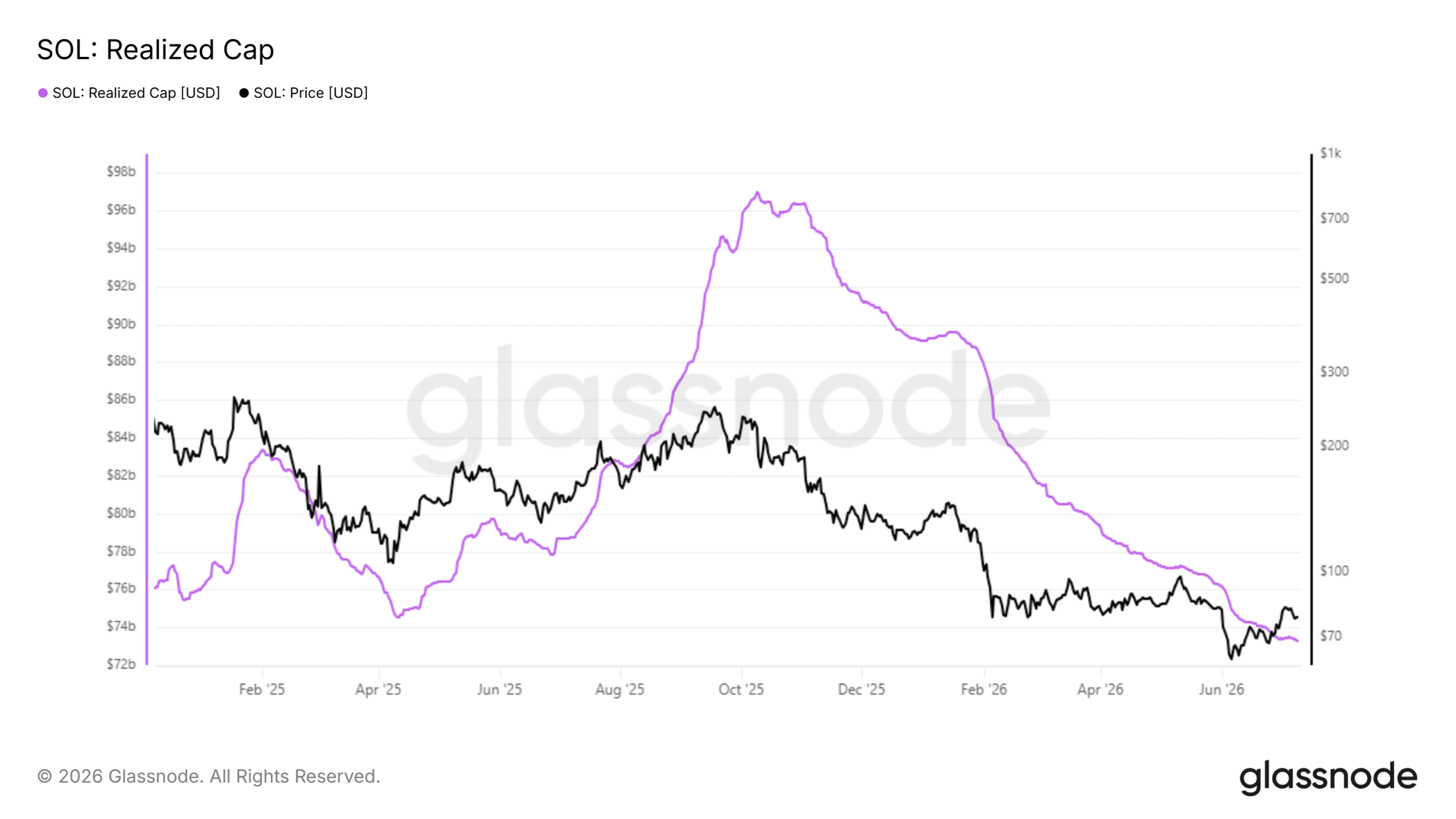
According to Glassnode, SOL’s Realized Cap, which tracks on-chain capital inflows into the SOL market, has dropped from a record $97B last year to $73B in 2026. This was the lowest level the metric has dropped since late 2024.
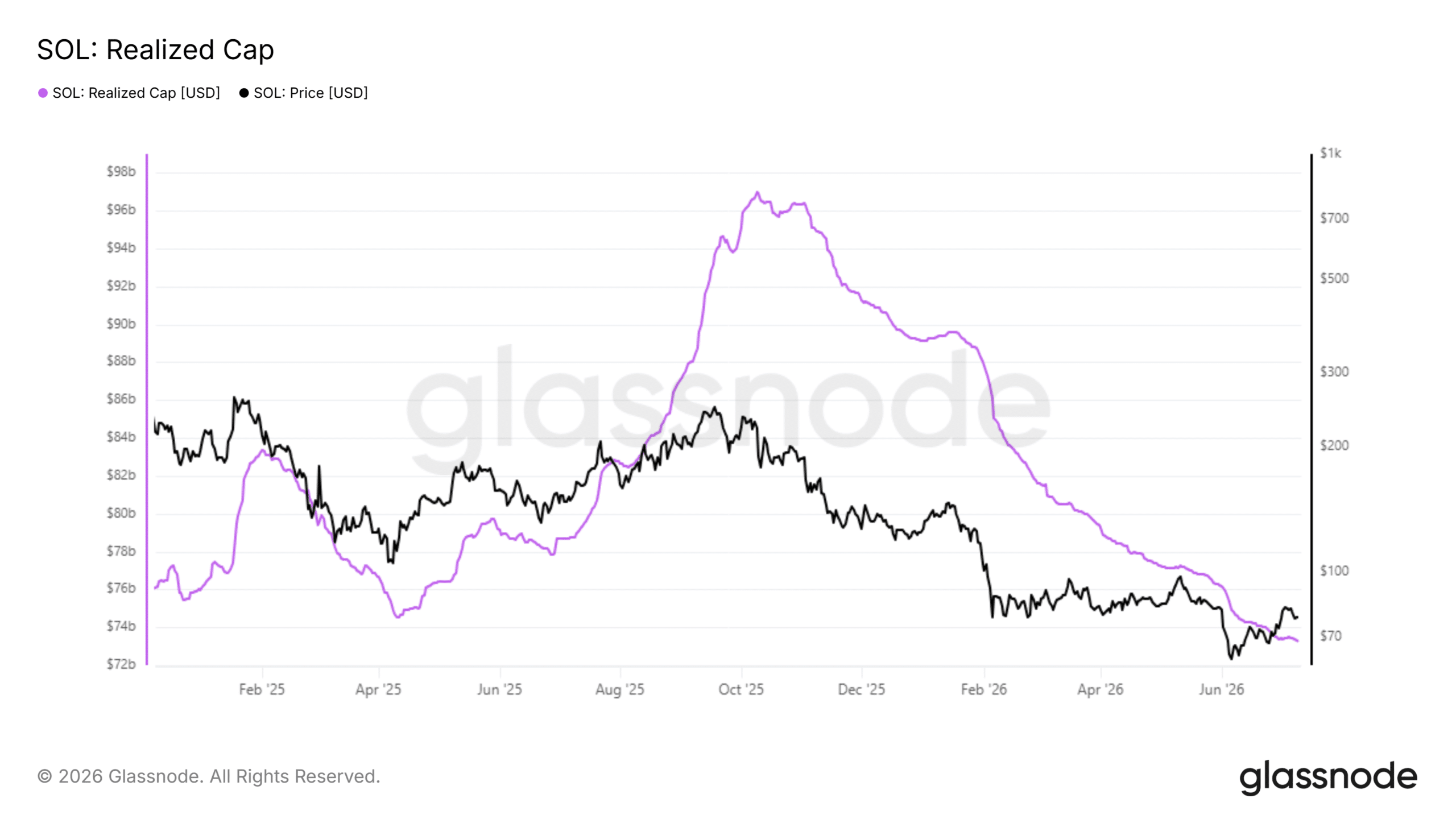
Source: Glassnode

In other words, SOL saw $24B in capital outflows in the past few months. The bearish trend is yet to reverse despite the recent 28% relief recovery.

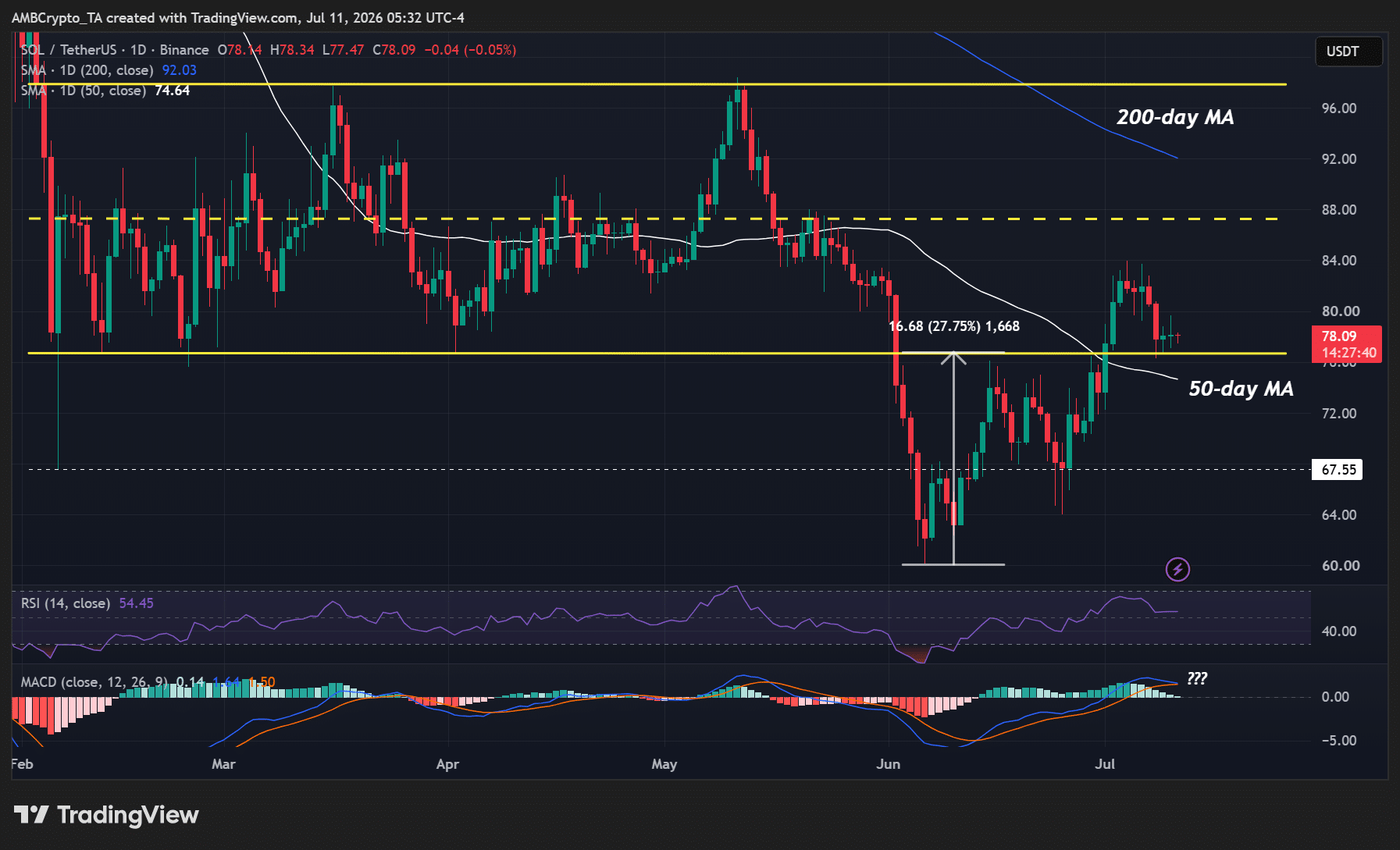
During the broader recovery in early June, SOL bounced from $60 to $84, effectively reclaiming its 2026 range-low of $75 (orange channel). Since February, SOL has been range-bound between $98 and $75.
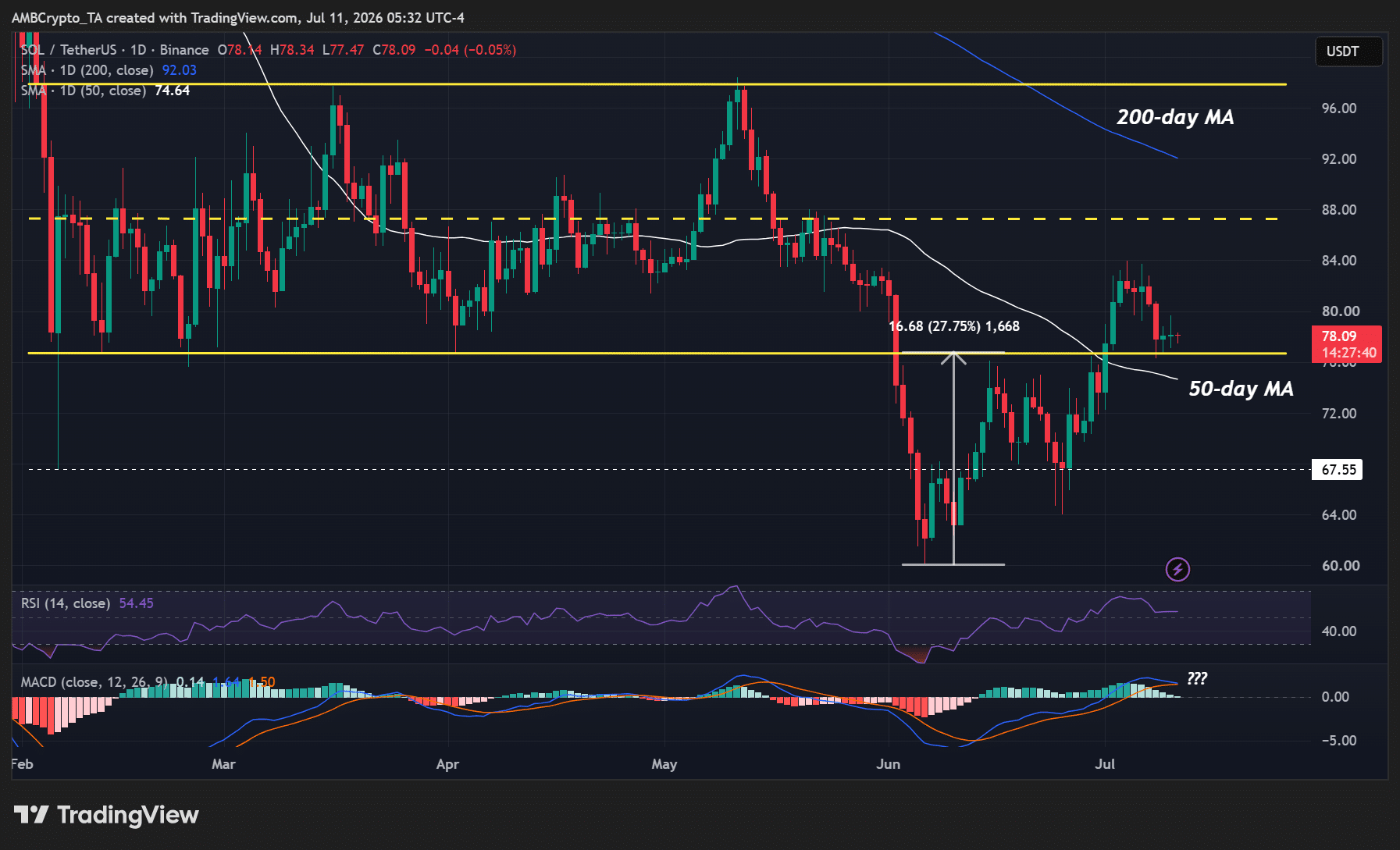
Source: SOL/USDT, TradingView

It broke below the range after broader market risk-off triggered by Strategy’s BTC sale in early June. If the recent momentum holds, bulls could defend $75 and eye the mid-range level at $88 or the upside target at $92 (200-day Moving Average, blue line).

If so, that would imply a 13% to 20% upside potential assuming BTC does not post more losses in early Q3.

Separately, Web3 researcher Zach XBT reported that an early Solana whale has been exploited and 180.9K SOL ($14.2M) stolen. Should the hacker cash out the funds, it could trigger a short-term sell-off and test the $75 support.


Final Summary

  • Solana fees plunged 78% YoY to $51M, the worst since late 2023
  • SOL reclaimed the 2026 price range, but $75 support could be tested if $14M stolen funds hit the market


Trending Cryptos

Related Questions

QWhat was the percentage decrease in Solana's total fees in Q2 2026 compared to the previous year?

ASolana's total fees decreased by 78% year-on-year (YoY) in Q2 2026.

QWhat is the significance of the drop in Solana's fees according to the article?

AThe drop in fees indicates a significant decrease in on-chain network activity, as fees track the value paid by users for transactions. This is a structural factor that could hinder a strong price recovery for SOL.

QWhat is the 'Realized Cap' for SOL as mentioned in the article, and what does its drop signify?

AThe 'Realized Cap' tracks on-chain capital inflows into the SOL market. It dropped from a record $97B last year to $73B in 2026, signifying approximately $24B in capital outflows and indicating bearish sentiment that has not yet reversed.

QWhat are the potential upside price targets for SOL mentioned in the article, assuming recent momentum holds?

AIf the recent momentum holds, the article suggests bulls could defend the $75 support and target the mid-range level at $88 or the upside target at the 200-day Moving Average around $92, implying a 13% to 20% upside potential.

QWhat event does the article mention that could potentially test the $75 support level for SOL?

AThe article mentions that a hack resulted in 180.9K SOL ($14.2M) being stolen. If the hacker cashes out these funds, it could trigger a short-term sell-off and test the $75 support level.

Related Reads

US Stock Market Trends (Aug 27): PCE Exceeds Expectations, Pressures Broader Market; Nvidia Rises 4% After-Hours, Nasdaq Futures Up 1%

U.S. Market Trends (Aug 27): PCE Data Weighs on Indices, Nvidia Rises 4% After-Hours, Nasdaq Futures Up 1% U.S. stocks closed slightly lower on Wednesday amid narrow trading. The S&P 500, Nasdaq, and Dow Jones all edged down, ending the Dow's two-day winning streak. The key pressure came from July's PCE inflation data, which showed a 3.7% year-over-year increase, exceeding expectations. While the core PCE met forecasts at 3.3%, the hot headline number boosted Treasury yields and the dollar, dampening hopes for imminent Fed rate cuts. Gold fell below $4,600/oz. Oil prices continued to weaken despite mixed geopolitical signals. The market's real focus was after the close. Nvidia reported Q2 revenue of $96.2 billion, beating estimates, guided for current-quarter revenue to surpass $100 billion for the first time, and projected 70% revenue growth for the next fiscal year. Its shares rose approximately 4% after-hours, lifting Nasdaq futures by about 1%. Amazon's announcement to deploy an additional 2 million GPUs further validated the data center demand narrative for Nvidia. In other sectors, chip stocks like Western Digital and Arm gained. Among the "Magnificent Seven," moves were mixed. Salesforce surged on strong guidance and an expanded partnership with Anthropic. Meta settled a youth addiction case with 29 U.S. states for up to $18 billion, a figure seen as favorable compared to earlier fears. Bitcoin retreated from recent highs, while industrial metals like copper extended their rally. The core market tension remains between inflation concerns pressuring the broader market and strong AI earnings providing sector-specific momentum, setting the tone for early September trading.

marsbit50m ago

US Stock Market Trends (Aug 27): PCE Exceeds Expectations, Pressures Broader Market; Nvidia Rises 4% After-Hours, Nasdaq Futures Up 1%

marsbit50m ago

A Record $70 Billion Inflow in 5 Days! Investors Are No Longer Choosy, Buying Gold and Bitcoin Together

Investors are moving beyond "either/or" choices and are simultaneously pouring money into both gold and bitcoin ETFs. Over the past five trading sessions, ETFs tracking these assets attracted a record $7 billion in combined inflows, pushing some of the largest gold and bitcoin funds to the top of the U.S. weekly ETF inflow rankings. This surge was triggered by U.S. Treasury Secretary's announcement to at least double long-term bond buybacks, which initially pressured Treasury yields and the dollar, boosting prices for both assets. Gold has risen about 13% this month, while bitcoin reclaimed the $80,000 level. The synchronized rally signals the return of the "monetary debasement trade." Amid growing concerns over fiscal sustainability and easing financial conditions, investors are seeking scarce assets perceived as outside direct government control. Gold benefits from its traditional safe-haven role, while bitcoin's fixed supply of 21 million coins positions it as a potential hedge. The SPDR Gold ETF (GLD) attracted nearly $3.4 billion, and the iShares Bitcoin Trust (IBIT) saw $1.5 billion in inflows, both ranking in the weekly top ten. Analysts note the momentum behind the flows is as significant as the volume, indicating investors are aggressively adjusting previously underweight positions. While the narrative of hedging against fiscal stress and currency debasement is gaining traction, some analysts question its sustainability, suggesting equities might be a more reliable hedge in the long run.

华尔街日报55m ago

A Record $70 Billion Inflow in 5 Days! Investors Are No Longer Choosy, Buying Gold and Bitcoin Together

华尔街日报55m ago

Yangtze Memory: Is It the Second ChangXin?

The largest IPO in the history of the STAR Market is approaching. Yangtze Memory Technologies (YMTC) has filed for a listing on the Shanghai Stock Exchange's STAR Market, aiming to raise 33 billion yuan. This surpasses the previous record set by competitor ChangXin Memory Technologies (CXMT), which raised 29.5 billion yuan and saw its market capitalization surge on its debut. Despite both being leading Chinese memory chipmakers founded in 2016 and operating under the IDM model, the two companies are fundamentally different. CXMT focuses on DRAM, the memory used for temporary data processing, while YMTC specializes in NAND Flash, used for long-term data storage. Industry reports indicate the global DRAM market is significantly larger and more concentrated among three major players, where CXMT ranks as the fourth-largest supplier. The NAND Flash market is more fragmented, with YMTC ranking third globally by shipment volume in Q2 2026, though fifth by revenue due to a stronger focus on consumer-grade products. Experts are divided on whether YMTC can replicate CXMT's explosive market debut. Some analysts believe it is highly unlikely, citing a cooler market environment and YMTC's perceived lower strategic scarcity within the AI supply chain compared to DRAM/HBM-focused companies. They warn that aggressive IPO pricing could lead to downward pressure post-listing. Industry forecasts suggest the DRAM market may remain tight, while the NAND Flash market could face price corrections due to new capacity and weaker demand. Other experts argue that while short-term market sentiment differs, the long-term investment value of both companies is comparable, hinging on future performance and potential breakthroughs in areas like HBM. They believe YMTC's IPO is unlikely to face significant cooling given still-elevated market interest in the semiconductor sector.

marsbit1h ago

Yangtze Memory: Is It the Second ChangXin?

marsbit1h ago

Trading

Spot

Hot Articles

Discussions

Welcome to the HTX Community. Here, you can stay informed about the latest platform developments and gain access to professional market insights. Users' opinions on the price of SOL (SOL) are presented below.

活动图片