Organized & Compiled: Deep Tide TechFlow
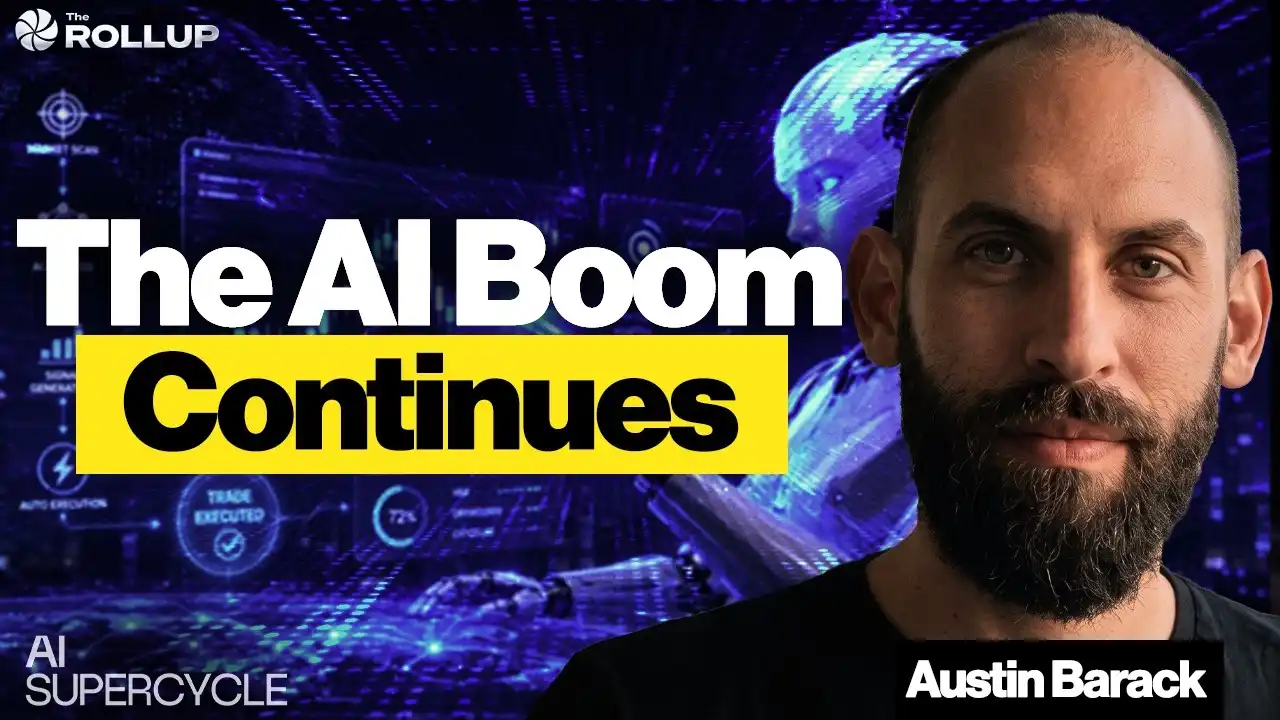
Guest: Austin Barack, Founder of Relayer Capital (a digital asset investment fund focused on the AI sector)
Host: Andy
Podcast Source: The Rollup
Original Title: Austin Barack: My AI Bull Thesis (...And What I'm Holding)
Broadcast Date: May 23, 2026
Key Summary
This episode of AI Supercycle invited Austin Barack, founder of Relayer Capital, to discuss Venice, Grass, NEAR, Akash, and the broader Crypto x AI asset framework. Austin's core viewpoint is that AI is scaling user data to levels unimaginable for past internet products, making privacy AI, data supply, inference computing power, decentralized training, and Agent infrastructure key sectors. He believes there is a clear misalignment between the revenue growth, user growth, and valuation of Venice and Grass, and that NEAR's positioning in cross-chain Intents and Agent infrastructure is also undervalued. Regarding the broader crypto market, Austin emphasizes that investors should start from the perspective of "net Token value flow" rather than mechanically looking at buyback and burn mechanisms, truly assessing whether Token holders are capturing the value created by the business.
Excerpts of Notable Points
The True Value of Venice and Privacy AI
- "In AI, privacy is more important than in any other scenario. Because you're sharing health data, financial data, you'll connect all your files, and you'll share your entire life in ways never done before."
- "This isn't 10 times more data than social media; it's 100 times more data."
- "What's really cool about Venice is that it's not just about using AI in a private environment; it does this without sacrificing the user experience at all, even improving it."
- "Tokens can become a very important part, significantly enhancing the experience, but for most users, they don't need to understand Tokens to find the product useful."
VVV, DM, and Venice's Economic Model
- "The role of DM is: for every 1 DM Token you own, you get $1 worth of free inference compute credit per day on the Venice platform. You can think of it as a kind of perpetual right, equivalent to getting $365 of compute credit per year."
- "Its credit expires if unused; it doesn't accumulate over time. If you only used 50 cents one day, it doesn't become $1.50 the next day; it resets to $1."
- "If all DM is locked and used for inference compute, then Venice's maximum cost is $38,000 per day, an annualized cost of about $10 million, and this cost will not exceed that figure."
- "I think DM should be valued more like a corporate bond, rather than using a high discount rate to suppress its value."
Grass and AI Data Demand
- "Grass collects datasets and then sells these datasets to cutting-edge AI labs that need data to train new models."
- "This isn't random web crawling; it has to be very specialized, very specific datasets, and of high quality."
- "The scale of investment into models is huge, and Grass benefits from this trend. The more invested in models, the greater the demand for data."
- "According to recently disclosed data, the project's ARR is about $50 million. Currently, its valuation is about $400 million. For a project growing this fast, valuing it at just 5x revenue seems completely unreasonable to me."
NEAR, Akash, and the AI Stack
- "NEAR Intents is very practical and arguably one of the best cross-chain Swap experiences available now. Also, it plays a very important role in the Agent space."
- "I think NEAR is doing very well on the Intents side. They're also doing many other things, like private intents and other elements around AI usage; it's one of the few L1s that has truly found its unique positioning."
- "Akash. They started with a decentralized CPU marketplace early on and later pivoted to the GPU market."
- "The main areas I'm focused on include: decentralized training, inference and compute marketplaces, Agent infrastructure, data, and consumer-facing model usage applications."
Token Value Capture and Market Divergence
- "Hyperliquid is first and foremost a very successful business model, so people like its Token, and buybacks are just one way it transfers value to Token holders. If it wasn't a well-functioning business to begin with, then even with a buyback mechanism, the Token price wouldn't naturally rise."
- "The core issue isn't what the mechanism is called, but whether Token holders can maximally capture the value generated by what you're building."
- "Every project and each mechanism needs specific analysis. But the core question is: Are Token holders able to benefit from the value the system is generating?"
- "Investors can choose from a smaller pool of quality projects. Now, capital flows are concentrating into projects like Venice, HYPE, Grass, AERO, NEAR, and Zcash."
- "For investors seeking 5 to 10x, or even 3x returns, it's easier to succeed now than before. While you might still achieve a 100x return eventually, I think there's a set of projects doing very interesting things right now, and these are the assets I would watch and invest in."
Venice Privacy Overview
Host Andy: I used Venice for the first time not long ago. I typed into Venice: "Is this really private?" It replied: "Yes, the inference process is private," then explained a bunch. I replied: "That's so cool." It immediately responded: "Yes, it is pretty cool, isn't it? Using Venice, you can..."
So the first time using Venice, there's an interesting moment: you suddenly realize that all the chat content you've ever entered into typical AI providers, while not necessarily public, the data flows to large providers. The most private diaries, trade secrets, plans, etc., are all handed over to them.
From a high-level perspective, regarding market structure, investment logic, founding team, how do you view private AI and Venice?
Austin:
Venice is interesting because it has gone through many different stages of iteration. I first came across the project last January. I was closely following Virtuals and aixbt at the time, and a large portion of Venice's early airdrop went to holders of tokens in those ecosystems, so that's where I first saw it.
It was already an interesting product at that time. It's crazy that even though only about 16 months have passed, AI was far from being as ubiquitous as it is today, and it hadn't become an indispensable part of everyone's daily life yet. During this period, whether it's Claude, ChatGPT, or other services, AI started out as a replacement for Google search. People would say: "I don't use Google to search for certain questions anymore; I go directly to an AI platform to ask an LLM." But now it's entered into creation, task solving, even the stage where you have an entire team and a bunch of Agents helping you work.
AI Data Usage is 100x Greater Than Before
Austin:
I think people are gradually realizing that privacy in AI is more important than in any other scenario. Because you're sharing health data, financial data, you connect all your files, you share your entire life in ways never done before.
In the past, when people talked about privacy, it was more in the context of social media, like whether my account is public or private, whether Facebook knows too much about me. But AI isn't just 10 times more data; it's 100 times more data.
The really cool thing about Venice is that it doesn't just let you use AI in a private environment; it does so without sacrificing the user experience at all, even improving it. Because you're not tied to one specific model. For example, if you use ChatGPT, you're just following OpenAI's model upgrades; if you use Anthropic, you follow Anthropic's different model evolutions; or you use Gemini, open-source models, each with its own boundaries.
In Venice, you can choose the most suitable model for each task, and you can also choose which models you want to use. So it has a high degree of customization. They first created a very, very good consumer product, and most users don't know what Tokens are.
Tokens then add an interesting element on top of that. I'm very bullish on what they're doing. The key here is, I think crypto consumer products will evolve into a form where Tokens can become a very important part, significantly enhancing the experience, but for most users, they don't need to understand Tokens to find the product useful.
Host Andy: This indeed seems like a breakthrough form for consumer products: there's Crypto underneath, but users don't need to understand it first. But it also brings an interesting Token structure. Some compare it to Luna: staking VVV yields DM Tokens, then the inference credit forms some sort of debt structure.
3 Million Users
Host Andy: So how should one understand the VVV Token and DM Token within Venice's current flywheel? Also, could you talk about Venice's revenue side? Because they are indeed doing some buybacks, but the scale isn't particularly large. How do these two Tokens actually work? Why isn't it like Luna?
Austin:
They just announced having 3 million users, and growth is very fast. They added about 1 million users in the last 3 months, whereas the previous 1 million users took about 7 months. So growth has been accelerating.
The VVV and DM Token Flywheel
Austin:
They have two Tokens. The first is VVV. Protocol revenue is used to burn VVV. Users can also stake VVV to get free membership. But the most interesting part is that users can stake and lock VVV to mint a Token called DM. You can also buy DM on the open market, but the core mechanism is staking VVV and minting DM.
The role of DM is: for every 1 DM Token you own, you get $1 worth of free inference compute credit per day on the Venice platform. You can think of it as a kind of perpetual right, equivalent to getting $365 of compute credit per year.
But its credit expires if unused; it doesn't accumulate over time. If you only used 50 cents one day, it doesn't become $1.50 the next day; it resets to $1. I think this creates a very interesting mechanism, similar to a tool for customer acquisition at near cost. This is different from Luna. Luna went to an extreme state, issuing an insane number of Tokens, leading to stablecoin scale in the tens or hundreds of billions. Venice is very clear on this: they keep the potential cost within a defined range.
Currently, the amount of DM that can be minted per Venice Token gradually decreases as the amount of DM in circulation increases, which effectively sets a hard cap of about 38,000 DM. Under current conditions, if all DM is locked and used for inference compute, then Venice's maximum cost is $38,000 per day, an annualized cost of about $10 million, and this cost will not exceed that figure.
Currently, about 10,000 DM are used for inference compute per day, corresponding to an annualized cost of about $3.5 million. This cost is offset by their business revenue. They offer Pro and Premium subscription services, ranging from $18 to $68 per month, or even higher. At the same time, when users use the platform, they also purchase Tokens or additional credits to use models.
Notably, their daily Token usage has grown from the initial few billion to recently about 70 billion, a roughly 15x increase over the past few months. So the difference here from Luna, I think, is that there is a maximum potential cost for the company, and DM users, while using DM, also use subscription services. If they need more than $1 credit per Token per day, they also buy other credits. This cost is easily covered by business revenue, and business revenue already far exceeds it.
DM Should Be Priced Like a Corporate Bond
Austin:
On the other hand, the coolest thing about DM is that it guarantees you future access to compute resources. The market currently values it with about a 20% discount rate, with a price around $1,800.
I think this type of asset should be priced more like a corporate bond, for example using an 8% to 12% discount rate. Using a 10% discount rate, its price would be roughly $3,650. For example, when I first started paying attention to it, the price was in the $200 range.
Host Andy: I was also thinking, how can an asset that generates $365 worth of rights per year be worth only $200? Unless the market believes Venice simply cannot sustain this mechanism.
Austin:
Exactly. So at that price point, it was almost a no-brainer investment opportunity for me. Even now, I still think there's room for upside.
However, looking beyond DM at Venice's overall economic situation, the numbers are very impressive. And its growth model is completely different from most projects we see in the crypto industry. It's more like the growth rate only possible in the AI field, which is why it's so attractive.
Is Venice at $20 Still Undervalued?
Host Andy: So you're convinced that Venice's VVV asset price is now around $20. Do you think a valuation range of $1.5 to $2 billion is still significantly undervalued for VVV?
Austin:
Yes. When I first bought in January, it was around $2.5. At that time, their daily token volume was only a few billion. Now it's about 15 times that.
Back then, their daily token transaction volume was only a few billion, and now it's grown 15 times that. Their user base grew from 1.5 million to the current 3 million. By my estimates, their revenue is at least 3 times what it was then.
Currently, Venice's valuation is roughly 20 to 30 times its annual revenue, and this is a company still growing at 20% per month. From this perspective, I think its valuation remains very low. You could even compare it to OpenRouter. OpenRouter's valuation is similar to Venice's, but its revenue scale might be slightly lower, and its growth speed might not be as fast as Venice's.
The key difference is that Venice has direct customer resources. It's not a pure backend infrastructure service provider, but a platform that users actively use every day. Personally, currently, the only way I use AI is through Venice.
So, I think its potential is still huge. Of course, this is just my personal opinion and not any investment advice.
How Grass Makes Money
Host Andy: I'm not very familiar with Grass yet. You've mentioned this project multiple times before, and it seems poised for rapid growth now. Of course, its price might have pulled back today. I heard its annualized revenue has exceeded $50 million, and growth is accelerating, reaching triple-digit growth rates. Could you briefly explain Grass's core profit model? How does it make money? And why is it so attractive?
Austin:
Grass collects datasets and then sells these datasets to cutting-edge AI labs that need data to train new models. These labs are generating new models at a very fast pace, but to generate these new models, they need more data. And this isn't random internet crawling; it has to be very specialized, very specific datasets, and of high quality.
This is the role Grass plays, because the scale of investment into building these models is huge, and Grass becomes a beneficiary of this trend. The more invested in models, the greater the demand for data.
Grass's Triple-Digit Growth
Austin:
The Grass team has been building for many years. I remember in some quarter last year, they did about $3 million in revenue. By the end of the year, they were doing $12 million or close to $13 million per quarter. By my estimates, they are growing even faster now. In the next month to a month and a half, they will hold a Token holder call, and we'll get more information.
But this is a project showing triple-digit growth. According to recently disclosed data, the project's ARR is about $50 million. However, I expect it might now be close to $80 million. Currently, its valuation is about $400 million. So, for a project growing this fast, valuing it at just 5x revenue seems completely unreasonable to me; it's a prime candidate for a revaluation.
Host Andy: Is there any working relationship between Grass and Venice?
Austin:
Currently, no. Venice typically doesn't build its own models. So no relationship for now. Who knows in the future. But I see them as two different sides of the same equation. One question is: How do you use AI, and how do you use it privately? Another question is: How are models built in the first place? Grass and Venice are addressing these two sides respectively.
Is Grass's $400M Valuation Too Cheap?
Host Andy: So Grass is trading at about 5x revenue. Some things in the crypto industry trade at 20, 30, 40, 50x revenue. Do you think the ~$400 million range is kind of a no-brainer?
Austin:
Yes. I think it's important to note that the crypto industry also has other things trading at relatively low multiples, but they don't have growth. People come to crypto because they want to invest in growth.
So I think many low-multiple cases might not hold up because there's no capital flow there. But a case like Grass is one of the best examples of extremely fast growth. I think that alone makes it worth paying attention to, let alone the fact that it seems quite cheap to me.
NEAR Cross-Chain Swap
Host Andy: So do you have an investment thesis for NEAR? Are you following NEAR?
Austin:
I've been following NEAR. Even without the AI component, NEAR is an interesting project. Because it's the underlying infrastructure for a lot of cross-chain Swaps. Last October, November, when people were moving in and out of Zcash, NEAR gained a lot of attention in that regard.
NEAR Intents is very practical and arguably one of the best cross-chain Swap experiences available now. Also, it plays a very important role in the Agent space. In my view, NEAR is one of the most suitable infrastructures for carrying cross-chain Swaps, able to avoid many dependencies issues other projects have.
They are growing fast in this area. Now if you're an L1, I think you need to satisfy one of several directions: either you are a vertically integrated app experience, or you're 10x better at something, or you're very, very strong in a certain class of applications.
I think NEAR is doing very well on the Intents side. They're also doing many other things, like private intents and other elements around AI usage; it's one of the few L1s that has truly found its unique positioning.
This reminds me of NBA player categories. Now there are many new L1s and L2s on the market; they're like promising rookies. Over time, some will become superstars, and some will fade away. But there's another category of players, "role players," who perform exceptionally well in their specific roles. For example, OKC's Lu Dort or Alex Caruso.
That's how NEAR feels to me. It's not LeBron James, but it's very important because it's very strong at what it does.
Akash GPU Market Update
Host Andy: Another project that has been constantly undervalued, and Robbie always emphasizes to me, is Akash. Too bad he's not here today. Akash got into distributed inference, distributed models, decentralized training very early, right?
This sounds like the first wave of Crypto AI narrative. After that, we went through those fake Agent projects with Meme Tokens. Now, we seem to have entered the next wave of decentralized inference and model training, but this time the products are much stronger. Have you looked at what Akash is doing? Do you have an investment view on this project?
Austin:
I have indeed looked at Akash. They started with a decentralized CPU marketplace early on and later pivoted to the GPU market. Now, you can actually see how much data is flowing through OpenRouter. A significant portion of that data goes through Akash, i.e., Akash ML, which is very cool. And this data is public; anyone can see it.
However, I must admit, Akash isn't one of the projects I follow most closely. But for a team that's been around for a long time, constantly iterating, it's cool to see them finally finding real product-market fit, and that fit seems to be accelerating.
AI Stack Breakdown
Host Andy: There's a project called Gitlab, with a small market cap on Base, but the number of tokens produced daily performs strongly. Now there's a batch of highly speculative AI Tokens on Base, and there are many small sub-sectors within this puzzle that need to be understood.
I want to ask from a broader perspective: Within this AI stack, are there certain parts most suitable for achieving massive growth after integrating with blockchain? We've already seen Venice providing private inference and uncensorable ChatGPT; NEAR as infrastructure for an Agent marketplace; Akash has Akash ML; Grass focuses on datasets.
In your view, within the AI stack, what are the key sectors or components most likely to be replaced by blockchain technology, or most suitable for on-chain use?
Austin:
I think first is the privacy context, including private use of large language models (LLMs) and uncensorable use. Then comes the data collection needed to train models, which is what Grass is doing.
Next is inference compute and compute marketplaces; you mentioned Akash. We also see other inference marketplaces emerging. There's another project building around DM, also offering other services allowing users to sell idle compute, called AnC. That's an interesting project I've been watching. While it doesn't have a Token live yet, I think they're already doing some very cool things, especially regarding integration with Venice and DM.
I think another important direction is decentralized model training. The question is how to build open-source models while retaining model ownership and monetization ability through private weights. Several teams are currently exploring this space. For example, I think Pluralis is one of the most interesting projects. Nous Research is also doing some very interesting work around Hermes. Additionally, there's Prime Intellect and a few other teams working in this area.
So the main areas I'm focused on include: decentralized training, inference and compute marketplaces, Agent infrastructure, data, and consumer-facing model usage applications.
Net Token Value Flow Framework
Host Andy: Recently you've been emphasizing another point: we need new ways to understand Token models and economics. You've been a strong supporter of projects like Aerodrome and Hyperliquid.
I want to ask a broader question to conclude, outside the AI context: How do you view net Token value flow? That is, using a credit (income) and debit (expense) approach, using a plus-minus table to analyze a crypto asset's value. What kind of shift in thinking do you think is happening across the industry when analyzing Token economics? What is your current framework? Do you agree that investors should understand the net Token value flow of an asset as if looking at a plus-minus table?
Austin:
I think there are several different ways to look at this, and it's not a one-size-fits-all thing.
We can start with high-level mechanisms like buyback and burn. Hyperliquid made this mechanism very popular, and people say, "Look how well Hyperliquid is doing; it has buyback and burn." But for every Hyperliquid, there are nine other Tokens also trying to adopt the same buyback and burn mechanism, and their price performance ends up being very poor.
What's the lesson here? The lesson is that Hyperliquid is first and foremost a very successful business model, so people like its Token, and buybacks are just one way it transfers value to Token holders. If it wasn't a well-functioning business to begin with, then even with a buyback mechanism, the Token price wouldn't naturally rise.
This is the first point I think people often confuse.
The second point is, are you actually creating value for Token holders. Whether you adopt buyback and burn, buyback and distribute, reinvest funds into the business, or put funds in a bank account to enhance balance sheet flexibility, the core question is: Can Token holders maximally capture the value generated by what you're building.
For example, Hyperliquid does it, Aerodrome does it. As for Grass, many people wish it would do more buybacks, but clearly, all its contracts are with the foundation, all revenue goes into the foundation's bank account, and these assets are controlled by Token holders.
So, I think there are many different ways to understand this matter.
Buyback and Burn Only Works in Some Cases
Austin:
Then there's the issue of Token liquidity. Take Hyperliquid as an example. Theoretically, it has a maximum unlock amount per month, but in reality, maybe only two to three hundred thousand Tokens get unlocked. However, buying volume from ETFs, DAT, and the assistance fund is much higher. Therefore, naturally, there are more buyers than sellers.
Look at Aerodrome. If you lock AERO as veAERO, then after they expand to the Ethereum mainnet in July, veAERO will be renamed sAERO. Holders not only earn the platform's full revenue but can also direct Token emissions to the liquidity pools most in need of liquidity while also generating the most revenue.
Some might say that if the value of Token emissions in a certain cycle exceeds the value of revenue, then that cycle is net negative. But I think this view is completely wrong.
The correct way to analyze it is: How much revenue did the system generate in this cycle? How much did the Token circulating supply increase, but actually wasn't sold? For example, Aerodrome recently renamed one of its mechanisms the Momentum Fund, whose essence is similar to the foundation continuously doing buybacks. Additionally, many people who earn AERO choose to lock and stake it as veAERO to earn more revenue. Moreover, some people are just confident in the Token's future and never planned to sell in the first place.
From this perspective, every cycle, that is, every week, the amount of Tokens actually flowing to the open market is far less than the revenue scale the platform generates in the same cycle.
Coupled with some recent new launches, like Atlas, Aura, and other projects, Aerodrome's revenue has increased significantly now. Here, when I mention revenue, I mean the earnings Token holders get from the platform, which have clearly exceeded the value actually emitted out.
So, every project and each mechanism needs specific analysis. But the core question is: Are Token holders able to benefit from the value the system is generating? That's the key point of analysis. Building on this, you can continue deeper analysis from this perspective.
Two New Groups in Digital Asset Markets
Host Andy: I think the entire industry is moving towards a similar mental model, even though this model is very detailed. Now two types of things seem to be emerging: one is those companies with revenue, with fundamentals; the other is more narrative-driven, niche, but technically very useful projects, like Zcash, Venice, NEAR—assets related to AI privacy. Additionally, there are purely on-chain business projects, while the middle ground doesn't seem to have much happening currently.
Austin:
I agree with you. An interesting point about this market is that the set of Tokens truly worth watching has become smaller. Because now people have a clearer understanding of which projects truly have market appeal, which are real and not just hype. Now maybe only 10 to 20 Tokens have very strong fundamentals.
Therefore, we see these Tokens clearly outperforming the market. Because for the first time in a long while, this is the situation: investors can choose from a smaller pool of quality projects. Now, capital flows are concentrating into projects like Venice, HYPE, Grass, AERO, NEAR, and Zcash.
Zcash is another project focused on privacy. Some people now worry that Bitcoin might become increasingly influenced by Michael Saylor (that's another topic), while Zcash represents Bitcoin's original spirit, and its structure is also very similar to Bitcoin.
Although Zcash doesn't have revenue in the current context, it's still an interesting asset. Because the higher its price, the greater its actual utility. The higher the price, the more likely it is to become consolidated, forming stronger consensus and community value around it.
So, I think we're at a very interesting stage now: it's easier to choose the right Tokens. It just requires more focused research to discern which projects are real and which are just false hype.
For investors seeking 5 to 10x, or even 3x returns, it's easier to succeed at this point in time than before. While you might still achieve a 100x return eventually, I think there's a set of projects doing very interesting things right now, and these are the assets I would watch and invest in.