XRP Price Falls 69% from Peak While Activity of Existing Wallets Increases

cryptonews.ruPublished on 2026-08-14Last updated on 2026-08-14

Abstract

The price of XRP has fallen approximately 69% from its January 2025 peak of around $3.30, trading near $1.00 in mid-August, its lowest level since November 2024. However, blockchain activity shows a contrasting trend. Data from Santiment reveals that the average daily number of active XRP addresses surged by about 35% in August compared to July, reaching around 35,700. Notably, August 11th was the most active day since early June. This increase in network usage occurred without a corresponding rise in new user adoption. The average number of new addresses created daily remained virtually flat at around 2,260. The analysis indicates that existing wallet holders are transacting more frequently, rather than a wave of new users entering the network. Other metrics show mixed signals. The number of wallets holding at least 1 million XRP tokens increased by 32 over three months, even as the token's market cap fell. Institutional access is growing through regulated derivatives, with CME Group launching products and open interest previously exceeding $1 billion. Corporate use cases, like payroll, are also cited, though they do not directly explain the short-term spike in address activity. The data suggests heightened engagement from the existing holder base amid a significant price decline.

On August 13, $XRP was trading near the $1 mark — its lowest level since November 2024 and approximately 69% below the January 2025 peak of around $3.30, while on-chain activity increased despite the sharp price drop. Analysis by Santiment showed a sharp rise in the number of active addresses in August, while the number of new addresses remained virtually unchanged compared to July.

Amid favorable regulatory developments, $XRP climbed even higher in July 2025, reaching a new peak of around $3.65. The summer rally briefly pushed its market capitalization above $200 billion, cementing its status as one of the most profitable assets of that period.

"On August 12, the price closed at ~$1.00 — its lowest daily close since November 2024 and approximately 69% below the January 2025 peak of around $3.30," writes Santiment, illustrating how much the asset has fallen during the prolonged decline. The company added:

"Activity, however, has increased. In August, the average daily number of active addresses was about 35,700 compared to approximately 26,400 in July, which is a third higher, with August 11 being the most active day since June 5."

This calculation reflects market dynamics, not network health, and the simultaneous increase in address activity does not provide direct evidence that more intensive use of the blockchain can reverse the price trend.
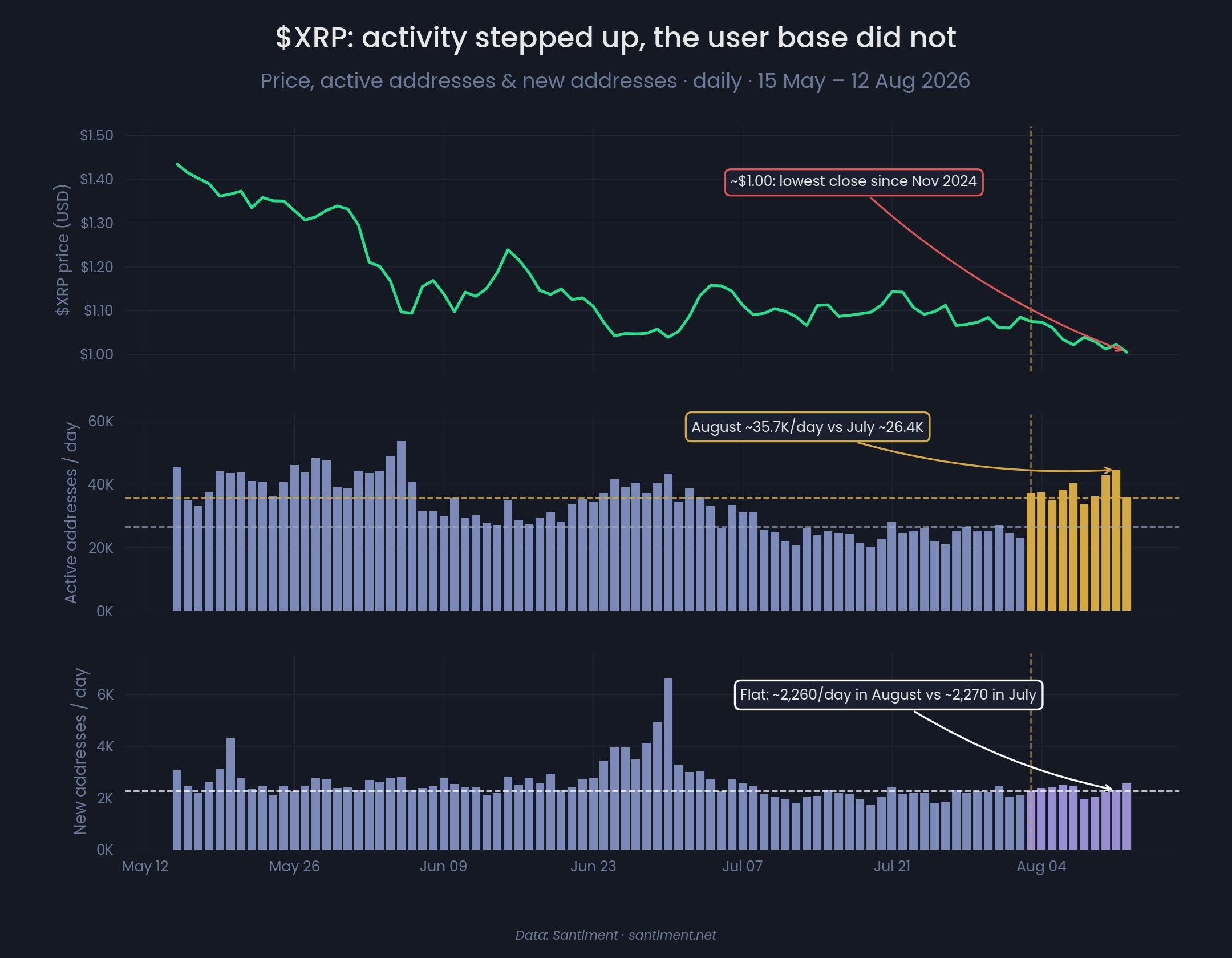
Activity for $XRP has increased according to Santiment. Source: Santiment post on X.

This data indicates that activity on the $XRP ledger increased without a comparable rise in newly created addresses. This pattern allows for a more narrow conclusion than claims of broad adoption: engagement with the ledger intensified throughout August, while available metrics showed virtually no growth in the number of new addresses.

Address Data Shows Activity Without Growth in Account Numbers

From August 1 to 12, the average daily number of active addresses was about 35,700, compared to approximately 26,400 throughout the entire month of July, representing an increase of nearly 35%. Santiment defines the daily number of active addresses as unique addresses participating in transactions during a day, making this metric an indicator of network usage, not a direct count of people.

In August, the number of new addresses averaged about 2,260 per day, almost matching the July figure of 2,270, although August 11 saw the highest number of active addresses since June 5. This gap highlights the limitations of public blockchain data: address activity does not directly equate to unique users.

Data on large holders reflects another form of activity during the downturn, although it measures account balances rather than the number of new participants or transaction frequency. Analysis from August 12 showed that the number of $XRP wallets holding at least 1 million tokens increased by 32 over three months, while the token's market capitalization fell by 29% over the same period.

Institutional Investor Access Grows, While Adoption Data Remains Mixed

Corporate use cases also remain separate from Santiment's August address data and cannot explain the short-term increase without transaction-level attribution. Anodos Finance co-founder and CEO Panos Mekras characterized $XRP as a treasury and payment asset, stating that his company has been buying, holding, and using $XRP for employee payments since 2023.

Ripple CEO Brad Garlinghouse separately outlined institutional opportunities in sectors that process about $16 trillion in annual payments and clearing. Garlinghouse noted that the share of digital assets in these flows is close to zero, presenting this figure as a potential market reach, not as a volume of completed $XRP transactions.

Regulated derivatives have expanded professional investors' access to $XRP, even as the token's spot price remains under pressure. CME Group launched continuous cryptocurrency trading with Ripple Prime as the clearing and funding partner, and open interest for $XRP futures previously exceeded $1 billion within a three-month period.

Events in the institutional investor, treasury operations, and large wallet spheres demonstrate several channels of engagement with $XRP, yet none allow the conversion of August's growth in active addresses into confirmed data on the number of new users. Santiment's average daily new address figure provides the clearest insight: up to August 12, approximately 2,260 new addresses appeared daily, about 10 fewer than the corresponding July average. At the time of writing, $XRP is trading at $1.008.

end-content

Trending Cryptos

Related Questions

QAccording to the article, what was XRP's price on August 13th and how much has it fallen from its January 2025 peak?

AOn August 13th, XRP was trading near $1, which is approximately 69% lower than its January 2025 peak of about $3.30.

QWhat does Santiment's data show about the activity of XRP addresses in August compared to July?

AAccording to Santiment, the average daily number of active XRP addresses in August was about 35,700, a roughly 35% increase compared to approximately 26,400 in July.

QDespite the increase in active addresses, what key metric showed almost no growth according to the analysis?

AThe number of new XRP addresses created daily showed almost no growth. The daily average in August was about 2,260, nearly identical to the July figure of 2,270.

QWhat trend was observed among large XRP holders (wallets containing at least 1 million tokens) during the three-month period ending August 12th?

AThe number of XRP wallets holding at least 1 million tokens increased by 32 over the three-month period ending August 12th, even as the token's market cap fell by 29%.

QWhat institutional development mentioned in the article expanded professional investor access to XRP despite its spot price pressure?

ACME Group launched round-the-clock cryptocurrency trading with Ripple Prime as a clearing and financing partner. Open interest for XRP futures on CME had previously exceeded $1 billion within three months.

Related Reads

Staking Inflation Reforms Trap Ethereum and Solana

The article discusses the "Morton's Fork" dilemma facing both Ethereum and Solana, where both blockchains must choose between two paths that lead to the same outcome: increased centralization of their validator networks. Ethereum researchers have proposed EIP-8363, a "Progressive Issuance Burn" plan. It would gradually increase the proportion of validator rewards burned as the total staked ETH rises, aiming to reduce new token issuance. If staking reaches 50% of the supply, rewards would drop to zero. This proposal has faced strong opposition from major staking service providers and DeFi platforms (e.g., Aave, ether.fi), as staking yields form a crucial base rate for DeFi leverage strategies. Critics argue slashing rewards would first hurt small, individual node operators due to fixed operational costs, accelerating centralization. Solana faces a similar challenge. Its validators have fixed costs but rely heavily on token issuance for rewards (only ~13% of validator income comes from fees). Two current proposals, SIMD-0550 and SIMD-0553, aim to accelerate the reduction of its inflation rate and increase fee burns, respectively. A vote concludes on August 18th. The core conflict is between large token holders (whose assets are diluted by issuance) and the concentrated staking industry that depends on high yields. While reducing issuance could curb the influx of capital into centralized staking services, it could also force out smaller validators first. The article concludes that as blockchains grow into large financial systems, underlying economic forces—yields, leverage, and operational costs—ultimately constrain their original design visions and push them toward centralization, regardless of the specific policy path chosen.

marsbit11m ago

Staking Inflation Reforms Trap Ethereum and Solana

marsbit11m ago

Trading

Spot

Hot Articles

What is XRP 2.0

XRP 2.0: A New Frontier in the Cryptocurrency Landscape Introduction to XRP 2.0 In the ever-evolving realm of cryptocurrency, new projects continuously emerge, vying for attention and adoption. One such promising initiative is XRP 2.0, a novel cryptocurrency project designed to leverage advanced blockchain technology and robust encryption methodologies. While the name draws parallels with Ripple’s XRP, it’s crucial to note that XRP 2.0 operates independently, focusing on enhancing transaction security, privacy, and scalability. As the digital financial landscape increasingly embraces decentralized solutions, XRP 2.0 aims to contribute meaningfully to web3 and the overall expansion of crypto projects. What is XRP 2.0? At its core, XRP 2.0 is a cryptocurrency project that aims to create a secure and decentralized digital currency ecosystem. Its foundational technology integrates sophisticated blockchain principles with cutting-edge encryption techniques. The overarching goal of XRP 2.0 is to establish itself as a reliable and efficient platform enabling swift transaction execution while prioritizing enhanced privacy protections for its users. The project is promoted as a solution to many limitations faced by existing cryptocurrencies, proposing a system that can handle a higher volume of transactions with improved speed and privacy. This versatility positions XRP 2.0 as a significant contender in a marketplace riddled with various digital currencies. Who is the Creator of XRP 2.0? The identity of the creator behind XRP 2.0 has been flagged as ‘Wilbur.’ However, comprehensive details regarding Wilbur or their associated entity remain elusive. The anonymity of many cryptocurrency creators is not an uncommon phenomenon in the industry, often designed to maintain a degree of privacy and security. Who are the Investors of XRP 2.0? As of now, specific information related to the investment foundations or organizations supporting XRP 2.0 is not publicly available. In the cryptocurrency sector, the backing by reputed investors can significantly influence a project's credibility and success, yet the transparency regarding the financial supporters of XRP 2.0 has not been established. How Does XRP 2.0 Work? XRP 2.0 stands out by employing a combination of blockchain technology and advanced encryption algorithms that ensures secure and decentralized transactions. Its innovative structure includes unique features designed to foster user engagement and broaden functionalities beyond conventional cryptocurrency transactions. Among these features, XRP 2.0 incorporates AI-powered capabilities, such as text-to-image and text-to-speech functionalities. These additions are designed to enhance the interactive experience for users, promoting broader applicability across various sectors. By bridging technological advancements with user-centered design, XRP 2.0 aims to capture the attention of a diverse range of individuals and enterprises looking to integrate cryptocurrency solutions into their operational frameworks. Timeline of XRP 2.0 Understanding XRP 2.0 requires examining the milestones that have defined its journey thus far: July 23, 2023: XRP 2.0 is introduced as a novel cryptocurrency project, aiming to revolutionize secure and decentralized transaction capabilities in the blockchain domain. September 8, 2023: The launching of another project, XRP20, occurs, marking the emergence of an ERC-20 token on the Ethereum blockchain that remains unrelated to XRP 2.0. November 13, 2023: The XRP Ledger undergoes a significant update with the release of rippled server software version 2.0.0. It is essential to note that this development is disconnected from the XRP 2.0 cryptocurrency project. Key Points About XRP 2.0 To distill the essence of XRP 2.0, several critical factors emerge: Unique Features: The inclusion of features like AI-powered text-to-image and text-to-speech further diversifies the potential applications of XRP 2.0. Blockchain Technology: The framework utilizes advanced blockchain mechanisms and encryption protocols, ensuring a secure and decentralized environment for transactions. Scalability and Privacy: XRP 2.0 prioritizes enhanced privacy protections in transaction processes and the scalability necessary to accommodate a growing user base. No Affiliation with Ripple: Importantly, despite its name, XRP 2.0 does not have any allegiance or collaboration with Ripple’s XRP, distinguishing its operational framework and objectives within the cryptocurrency ecosystem. Conclusion XRP 2.0 represents an ambitious venture into the cryptocurrency sphere, aiming to offer a combination of security, privacy, and efficiency in digital transactions. By integrating sophisticated technologies and user-friendly features, the project sets out to broaden the horizons of what cryptocurrency can achieve in today's digital economy. While the anonymity of its creator and lack of disclosed investors might raise questions for some, XRP 2.0's focus on advanced functionalities and decentralisation enhances its appeal amidst an increasingly crowded crypto market. As the cryptocurrency landscape continues to evolve, XRP 2.0 may yet emerge as a pivotal player in the expansion of secure and scalable blockchain solutions.

1.5k Total ViewsPublished 2024.04.01Updated 2024.12.03

What is XRP 2.0

Discussions

Welcome to the HTX Community. Here, you can stay informed about the latest platform developments and gain access to professional market insights. Users' opinions on the price of XRP (XRP) are presented below.

活动图片