Shing-Tung Yau Invites Wang Hong and Deng Yu to Teach Back Home, After 20 Years of Rivalry, Tsinghua and Peking University Realize the Opponent Isn't Each Other

marsbitPublished on 2026-07-24Last updated on 2026-07-24

Abstract

On July 23, the Fields Medal, the highest global mathematics award, was awarded to two Chinese mathematicians, Wang Hong and Deng Yu, both undergraduate classmates from Peking University's class of 2007. This marks the first time mathematicians who completed their undergraduate studies in mainland China have won the prize, with two laureates in the same year. Following the announcement, renowned mathematician Shing-Tung Yau publicly invited Wang and Deng to return to China to teach at Tsinghua University's Qiuzhen College. This invitation is the latest episode in a decades-long rivalry between Tsinghua and Peking University (PKU) for supremacy in Chinese mathematics. The competition traces back to a 1952 national university restructuring that transferred Tsinghua's entire mathematics department to PKU, leaving Tsinghua without a math program for nearly 30 years until its reinstatement in 1979. The rivalry intensified in 2005 with a public falling-out between Yau and his former student, PKU professor Gang Tian. Subsequently, Yau shifted his efforts to building Tsinghua's mathematics program from the ground up. He established the Yau Mathematical Sciences Center in 2009 and founded the Qiuzhen College in 2021, implementing an elite, accelerated "Math Leadership Program" to recruit prodigies as young as middle school students. The competition spans multiple fronts: recruiting top junior high and high school students from math olympiads, luring renowned scholars from overseas,...

Late on July 23rd, the Fields Medal, the highest global award in mathematics granted every four years, was announced, with two Chinese mathematicians winning simultaneously: Wang Hong and Deng Yu.

They were both undergraduate classmates from the Peking University School of Mathematical Sciences class of 2007. One solved the century-old Kakeya conjecture in three dimensions that had perplexed the mathematical community, while the other resolved the narrow Hilbert's sixth problem.

This is the first time mathematicians who completed their undergraduate studies in mainland China have won the Fields Medal, and two in the same year at that.

Soon after the award results were announced, Shing-Tung Yau stated at a public event at Tsinghua University: "I sincerely invite scholars Wang Hong and Deng Yu to return and teach. The Yau Mathematical Sciences Center at Tsinghua University welcomes them at any time."

This is not the first time Yau has competed with Peking University for talent, nor is it the first time Tsinghua has clashed head-on with Peking University in mathematics.

These two top Chinese universities have been contending, overtly and covertly, for decades in mathematics, the most fundamental and rigorous discipline.

From vying for teenage prodigies in junior high to competing for established Fields Medalists; from undergraduate competition arenas to the new battlefield of AI; from the falling out between mentor Shing-Tung Yau and disciple Gang Tian, the rivalry has persisted all the way to today's Fields Medal award ceremony stage.

But the origin of all this traces back to a nationwide university department restructuring seventy years ago.

01

Why Have Peking University and Tsinghua Been Locked in a Mathematics Rivalry?

During the 1952 nationwide university department restructuring, the entire Tsinghua University mathematics department was transferred to Peking University. Teachers, library materials, everything moved to Yanyuan (Peking University campus). Tsinghua's mathematics program was effectively discontinued for nearly 30 years, not rebuilt until 1979 as the Department of Applied Mathematics.

After that adjustment, Peking University's School of Mathematical Sciences was the undisputed, singular top dog in China's mathematics community. The nation's best math prospects defaulted to Peking University.

It produced China's mathematics "Golden Generation": Yitang Zhang, Chenyang Xu, Zhiwei Yun, Wei Zhang. Later, young mathematicians winning the Sloan Fellowship, Ramanujan Prize, or New Horizons Prize were overwhelmingly Peking University graduates.

Gold medalists in the National Mathematics Olympiad, from the moment they filled out their college applications, defaulted to Peking University's School of Mathematical Sciences. Dongyi Wei, a two-time IMO gold medalist with perfect scores, being admitted to Peking University was the most natural thing at the time.

Initially, Shing-Tung Yau actually wanted to help Peking University. During his first return to China to give lectures in 1979, he first went to Peking University. Back then, he aimed to help build a world-class mathematics center in China. Gang Tian was a student he recruited domestically during this period, later taking him to Harvard for a Ph.D., becoming one of his most accomplished disciples.

For the next two decades, he shuttled back and forth, establishing mathematics institutes at the Chinese Academy of Sciences and Zhejiang University, donating books and giving lectures at Peking University. Even he assumed the roots of Chinese mathematics would inevitably be planted at Yanyuan.

Around 2000, Yau wanted to establish platforms meeting international standards, opposed academic inbreeding, felt Peking University kept too many of its own graduates, and that academic evaluation was based on seniority.

This conflict erupted completely in 2005, triggering an earthquake in the Chinese mathematics community. Yau publicly criticized Peking University's School of Mathematical Sciences,点名批评 his former doctoral student Gang Tian, whom he personally mentored at Harvard, accusing him of academic misconduct and problematic academic style, even directly stating Peking University's mathematics research center was "forming cliques."

A retired Peking University professor retorted: "Shing-Tung Yau wanted to be the overlord of China's mathematics community but didn't succeed." Mentor and disciple completely fell out, severing ties thereafter. Since then, Yau has never set foot in Peking University's School of Mathematical Sciences again.

In 2009, he directly landed at Tsinghua University, becoming the director of the Yau Mathematical Sciences Center. A detail worth noting: From Yau's first lecture tour in China in 1979, over forty-plus years of lecturing and establishing centers domestically, he has never taken a single cent of salary from China, even donating $1 million of his own money to Tsinghua to cultivate mathematical talent.

In 2010, he personally funded and established the Yau College Student Mathematics Contests, with a format directly对标 the most顶尖 Putnam Competition internationally, several levels more difficult than ordinary domestic undergraduate math contests.

Yau's goal was clear: to build a擂台 he controlled,吸引全国最好的数学苗子 to Tsinghua. To beat Peking University, Yau truly invested heavily.

In 2018, he started the Yau Mathematical Sciences Elite Class, admitting no more than 30 prodigies in their second or third year of high school annually, allowing them to enter Tsinghua without taking the Gaokao. In 2021, he went further, directly establishing the Qiuzhen College, launching the "Mathematical Sciences Leadership Program,"开始捞人 from as early as ninth grade. If your mathematical talent is sufficient, no Zhongkao, no Gaokao needed, an integrated eight-year bachelor's-to-doctorate program, admitting up to 100 students per year, providing the best faculty,全英文教学.

In July 2026, among 94 preparatory class students, 20% were dismissed for failing two core courses, Mathematical Analysis and Advanced Algebra. Over twenty parents protested at the school. Several deputy deans advised him to show leniency, saying it would hurt recruitment next year. He directly retorted: "People scoring 20 or 30 points, keeping them here is a waste of resources."

To beat Peking University, Yau truly went all out, showing no mercy.

But the decades-old foundation of Peking University's School of Mathematical Sciences isn't easily overtaken. 80% of annual National Mathematics Olympiad gold medalists eventually go to Peking University's School of Mathematical Sciences. Take the well-known "Wei God" Dongyi Wei: a two-time IMO gold medalist with perfect scores, a feat few worldwide have achieved. During his undergraduate years, he won awards at the Yau Contests effortlessly. A saying circulated then: "When Wei God competes, others can only vie for second."

After graduation, he directly stayed at the Beijing International Center for Mathematical Research where Gang Tian is director, now becoming a living招牌 for Peking University's School of Mathematical Sciences.

02

Competing for Students, Faculty, AI

The competition between the two schools extends from competing for junior high students, then to competing for faculty, funding, academic resources, and even the currently hottest field of AI mathematics, where sparks are flying.

First, competing for students. Tsinghua's Leadership Program lowered the admission threshold to ninth grade. Peking University immediately followed with its Mathematical Sciences Elite Class, also开始抢高二以前的天才. On the days when CMO (Chinese Mathematical Olympiad) results are released annually, Tsinghua and Peking University admissions staff wait outside the exam halls, surrounding gold medalists immediately, offering conditions on the spot,生怕晚一步被对面抢走.

Many participating students have爆料, just after exiting the exam hall, as Tsinghua teachers finish handing out business cards, Peking University teachers directly pull people into their cars.

Some students are轮番堵在酒店谈 by admissions staff from both sides,从下午谈到后半夜; there have even been admissions teams,为了抢人, directly promising "As long as you come,随便挑 major, we'll add an additional保送名额 to your high school alma mater."

After competing for students, they compete for faculty. In recent years, Tsinghua has recruited many young mathematicians from overseas, offering high salaries,编制, research startup funds. Peking University不甘示弱, relying on its decades-old alumni network, has invited back many top mathematicians who graduated from Peking University.

In 2021, Tsinghua recruited the 40-year-old Fields Medalist Caucher Birkar to the Yau Mathematical Sciences Center. This was the first time a domestic university directly recruited a Fields Medalist still in their academic prime, offering Tsinghua's highest-level待遇. It was like planting a金字招牌 right opposite Peking University.

Additionally, Tsinghua recruited a group of young mathematicians from overseas like Jun Liu, tenured professor of statistics at UPenn, Zhengwei Liu from Vanderbilt University, among whom Zhengwei Liu is also a Peking University undergraduate graduate.

In 2024, Peking University invited Jian Ding, tenured professor at the Wharton School of the University of Pennsylvania, back to the School of Mathematical Sciences as a chair professor. Ding is a Peking University class of '03 undergraduate, winner of the Rollo Davidson Prize, the highest award in probability theory. Tsinghua also offered him a position at the time, but he ultimately chose to return to Yanyuan.

Earlier, Peking University also invited back representatives of the "Golden Generation" like Chenyang Xu, Zhiwei Yun, and Wei Zhang. Although Xu later went to MIT, Peking University's alumni recall strategy has never stopped.

The two sides have even,为了抢一个刚拿了斯隆奖的年轻学者, offered almost identical conditions,最终就看谁跟对方导师的私交更好.

But the most intense new battlefield is currently the hottest field: AI.

Yau once said this: "Without mathematical breakthroughs, large language models will forever be绣花枕头堆参数."

In Yau's view, the reasoning capability bottleneck of current LLMs is essentially a mathematical capability bottleneck. Whoever can first enhance AI's mathematical ability will secure a ticket to the next generation of large models.
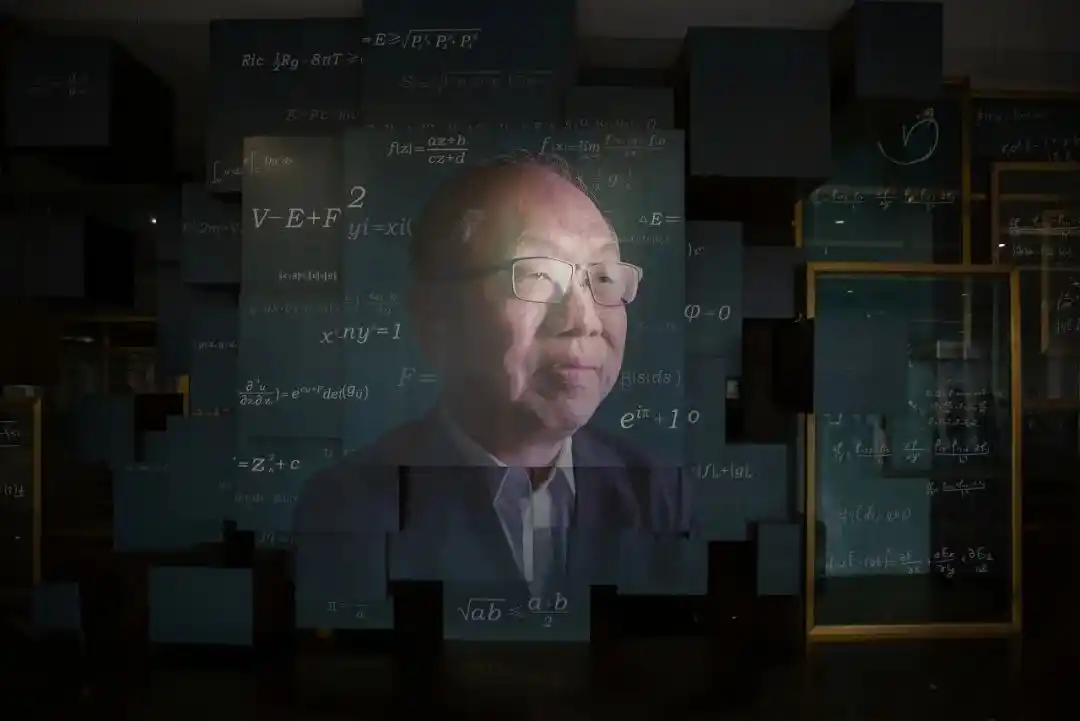
Image source: Visual China

Tsinghua acted fastest on this front. Collaborating with the Tencent Hunyuan team, they developed the STARE algorithm specifically addressing the old problem in LLMs solving math problems where "one wrong intermediate step leads to all subsequent calculations being wasted." On the most authoritative math competition benchmarks AIME24 and AIME25, it directly increased accuracy by 4% to 8%.

The ZhiPu AI developed by Tsinghua's Computer Science Department team led by Jie Tang has always been in the first tier of domestic LLMs in mathematical ability,背后撑着的就是清华数学系的一帮人.

On Peking University's side, collaborating with the Beijing Institute for General Artificial Intelligence, they developed the TongGeometry geometry large model, building the world's largest geometry theorem database,专门攻克IMO里最难的几何题, even capable of discovering new geometry theorems independently.

The core team behind the M3 model released earlier by MiniMax, which can win IMO gold medals, also includes people from Peking University's School of Mathematical Sciences.

At the 2025 WAIC World Artificial Intelligence Conference, Yau personally出题, putting several domestic leading LLMs through a closed-book exam on-site. In the end, the scores remained extremely close, with no clear winner emerging.

03

Ultimately, It's Still About AI

Twenty years ago, Chinese mathematics research couldn't rank globally. Good students went to the US after graduation. Domestically, there wasn't even a decent mathematics research center.

But looking at it now, on the ICCM (International Congress of Chinese Mathematicians) award list, 1/3 of awarded scholars are from mainland China, double the number from a decade ago. Tsinghua's Qiuzhen College and Peking University's School of Mathematical Sciences now annually produce papers published in the top four mathematics journals. Young scholars at the level of Sloan Fellowships emerge several per year.

Yau criticized Peking University harshly back then, but he himself knows clearly that precisely because there is such a strong opponent next door, Tsinghua拼命地建数学中心,拼命地培养学生.

And Peking University, precisely because Tsinghua is biting at its heels, has continuously reformed its training system,抢最好的苗子.

On June 28th, 2026, the award ceremony for the 17th Yau College Student Mathematics Contests was held at Tsinghua University's Meng Minwei Concert Hall. Yau himself stood on stage, with the smartest batch of mathematical geniuses in China seated below.

For the most prestigious individual all-around award, the "Yau Award," the gold went to Peking University's Haojia Shi; silver to Peking University's Junpeng Lu and Huankun Guo; bronze still to Peking University's Yuxing Ye. The top four spots were all taken by Peking University.
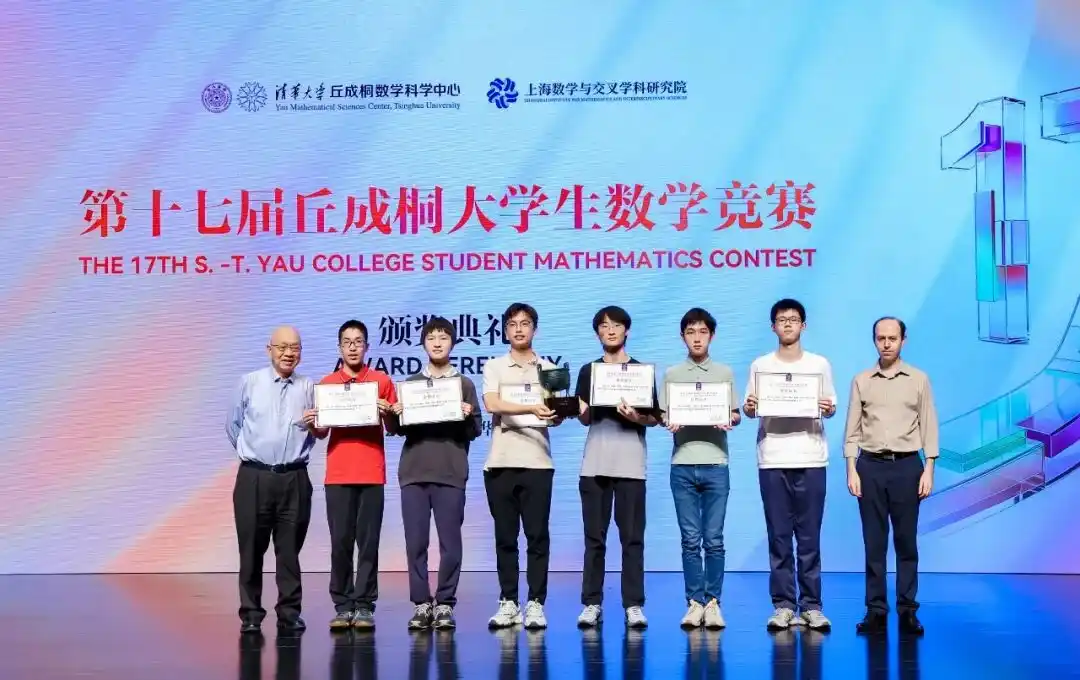
Image source: Tsinghua University官网

Six individual gold awards—Hua Luogeng Award, S.S. Chern Award, Chow Wei-Liang Award, Chia-Chiao Lin Award, Pao-Lu Hsu Award—加上 the all-around award, all went into Peking University's pocket. Even the team gold was jointly awarded to Tsinghua and Peking University.

But when Yau presented awards to Peking University's gold medalists, he was smiling,看不出生气的样子. He even呼吁 in his speech that domestic young students should collaborate across universities to jointly advance Chinese mathematics.

After all these years of rivalry, Yau understands clearly in his heart. What he wanted was never for Tsinghua to dominate alone; he wanted the entire Chinese mathematics community to stand up.

Years ago, he alone came from Hong Kong to the mainland, establishing one mathematics center after another, organizing one competition after another. Ultimately, it was all for one thing: for China to produce true mathematicians, to have its own Fields Medalists.

For over forty years, he hasn't taken a single cent of domestic salary,掏腰包办比赛、设奖学金, all for this one goal.

On July 20th, an Anthropic researcher, while watching the World Cup final, let the Fable 5 model compute for several hours, finally posting three lines of simple polynomials that directly推翻 the 87-year-old Jacobian conjecture, on which countless mathematicians had spent their lifetimes.

Yitang Zhang's doctoral thesis, stalled for seven years, was precisely in this direction.

To be fair, on the new battlefield combining AI and mathematics, it's Tsinghua that is ahead.

Currently, half of the first tier of domestic large models are Tsinghua-affiliated. For example, the aforementioned Jie Tang,以及他当年最得意的学生 Zilin Yang who founded Moonshot AI's Kimi. The latest K3 model's mathematical ability is already on par with Fable 5 and GPT-5.6 Sol, one of the best数学成绩 among current domestic models.

Peking University当然也不是没人做. But Peking University's teams are mostly偏纯学术研究, haven't produced commercially viable large models as competitive as ZhiPu and Kimi. In terms of industrial落地 and public recognition, they确实比清华差了一截.

Terence Tao foresaw this change in a speech at Stanford three months ago.

He said mathematics has moved from an era of "proof scarcity" to an era of "proof surplus." AI can generate dozens of top-journal-level proofs per day, an output速度 faster than human mathematicians can read and verify. He has already stopped trying to keep up with all newly published papers because it's simply impossible.

In fact, just over a year ago, Tao was still criticizing AI as too "dumb," getting 8 out of 10 problems wrong.

Decades of rivalry between Tsinghua and Peking University suddenly seem lighter in the face of AI. Regardless of who wins more gold medals, who recruits more professors, ultimately, they must stand on the same new starting line. The era of AI主导数学研究 has arrived. This is the future all mathematicians truly face.

This article is from the WeChat public account "字母AI," author: Miao Zheng, editor: Wang Jing

Trending Cryptos

Related Questions

QWhat major event in 2026 sparked the renewed discussion of the competition between Peking University and Tsinghua University in mathematics?

AThe awarding of the Fields Medal to two Chinese mathematicians, Wang Hong and Deng Yu, both of whom were undergraduate classmates in the 2007 class at Peking University's School of Mathematical Sciences.

QWhat historical event is cited as the origin of the long-standing rivalry between Peking University and Tsinghua University in mathematics?

AThe 1952 nationwide university department adjustment, during which Tsinghua University's entire mathematics department (including faculty and library resources) was merged into Peking University, leaving Tsinghua without a mathematics program for nearly 30 years until 1979.

QWhat specific method did Yau Shing-Tung establish at Tsinghua to attract top mathematical talent, and at what educational level does it start recruiting?

AHe established the 'Qiu-Zhuang Program' (also referred to as the mathematical leading talent program) at the Qiu Chengtong Honors College (Qiu-cheng Tong College). It recruits students as early as the third year of junior high school (Grade 9), bypassing the high school entrance and college entrance exams for an 8-year integrated bachelor's-doctoral program.

QAccording to the article, what is the new and intense battleground for competition between Peking University and Tsinghua University beyond recruiting students and faculty?

AThe integration of mathematics and Artificial Intelligence (AI). Both universities are aggressively competing to advance the mathematical reasoning capabilities of AI models, viewing it as key to the next generation of large language models.

QWhat does the article suggest is Yau Shing-Tung's ultimate goal, beyond simply making Tsinghua's mathematics program superior to Peking University's?

AHis ultimate goal is to elevate the entire landscape of Chinese mathematics to a world-class level. He wants China to produce genuine top-tier mathematicians and its own Fields Medalists. The competition with Peking University serves as a driving force to push both institutions and the country's mathematical research forward.

Related Reads

The Verdict in Choi Tae-won's Divorce Case: Revealing the Inheritance Undercurrent Behind SK Hynix's Trillion-Won Empire

SK Group Chairman Chey Tae-won's high-profile divorce case, involving a record 1.38 trillion won settlement, has drawn attention to the succession plans for Korea's second-largest conglomerate, especially its crown jewel, SK hynix. Unlike traditional chaebol scripts centered on the eldest son, Chey's three children from his marriage to former President Roh Tae-woo's daughter, Roh Soh-yeong, are carving distinct, non-traditional paths. Eldest daughter Chey Yun-jung (b. 1989) is seen as the most evident successor. With a scientific and consulting background, she holds executive roles at SK bioscience and SK Inc.'s growth support department, focusing on future strategy and biopharma. Her marriage is to an AI infrastructure entrepreneur, not a traditional business alliance. Second daughter Chey Min-jung (b. 1991) took a unique route, voluntarily serving as a South Korean naval officer, including an anti-piracy deployment. She later worked on policy and strategy for SK hynix in Washington D.C. before co-founding an AI-driven healthcare startup. She married a former U.S. Marine Corps officer, connecting her to U.S. defense and policy circles—networks crucial for a global semiconductor giant. The only son, Chey In-geun (b. 1995), who studied physics like his father, worked briefly at SK E&S before joining McKinsey. Despite fitting the traditional "heir" profile as the eldest son, he remains silent and holds no public position or shares in SK, suggesting the old succession playbook is obsolete. As SK hynix's valuation soars, becoming a geopolitical asset in the AI era, the heirs' legitimacy is no longer automatic. They must prove themselves in fields like AI biotech, global policy, and strategic consulting. Their marriages also reflect new elite networks in tech and defense, not old political alliances. Their inheritance is the complex challenge of navigating a globalized, tech-driven world, not just a corporate throne.

marsbit12h ago

The Verdict in Choi Tae-won's Divorce Case: Revealing the Inheritance Undercurrent Behind SK Hynix's Trillion-Won Empire

marsbit12h ago

From OpenSea to OpenRouter: Is Alex Atallah Repeating His 'Exit at the Peak' Playbook?

From OpenSea to OpenRouter: Is Alex Atallah Repeating His "Exit at the Peak" Playbook? According to the Wall Street Journal, payments giant Stripe is in talks to acquire the AI model aggregation platform OpenRouter in a potential deal valuing the company near $100 billion. This would mark founder Alex Atallah's second creation of a company reaching a $100 billion valuation, following his co-founding of NFT marketplace OpenSea. OpenRouter, founded just over three years ago, has grown rapidly by acting as a unified gateway for developers to access over 400 AI models. It currently has about 10 million users and processes over 200 trillion tokens monthly. While the platform's annualized revenue is around $50 million, its valuation has skyrocketed from $1.3 billion in March 2026. The potential acquisition by Stripe, a company OpenRouter's founder once likened it to, represents a major expansion into AI infrastructure for the payments leader. This move echoes Atallah's previous timing with OpenSea, where he departed before the NFT market's significant downturn. For OpenRouter, selling now may be strategic. Despite its scale, its business model—charging a 5-5.5% fee on AI inference calls—faces pressure from competition, open-source models, and potential price wars among model providers, limiting its profitability narrative for an IPO. A key asset for potential acquirers like Stripe is OpenRouter's vast repository of real-world AI usage data, which offers unique insights into model performance and developer preferences that are difficult to replicate. Whether this potential deal signifies a new valuation benchmark for AI infrastructure or another market peak signal remains to be seen.

链捕手12h ago

From OpenSea to OpenRouter: Is Alex Atallah Repeating His 'Exit at the Peak' Playbook?

链捕手12h ago

Trading

Spot

Hot Articles

What is LINON

Linde plc Tokenized Stock (Ondo): Revolutionizing Traditional Equity Access Through Blockchain Innovation The emergence of Linde plc Tokenized Stock (Ondo), represented by the ticker $LINON, signifies a monumental shift in the fusion of traditional financial structures and decentralized finance (DeFi). This innovative financial instrument showcases the tremendous potential of blockchain technology to democratize access to traditional equity markets while ensuring the security and regulatory compliance necessary for institutional-grade financial products. Through Ondo Finance's pioneering tokenization platform, $LINON provides a seamless pathway for global investors to engage with one of the world's leading industrial gas companies, Linde plc, creating a blockchain-native representation of the underlying equity. Introduction to Linde plc Tokenized Stock The landscape of financial markets is witnessing a groundbreaking transformation through the tokenization of real-world assets. Linde plc Tokenized Stock (Ondo) epitomizes this revolutionary approach by bridging the gap between conventional stock ownership and blockchain-enabled financial infrastructure. The $LINON token allows investors to gain exposure to one of the prominent industrial companies worldwide through decentralized technology. Operating within Ondo Finance's comprehensive ecosystem, $LINON symbolizes a practical application of tokenization technology that enhances accessibility, efficiency, and global connectivity in traditional financial markets. By leveraging blockchain infrastructure, this tokenized stock enables international investors to participate in U.S. equity markets, overcoming traditional barriers associated with cross-border investing. The significance of $LINON goes beyond technological innovation; it represents a fundamental shift in asset structuring, distribution, and trading in the digital age. This tokenized stock maintains all the economic benefits associated with traditional Linde plc shares while offering improved liquidity, programmable compliance features, and seamless integration with decentralized finance protocols. The development of $LINON indicates a growing acceptance of blockchain technology as a viable means for traditional finance, exemplifying how even well-established assets like Linde plc can integrate into blockchain systems. This approach preserves the core attributes that appeal to investors while introducing advanced capabilities that enhance the overall investment proposition. Project Overview and Objectives Linde plc Tokenized Stock (Ondo) encapsulates a strategic effort to democratize access to traditional equity markets through advanced blockchain technologies. The primary objective of $LINON is to provide approved global investors seamless access to the economic exposure associated with Linde plc shares, furthering an effort to create a more inclusive financial ecosystem. Beyond the digital representation of traditional assets, $LINON endeavors to eliminate barriers of geography and time zones that limit investor participation. Its design ensures that blockchain technology can elevate traditional investment vehicles without undermining the security or compliance requirements expected by investors. Key goals of the project include enhanced liquidity provision, programmable compliance mechanisms, and interoperability with other blockchain networks. Each $LINON token is fortified by actual Linde plc securities housed at U.S.-registered broker-dealers, allowing holders to reap economic advantages akin to traditional stockholders, such as dividend reinvestment. Furthermore, $LINON aims to establish new industry standards for institutional-grade tokenized securities, paving the way for traditional assets to embrace blockchain technology while remaining compliant with regulatory frameworks. By associating itself with a company as reputable as Linde plc, the project opens avenues for exploring tokenized equities catering to both conservative institutional players and daring retail investors. Project Creator and Development Team The vision for Linde plc Tokenized Stock (Ondo) comes from Nathan Allman, founder and CEO of Ondo Finance. His background in traditional finance coupled with expertise in blockchain technology positions him uniquely to navigate the complexities of asset tokenization. Allman's academic journey began at Brown University, focusing on Economics and Biology, equipping him with valuable analytical skills. His time at Goldman Sachs in the Digital Assets division strengthened his understanding of the interplay between financial institutions and emerging technologies, laying the groundwork for his later endeavors in alternative investment strategies. Under Allman's guidance, Ondo Finance has emerged as a leader in asset tokenization, launching $LINON as a flagship example of the company's larger mission towards revolutionizing traditional financial systems using blockchain technology. His commitment to leveraging blockchain for creating institutional-grade financial products has shaped the landscape of real-world asset tokenization. Investment and Funding Structure The growth of Ondo Finance, the platform powering Linde plc Tokenized Stock (Ondo), is bolstered by robust financial backing from prestigious venture capital firms and strategic investors. This strong investment foundation underpins the development of the key infrastructure essential for compliant tokenized securities like $LINON. In August 2021, Ondo Finance secured $4 million in seed funding led by a major venture capital firm, which enabled the company to commence platform development and establish the necessary regulatory processes for tokenizing real-world assets. This early investment cemented Ondo Finance's credibility within the industry. The Series A funding round followed, garnering $20 million with participation from renowned firms committed to transformative technology companies. This backing demonstrated substantial institutional confidence in Ondo Finance's vision, allowing it to hone its approach to asset tokenization through mechanisms that ensure compliance and accessibility. Noteworthy contributors, including institutional investors and experienced partners, have added significant value to Ondo Finance’s development efforts. Their involvement underscores the confidence across sectors in Ondo Finance's approach to bridging traditional finance with blockchain innovations. Technical Infrastructure and Innovation The technical architecture that underpins Linde plc Tokenized Stock (Ondo) represents a sophisticated melding of traditional finance systems and cutting-edge blockchain technology. The architecture's foundation is built on the Ethereum network, renowned for its security and programmability—both critical for intricate financial instruments. The $LINON tokenization process comprises creating a blockchain-native representation of Linde plc shares that preserves economic benefits while augmenting investor capabilities. Each token corresponds to actual shares held at U.S.-registered broker-dealers, creating a compliant custody structure that legitimizes the asset's existence and value. Automated compliance systems are integrated into the tokenization process, managing critical components such as know-your-customer (KYC) verification and anti-money laundering (AML) protocols. This incorporation of programmable compliance empowers $LINON to uphold regulatory standards essential for institutional proliferation. Cross-chain interoperability characterizes the advanced technical features of $LINON. While initially deployed on Ethereum, the framework is designed for expansion to other networks such as Solana and BNB Chain. This adaptability enhances liquidity and accessibility, allowing investors to select their preferred blockchain ecosystems. Historical Timeline and Development Crafting the history of Linde plc Tokenized Stock (Ondo) unfolds in parallel with the evolution of Ondo Finance's tokenization platform. The timeline's inception dates back to March 2021 when Nathan Allman laid the foundations for creating institutional-grade financial products on blockchain infrastructure. The initial funding round in August 2021 provided crucial resources for developing the platform and establishing partnerships necessary for effective tokenization. By January 2023, Ondo Finance launched its tokenized treasury products, establishing mechanisms that would facilitate future tokenized equities such as $LINON. A pivotal milestone arose in February 2025 when Ondo Chain—a Layer 1 blockchain designed specifically for asset tokenization—was introduced. This infrastructure enhances capabilities vital for institutional markets, demonstrating Ondo Finance's long-term commitment to tokenization. Subsequently, the launch of Ondo Global Markets in September 2025 marked the official debut of $LINON. This milestone showcased the successful transition from development to active trading, enabling investors around the world to access American financial markets seamlessly. Ongoing development plans include a targeted expansion of available tokenized assets to over 1,000 by the end of 2025, pointing to a bright future for Ondo Finance's ecosystem and its mission to broaden tokenized equity accessibility. Regulatory Compliance and Legal Framework The legal architecture governing Linde plc Tokenized Stock (Ondo) emphasizes a sophisticated approach to regulatory compliance, allowing tokenized securities to be implemented within a blockchain-based framework. The legal structure governing $LINON spans multiple jurisdictions while maintaining a robust legal footing. Compliance systems ensure that only eligible investors can access the token, enforced through automated verification that aligns with international regulations. This innovative regulatory technology promises real-time enforcement of complex requirements, considerably enhancing efficiency in operating within the regulatory landscape. The custody framework undergirding $LINON ensures that the underlying shares are securely held at U.S.-registered broker-dealers, complying with necessary regulations while delivering blockchain-driven access to investors. The token maintains its economic equivalency and security through this carefully structured custody arrangement. KYC and AML compliance systems are embedded within the smart contract architecture, ensuring integrity and adherence to regulatory practices while fostering transparency for investors. The jurisdictional restrictions mark a commitment to navigating the evolving landscape of international securities laws. Market Impact and Industry Significance The advent of Linde plc Tokenized Stock (Ondo) holds profound implications for the broader financial landscape, symbolizing a clear shift towards blockchain-enabled markets. $LINON serves as a proof-of-concept for integrating traditional companies into blockchain ecosystems, showcasing the potential benefits such as broader accessibility and improved efficiency. The market's response to $LINON indicates a growing acceptance of tokenization among institutional investors, contributing to the emergence of an expanding sector wherein traditional assets can be interconnected with blockchain innovations. The success of $LINON further solidifies market confidence, indicating an overarching shift towards recognizing asset tokenization as a transformative force in finance. Future Development and Expansion Plans The future trajectory for Linde plc Tokenized Stock (Ondo) centers around the expansion of the tokenization ecosystem and enhanced infrastructure supporting blockchain-enabled financial services. Plans for cross-chain integration usher in new opportunities for liquidity and flexibility within the investment framework, with existing capabilities poised for continuous enhancement. With the introduction of Ondo Chain, Ondo Finance aims to transition $LINON to an optimized blockchain environment specifically designed for asset tokenization. This new infrastructure heralds exciting prospects for the development of institutional-grade financial products, ensuring ongoing compatibility with contemporary investment strategies. Further integration with decentralized finance protocols signifies a commitment to empowering $LINON holders through advanced financial strategies. The anticipated expansion of available tokenized assets promises to broaden investor access, enhancing the utility and appeal of the platform. In alignment with ambitions for regulatory expansion, ongoing efforts to secure approvals for new jurisdictions will enhance investor access, further positioning $LINON at the forefront of the burgeoning tokenization market. Conclusion Linde plc Tokenized Stock (Ondo), as represented by the $LINON token, stands at the intersection of traditional finance and blockchain innovation. It embodies a transformative milestone in how financial assets are structured, distributed, and engaged within modern investment ecosystems. The technical sophistication behind $LINON, combined with its regulatory compliance framework, illustrates that asset tokenization can improve financial infrastructure rather than simply digitizing existing products. This pioneering effort not only enhances investor access to U.S. equity markets but also signifies an evolution of how traditional financial services can integrate blockchain technology. As the asset tokenization market grows exponentially, with prospects suggesting significant valuation increases, $LINON paves the way for a future where tokenized securities become standard fixtures in the financial landscape. The trajectory of $LINON will undoubtedly influence how traditional finance adapts to a transformed, blockchain-powered world.

3.5k Total ViewsPublished 2025.12.05Updated 2025.12.05

What is LINON

What is CRMON

Salesforce Tokenized Stock (Ondo): Revolutionising Traditional Equity Access Through Blockchain Innovation The emergence of Salesforce Tokenized Stock (CRMON) marks a pivotal advancement in integrating traditional financial markets with blockchain technology. This innovative approach offers investors unprecedented access to equity exposure through tokenisation. Developed by Ondo Finance, CRMON provides tokenholders with economic exposure equivalent to holding Salesforce stock (CRM) while automatically reinvesting dividends. This effectively bridges the gap between conventional equity markets and decentralised finance (DeFi). Introduction and Comprehensive Overview of Salesforce Tokenized Stock In recent years, the financial landscape has dramatically transformed due to blockchain technology, fundamentally altering how investors access and interact with traditional assets. The development of Salesforce Tokenized Stock (CRMON) is a prime example of this evolution, representing a sophisticated fusion of conventional equity markets with cutting-edge distributed ledger technology. CRMON is a tokenised version of Salesforce stock, emerging from the innovative work of Ondo Finance, a leading platform in the real-world asset tokenisation sector that positions itself as a bridge between traditional finance and decentralised systems. Designed to provide tokenholders with economic exposure that mirrors the performance of the underlying Salesforce stock, CRMON incorporates automatic dividend reinvestment mechanisms. This eliminates many traditional barriers associated with international equity investment, such as complex brokerage relationships, currency conversion challenges, and restricted trading hours. The tokenisation process reimagines stock ownership as a blockchain-native asset while maintaining its economic equivalence with the underlying security, offering enhanced portability and integration capabilities within decentralised finance ecosystems. CRMON transcends its individual utility as an investment instrument to represent a fundamental shift in how financial markets can operate in an increasingly digital world. By maintaining full backing through U.S.-registered broker-dealers and implementing robust compliance frameworks, CRMON demonstrates that tokenised securities can achieve the regulatory standards necessary for institutional adoption while delivering the technological advantages of blockchain infrastructure. Understanding Tokenized Real-World Assets and CRMON's Strategic Position Tokenised real-world assets signify one of the most significant innovations in modern finance, fundamentally reimagining how traditional securities are represented, traded, and utilised within digital ecosystems. CRMON operates as a tokenised equity instrument correlating directly with Salesforce stock while optimising accessibility and efficiency. This aligns with Ondo Finance's broader mission to democratise access to institutional-grade financial products through innovative tokenisation strategies. The tokenisation process guarantees complete economic equivalence with the underlying Salesforce equity. Each CRMON token represents a proportional claim on Salesforce stock held by qualified custodians, with dividend payments automatically reinvested to maintain continuous exposure to total return performance. This structure simplifies dividend management and ensures that tokenholders receive the full economic benefit of their equity exposure, encompassing both capital appreciation and income generation. Ondo Finance's strategy in tokenising Salesforce stock demonstrates its expertise in creating compliant, institutional-grade products that meet traditional financial markets' stringent requirements. The platform’s focus on merging regulatory compliance with blockchain benefits positions it at the forefront of decentralised finance, captivating both institutional and retail investors seeking blockchain-native solutions. The Technology and Innovation Framework Behind CRMON The technological infrastructure supporting CRMON integrates blockchain technology with traditional financial mechanisms, delivering institutional-grade security and compliance while maintaining the operational advantages of decentralised systems. Built on the Ethereum blockchain, CRMON utilises robust smart contract capabilities to ensure transparent, secure operations. The smart contract architecture incorporates layered security and compliance mechanisms, enabling automated compliance checks and real-time asset backing verification. Integration with oracle services maintains accurate pricing and dividend information, ensuring CRMON reflects the underlying Salesforce stock's accurate performance. This architecture delivers automated dividend reinvestments and other corporate actions, eliminating manual processing requirements and directly enhancing tokenholder benefits. Ondo Finance ensures CRMON's security structure includes daily third-party verification of holdings, independent collateral agents, and a multiple-layer custody system through partnerships with established financial institutions. This framework safeguards tokenholder interests against operational risks while providing robust asset backing. The user interface enhances integration capabilities, allowing seamless interaction between CRMON and various decentralised finance protocols, as well as cryptocurrency exchanges. This interoperability enables users to leverage their tokenised equity across multiple platforms, creating sophisticated investment strategies that marry traditional equity characteristics with blockchain-native innovation. Leadership and Corporate Structure of Ondo Finance The leadership team behind CRMON and Ondo Finance blends expertise from traditional finance and blockchain technology, presenting a robust combination of skills essential for successfully bridging conventional markets with decentralised finance. Nathan Allman, the founder and CEO, emerged from a distinguished financial background before establishing Ondo Finance in 2021. Allman's experience includes notable roles at major financial institutions, including significant contributions to developing cryptocurrency market services. His insights into regulatory compliance were paramount in developing products like CRMON that successfully unify traditional securities with blockchain technology. With a team of professionals boasting substantial experience in both conventional finance and blockchain sectors, Ondo Finance's leadership comprises diverse expertise that covers every aspect of tokenised asset development. Justin Schmidt serves as President and COO, contributing unique operational expertise, while Chris Tyrell brings essential compliance knowledge. Investment Landscape and Funding History The investment landscape surrounding Ondo Finance reflects significant institutional confidence in its mission to tokenise real-world assets. The company has raised substantial funds through various investment rounds, attracting leading venture capital firms and strategic investors that recognise the transformative potential of tokenised securities like CRMON. Notably, Ondo Finance completed a successful Series A funding round in 2022, led by well-known venture capital firms. This funding success validates Ondo Finance's innovative approach to creating compliant, institutional-grade tokenised products. In total, Ondo Finance has successfully secured substantial funding, raising significant capital for product development and market expansion, including a noteworthy token sale that reinforced its governance structure through the establishment of the ONDO token. The diverse composition of investors reflects broad market confidence in Ondo Finance's business model, demonstrating support from both traditional and blockchain-native organisations. Operational Mechanics and Technical Implementation The operational framework supporting CRMON exemplifies sophisticated integration of traditional financial mechanisms with blockchain technology. The technical implementation introduces multiple layers of security, compliance, and operational efficiency to meet institutional standards while enhancing accessibility. The tokenisation process begins by acquiring actual Salesforce stock through U.S.-registered broker-dealers, ensuring each CRMON token maintains direct correlation with the underlying equity performance. Smart contracts automate operational processes, including dividend reinvestment and corporate action processing, facilitating a streamlined user experience. The Minting and redemption processes allow authorised participants to manage CRMON tokens effectively. During U.S. trading hours, institutions can mint new tokens by depositing stablecoins that are used to purchase corresponding Salesforce equity. This structure maintains a tight correlation with underlying assets, enhancing liquidity and price discovery. Additionally, the infrastructure supports twenty-four-hour token transfer capabilities, providing CRMON holders with operations outside traditional market hours. This represents a significant advantage over conventional securities ownership, thus promoting integration with decentralised finance applications. Plans for cross-chain compatibility through partnerships signal further ambitions for CRMON's market reach. By expanding to other blockchain networks, Ondo Finance aims to enhance accessibility and user engagement with tokenised equity products. Timeline and Historical Development of Tokenized Equity Innovation The timeline of CRMON's development and Ondo Finance's broader tokenised capabilities demonstrates a systematic innovation process beginning with the company's founding in 2021. 2021: Ondo Finance is founded by Nathan Allman and co-founders, launching initial products focused on structured vault offerings on the Ethereum blockchain. 2022: The company completes substantial funding rounds—both equity and token sales—totaling significant capital and launching initial tokenised U.S. Treasury products. 2023-2024: Ondo Finance experiences substantial growth, establishing partnerships with major financial institutions while expanding its product offerings beyond fixed-income securities. February 2025: Ondo Global Markets is announced, marking the transition into equity tokenisation with plans for accessing over one hundred U.S. stocks and ETFs. September 2025: The official launch of Ondo Global Markets includes CRMON alongside other tokenised equity offerings, marking a significant evolution in Ondo Finance's product ecosystem. This timeline highlights the organisation's rapid growth and its capability to adapt its technological and compliance frameworks to accommodate different asset classes effectively while maintaining security and regulatory integrity. Regulatory Framework and Compliance Approach Ondo Finance's regulatory framework showcases a sophisticated compliance strategy, essential for achieving institutional adoption in the tokenised securities market. The company's strong partnerships with U.S.-registered broker-dealers promote adherence to Securities and Exchange Commission regulations and apply robust investor protections. Acquisitions, such as Oasis Pro—a registered broker-dealer—significantly enhance Ondo Finance's compliance capabilities, ensuring thorough alignment with existing regulatory structures. The company employs independent verification procedures that foster transparency, aiming for a solid performance standards reputation. Furthermore, Ondo Finance's commitment extends to international regulatory compliance, ensuring token access remains restricted to eligible investors while adhering to pertinent cross-border securities regulations. Comprehensive attention to tax implications and reporting requirements fortifies the security and compliance landscape of CRMON, ensuring that investor obligations remain manageable. Future Prospects and Market Positioning The forward-looking landscape for CRMON and Ondo Finance illustrates substantial growth opportunities driven by institutional adoption of blockchain technology and escalating demand for efficient alternatives to conventional securities ownership. Market projections indicate the tokenised asset sector could value multiple trillion dollars by 2030. With plans to scale CRMON offerings significantly and integrate it with a dedicated blockchain infrastructure—Ondo Chain—Ondo Finance aims to elevate its institutional-grade tokenised asset operations. Additionally, the development of strategic partnerships enhances distribution capabilities while establishing the company's credibility in the financial market. Furthermore, the integration of tokenised equity with decentralised finance protocols offers new potential for innovative financial products and strategies previously impossible with traditional securities. These factors underscore CRMON's positioning to effectively capture increased market share and deliver innovative solutions for international investment exposure. Conclusion Salesforce Tokenized Stock (CRMON) symbolises a transformative development within financial markets, successfully bridging traditional equity ownership with blockchain technology to create unprecedented accessibility for global investors. Through Ondo Finance's sophisticated tokenisation framework, CRMON provides complete economic exposure to Salesforce equity performance while enhancing operational advantages that exceed traditional ownership. The launch of CRMON reflects the broader evolution of financial markets towards blockchain infrastructures that maintain regulatory compliance while delivering increased efficiency. Ondo Finance's extensive approach to regulatory adherence, institutional-grade security, and technological innovation solidifies CRMON as a model for future tokenised securities, delivering access previously unattainable in conventional brokerage structures. As the tokenised asset sector continues to develop, CRMON is well-positioned to address historical inefficiencies in capital markets while providing investors with innovative solutions for accessing traditional securities. The outlook for CRMON looks exceptionally promising, supported by ambitious expansion plans, technological innovations, and strategic partnerships, thereby representing a pioneering model of modern financial infrastructure evolving through blockchain integration.

3.6k Total ViewsPublished 2025.12.05Updated 2025.12.05

What is CRMON

What is SHOPON

Shopify Tokenized Stock (Ondo): A Comprehensive Analysis of Real-World Asset Tokenization in Web3 This article delves into the Shopify Tokenized Stock (Ondo), recognised by its ticker symbol $SHOPON, exploring its implications at the intersection of traditional finance and blockchain technology. As a part of Ondo Finance's tokenized securities platform, Shopify’s tokenized stock exemplifies advancements in democratizing access to global capital markets through innovative digital assets. Introduction and Overview of Shopify Tokenized Stock (Ondo) Shopify Tokenized Stock (Ondo), or $SHOPON, portrays a pivotal innovation in the realm of tokenized securities, allowing investors to gain economic exposure akin to directly owning shares of Shopify Inc. This token, developed under the umbrella of Ondo Finance, not only provides investors with the ability to hold digital representations of the company’s stock but also integrates features such as automatic reinvestment of dividends. This advancement represents a substantial shift in the landscape of decentralized finance (DeFi), linking conventional equity markets with blockchain solutions designed to enhance accessibility, transparency, and liquidity. By eliminating geographical barriers and enabling 24/7 trading capabilities, $SHOPON is positioned as a bridge connecting traditional financial instruments and the emerging Web3 ecosystem. What is Shopify Tokenized Stock (Ondo), $SHOPON? The $SHOPON token serves as a digital manifestation of Shopify Inc.'s shares, engineered to provide a direct correlation to the underlying asset's performance. Through the utilization of blockchain technology, the token gives holders a mechanism to participate in the economic benefits associated with equity ownership, including capital appreciation and dividend distribution. The unique aspect of $SHOPON lies in its automatic dividend reinvestment mechanism, which allows returns to compound without necessitating active management by the investor. This feature inherently enhances its attractiveness as an investment vehicle, particularly for individuals seeking passive income growth alongside exposure to high-performing equities. The tokenization process is facilitated by the custody of actual Shopify shares through regulated intermediaries, ensuring that every $SHOPON token is verifiably backed by real equity. This structure empowers investors with the dual advantages of both traditional financial characteristics and the innovative benefits tied to blockchain technology. Who is the Creator of Shopify Tokenized Stock (Ondo)? The creator of Shopify Tokenized Stock (Ondo), Nathan Allman, is an experienced figure in the finance sector, formerly associated with Goldman Sachs. His rich background includes significant expertise in digital asset development, bridging the gap between traditional finance and cryptocurrencies. Allman’s educational journey, marked by studies at Brown University, provided him with a deep understanding of economics and biology, equipping him with analytical skills that inform his strategic vision. In 2021, he founded Ondo Finance, committing to developing tokenized securities that meet institutional-grade standards while leveraging blockchain's transformative capabilities. Under Allman's leadership, Ondo Finance has focused on creating compliant and innovative financial products that empower a diverse investor base. Who are the Investors of Shopify Tokenized Stock (Ondo)? The investment landscape surrounding Shopify Tokenized Stock (Ondo) is notably robust, underpinned by significant institutional support. Primarily, Pantera Capital stands out as a strategic partner through the Ondo Catalyst initiative, a $250 million commitment aimed at accelerating the development of on-chain capital markets. This partnership not only signifies institutional confidence in the potential of tokenized assets but also reinforces Ondo Finance's operational capabilities and market positioning. The funding pathways have included earlier rounds that amassed millions in seed funding and further structural investments, solidifying relationships with both venture capital firms and private investors. Moreover, the financial framework is complemented by strategic partnerships with established financial institutions and technology companies, enhancing Ondo’s infrastructure and operational expertise. How Does Shopify Tokenized Stock (Ondo), $SHOPON Work? At the core of $SHOPON's operational framework is a sophisticated system integrating traditional finance mechanisms with blockchain technology. The custody of actual Shopify shares ensures that token holders retain authentic economic exposure, safeguarding their investments in line with recognized legal structures. The smart contracts employed in managing $SHOPON handle various functions, including automatic dividend reinvestment and ownership transfer, offering instant settlement and increased liquidity, marking a significant departure from conventional trading systems plagued by multi-day settlement delays. By providing interoperability with other decentralized finance applications, $SHOPON empowers holders with potentially lucrative opportunities for advanced investment strategies, including lending and automated market making. This complex integration presents a unique value proposition, catering to both traditional and crypto-native investors. The innovative structure of $SHOPON also allows for real-time settlements and transactions documented on the blockchain, delivering unparalleled transparency and security—a major advancement over standard equity trading practices. Timeline of Shopify Tokenized Stock (Ondo) March 2021: Nathan Allman establishes Ondo Finance, initially focusing on decentralized finance yield optimization. August 2021: Completion of a $4 million seed funding round led by Pantera Capital. January 2023: Launch of initial tokenized treasury security products, laying the groundwork for future equity tokenization. July 2025: Announcement of the Ondo Catalyst initiative, a strategic investment program valued at $250 million, aimed at propelling the development of tokenization in capital markets. September 3, 2025: Launch of Ondo Global Markets featuring over 100 tokenized U.S. stocks and ETFs, including $SHOPON. Technical Implementation and Blockchain Infrastructure Shopify Tokenized Stock (Ondo) operates on a technical architectural framework that marries blockchain protocols with traditional financial custody arrangements. The ecosystem leverages Ethereum's smart contract capabilities, providing seamless transaction management while ensuring compliance with regulatory standards through established financial custodians. Central to this architecture are security measures and transparent transaction records that affirm the legitimacy of each tokenholder's economic stake. With automated features managed by intricate smart contracts, $SHOPON not only streamlines ownership transfers but also allows for the tactical reinvestment of dividends—a hallmark of modern investment strategies. Moreover, the incorporation of LayerZero technology facilitates cross-chain interoperability, making $SHOPON accessible across multiple blockchain environments while preserving its functional robustness. This forward-thinking technical design positions $SHOPON as an adaptable asset within the larger DeFi milieu. Regulatory Framework and Compliance Architecture $SHOPON's regulatory framework is built upon the meticulous navigation of existing financial regulations that govern securities. The custody arrangements for the underlying Shopify shares are managed by U.S.-regulated broker-dealers, ensuring compliance and protection for investors. By maintaining a separation between the blockchain tokenization process and traditional custody, $SHOPON adheres to legal requirements while offering innovative functionalities that challenge conventional constraints. This dual-layered compliance approach enhances investor confidence and underscores Ondo Finance's commitment to regulatory integrity. Notably, the availability of $SHOPON is tailored to international investors from regions such as Asia-Pacific, Europe, and Africa, as regulatory parameters in the U.S. and U.K. present challenges in accessing tokenized securities. Market Access and Global Distribution Strategy The distribution strategy of $SHOPON is keenly designed to optimize global access while conforming to regulatory standards. The platform aims to establish comprehensive coverage for eligible investors across multiple regions, effectively dismantling traditional barriers through the implementation of blockchain technology. Integration with various cryptocurrency wallets and exchanges also promotes user-friendliness and accessibility, establishing a streamlined experience for investors to manage their holdings. Moreover, the 24/7 trading capabilities afforded by the tokenized model allow participants to react promptly to market shifts, fundamentally transforming how global equities are accessed and traded. Technology Integration and Cross-Chain Functionality The remarkable technological underpinnings of $SHOPON propagate its multi-chain functionality, set to expand its reach beyond Ethereum to networks such as Solana and BNB Chain. Such cross-chain capabilities allow users flexibility when navigating between blockchains, concurrently leveraging distinct network attributes to optimize their trading experience. LayerZero serves as the backbone for ensuring decentralized transfers between networks while providing the requisite security and speed, quintessential for maintaining investor trust. This comprehensive interoperability illustrates $SHOPON's commitment to being a versatile, user-centric asset in the evolving investment landscape. Ecosystem Integration and DeFi Compatibility Incorporating $SHOPON into broader DeFi protocols signifies its potential beyond traditional stock ownership. Token holders can leverage their holdings for various sophisticated strategies and applications, enhancing investment returns and liquidity management. By establishing a presence in lending protocols and automated trading systems, $SHOPON effectively democratizes access to advanced financial strategies previously limited to institutional investors. Such integration contributes to a more competitive and dynamic financial landscape, where individual investors can capitalize on tools typically reserved for larger entities. Risk Management and Security Framework Security remains paramount in the operational infrastructure of $SHOPON. The tokenization framework employs multiple layers of protection—beginning with regulated custody of the underlying Shopify shares. The operational protocols establish rigorous auditing, key management, and transaction monitoring standards, thus safeguarding against potential vulnerabilities. Moreover, meticulous adherence to evolving regulatory requirements provides an extra layer of security, fortifying investor protections and institutional compliance. Market Impact and Industry Implications The introduction of Shopify Tokenized Stock (Ondo) heralds a transformative shift in how financial markets operate, emphasizing the potential of tokenized securities to reshape traditional investment paradigms. The successful integration of $SHOPON encapsulates the efficiencies inherent in blockchain technology and opens avenues for new user demographics previously barred from extensive market participation. The impact extends beyond the immediate benefits to token holders, indicating broader trends that may challenge the status quo of investment services, particularly in addressing geographic restrictions and operational costs typically associated with traditional brokerage platforms. Undeniably, $SHOPON encapsulates the potential for traditional institutions to innovate further, leveraging the increasing demand for seamless blockchain access to complement existing financial infrastructure. Future Development Roadmap and Strategic Vision As Ondo Finance looks forward, the trajectory of $SHOPON rests on ambitious goals aimed at broadening the spectrum of available tokenized assets significantly. Over the next few years, plans are in place to expand to more than 1,000 tokenized securities, further enhancing market participation and investment options for individuals worldwide. Continued integration with traditional financial actors, development of specialized institutional products, and enhancements in automated trading capabilities will ensure that $SHOPON maintains its position at the forefront of financial innovation. Regulatory collaboration will also remain a focal point, establishing a framework that not only supports the compliance requirements but also promotes a healthy environment for tokenized asset proliferation. Conclusion and Market Significance In summary, Shopify Tokenized Stock (Ondo), represented by the ticker $SHOPON, is more than merely a tokenized equity offering; it embodies the innovation possible when traditional finance collides with modern blockchain applications. With a robust technical architecture, a commitment to compliance, and a clear strategic vision, $SHOPON exemplifies the potential for tokenized assets to enhance liquidity, accessibility, and functionality in capital markets. As the global investment landscape evolves, the transformative implications of $SHOPON extend beyond individual investors to revolutionize how financial instruments are perceived, traded, and utilized within both traditional and decentralized frameworks.

3.6k Total ViewsPublished 2025.12.05Updated 2025.12.05

What is SHOPON

Discussions

Welcome to the HTX Community. Here, you can stay informed about the latest platform developments and gain access to professional market insights. Users' opinions on the price of HOME (HOME) are presented below.

活动图片