Bitcoin Price Fluctuates Around $64,000 as Coldcard Losses Exceed $116 Million

cryptonews.ruPublished on 2026-08-05Last updated on 2026-08-05

Abstract

Bitcoin's price is holding around $64,000 despite significant negative pressure. Losses from a vulnerability in Coldcard hardware wallets have surpassed $116 million, with thefts continuing in waves. Michael Saylor's MicroStrategy sold another 1,638 BTC (its third sale this year), and wallets linked to the firm moved a further 1,030 BTC, raising fears of a fourth sale. In Washington, the "Clarity Act" bill faces likely failure after Democratic senators blocked negotiations. The Coldcard flaw, stemming from a March 2021 firmware bug, caused some devices to generate seeds with only ~40 bits of entropy instead of 128, exposing long-term holders to brute-force attacks. Developer James O'Beirn launched a public dashboard tracking the ongoing thefts in real-time; a test wallet with no added entropy was drained within an hour. Coinkite has halted shipments and urged affected users to move funds immediately, as firmware updates alone cannot eliminate the risk. For bulls, a potential floor is seen around Bitcoin's production cost, currently estimated at $54,000 (with an energy cost component of ~$40k). Historically, prices have bottomed below this cost in previous cycles. Meanwhile, exchange inflows have spiked as worried Coldcard users transfer coins, and with MicroStrategy still holding $5 billion in approved sales, alongside the potential collapse of the Clarity Act, further downward pressure looms.

By any ordinary measure, Bitcoin should be falling. Losses from the Coldcard hardware wallet theft have exceeded $116 million, and waves of fund withdrawals have continued since the vulnerability was discovered on July 30. Michael Saylor's company, Strategy, reported selling 1,638 $BTC for approximately $104.7 million (its third sale this year), and wallets linked to the company transferred another 1,030 $BTC on Wednesday, heightening concerns about a fourth sale.

In Washington, a vote to end debate on the 'Clarity Act' bill is poised to fail after Democratic senators blocked negotiations on ethics issues. The probability of the bill becoming law in 2026 has dropped from 27% to 23% (as of today), according to Polymarket.

Nevertheless, despite all this, Bitcoin has not given up: its price continues to fluctuate around $64,000—significantly below its highs, yet it stubbornly maintains a stable level despite an almost exclusively negative news flow.

Tracking the Attack in Real Time

The Coldcard vulnerability remains the most troubling story of the week. A bug in firmware dating back to March 2021 caused some devices from Canadian manufacturer Coinkite to generate recovery seeds with approximately 40 bits of entropy instead of 128, exposing long-term holders to brute-force attacks. Bitcoin.com News published a full analysis of who lost coins and who remains at risk.

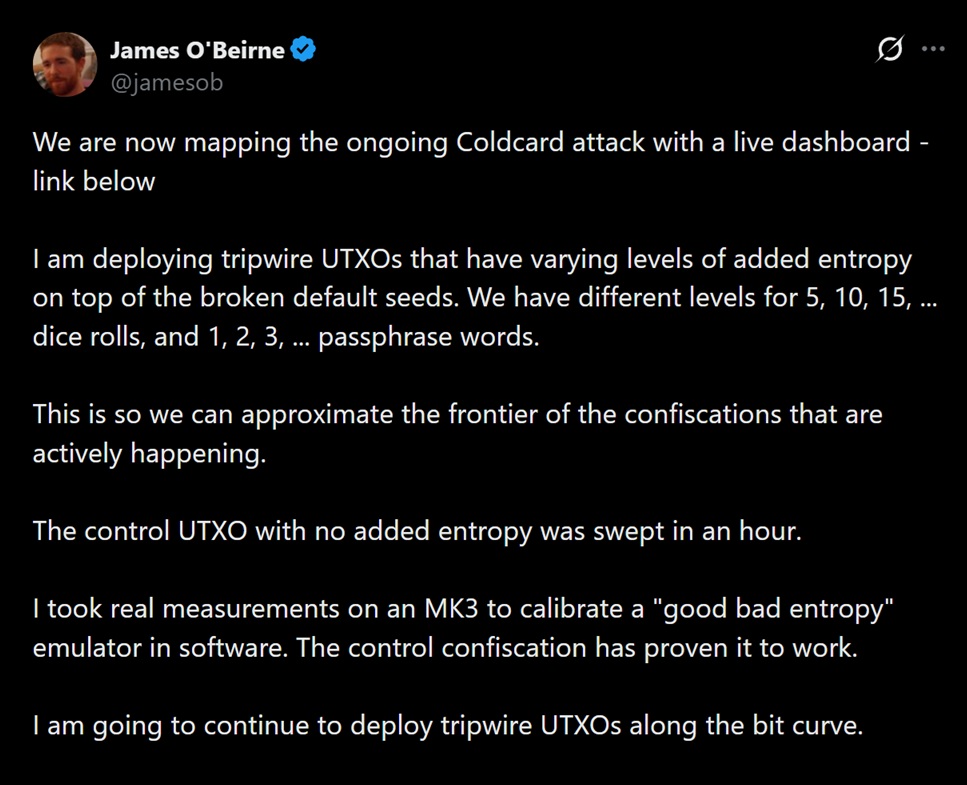
The attack is ongoing and is now being tracked publicly. Bitcoin developer James O'Beirne launched an interactive monitoring dashboard displaying the ongoing thefts by seeding the network with "tripwire" unspent transaction outputs (UTXOs) built on vulnerable default seeds with varying levels of added entropy. The results were alarming: his control wallet with no added entropy was drained within an hour, proving that attackers are continuously scanning the vulnerable seed phrase space.
Coinkite has halted shipments and destroyed remaining stock manufactured with the vulnerable firmware, telling customers: 'Years of saved money are gone. Years of trust are destroyed.' The company urgently advised affected device users to immediately transfer their funds to new wallets, warning that a firmware update alone is insufficient to eliminate the risk. A fourth wave of thefts took 388.9 $BTC (approximately $29 million) in one Sunday evening.

What the Bottom Could Look Like

The bulls seem to have a benchmark for evaluation: Capriole Investments founder Charles Edwards referenced Bitcoin's production cost (the total cost for miners to produce one coin), emphasizing it currently stands at $54,000, with the electricity cost portion of this metric estimated at $40,000.

Historically, prices have fallen below the production cost at every cycle bottom, meaning the current price of $64,000 is still trading at a premium, but a floor is clearly defined.

Finally, exchange inflows spiked as frightened Coldcard users transferred their coins, while Strategy still has $5 billion in authorized sales remaining. As if that weren't enough, the failure of the Clarity vote this week seems poised to deliver another blow before the August recess (which could send Bitcoin's value tumbling again).

end-content

Trending Cryptos

Related Questions

QWhat are the main negative factors affecting Bitcoin's price mentioned in the article?

AThe main negative factors are: the ongoing thefts from vulnerable Coldcard hardware wallets exceeding $116 million in losses; the large Bitcoin sales by Michael Saylor's company, MicroStrategy, which have intensified fears of further selling pressure; and the anticipated failure of the 'Clarity Act' bill in Washington, which reduced its probability of becoming law from 27% to 23%.

QWhat is the nature of the vulnerability in Coldcard devices?

AThe vulnerability was a firmware bug dating back to March 2021, which caused affected Coldcard devices from Coinkite to generate wallet recovery seeds with only about 40 bits of entropy instead of the secure 128 bits. This made the private keys vulnerable to brute-force attacks.

QAccording to the article, what is a potential technical bottom for Bitcoin's price based on historical cycles?

AAccording to Charles Edwards of Capriole Investments, a potential technical bottom could be around Bitcoin's production cost, which is currently $54,000. Historically, prices have fallen below the production cost at every cycle bottom, with the energy-only component of that cost estimated at $40,000.

QWhat actions did Coinkite, the maker of Coldcard, take in response to the vulnerability?

ACoinkite suspended shipments and destroyed its remaining inventory of devices manufactured with the vulnerable firmware. They urgently warned affected users to immediately move their funds to new wallets, stating that a firmware update alone was not sufficient to eliminate the risk.

QWhat did developer James O'Beirn's monitoring dashboard reveal about the Coldcard attacks?

AJames O'Beirn's public monitoring dashboard revealed that attackers are continuously scanning the vulnerable seed phrase space. His control wallet, set up with a default vulnerable seed and no added entropy, was drained within an hour, proving the attackers' persistent activity.

Related Reads

Trading

Spot

Hot Articles

What is $BITCOIN

DIGITAL GOLD ($BITCOIN): A Comprehensive Analysis Introduction to DIGITAL GOLD ($BITCOIN) DIGITAL GOLD ($BITCOIN) is a blockchain-based project operating on the Solana network, which aims to combine the characteristics of traditional precious metals with the innovation of decentralized technologies. While it shares a name with Bitcoin, often referred to as “digital gold” due to its perception as a store of value, DIGITAL GOLD is a separate token designed to create a unique ecosystem within the Web3 landscape. Its goal is to position itself as a viable alternative digital asset, although specifics regarding its applications and functionalities are still developing. What is DIGITAL GOLD ($BITCOIN)? DIGITAL GOLD ($BITCOIN) is a cryptocurrency token explicitly designed for use on the Solana blockchain. In contrast to Bitcoin, which provides a widely recognized value storage role, this token appears to focus on broader applications and characteristics. Notable aspects include: Blockchain Infrastructure: The token is built on the Solana blockchain, known for its capacity to handle high-speed and low-cost transactions. Supply Dynamics: DIGITAL GOLD has a maximum supply capped at 100 quadrillion tokens (100P $BITCOIN), although details regarding its circulating supply are currently undisclosed. Utility: While precise functionalities are not explicitly outlined, there are indications that the token could be utilized for various applications, potentially involving decentralized applications (dApps) or asset tokenization strategies. Who is the Creator of DIGITAL GOLD ($BITCOIN)? At present, the identity of the creators and development team behind DIGITAL GOLD ($BITCOIN) remains unknown. This situation is typical among many innovative projects within the blockchain space, particularly those aligning with decentralized finance and meme coin phenomena. While such anonymity may foster a community-driven culture, it intensifies concerns about governance and accountability. Who are the Investors of DIGITAL GOLD ($BITCOIN)? The available information indicates that DIGITAL GOLD ($BITCOIN) does not have any known institutional backers or prominent venture capital investments. The project seems to operate on a peer-to-peer model focused on community support and adoption rather than traditional funding routes. Its activity and liquidity are primarily situated on decentralized exchanges (DEXs), such as PumpSwap, rather than established centralized trading platforms, further highlighting its grassroots approach. How DIGITAL GOLD ($BITCOIN) Works The operational mechanics of DIGITAL GOLD ($BITCOIN) can be elaborated on based on its blockchain design and network attributes: Consensus Mechanism: By leveraging Solana’s unique proof-of-history (PoH) combined with a proof-of-stake (PoS) model, the project ensures efficient transaction validation contributing to the network's high performance. Tokenomics: While specific deflationary mechanisms have not been extensively detailed, the vast maximum token supply implies that it may cater to microtransactions or niche use cases that are still to be defined. Interoperability: There exists the potential for integration with Solana’s broader ecosystem, including various decentralized finance (DeFi) platforms. However, the details regarding specific integrations remain unspecified. Timeline of Key Events Here is a timeline that highlights significant milestones concerning DIGITAL GOLD ($BITCOIN): 2023: The initial deployment of the token occurs on the Solana blockchain, marked by its contract address. 2024: DIGITAL GOLD gains visibility as it becomes available for trading on decentralized exchanges like PumpSwap, allowing users to trade it against SOL. 2025: The project witnesses sporadic trading activity and potential interest in community-led engagements, although no noteworthy partnerships or technical advancements have been documented as of yet. Critical Analysis Strengths Scalability: The underlying Solana infrastructure supports high transaction volumes, which could enhance the utility of $BITCOIN in various transaction scenarios. Accessibility: The potential low trading price per token could attract retail investors, facilitating wider participation due to fractional ownership opportunities. Risks Lack of Transparency: The absence of publicly known backers, developers, or an audit process may yield skepticism regarding the project's sustainability and trustworthiness. Market Volatility: The trading activity is heavily reliant on speculative behavior, which can result in significant price volatility and uncertainty for investors. Conclusion DIGITAL GOLD ($BITCOIN) emerges as an intriguing yet ambiguous project within the rapidly evolving Solana ecosystem. While it attempts to leverage the “digital gold” narrative, its departure from Bitcoin's established role as a store of value underscores the need for a clearer differentiation of its intended utility and governance structure. Future acceptance and adoption will likely depend on addressing the current opacity and defining its operational and economic strategies more explicitly. Note: This report encompasses synthesised information available as of October 2023, and developments may have transpired beyond the research period.

1.5k Total ViewsPublished 2025.05.13Updated 2025.05.13

What is $BITCOIN

Discussions

Welcome to the HTX Community. Here, you can stay informed about the latest platform developments and gain access to professional market insights. Users' opinions on the price of BTC (BTC) are presented below.

活动图片