Bitcoin faces $58K test as U.S. demand cracks – What’s next for BTC?

ambcryptoPublished on 2026-07-01Last updated on 2026-07-01

Abstract

Bitcoin (BTC) faces a critical test around $58,000 as key pillars of its rally show significant weakness. The primary concern is a notable drop in U.S. demand, historically a major driver for BTC. The U.S. to Rest of World Reserve Ratio has fallen from a peak near 1.79 to around 1.59, indicating declining American capital inflows. This trend is confirmed by substantial spot Bitcoin ETF outflows, with the latest monthly net flow showing an outflow of approximately $4.29 billion, marking a sharp reversal from previous months of strong institutional buying. With BTC trading near $58,500 and sellers in control, technical indicators like the RSI point to continued market pressure. Analysts suggest that without a recovery in U.S. demand and a price move back above the $60,000-$62,000 range, BTC faces the risk of further decline to lower support levels.

Bitcoin’s [BTC] rally is losing strength. For much of history, American capital has been one of the biggest drivers of BTC; now, that’s not the case.

With ETFs bleeding in addition, is the market set for chaos?

U.S. Bitcoin demand loses strength

One key metric to keep an eye on is the U.S. to The Rest Reserve Ratio, which compares Bitcoin held by U.S. entities with the rest of the world. After rising in strength through this cycle, the ratio has now fallen from its recent peak near 1.79 to around 1.59.

Because U.S. capital is a major force behind Bitcoin’s rally, BTC is struggling to hold when this demand falls. Interestingly, this ratio was going weak before BTC price started to.
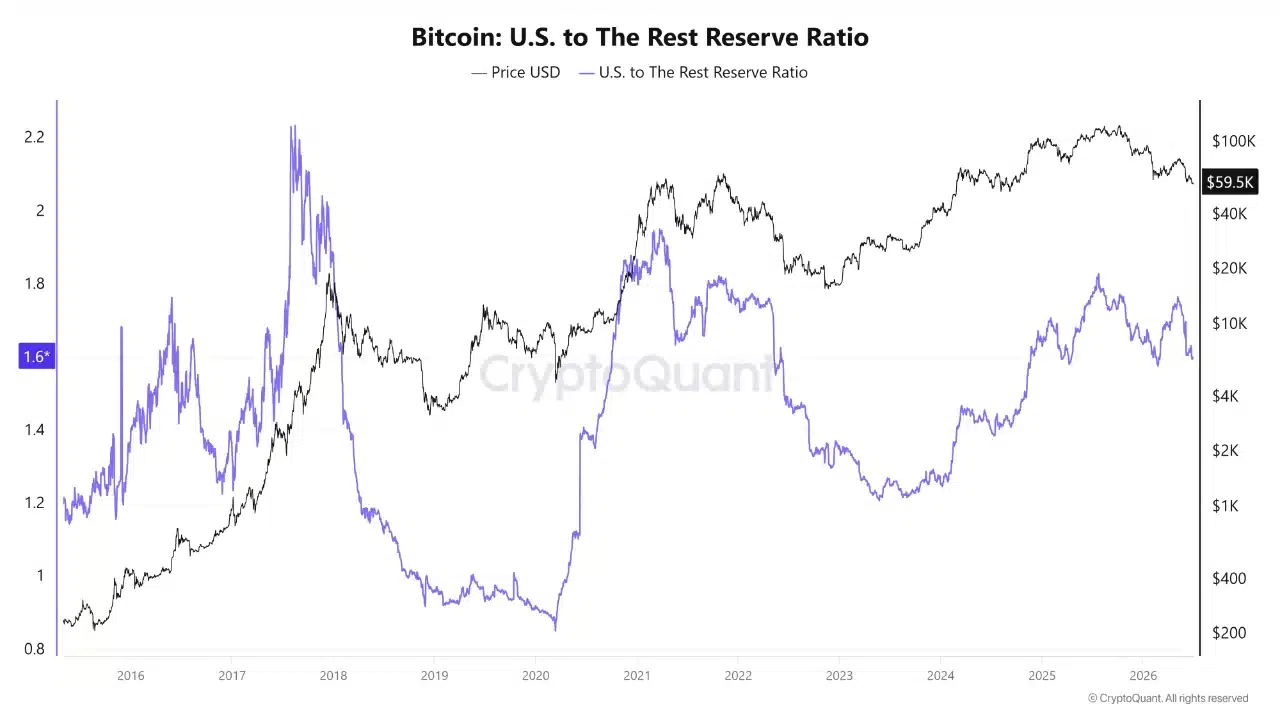
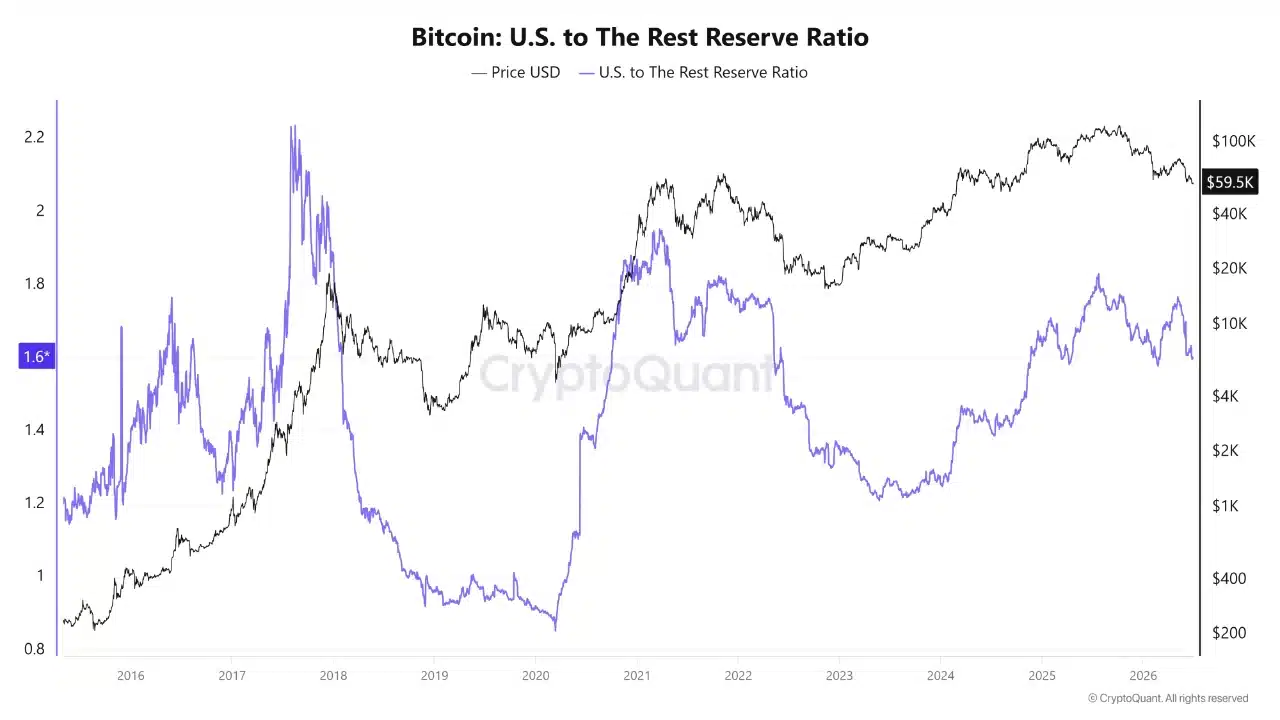
Source: CryptoQuant

The first cryptocurrency will most certainly face resistance and more downside pressure, unless U.S. demand starts recovering.

Spot ETF outflows confirm the fall

After months of green, the ETF trend has now flipped. The latest monthly net flow saw a huge outflow of around $4.29 billion. Considering ETFs were one of the clearest signs of institutional buying during rallies, this is concerning.
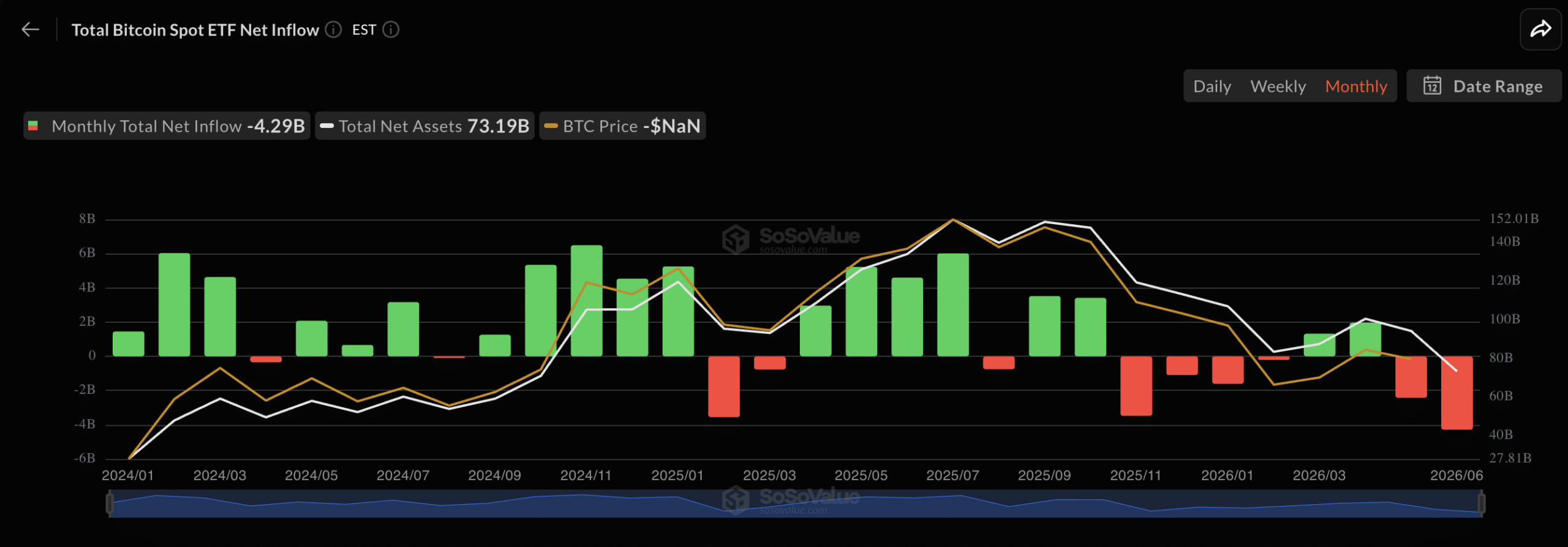
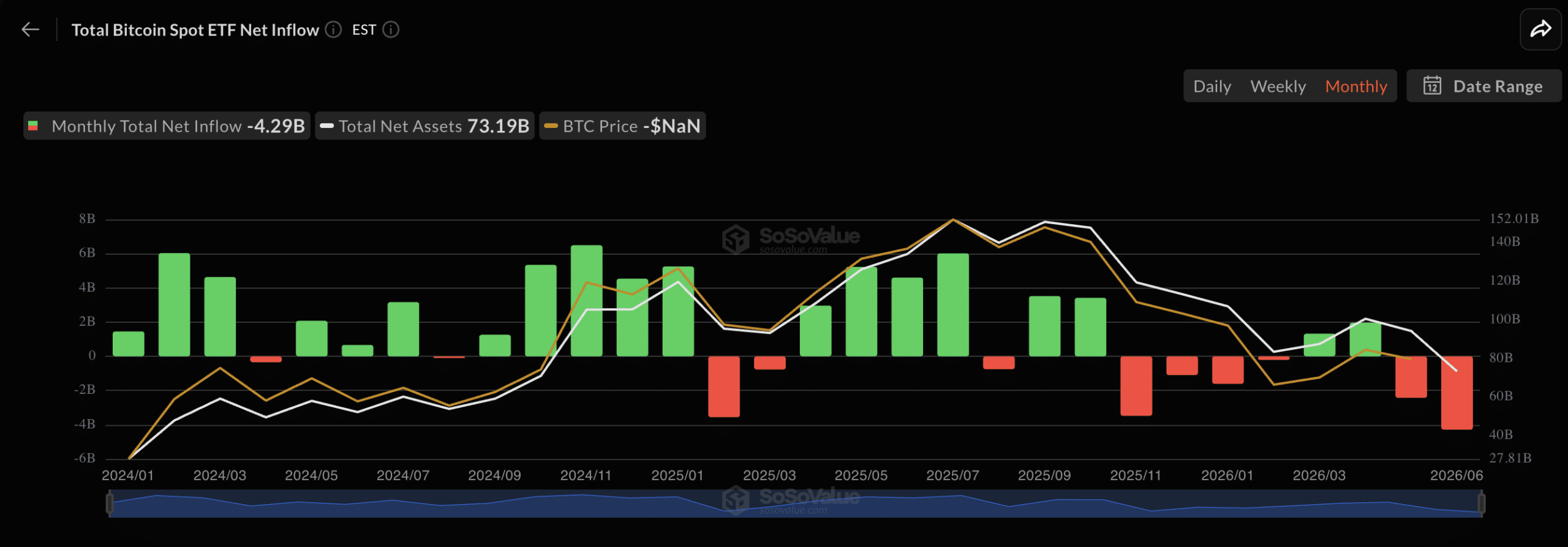
Source: SoSoValue

When ETF demand was strong, BTC found steady support. But now, with two weak months, the market looks nervous.

Price tests $58K support

Bitcoin slipped below the $60K area and was trading close to $58,500 at the time of writing. Sellers were very much still in control. The RSI was near the oversold zone, so the market is under pressure. However, we’re not ready for a big bounce yet.
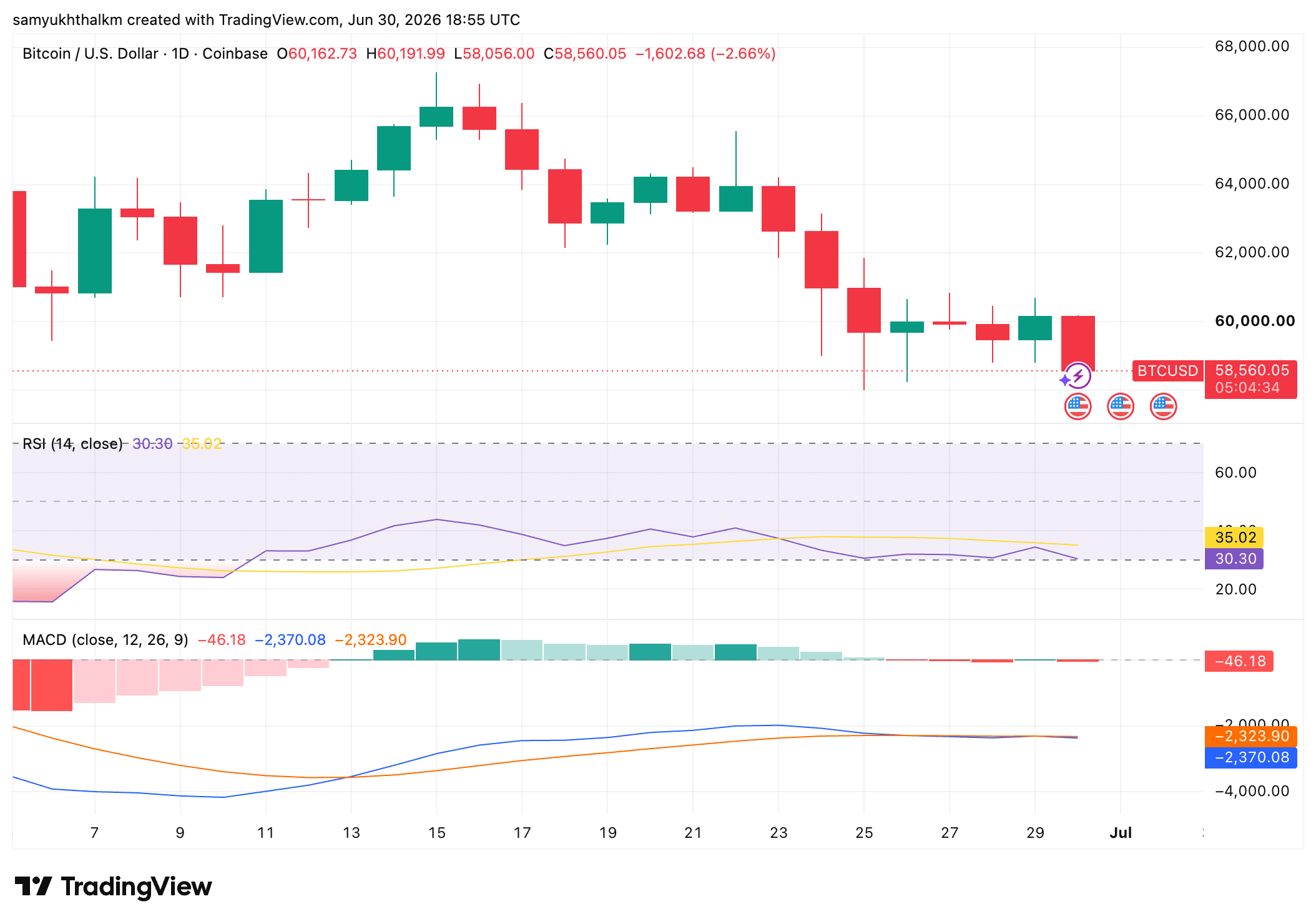
Source: TradingView

Pace has not gone back in favor of the buyers. A short relief move is possible after this decline, but greater picture is still unclear. Unless BTC makes it back to the $60-$62K range, a bigger fall to lower support levels is possible.


Final Summary

  • U.S. demand for Bitcoin is weakening, with Spot ETF outflows reaching $4.29 billion. This signals reduced investor confidence.
  • Bitcoin is struggling to hold the $58K support zone, while the U.S. reserve ratio has dropped to 1.59 – reinforcing downside risks.


Trending Cryptos

Related Questions

QAccording to the article, what is the main reason Bitcoin's rally is losing strength?

AThe main reason is the weakening demand from the U.S. market, a key historical driver, as evidenced by the declining U.S. to The Rest Reserve Ratio and significant outflows from Spot ETFs.

QWhat is the current value of the U.S. to The Rest Reserve Ratio for Bitcoin mentioned in the article?

AThe ratio has fallen from a recent peak near 1.79 to around 1.59.

QHow much was the latest monthly net outflow from Spot ETFs, as reported in the article?

AThe latest monthly net flow saw a huge outflow of approximately $4.29 billion.

QWhat key price level is Bitcoin testing for support at the time of writing?

ABitcoin was trading close to $58,500, testing the $58K support zone.

QAccording to the article's final summary, what is required to avoid a potential bigger fall in Bitcoin's price?

ABitcoin needs to make it back to the $60-$62K range; otherwise, a bigger fall to lower support levels is possible.

Related Reads

Google Shaken, Market Cap Evaporates Hundreds of Billions. Can Gemini Spark Save the Day?

Google is facing a turbulent period marked by a significant brain drain of top AI talent. Key figures like Noam Shazeer, John Jumper, Jonas Adler, and Alexander Pritzel have recently left for competitors OpenAI and Anthropic, causing investor concern and a sharp stock decline wiping hundreds of billions from Alphabet's market cap. Amidst this talent exodus and the delayed launch of the anticipated Gemini 3.5 Pro model, Google has unveiled its major new offering: Gemini Spark. This is not a standard chatbot but a persistent, cloud-based AI agent designed to automate multi-step workflows across Google's ecosystem (Gmail, Calendar, Docs, Drive, etc.) and some third-party apps. Powered by the Antigravity framework with Tasks, Skills, and Schedules, it aims to function as a continuous digital assistant. However, its high price point—exclusive to the $100/month AI Ultra tier—has drawn criticism. The article positions Spark as Google's critical, albeit late, move into the AI agent arena, where AI transitions from a tool to an autonomous workforce. While competitors and startups are already advancing in this space, Google's vast integration with Workspace gives it a potential edge, though its historical caution due to scale and risk may have cost it the lead. Ultimately, Spark represents a necessary shift for Google, but the question remains whether this "digital employee" can compensate for the loss of foundational talent and restore investor confidence in the company's future.

marsbit2m ago

Google Shaken, Market Cap Evaporates Hundreds of Billions. Can Gemini Spark Save the Day?

marsbit2m ago

24/5 Settlement Is Here for US Stocks, but Cryptocurrency Didn't Get a Ticket

The U.S. National Securities Clearing Corporation (NSCC), a subsidiary of the Depository Trust & Clearing Corporation (DTCC), has announced the implementation of 24-hour clearing operations on weekdays. This move, approved by the SEC and being rolled out in phases, fundamentally challenges a core narrative of the cryptocurrency industry: that digital assets offer a unique advantage with their 7x24 trading availability, unlike traditional markets that close at 4 p.m. The transition to near-continuous clearing for stocks and other traditional assets diminishes this perceived crypto edge. While crypto markets still operate on weekends, the article notes that DTCC could potentially expand to weekend clearing in the future if demand warrants. The development is presented as another instance where DTCC has disappointed crypto enthusiasts. Despite frequent speculation from communities supporting Ethereum, XRP Ledger, and others that DTCC would integrate public blockchains, the clearing giant consistently opts for private, permissioned distributed ledger solutions for its projects, such as its Ion platform and a recent U.S. Treasury tokenization initiative on the Canton network. The article concludes that the successful launch of this traditional finance "always-on" market relied entirely on existing mature infrastructure, with the cryptocurrency industry failing to secure a role or "admission ticket" in its implementation.

Foresight News18m ago

24/5 Settlement Is Here for US Stocks, but Cryptocurrency Didn't Get a Ticket

Foresight News18m ago

Karpathy's Genius Strikes Again, Challenging RAG, Turning Your Notes into a Second Brain

Andrej Karpathy has proposed a revolutionary concept for managing personal knowledge: treating notes as immutable "source code" and using LLMs as "compilers" to build a structured, interlinked wiki. This approach fundamentally shifts the cognitive workflow away from the limitations of RAG (Retrieval-Augmented Generation), which merely retrieves and pieces together fragments, leading to contradictions and "digital mummies"—unused, decaying notes. The LLM-Wiki framework introduces a three-layer architecture: the **Raw Layer** for original, immutable notes; the **Schema Layer** defining rules for structuring knowledge; and the **Wiki Layer**, where the LLM continuously compiles and maintains a coherent, cross-referenced knowledge base. Key operations are **Ingest** (adding new material, which triggers updates across related pages), **Query** (asking the compiled wiki, with answers that can become new pages), and **Lint** (periodic AI audits to find contradictions, outdated claims, or gaps). This system automates the tedious maintenance—updating links, resolving conflicts, keeping summaries fresh—that has historically made large-scale personal knowledge management unsustainable. It realizes Vannevar Bush's 1945 "Memex" vision by finally solving the maintenance problem. Karpathy's proposal represents a third piece in human-AI collaboration, following "Vibe Coding" and "Agentic Engineering." It liberates human attention from organizational drudgery, refocusing it on what matters: deciding what to read and deriving meaning.

marsbit27m ago

Karpathy's Genius Strikes Again, Challenging RAG, Turning Your Notes into a Second Brain

marsbit27m ago

Claude Science Completes Two Years' Work in a Few Weeks, Is 10x Research Acceleration Really Here?

Claude Science, a new AI workbench from Anthropic, is being tested by scientists, reportedly accelerating specific research workflows by up to 10x. A neuro-scientist at the Allen Institute completed a lengthy literature review in weeks instead of nearly two years using the tool, which automates tasks like citation verification. The platform is an integrated environment for macOS and Linux, connecting to local or remote computing resources. It streamlines the fragmented research process—literature analysis, computation, visualization, and drafting—into a single, auditable workflow. A key feature is its emphasis on reproducibility: every chart generated includes the exact code, environment, and history used to create it. Claude Science uses a multi-agent system. A coordinator manages over 60 pre-configured skills for life sciences (genomics, proteomics, etc.) and can spawn specialized agents. A dedicated reviewer agent checks citations and calculations for accuracy, creating a form of internal AI peer review. The system operates with a human-in-the-loop, requiring user approval for major steps. Initial applications are in life sciences. Examples include target identification for biotech company Manifold Bio and germline variant analysis for glioma research at UCSF, completing analyses in roughly one-tenth the previous time. The approach contrasts with competitors: Google focuses on proprietary models like AlphaFold, while OpenAI is advancing models' scientific reasoning with benchmarks like GeneBench-Pro. Claude Science differentiates by automating and integrating the practical research pipeline, not just the model's intelligence, aiming to make AI-aided science more reproducible and integrated into daily lab work.

marsbit31m ago

Claude Science Completes Two Years' Work in a Few Weeks, Is 10x Research Acceleration Really Here?

marsbit31m ago

Trading

Spot

Hot Articles

What is $BITCOIN

DIGITAL GOLD ($BITCOIN): A Comprehensive Analysis Introduction to DIGITAL GOLD ($BITCOIN) DIGITAL GOLD ($BITCOIN) is a blockchain-based project operating on the Solana network, which aims to combine the characteristics of traditional precious metals with the innovation of decentralized technologies. While it shares a name with Bitcoin, often referred to as “digital gold” due to its perception as a store of value, DIGITAL GOLD is a separate token designed to create a unique ecosystem within the Web3 landscape. Its goal is to position itself as a viable alternative digital asset, although specifics regarding its applications and functionalities are still developing. What is DIGITAL GOLD ($BITCOIN)? DIGITAL GOLD ($BITCOIN) is a cryptocurrency token explicitly designed for use on the Solana blockchain. In contrast to Bitcoin, which provides a widely recognized value storage role, this token appears to focus on broader applications and characteristics. Notable aspects include: Blockchain Infrastructure: The token is built on the Solana blockchain, known for its capacity to handle high-speed and low-cost transactions. Supply Dynamics: DIGITAL GOLD has a maximum supply capped at 100 quadrillion tokens (100P $BITCOIN), although details regarding its circulating supply are currently undisclosed. Utility: While precise functionalities are not explicitly outlined, there are indications that the token could be utilized for various applications, potentially involving decentralized applications (dApps) or asset tokenization strategies. Who is the Creator of DIGITAL GOLD ($BITCOIN)? At present, the identity of the creators and development team behind DIGITAL GOLD ($BITCOIN) remains unknown. This situation is typical among many innovative projects within the blockchain space, particularly those aligning with decentralized finance and meme coin phenomena. While such anonymity may foster a community-driven culture, it intensifies concerns about governance and accountability. Who are the Investors of DIGITAL GOLD ($BITCOIN)? The available information indicates that DIGITAL GOLD ($BITCOIN) does not have any known institutional backers or prominent venture capital investments. The project seems to operate on a peer-to-peer model focused on community support and adoption rather than traditional funding routes. Its activity and liquidity are primarily situated on decentralized exchanges (DEXs), such as PumpSwap, rather than established centralized trading platforms, further highlighting its grassroots approach. How DIGITAL GOLD ($BITCOIN) Works The operational mechanics of DIGITAL GOLD ($BITCOIN) can be elaborated on based on its blockchain design and network attributes: Consensus Mechanism: By leveraging Solana’s unique proof-of-history (PoH) combined with a proof-of-stake (PoS) model, the project ensures efficient transaction validation contributing to the network's high performance. Tokenomics: While specific deflationary mechanisms have not been extensively detailed, the vast maximum token supply implies that it may cater to microtransactions or niche use cases that are still to be defined. Interoperability: There exists the potential for integration with Solana’s broader ecosystem, including various decentralized finance (DeFi) platforms. However, the details regarding specific integrations remain unspecified. Timeline of Key Events Here is a timeline that highlights significant milestones concerning DIGITAL GOLD ($BITCOIN): 2023: The initial deployment of the token occurs on the Solana blockchain, marked by its contract address. 2024: DIGITAL GOLD gains visibility as it becomes available for trading on decentralized exchanges like PumpSwap, allowing users to trade it against SOL. 2025: The project witnesses sporadic trading activity and potential interest in community-led engagements, although no noteworthy partnerships or technical advancements have been documented as of yet. Critical Analysis Strengths Scalability: The underlying Solana infrastructure supports high transaction volumes, which could enhance the utility of $BITCOIN in various transaction scenarios. Accessibility: The potential low trading price per token could attract retail investors, facilitating wider participation due to fractional ownership opportunities. Risks Lack of Transparency: The absence of publicly known backers, developers, or an audit process may yield skepticism regarding the project's sustainability and trustworthiness. Market Volatility: The trading activity is heavily reliant on speculative behavior, which can result in significant price volatility and uncertainty for investors. Conclusion DIGITAL GOLD ($BITCOIN) emerges as an intriguing yet ambiguous project within the rapidly evolving Solana ecosystem. While it attempts to leverage the “digital gold” narrative, its departure from Bitcoin's established role as a store of value underscores the need for a clearer differentiation of its intended utility and governance structure. Future acceptance and adoption will likely depend on addressing the current opacity and defining its operational and economic strategies more explicitly. Note: This report encompasses synthesised information available as of October 2023, and developments may have transpired beyond the research period.

538 Total ViewsPublished 2025.05.13Updated 2025.05.13

What is $BITCOIN

Discussions

Welcome to the HTX Community. Here, you can stay informed about the latest platform developments and gain access to professional market insights. Users' opinions on the price of BTC (BTC) are presented below.

活动图片