Written by: Gino Mato
Compiled by: Saoirse, Foresight News
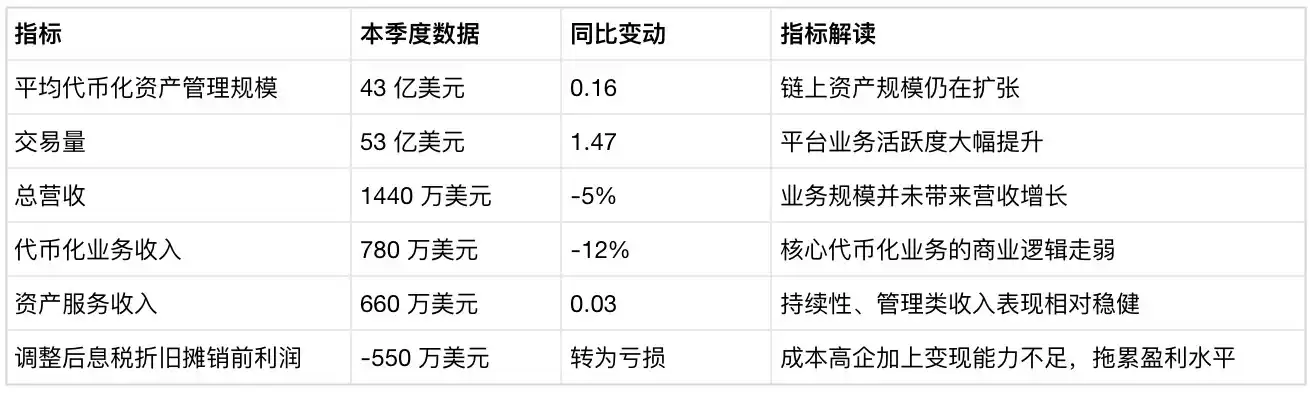
Securitize's first quarterly earnings report since going public: the average assets under management on its tokenization platform reached a historic high of $4.3 billion, a 16% year-over-year increase; platform trading volume surged 147% to $5.3 billion.
However, the company's total revenue decreased by 5% year-over-year to just $14.4 million; tokenization business revenue dropped approximately 12% to $7.8 million; adjusted EBITDA turned into a loss of $5.5 million.
Compared to the same period last year, the company has tokenized more assets and handled a significantly larger business volume, yet its earnings have decreased.
CFO Explains the Discrepancy Between Scale and Revenue
Securitize CFO Francisco Flores stated in the earnings call that, at this stage, revenue from assets under management (AUM) is minimal, and the vast majority of platform trading volume has not yet been commercialized.
He added that most of the tokenization business revenue still comes from projects such as integrating new protocols and expanding business networks.
Meanwhile, asset servicing revenue—fees charged for managing the platform's existing assets—performed much better, rising slightly by 3% to $6.6 million. Flores noted that monetizing transactions is a medium-to-long-term opportunity, and the current business model cannot yet tap into this part of the revenue.
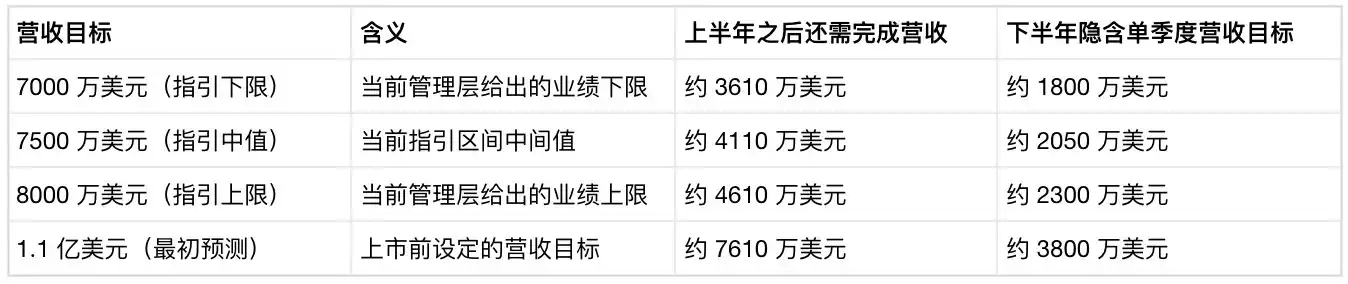
Pre-IPO materials from Securitize had projected the company's 2026 total revenue to reach $110 million, with EBITDA of $32 million. Management claimed that $85 million of this revenue was contractually guaranteed, recurring, or based on existing assets and partnerships, making the initial forecast highly achievable.
Now, management has lowered the full-year revenue guidance to $70–80 million. The company's total revenue for the first half of the year was $33.9 million. To meet the lower end of the guidance, quarterly revenue in the second half needs to reach about $18 million; to reach the upper end, quarterly revenue needs to approach $23 million.
To achieve the original $110 million target, quarterly revenue would need to be $38 million, more than 2.6 times the revenue level of this quarter.
Why Is There Such a Huge Gap Between Tokenized Asset Scale and Revenue?
Edwin Mata, CEO of tokenization platform Brickken, stated that the contradiction revealed in Securitize's financial report is a structural challenge faced by the entire industry.
He noted that tokenized assets under management can continue to rise, but the underlying commercial monetization model struggles to scale at the same pace; merely tokenizing more assets does not automatically create a business model that grows accordingly.
Mata explained that current tokenization implementations largely rely on large-scale custom projects, dedicated system integrations, adaptations for different jurisdictions, and extensive professional services for each new asset issuance.
Adding a new asset class, entering a new jurisdiction, or launching a new product often equates to starting a new implementation project. When revenue depends on custom implementations project by project, the growth rate of tokenized assets will far outpace the recurring revenue it can generate.
Mata believes the truly significant business opportunity lies after assets are tokenized, not during the issuance phase. Companies need infrastructure capable of managing financial products long-term, covering access control, compliance, reporting, distribution, corporate actions, and secondary market transfers.
This is the difference between implementation revenue and infrastructure revenue: implementation revenue is a one-time fee for deploying assets onto the blockchain; infrastructure revenue is the recurring fee for maintaining the ongoing operation of assets on-chain.
In his view, to capture infrastructure revenue, the tokenization industry needs to look to enterprise software: building standardized infrastructure, creating reusable workflows, and supporting multiple financial products and jurisdictions within a single system.
Complex business structures will still require consulting and professional services, but the core profit logic must be embedded within the infrastructure itself.
Why Simply Calculating Platform Fees Leads to Misjudgment
Utkarsh Ahuja, Founder and Managing Partner of Moon Pursuit Capital, believes Securitize's earnings report serves as a realistic warning: the speed of industry adoption and commercialization are not in sync at all.
He poses questions to investors: When assets under management and trading volume continue to expand, what happens commercially? How much of this growth translates into recurring revenue? Do profit margins improve? Do operational efficiencies increase as the business scales?
Ahuja stated that the tokenization industry is entering a rational development phase. The market has validated over recent years that institutions are indeed willing to tokenize real-world assets; now it's time for the underlying infrastructure business models supporting this sector to be tested.
As more institutional capital flows into tokenized assets, investors will increasingly focus on revenue quality, customer retention, profit margins, and the long-term commercial returns of maintaining assets. This is also key to distinguishing whether a platform is a genuinely sustainable business or merely a growth story.
Simply dividing Securitize's $14.4 million revenue by $5.3 billion in trading volume might seem to yield a decent platform fee rate, but this calculation does not reflect the company's actual profitability at all.
Securitize's trading volume statistics are broad, encompassing investments, redemptions, dividends, and cross-chain asset transfers; as CFO Flores admitted, only a tiny fraction of this volume currently generates revenue.
A more realistic conclusion is this: The fact that Securitize has not yet established a mature 'platform activity-revenue sharing' model is far more significant than any single fee rate figure.
How Will the Tokenized Asset Scale-Revenue Contradiction Evolve?
Bullish Scenario: Securitize focuses on tokenized public stock business, leveraging issuers tokenizing shares, broker capabilities, and atomic settlement to drive high-frequency trading, thereby earning transaction fees. Management believes tokenized stocks have stronger trading attributes compared to tokenized treasuries or credit products. However, this is a medium-to-long-term strategic move and will not impact the current fiscal year's performance.
To achieve full-year revenue close to or reaching $80 million, quarterly revenue in the second half needs to be about $23 million, a significant acceleration compared to the current quarter.
Bearish Scenario: Assets under management and trading volume continue to hit new highs, but the underlying business model remains reliant on custom projects one by one. Tokenization business revenue fluctuates sharply, and asset servicing revenue growth is too slow to offset these issues.

If full-year revenue only meets the lower guidance of $70 million, quarterly revenue would need to be only about $18 million, slightly higher than this quarter. Even as announced business scale continues to reach new highs, adjusted EBITDA could remain in the red.
The core challenge the tokenization industry must face next: when a platform adds billions more in assets or trading volume, can it autonomously generate recurring revenue without relying on new projects?