Football Draw Harvests Whales: Extreme Profit-Loss Divergence on Polymarket's World Cup

Foresight NewsPublished on 2026-06-18Last updated on 2026-06-18

Abstract

A bettor known as "fishalive" made a stunning profit of nearly $9 million on the Polymarket prediction platform by correctly wagering against favorites during the 2026 FIFA World Cup group stage. The account, registered just before the tournament, risked roughly $400,000 on two contracts for a Spain vs. Cape Verde match: one that Spain would *not* win, and another on a Cape Verde +2.5 goal handicap. The resulting 0-0 draw triggered both payouts. This single event, with a total market volume of $64 million, highlighted extreme profit-and-loss divergence. Other traders, like "betoor619" and "leeeeroyjenkins," lost millions by betting heavily on favorites Spain and Belgium to win outright—contracts that become worthless in a draw. The article explains that while markets heavily favored strong teams, the "team to win" contracts are binary and do not account for the common outcome of a draw. This creates high-risk, low-reward scenarios for favorite backers, while asymmetric profits flow to those betting on underdogs or against outright wins. The transparency of Polymarket's on-chain ledger publicly documents these massive wins and losses, driving mainstream media coverage. As the tournament progresses, the author suggests traders may shift towards hedging strategies that account for draws. The piece also notes growing regulatory scrutiny in the US and Europe, questioning whether such large-scale, anonymous sports prediction markets should be regulated as gambling or financial d...


By: Gino Matos

Compiled by: Saoirse, Foresight News


In the June 14th match where Spain faced Cape Verde, Spain dominated possession at nearly 75% and fired off 27 shots — statistics that, in most tournaments, would guarantee a victory. However, the final score was 0-0, with Cape Verde's 40-year-old goalkeeper Vozinha named Man of the Match. This draw caused significant losses for many bettors on Polymarket, while simultaneously allowing an unknown wallet to rake in approximately $9 million in a single day.


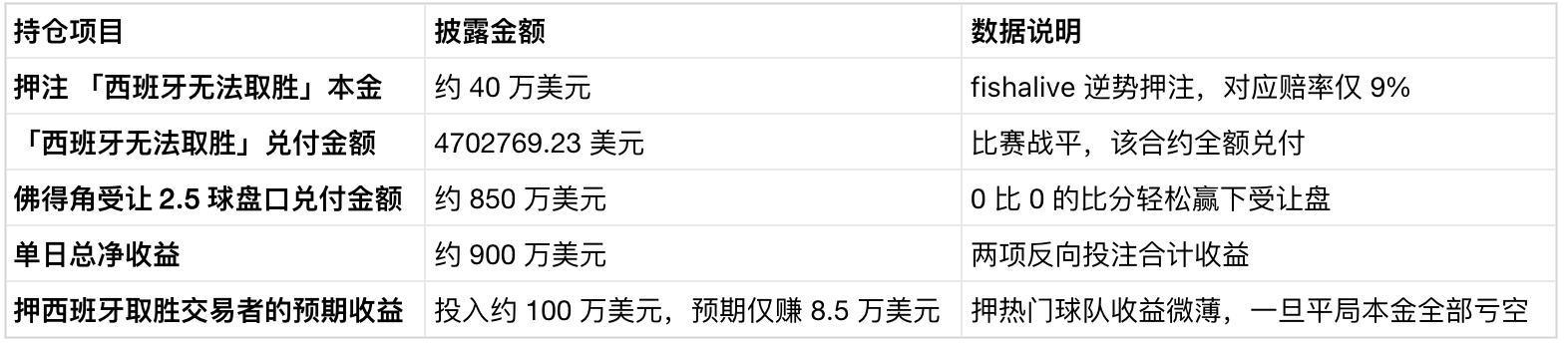
The wallet, belonging to an account named 'fishalive', was only registered on Polymarket in June 2026, with only two predictive bets in its public record. The account bet on the contract "Spain will not win," cashing out around $4.7 million; simultaneously, it placed a bet on the Cape Verde +2.5 handicap spread (a sports betting rule to balance odds between strong and weak teams, manually adding 2.5 goals to Cape Verde's total before comparing scores), securing another approximately $8.5 million. With an initial investment of only about $400,000, it netted nearly $9 million.


Data from Polymarket's sports section shows that this $400,000 bet had an initial implied probability of only 9%, with a final payout reaching $4,702,769.23. The bet's size, timing (placed just 8 minutes before kickoff), and the account's recent registration sparked extensive online discussion. Commenters noted that the $4.5 million position was established just 8 minutes before the match started.


This newly registered wallet accurately predicted Cape Verde's chances, and the platform's fully public on-chain ledger allowed everyone to witness the entire process of this massive profit realization in real-time.


Position and Profit Data Overview:


In the single market for the World Cup winner alone, Polymarket's trading volume reached $24.6 billion. Market odds show France leading in championship expectations at about 17.6%, followed closely by Spain at 13.9%; Portugal and England are not far behind at 10.8% and 10.5% respectively. The winner contract will settle around July 20th. Polymarket states that for the 2026 World Cup, there are a total of 362 active trading markets across all categories, with total volume exceeding $25 billion.


The enormous trading scale turns individual football matches into independent financial trading events. For the Spain vs. Cape Verde match alone, platform trading volume reached $64 million.


Popular Teams Suffer Upsets, Bettors Face Widespread Losses


A trader named 'betoor619' bet on a Spain win with an implied probability as high as 92%. He invested nearly $1 million in principal, with a potential profit of only $85,000. The draw rendered this position completely worthless.


Days earlier, Polymarket's sports section had recorded a similar operation: another user invested $1 million betting on Spain to defeat Cape Verde, which would have returned only $1,085,943.48 if successful. Cape Verde held firm for the entire match, not conceding even in stoppage time, earning their first-ever World Cup point and voiding both bets on a Spanish victory.


The same script played out again within 24 hours. Media outlet Inc. reported that trader 'FlickRaw' incurred total losses of approximately $4.2 million: $2.7 million betting on the Netherlands to defeat Japan and $1.5 million on Belgium to defeat Egypt. Japan equalized twice, with an 88th-minute goal locking the final score at 2-2; Belgium conceded to Egypt in the 19th minute, equalized in the 66th, but ultimately settled for a 1-1 draw.



The draw between Belgium and Egypt also wiped out the single largest bet of the tournament so far: trader 'leeeeeroyjenkins' invested $8.6 million on a Belgium win. Had the team succeeded, he would have received a payout of about $13.1 million. Polymarket's sports section updated the match odds in real-time, first announcing Egypt's 1-0 halftime lead and finally confirming the draw, resulting in a complete loss for this massive bet.


Why Do Bets on Favorites Lead to Widespread Losses?


Theoretically, Spain, the Netherlands, and Belgium were clearly stronger, a judgment shared by the trading markets. However, "team to win" contracts only pay out under a single outcome, while draws are common in football. Once the final whistle blows with a tied score, even the most dominant performance renders the bet slip worthless.


Shares for "team to win" were priced as high as 92 cents, with the market assuming victory was almost certain. But if the team fails to score one more goal, the share value plummets to zero. 'fishalive's' two bets were profitable because the "Spain will not win" contract and the Cape Verde +2.5 handicap spread both pay out in the event of a draw. All traders betting on favorites to win this week fell victim to the draw.


The championship expectation rankings reflect shifts in market sentiment. As match results come in, traders continuously reassess each national team's probability of winning. Single-match contracts have extremely high visibility: they settle in 90 minutes, and screenshots of large profits and losses spread easily on social media, meaning unreasonable large bets pay the price immediately.


Large traders concentrated heavily on favorites to win, but the contracts offering high asymmetric returns are always those like handicap spreads and "team will not win" bets, which price in the risk of a draw in advance.


Pre-tournament predictive models from Goldman Sachs gave Spain a 26% probability of winning the tournament, higher than France's 19%. However, after Cape Verde held Spain to a draw, Polymarket's market funds repriced, and France's championship expectations directly overtook Spain's.


The World Cup has a global audience, and fans generally understand match outcome logic. The dense group stage schedule creates new market hotspots every few hours. National team events carry strong emotional attributes, independent of financial gains or losses. Simultaneously, the transparent settlement mechanism generates a complete, screenshot-worthy transaction record for every large bet. All these characteristics allow prediction markets to break through the crypto industry bubble and reach a mainstream audience.


Two Major Development Trends Ahead


As the knockout stage approaches, World Cup-related trading volume will continue to expand. Public on-chain wallet records, real-time odds movements, and emotionally charged national team events keep Polymarket a focal point for ongoing sports media coverage.


The profit story from the Cape Verde match and the massive loss case from the Belgium match are just the beginning of this tournament. New high-profile, large-scale trading stories will emerge every few days. Compared to traditional sports betting, single-match trading markets offer a faster pace and more immediate impact from profits and losses.



A scenario where major players reduce their betting is foreseeable: many traders, like those betting on Spain to win, invested millions expecting only tens of thousands in returns. After consecutive losses, they will reduce one-sided heavy positions, and funds will shift towards contracts that hedge draw risk in advance, such as handicap spreads and反向投注合约 contracts.


Regulatory resistance will further accelerate this trend. On June 10th, the U.S. Commodity Futures Trading Commission (CFTC) released a draft rule proposal aiming to establish a federal regulatory framework for prediction markets, while acknowledging the price discovery value of sports-related contracts. However, U.S. states, Native American tribes, and the traditional gambling industry collectively oppose this regulatory approach. A survey by the American Gaming Association shows that 85% of the U.S. public classify these prediction contracts as gambling.


As early as late May, Spain briefly banned Polymarket and Kalshi due to compliance qualification issues. This incident also shifted the focus of public debate from market growth to regulatory controversy: whether anonymous wallets and multi-million dollar sports bets should be subject to the same regulatory standards as financial derivatives.


It is currently impossible to determine whether 'fishalive's' massive profit resulted from accurate market judgment, pure luck, or exploitation of a pricing flaw in one-sided "win" contracts — Polymarket's on-chain ledger alone cannot provide the answer. But the ledger clearly records, match after match, funds flowing from bettors convinced of the favorite's certain victory to traders who understand the risk of a football draw.


Trending Cryptos

Related Questions

QWho was the biggest winner in the Spain vs. Cape Verde match on Polymarket, and what was their approximate profit?

AThe biggest winner was a user with the account name 'fishalive'. This user placed bets on contracts for 'Spain cannot win' and 'Cape Verde +2.5 handicap'. With an initial investment of approximately $400,000, they earned a net profit of nearly $9 million.

QWhat does the article suggest is a key risk for traders who heavily bet on favored teams to win on Polymarket?

AThe article suggests a key risk is the prevalence of draws in football. Bets on a team to win ('win-only' contracts) only pay out if that specific outcome occurs. If the match ends in a draw, these bets become worthless, regardless of how dominant the favored team was during the game.

QAccording to the article, how did the Spain vs. Cape Verde result impact the championship odds for Spain and France on Polymarket?

ABefore the match, Spain had higher championship odds than France. However, after Spain's draw with Cape Verde, the market repriced the odds, and France's championship expectation surpassed Spain's on the Polymarket platform.

QWhat are the two major future trends for prediction markets like Polymarket discussed in the article's conclusion?

AThe two major trends discussed are: 1) Large traders may shift their strategies away from heavy, one-sided bets on favorites towards contracts that hedge against draws, such as handicap or 'cannot win' bets. 2) Increased regulatory scrutiny and challenges, as authorities debate whether these anonymous, large-scale sports prediction contracts should be classified and regulated as gambling or financial derivatives.

QWhat was the total trading volume for the Spain vs. Cape Verde match alone on Polymarket, according to the article?

AAccording to the article, the total trading volume for the Spain vs. Cape Verde match on Polymarket reached $64 million.

Related Reads

The Brutal Truth Behind CARDS' $535M FDV: Only $43M in Net Revenue and Halved Profit Margins

The article titled "The Brutal Truth Behind CARDS' $535 Million FDV: Only $43 Million Net Revenue, Profit Margins Halved" provides a critical analysis of Collector Crypt (CC), a platform combining physical collectible cards with NFTs in a gacha-style system. Key findings include: * CC has generated $635 million in total user deposits. However, 90.6% ($576 million) is instantly returned to users via automatic card buybacks, resulting in only $43 million in net platform revenue (6.7% retention). * Activity is highly concentrated among dozens of high-frequency wallets, with an average of only ~420 daily active players. * There is minimal secondary market activity for the cards (under $5 million total), indicating the platform functions more as a gambling casino than a collector's marketplace. eBay sales as a percentage of gacha volume have declined for six consecutive quarters. * Despite a tripling in transaction volume, net profit margins have been halved from 11.2% to 5.8% as activity shifts to higher-priced card packs with lower margins. * Value captured by the CARDS token is minimal: only $140,000 (from burns and recent buybacks), representing just 3.4% of CC's cumulative net revenue. In contrast, wallets linked to operational infrastructure have off-ramped $45.7 million in USDC. * The token's ~$535 million Fully Diluted Valuation (FDV) represents a 7.3x multiple of annualized net revenue. Only 20.5% of the token supply is floating, with 72% allocated to insiders and locked until November 2027. The conclusion is that CC has found product-market fit as a high-speed gambling platform for a niche user base, not as a growing collector economy. The token currently captures a negligible share of the platform's revenue.

Foresight News19m ago

The Brutal Truth Behind CARDS' $535M FDV: Only $43M in Net Revenue and Halved Profit Margins

Foresight News19m ago

BitTorrent Launches BTTInferGrid: The Decentralized Infrastructure Layer for Scalable AI Inference

BitTorrent has launched BTTInferGrid, a decentralized GPU computing network designed to meet the surging demand for AI inference workloads. The platform aggregates global idle GPU resources into an open-access, verifiable, and pay-as-you-go infrastructure, aiming to solve the cost, scalability, and supply bottlenecks of traditional centralized cloud providers. BTTInferGrid addresses a key market shift, as industry forecasts indicate over 70% of future AI compute will be for inference—a continuous operational cost. It tackles centralization issues like inflexible resource allocation during volatile demand, prohibitive GPU pricing, and the underutilization of fragmented global compute capacity. The platform establishes a direct corridor between AI developers and idle hardware. On the supply side, it allows providers to monetize underutilized GPUs through tokenized incentives. On the demand side, it offers developers cost-efficient, on-demand inference with on-chain verification. Key differentiators include permissionless access for providers, verifiable service quality through blockchain validation, and a sustainable, demand-driven economic model. Built on BitTorrent's proven DePIN expertise from the BitTorrent File System (BTFS), BTTInferGrid follows a phased roadmap. It begins with network bootstrapping in 2026, focusing on scaling GPU nodes, and aims to evolve into a foundational Web3 AI infrastructure layer by 2028, supporting diverse model architectures and decentralized fine-tuning.

TheNewsCrypto56m ago

BitTorrent Launches BTTInferGrid: The Decentralized Infrastructure Layer for Scalable AI Inference

TheNewsCrypto56m ago

Trading

Spot
Futures

Hot Articles

What is SONIC

Sonic: Pioneering the Future of Gaming in Web3 Introduction to Sonic In the ever-evolving landscape of Web3, the gaming industry stands out as one of the most dynamic and promising sectors. At the forefront of this revolution is Sonic, a project designed to amplify the gaming ecosystem on the Solana blockchain. Leveraging cutting-edge technology, Sonic aims to deliver an unparalleled gaming experience by efficiently processing millions of requests per second, ensuring that players enjoy seamless gameplay while maintaining low transaction costs. This article delves into the intricate details of Sonic, exploring its creators, funding sources, operational mechanics, and the timeline of significant events that have shaped its journey. What is Sonic? Sonic is an innovative layer-2 network that operates atop the Solana blockchain, specifically tailored to enhance the existing Solana gaming ecosystem. It accomplishes this through a customised, VM-agnostic game engine paired with a HyperGrid interpreter, facilitating sovereign game economies that roll up back to the Solana platform. The primary goals of Sonic include: Enhanced Gaming Experiences: Sonic is committed to offering lightning-fast on-chain gameplay, allowing players and developers to engage with games at previously unattainable speeds. Atomic Interoperability: This feature enables transactions to be executed within Sonic without the need to redeploy Solana programmes and accounts. This makes the process more efficient and directly benefits from Solana Layer1 services and liquidity. Seamless Deployment: Sonic allows developers to write for Ethereum Virtual Machine (EVM) based systems and execute them on Solana’s SVM infrastructure. This interoperability is crucial for attracting a broader range of dApps and decentralised applications to the platform. Support for Developers: By offering native composable gaming primitives and extensible data types - dining within the Entity-Component-System (ECS) framework - game creators can craft intricate business logic with ease. Overall, Sonic's unique approach not only caters to players but also provides an accessible and low-cost environment for developers to innovate and thrive. Creator of Sonic The information regarding the creator of Sonic is somewhat ambiguous. However, it is known that Sonic's SVM is owned by the company Mirror World. The absence of detailed information about the individuals behind Sonic reflects a common trend in several Web3 projects, where collective efforts and partnerships often overshadow individual contributions. Investors of Sonic Sonic has garnered considerable attention and support from various investors within the crypto and gaming sectors. Notably, the project raised an impressive $12 million during its Series A funding round. The round was led by BITKRAFT Ventures, with other notable investors including Galaxy, Okx Ventures, Interactive, Big Brain Holdings, and Mirana. This financial backing signifies the confidence that investment foundations have in Sonic’s potential to revolutionise the Web3 gaming landscape, further validating its innovative approaches and technologies. How Does Sonic Work? Sonic utilises the HyperGrid framework, a sophisticated parallel processing mechanism that enhances its scalability and customisability. Here are the core features that set Sonic apart: Lightning Speed at Low Costs: Sonic offers one of the fastest on-chain gaming experiences compared to other Layer-1 solutions, powered by the scalability of Solana’s virtual machine (SVM). Atomic Interoperability: Sonic enables transaction execution without redeployment of Solana programmes and accounts, effectively streamlining the interaction between users and the blockchain. EVM Compatibility: Developers can effortlessly migrate decentralised applications from EVM chains to the Solana environment using Sonic’s HyperGrid interpreter, increasing the accessibility and integration of various dApps. Ecosystem Support for Developers: By exposing native composable gaming primitives, Sonic facilitates a sandbox-like environment where developers can experiment and implement business logic, greatly enhancing the overall development experience. Monetisation Infrastructure: Sonic natively supports growth and monetisation efforts, providing frameworks for traffic generation, payments, and settlements, thereby ensuring that gaming projects are not only viable but also sustainable financially. Timeline of Sonic The evolution of Sonic has been marked by several key milestones. Below is a brief timeline highlighting critical events in the project's history: 2022: The Sonic cryptocurrency was officially launched, marking the beginning of its journey in the Web3 gaming arena. 2024: June: Sonic SVM successfully raised $12 million in a Series A funding round. This investment allowed Sonic to further develop its platform and expand its offerings. August: The launch of the Sonic Odyssey testnet provided users with the first opportunity to engage with the platform, offering interactive activities such as collecting rings—a nod to gaming nostalgia. October: SonicX, an innovative crypto game integrated with Solana, made its debut on TikTok, capturing the attention of over 120,000 users within a short span. This integration illustrated Sonic’s commitment to reaching a broader, global audience and showcased the potential of blockchain gaming. Key Points Sonic SVM is a revolutionary layer-2 network on Solana explicitly designed to enhance the GameFi landscape, demonstrating great potential for future development. HyperGrid Framework empowers Sonic by introducing horizontal scaling capabilities, ensuring that the network can handle the demands of Web3 gaming. Integration with Social Platforms: The successful launch of SonicX on TikTok displays Sonic’s strategy to leverage social media platforms to engage users, exponentially increasing the exposure and reach of its projects. Investment Confidence: The substantial funding from BITKRAFT Ventures, among others, emphasizes the robust backing Sonic has, paving the way for its ambitious future. In conclusion, Sonic encapsulates the essence of Web3 gaming innovation, striking a balance between cutting-edge technology, developer-centric tools, and community engagement. As the project continues to evolve, it is poised to redefine the gaming landscape, making it a notable entity for gamers and developers alike. As Sonic moves forward, it will undoubtedly attract greater interest and participation, solidifying its place within the broader narrative of blockchain gaming.

1.7k Total ViewsPublished 2024.04.04Updated 2024.12.03

What is SONIC

What is $S$

Understanding SPERO: A Comprehensive Overview Introduction to SPERO As the landscape of innovation continues to evolve, the emergence of web3 technologies and cryptocurrency projects plays a pivotal role in shaping the digital future. One project that has garnered attention in this dynamic field is SPERO, denoted as SPERO,$$s$. This article aims to gather and present detailed information about SPERO, to help enthusiasts and investors understand its foundations, objectives, and innovations within the web3 and crypto domains. What is SPERO,$$s$? SPERO,$$s$ is a unique project within the crypto space that seeks to leverage the principles of decentralisation and blockchain technology to create an ecosystem that promotes engagement, utility, and financial inclusion. The project is tailored to facilitate peer-to-peer interactions in new ways, providing users with innovative financial solutions and services. At its core, SPERO,$$s$ aims to empower individuals by providing tools and platforms that enhance user experience in the cryptocurrency space. This includes enabling more flexible transaction methods, fostering community-driven initiatives, and creating pathways for financial opportunities through decentralised applications (dApps). The underlying vision of SPERO,$$s$ revolves around inclusiveness, aiming to bridge gaps within traditional finance while harnessing the benefits of blockchain technology. Who is the Creator of SPERO,$$s$? The identity of the creator of SPERO,$$s$ remains somewhat obscure, as there are limited publicly available resources providing detailed background information on its founder(s). This lack of transparency can stem from the project's commitment to decentralisation—an ethos that many web3 projects share, prioritising collective contributions over individual recognition. By centring discussions around the community and its collective goals, SPERO,$$s$ embodies the essence of empowerment without singling out specific individuals. As such, understanding the ethos and mission of SPERO remains more important than identifying a singular creator. Who are the Investors of SPERO,$$s$? SPERO,$$s$ is supported by a diverse array of investors ranging from venture capitalists to angel investors dedicated to fostering innovation in the crypto sector. The focus of these investors generally aligns with SPERO's mission—prioritising projects that promise societal technological advancement, financial inclusivity, and decentralised governance. These investor foundations are typically interested in projects that not only offer innovative products but also contribute positively to the blockchain community and its ecosystems. The backing from these investors reinforces SPERO,$$s$ as a noteworthy contender in the rapidly evolving domain of crypto projects. How Does SPERO,$$s$ Work? SPERO,$$s$ employs a multi-faceted framework that distinguishes it from conventional cryptocurrency projects. Here are some of the key features that underline its uniqueness and innovation: Decentralised Governance: SPERO,$$s$ integrates decentralised governance models, empowering users to participate actively in decision-making processes regarding the project’s future. This approach fosters a sense of ownership and accountability among community members. Token Utility: SPERO,$$s$ utilises its own cryptocurrency token, designed to serve various functions within the ecosystem. These tokens enable transactions, rewards, and the facilitation of services offered on the platform, enhancing overall engagement and utility. Layered Architecture: The technical architecture of SPERO,$$s$ supports modularity and scalability, allowing for seamless integration of additional features and applications as the project evolves. This adaptability is paramount for sustaining relevance in the ever-changing crypto landscape. Community Engagement: The project emphasises community-driven initiatives, employing mechanisms that incentivise collaboration and feedback. By nurturing a strong community, SPERO,$$s$ can better address user needs and adapt to market trends. Focus on Inclusion: By offering low transaction fees and user-friendly interfaces, SPERO,$$s$ aims to attract a diverse user base, including individuals who may not previously have engaged in the crypto space. This commitment to inclusion aligns with its overarching mission of empowerment through accessibility. Timeline of SPERO,$$s$ Understanding a project's history provides crucial insights into its development trajectory and milestones. Below is a suggested timeline mapping significant events in the evolution of SPERO,$$s$: Conceptualisation and Ideation Phase: The initial ideas forming the basis of SPERO,$$s$ were conceived, aligning closely with the principles of decentralisation and community focus within the blockchain industry. Launch of Project Whitepaper: Following the conceptual phase, a comprehensive whitepaper detailing the vision, goals, and technological infrastructure of SPERO,$$s$ was released to garner community interest and feedback. Community Building and Early Engagements: Active outreach efforts were made to build a community of early adopters and potential investors, facilitating discussions around the project’s goals and garnering support. Token Generation Event: SPERO,$$s$ conducted a token generation event (TGE) to distribute its native tokens to early supporters and establish initial liquidity within the ecosystem. Launch of Initial dApp: The first decentralised application (dApp) associated with SPERO,$$s$ went live, allowing users to engage with the platform's core functionalities. Ongoing Development and Partnerships: Continuous updates and enhancements to the project's offerings, including strategic partnerships with other players in the blockchain space, have shaped SPERO,$$s$ into a competitive and evolving player in the crypto market. Conclusion SPERO,$$s$ stands as a testament to the potential of web3 and cryptocurrency to revolutionise financial systems and empower individuals. With a commitment to decentralised governance, community engagement, and innovatively designed functionalities, it paves the way toward a more inclusive financial landscape. As with any investment in the rapidly evolving crypto space, potential investors and users are encouraged to research thoroughly and engage thoughtfully with the ongoing developments within SPERO,$$s$. The project showcases the innovative spirit of the crypto industry, inviting further exploration into its myriad possibilities. While the journey of SPERO,$$s$ is still unfolding, its foundational principles may indeed influence the future of how we interact with technology, finance, and each other in interconnected digital ecosystems.

59 Total ViewsPublished 2024.12.17Updated 2024.12.17

What is $S$

What is AGENT S

Agent S: The Future of Autonomous Interaction in Web3 Introduction In the ever-evolving landscape of Web3 and cryptocurrency, innovations are constantly redefining how individuals interact with digital platforms. One such pioneering project, Agent S, promises to revolutionise human-computer interaction through its open agentic framework. By paving the way for autonomous interactions, Agent S aims to simplify complex tasks, offering transformative applications in artificial intelligence (AI). This detailed exploration will delve into the project's intricacies, its unique features, and the implications for the cryptocurrency domain. What is Agent S? Agent S stands as a groundbreaking open agentic framework, specifically designed to tackle three fundamental challenges in the automation of computer tasks: Acquiring Domain-Specific Knowledge: The framework intelligently learns from various external knowledge sources and internal experiences. This dual approach empowers it to build a rich repository of domain-specific knowledge, enhancing its performance in task execution. Planning Over Long Task Horizons: Agent S employs experience-augmented hierarchical planning, a strategic approach that facilitates efficient breakdown and execution of intricate tasks. This feature significantly enhances its ability to manage multiple subtasks efficiently and effectively. Handling Dynamic, Non-Uniform Interfaces: The project introduces the Agent-Computer Interface (ACI), an innovative solution that enhances the interaction between agents and users. Utilizing Multimodal Large Language Models (MLLMs), Agent S can navigate and manipulate diverse graphical user interfaces seamlessly. Through these pioneering features, Agent S provides a robust framework that addresses the complexities involved in automating human interaction with machines, setting the stage for myriad applications in AI and beyond. Who is the Creator of Agent S? While the concept of Agent S is fundamentally innovative, specific information about its creator remains elusive. The creator is currently unknown, which highlights either the nascent stage of the project or the strategic choice to keep founding members under wraps. Regardless of anonymity, the focus remains on the framework's capabilities and potential. Who are the Investors of Agent S? As Agent S is relatively new in the cryptographic ecosystem, detailed information regarding its investors and financial backers is not explicitly documented. The lack of publicly available insights into the investment foundations or organisations supporting the project raises questions about its funding structure and development roadmap. Understanding the backing is crucial for gauging the project's sustainability and potential market impact. How Does Agent S Work? At the core of Agent S lies cutting-edge technology that enables it to function effectively in diverse settings. Its operational model is built around several key features: Human-like Computer Interaction: The framework offers advanced AI planning, striving to make interactions with computers more intuitive. By mimicking human behaviour in tasks execution, it promises to elevate user experiences. Narrative Memory: Employed to leverage high-level experiences, Agent S utilises narrative memory to keep track of task histories, thereby enhancing its decision-making processes. Episodic Memory: This feature provides users with step-by-step guidance, allowing the framework to offer contextual support as tasks unfold. Support for OpenACI: With the ability to run locally, Agent S allows users to maintain control over their interactions and workflows, aligning with the decentralised ethos of Web3. Easy Integration with External APIs: Its versatility and compatibility with various AI platforms ensure that Agent S can fit seamlessly into existing technological ecosystems, making it an appealing choice for developers and organisations. These functionalities collectively contribute to Agent S's unique position within the crypto space, as it automates complex, multi-step tasks with minimal human intervention. As the project evolves, its potential applications in Web3 could redefine how digital interactions unfold. Timeline of Agent S The development and milestones of Agent S can be encapsulated in a timeline that highlights its significant events: September 27, 2024: The concept of Agent S was launched in a comprehensive research paper titled “An Open Agentic Framework that Uses Computers Like a Human,” showcasing the groundwork for the project. October 10, 2024: The research paper was made publicly available on arXiv, offering an in-depth exploration of the framework and its performance evaluation based on the OSWorld benchmark. October 12, 2024: A video presentation was released, providing a visual insight into the capabilities and features of Agent S, further engaging potential users and investors. These markers in the timeline not only illustrate the progress of Agent S but also indicate its commitment to transparency and community engagement. Key Points About Agent S As the Agent S framework continues to evolve, several key attributes stand out, underscoring its innovative nature and potential: Innovative Framework: Designed to provide an intuitive use of computers akin to human interaction, Agent S brings a novel approach to task automation. Autonomous Interaction: The ability to interact autonomously with computers through GUI signifies a leap towards more intelligent and efficient computing solutions. Complex Task Automation: With its robust methodology, it can automate complex, multi-step tasks, making processes faster and less error-prone. Continuous Improvement: The learning mechanisms enable Agent S to improve from past experiences, continually enhancing its performance and efficacy. Versatility: Its adaptability across different operating environments like OSWorld and WindowsAgentArena ensures that it can serve a broad range of applications. As Agent S positions itself in the Web3 and crypto landscape, its potential to enhance interaction capabilities and automate processes signifies a significant advancement in AI technologies. Through its innovative framework, Agent S exemplifies the future of digital interactions, promising a more seamless and efficient experience for users across various industries. Conclusion Agent S represents a bold leap forward in the marriage of AI and Web3, with the capacity to redefine how we interact with technology. While still in its early stages, the possibilities for its application are vast and compelling. Through its comprehensive framework addressing critical challenges, Agent S aims to bring autonomous interactions to the forefront of the digital experience. As we move deeper into the realms of cryptocurrency and decentralisation, projects like Agent S will undoubtedly play a crucial role in shaping the future of technology and human-computer collaboration.

733 Total ViewsPublished 2025.01.14Updated 2025.01.14

What is AGENT S

Discussions

Welcome to the HTX Community. Here, you can stay informed about the latest platform developments and gain access to professional market insights. Users' opinions on the price of S (S) are presented below.

活动图片