Author: Ethereum Foundation
Compilation: Deep Chao TechFlow
Deep Chao Intro: The Ethereum Foundation (EF) has announced a 20% reduction in staff, with 54 people leaving, and has completed a months-long organizational restructuring. This is not a simple cost-cutting measure, but a strategic contraction—the Foundation is concentrating resources on the critical tasks that "only EF can and must do," reorganized into five major clusters. For investors, this signals Ethereum's shift from broad-scatter efforts to focusing on the protocol layer and sovereignty guarantees, but also exposes the financial pressure on non-profit organizations during the bear market.
Today, the Ethereum Foundation (EF) is changing form, concluding a months-long restructuring process, part of implementing our Mandate and treasury management policies.
The restructured EF has the structure, activities, and personnel needed to execute critical future missions. However, 54 colleagues have also departed, representing about 20% of EF's total staff. Many of them will continue contributing to Ethereum in other ways in the coming weeks.
This article briefly introduces the new structure and details how we are supporting those leaving.
New Structure
EF now has five clusters, each responsible for a different work area—Protocol Layer, Access Layer, User Layer, Community Layer, and Institutional Layer—plus a cluster focused on operations and a cluster comprising management and teams directly supporting management.
Each work area requires different approaches, is accountable for different types of outcomes, and has a different internal structure tailored to the required workload. We will share more details next month; today, only the highest-level overview is provided.
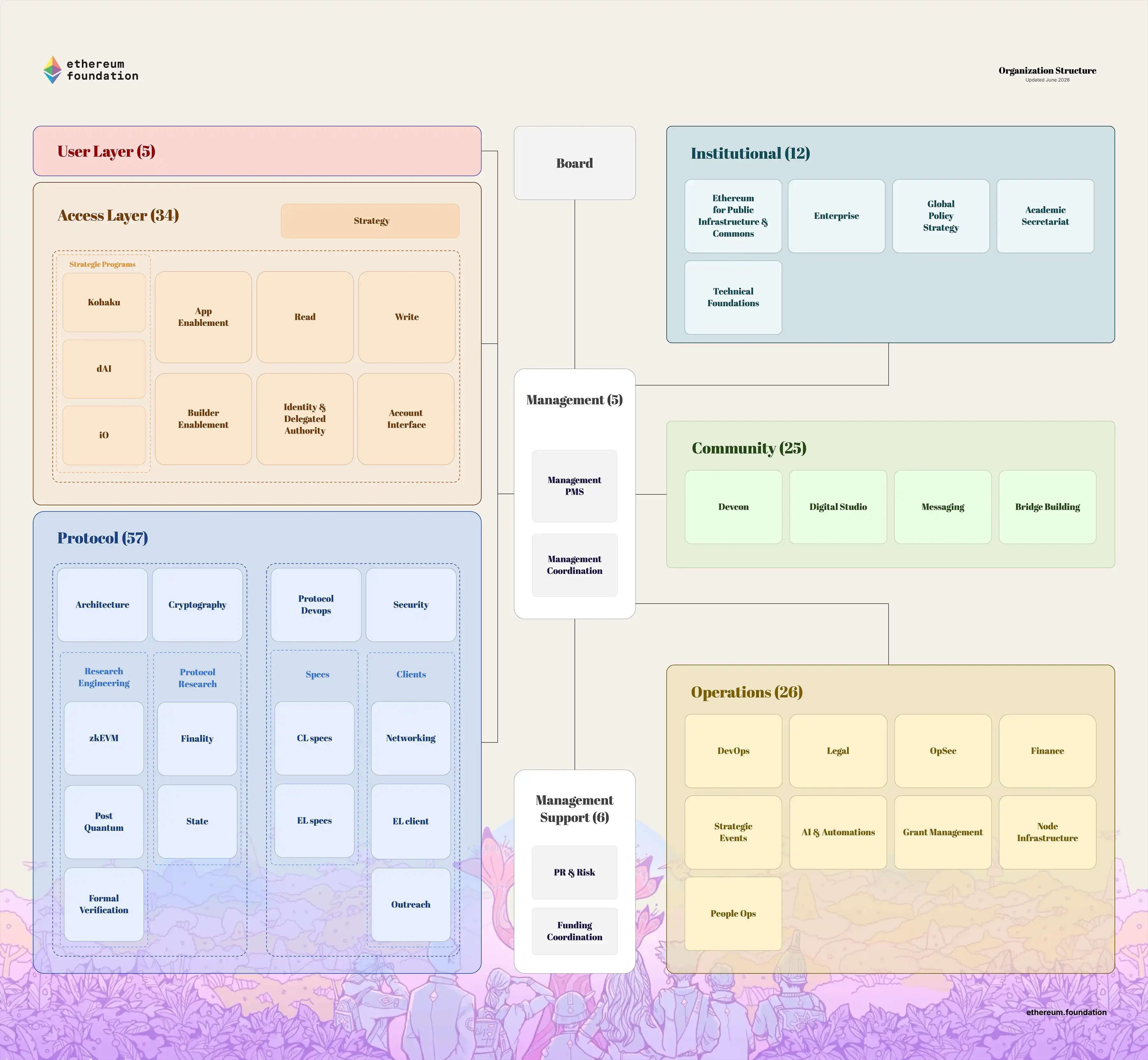
Protocol Layer
The Protocol cluster carries EF's legacy and responsibility, ensuring Ethereum delivers on its fundamental promise to scale self-sovereignty. It does this by laying the groundwork for strengthening and scaling the Ethereum protocol itself. Its goal is to ensure the Ethereum protocol continues to execute on the properties worth defending: censorship and capture resistance, openness and openness-source, and privacy and security as non-negotiable protocol guarantees.
The Protocol cluster exists to ensure the core protocol advances without compromising sovereignty guarantees. It does not exist to make Ethereum more marketable or focused on short-term interests, nor to make it easier to become another financial rail controlled by intermediaries. Its work is to make Ethereum harder to corrupt or capture, and easier to rely on when counterparties fail, platforms censor, governments overreach, or intermediaries extract rent. This means safely delivering forks, reducing unnecessary complexity, minimizing trusted dependencies, protecting transaction pipelines from harmful MEV and privileged order flow, and accelerating and translating long-term research like post-quantum security, zkEVM, and L1 privacy into protocol changes that preserve and improve sovereignty at scale.
Access Layer
The Access layer is where Ethereum serves—or fails—individuals who actually need CROPS properties. This cluster's work is to make self-sovereignty usable, understandable, and sustainable in critical operations: reading the chain, transacting, proving, delegating, and exiting. These operations must support users, and increasingly agents acting on their behalf, who must be able to read current state, history, and related data without relying on unverifiable intermediaries. They should be able to transact privately and without censorship risk, with outcomes either guaranteed or failing for free if conditions aren't met. As more work shifts to agents, users must retain control, grant limited permissions and revoke at will, and keep custody of their intent rather than exposing it to intermediaries. The interface, from silicon to front-end, must be verifiable, understandable, and recoverable, regardless of frequency of use or depth of technical knowledge.
The principle applied by this cluster is zero option: for every intermediated path, a credible, non-intermediated path must exist and remain accessible. Strategically, this means identifying where stronger CROPS properties can be applied to current infrastructure, and acknowledging that credible alternatives are necessary where economic incentives tend toward aggregation, identification, and control.
User Layer
The User Layer cluster grounds EF's work in the users and organizations with a material interest in using Ethereum self-sovereignly, and extends the tools and norms of such use as broadly as possible. It helps EF understand the most important capabilities, the most severe failure modes, and the trade-offs that are acceptable when necessary.
Its work includes user segmentation, roles, educational materials, use case studies, and impact assessments. The goal is not for EF to become a product studio, but to ensure decisions at the Protocol and Access layers are shaped by real current and potential users, real constraints, and real measures of sovereignty.
Community Layer
The Community cluster is responsible for how EF shows up in the world, both within and outside the Ethereum ecosystem. Its work is to make clear the positions EF represents, and how this differs substantively from zero-sum financial crypto, from crypto compromised by corporations, and from the mundane, status-quo-preserving, incentive-distorted, geostrategic-interest-laundering parts of non-profit grant management. EF commits to maximizing its community value by remaining independent from these and other counterproductive entanglements.
This cluster also builds EF's relationships beyond crypto. Self-sovereignty has natural allies in free and open source, security and local-first software and hardware, privacy and cryptography research and advocacy, and civil liberties, decentralized web, and public interest technology spaces. The cluster works to ensure the overlap between Ethereum and these fields is productive, non-coercive, and high-quality.
Institutional Layer
This cluster is responsible for EF's collaboration with institutions that shape how end users interact with Ethereum through institutional intermediary paths. This can include financial institutions, whether consumer payments, insurance, or others. It can include non-financial enterprises, covering manufacturing, social, publishing, and many other industries. It can include government applications. It can include universities or other non-profits.
In all cases, the goal is to prioritize creating showcase examples of Ethereum and crypto integration that maximize CROPS properties and the guarantees offered to both institutions and users—such as guaranteeing fair and correct execution, ensuring data portability and more generally practical exit capabilities, protecting all participants' privacy, proving data authenticity, better detecting or even preventing malfeasance, and so on. We believe many businesses, governments, and non-profits will realize their incentives align with serving users in ways that strengthen sovereignty, while retaining the guarantees they need to create value or fulfill their mission, and that Ethereum and crypto can be part of achieving this. Beyond direct engagements, the Institutional cluster will pursue these goals by helping establish and thoughtfully communicate best practices, standards, reference architectures, and educational materials for institutional adoption.
The Institutional cluster also works upstream with academia and allied advocacy organizations worldwide to ensure Ethereum is understood correctly in its current form and potential, and to track and respond to policy and regulatory developments that might impact Ethereum's commitment to sovereign use and its core principles of censorship (and capture) resistance, open source, privacy, and security.
Departing Personnel
As part of changing EF's structure, activities, and spending shape, we parted ways with 54 colleagues today.
These decisions were difficult but necessary. We must configure resources and organize in a way that allows us to focus for years ahead on the critical work that only EF can—and therefore must—do, without excessive distraction from short-term market fluctuations.
To ensure leavers are prepared for the transition, the package offered includes severance and transition support. Severance is the higher of one month's salary per year worked at EF or the amount specified by local regulations in the individual's jurisdiction. This matches the severance we've provided to colleagues leaving EF over recent months. Transition support includes assistance finding new contributing positions in the ecosystem and a small transition grant specifically for individual transition costs (career coaching, etc.).
We are grateful to each of them for the talent, dedication, and time they contributed to Ethereum at EF and look forward to continuing to work alongside those who find a home elsewhere in the ecosystem.
What's Next
The EF that emerges from this change is leaner and more focused. We'll share more in the coming weeks and months about how our work is changing and how the ecosystem can best engage with the new structure.