In one sentence, one weekend—Claude directly ran its own cutting-edge model on a brand-new AMD MI355X rack!
Human engineers didn't modify a single line of code.
Who could have imagined that the CUDA moat NVIDIA built over 20 years was crossed just like that.
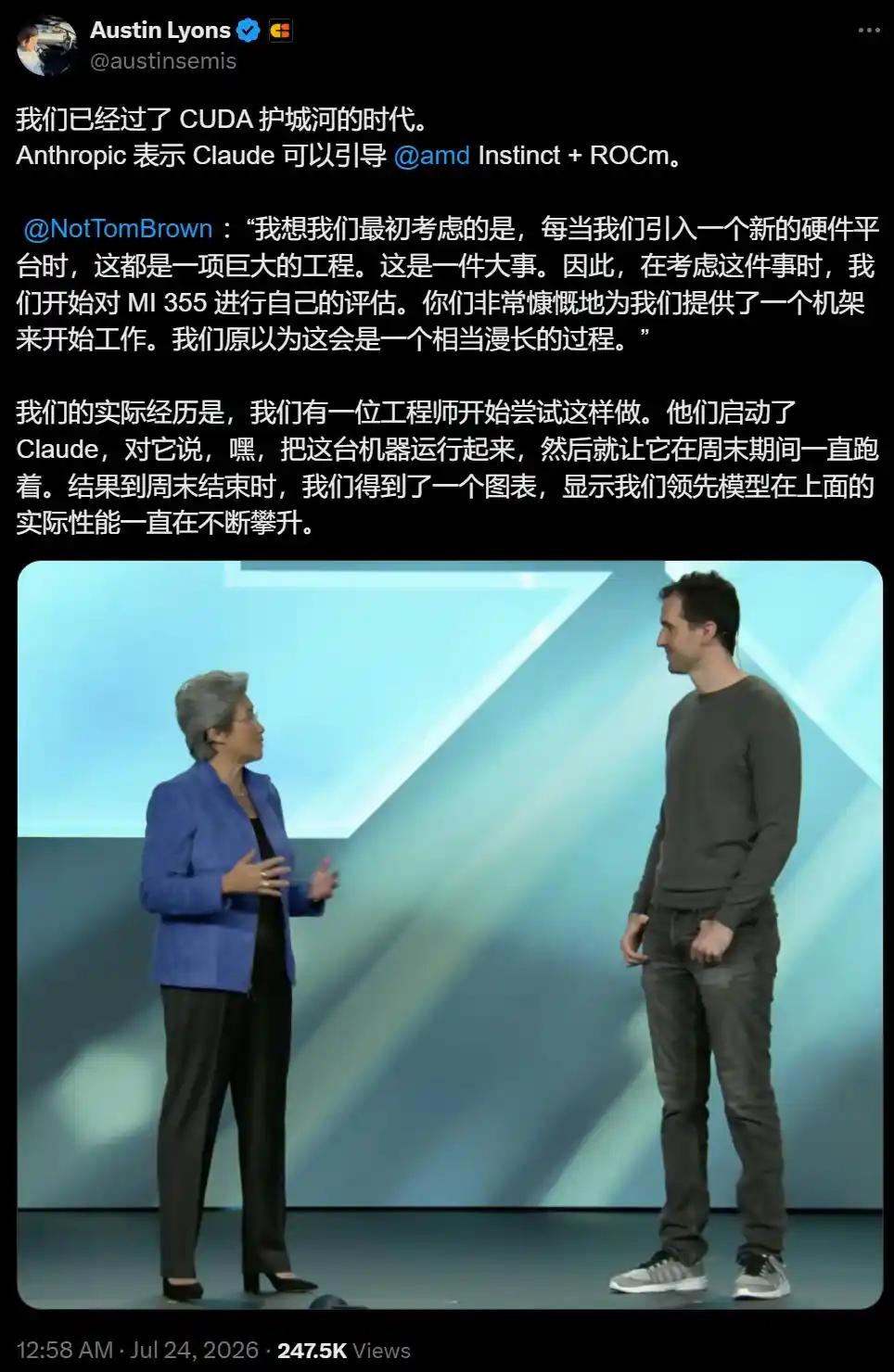
Over a Weekend, Claude Got AMD's New GPU Up and Running
Here's the story.
Some time ago, AMD sent Anthropic a rack equipped with MI355X.
After looking at it, the team mentally prepared for a tough battle. New platform with new software stack was bound to require a new round of adaptation.
However, Anthropic happened to have Claude.
The team decided to first let an engineer try: connect Claude to the machine and give it the command, "Go, get this machine running."
When they returned to their desks after the weekend, a steadily rising performance curve was already on the screen—not only did it run, but the performance kept improving round after round.
After Tom Brown, Anthropic's co-founder and chief computing officer, finished speaking, Lisa Su immediately took over:
Hearing that only one engineer at Anthropic was handling the MI355X, her first reaction was to have AMD's team rush over to help.
But the team came back and told her the other side said it wasn't needed—it was all done.
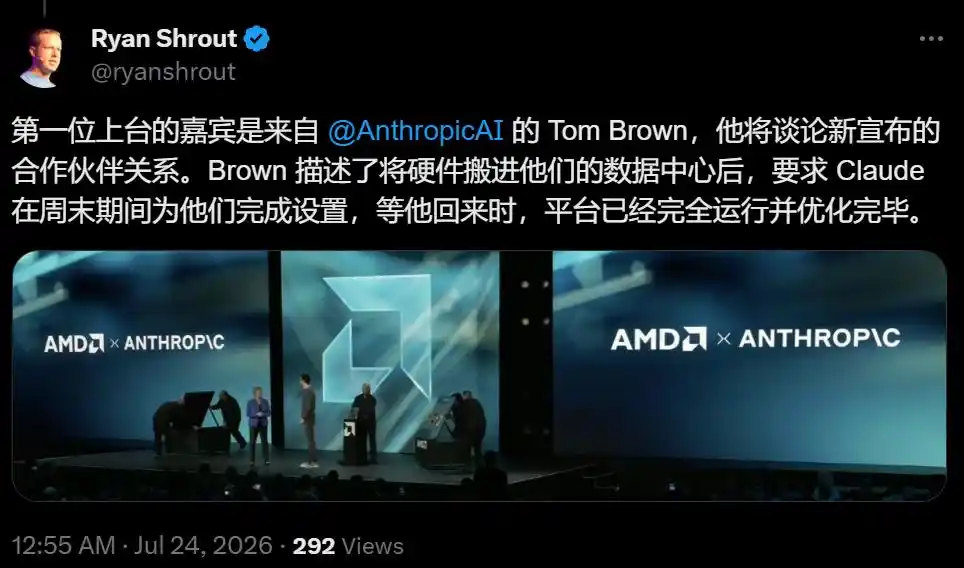
Soon, this weekend experiment connected to a real deployment plan.
Recently, Anthropic announced it will deploy up to 2GW of Instinct GPUs in AMD's Helios system, with the first 1GW planned for the first half of 2027.
Moreover, the two sides will directly use Claude to optimize AMD workloads and accelerate ROCm software development.
Chip Manuals Welcome a Non-Human Reader
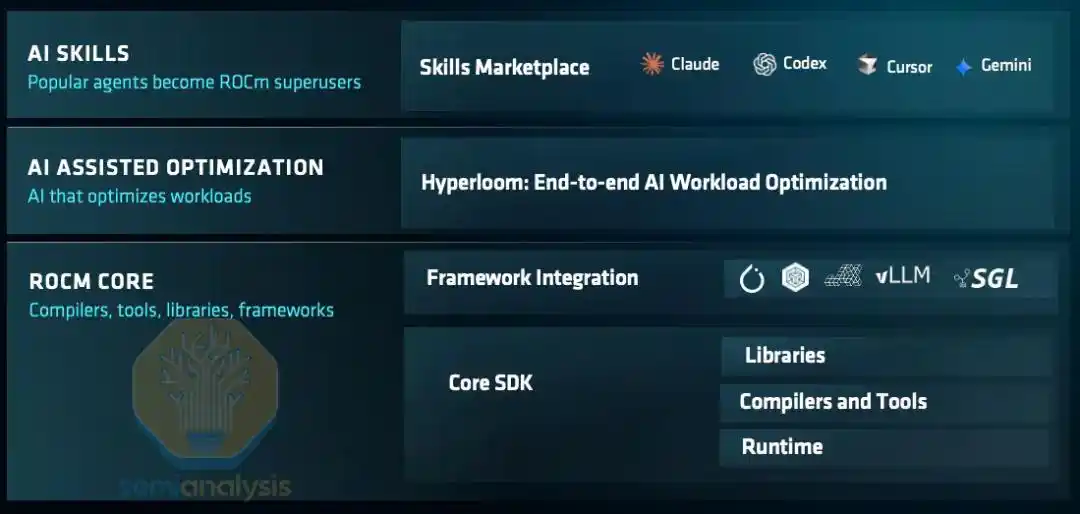
The reason Claude can achieve a "dimensionality reduction strike" against the CUDA ecosystem is that AMD has directly developed a set of tools for AI to get hands-on with GPU tuning.
ROCm.AI, released at the AMD Advancing AI 2026 conference, is a complete GPU toolkit prepared for Claude, Codex, and Cursor.
The entry point is called AMD Skills, which is filled with verified ROCm knowledge.
After agents acquire this knowledge, they can set up environments, deploy models, read logs, troubleshoot, and then call real machines via the ROCm CLI. Developers state the goal, and the agents find the path themselves.
Key point: AMD has even changed how chip manuals are written.
Anush Elangovan, AMD's Vice President of AI Software and Solutions, revealed on stage that each generation of AMD GPU will have its instruction set published, with AI-readable ISA provided.
After reading the manual, agents can directly start tuning performance.
AMD delegates this work to Hyperloom. It launches inference services, first establishes a baseline, then finds bottlenecks in CPU and GPU, tests different configurations, generates custom kernels, and finally runs the new solution again.
In the live demo, Hyperloom increased the output speed of the MiniMax M3 by 38%. AMD also had it run over 14,000 models at once, turning the test results into reusable experience for the next iteration.
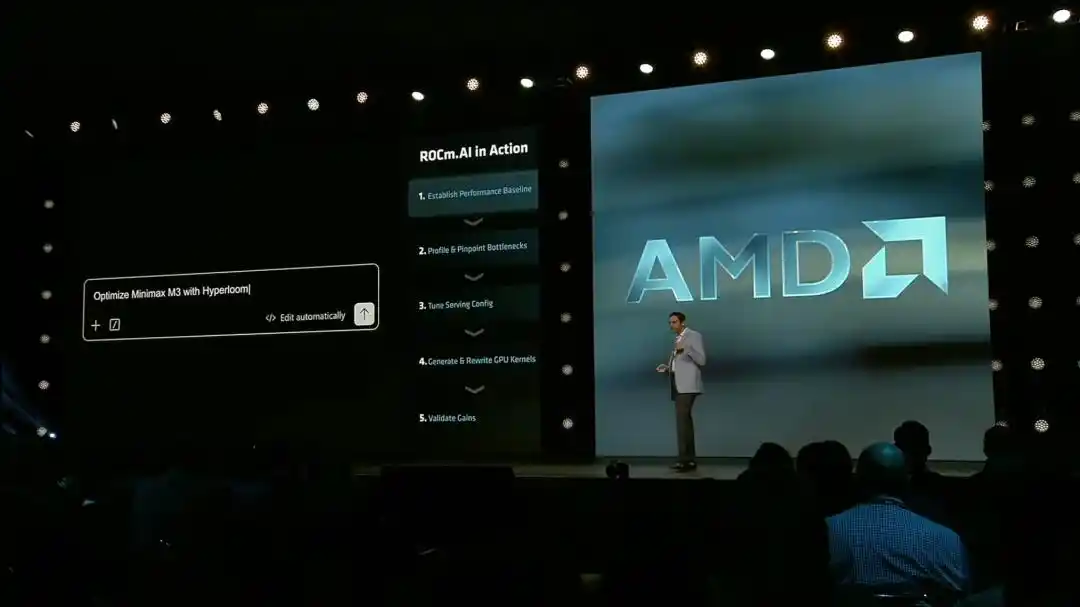
AMD is also training this capability with cutting-edge model companies. Elangovan's phrasing is quite interesting: make frontier models "natively speak AMD programming."
In the future, when looking at a chip, peak computing power and memory bandwidth will remain important, but whether AI can read it, call it, and tune its performance will also appear on the same spec sheet.
The developers that chip companies need to win over now include a new category: Agents.
Dimensionality Reduction Strike from ASI
CUDA has come a long way since 2006, relying on an ecosystem built line by line by countless engineers.
Compilers, math libraries, debuggers, performance analysis tools, development documentation—it has it all.
What's even harder to replicate is the intuitive knowledge accumulated by generations of engineers.
How to tune operators, how to speed up communication, how to allocate memory, where distributed deployments are most prone to issues—this experience is locked in the minds of a few experts.
Even if newcomers build chips with similar performance, they must walk the entire long software road from the beginning. Chip tape-outs can progress by the quarter, but ecosystem accumulation must be measured in years.
This is precisely the gap that Agents are filling.
They read platform documentation, call performance analysis tools, find where the speed is stuck, then modify code, compile, and test. If one solution doesn't work, they try the next; if benchmarks improve, they keep optimizing in that direction.
It takes years to train a top-tier GPU engineer for humans; launching another Agent just requires starting a new task.
One engineer unleashing a swarm of Agents can parallelize error investigation and performance bottleneck localization. Configurations that work, kernels written, and pitfalls encountered immediately become the starting point for the next batch of Agents.
Compressing year-long chases into task-level calculations is where AI's true value lies. This is also the dimensionality reduction strike that ASI-like capabilities deliver against the CUDA ecosystem.
Today, Chinese engineers are already on the front lines of this AI-driven transformation of GPU software stacks. The foundational experience they are accumulating is also being organized into more capabilities that Agents can call upon.
A new starting point for catching up with CUDA has emerged: hand hardware interfaces and software tools over to AI and let the Agents get to work.
A 20-year ecosystem gap can, for the first time, be handed over to a group of Agents to tirelessly chase back, day and night.
This article is from the WeChat public account "New Zhiyuan", author: ASI Revelation