Bitcoin Price Dips to $63,500: Traders Look Beyond CPI and Await Fed Signals

cryptonews.ruPublished on 2026-08-13Last updated on 2026-08-13

Abstract

Bitcoin's price fell to around $63,500, losing over 0.5% for the day and nearly 2% for the week, despite a U.S. inflation report meeting expectations and easing some market tension. July's CPI data aligned with forecasts, reducing traders' expectations for a September Fed rate hike to about 38% from 46%. The market reaction was muted: gold rose 1.3%, Ether gained just over 1%, and Bitcoin briefly climbed half a percent, but sustained momentum was absent. Altcoins traded mixed, with HYPE up over 3% while Dogecoin and XRP declined. Analysts note that Bitcoin reacts most to inflation data that shifts rate expectations; in-line reports remove downside risk but lack a catalyst for significant movement. Traders now look to the Jackson Hole symposium, the September jobs report, and the next CPI release. Meanwhile, stock markets responded more positively, with the MSCI Asia Pacific index rising nearly 1% and South Korea's Kospi jumping about 4%.

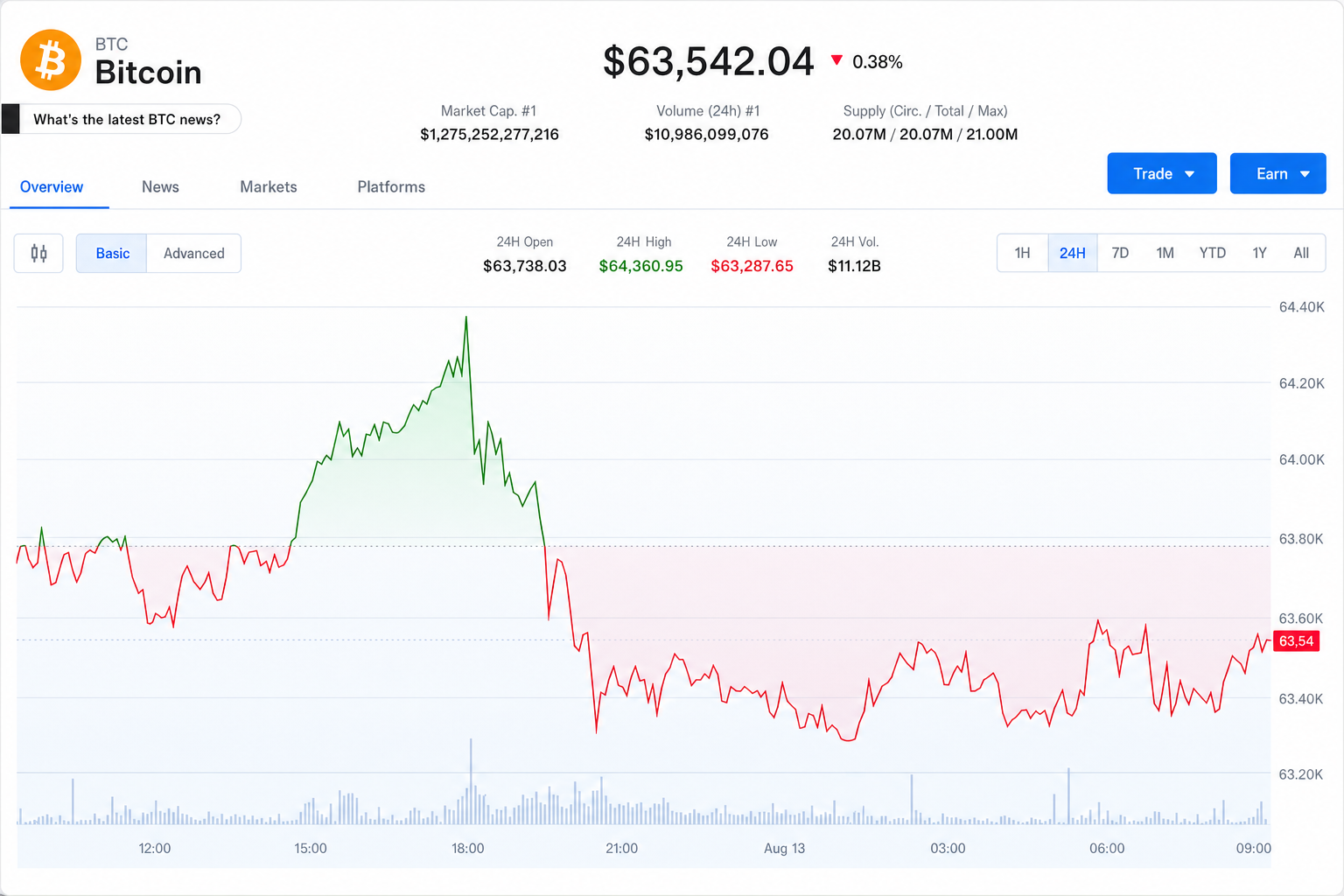
At the time of publication on Thursday, the price of bitcoin had fallen to around $63,500: Bitcoin lost more than 0.5% for the day and nearly 2% over the week, although the fresh US inflation report matched forecasts and alleviated some market tension.
In Short

  • Bitcoin fell to around $63,500 following the expected US inflation report: the data calmed the market but did not provide a strong catalyst for cryptocurrencies to rally.
  • July inflation matched forecasts, causing traders to reduce the probability they are pricing in for a Fed rate hike in September.
  • Stock markets reacted more briskly than cryptocurrencies: the MSCI Asia Pacific index rose nearly 1%, while South Korea's Kospi gained about 4%.

Inflation Removed Risk But Didn't Spark a Rally

The July figures almost exactly matched economists' expectations. Overall inflation rose 0.1% for the month and 3.4% year-over-year. The core index, which excludes food and energy, added 0.2%, while the annual pace slowed to 2.5%.

This was enough to reduce fears of another rate hike. Following the data release, the futures market priced the probability of a September Fed move at approximately 38%, down from 46% before the statistics were published.

The asset reaction was subdued. Gold rose 1.3%, Ether added just over 1%, Bitcoin rose roughly half a percent after the data, and S&P 500 futures gained 0.2%. However, the crypto market failed to receive a sustained impulse.

At a practical level, this is visible in the BTC/USD pair: the Bitcoin Price is considered in terms of the United States dollar, so expectations for dollar interest rates are quickly reflected in quotes. For Cryptocurrency exchanges, including Coinbase, such periods become a test of Market liquidity: when there is no major surprise, Trade proceeds more cautiously, and the Market capitalization of the sector changes without a clear trend.

Altcoins Traded in Mixed Directions

Against the general backdrop, HYPE from Hyperliquid stood out: the token rose more than 3% to reach $56, though it remained almost unchanged for the week. Tron added slightly and traded just below 34 cents, maintaining a weekly gain of about 2%.

The picture for the largest coins looked as follows:

  • Dogecoin: around 7 cents, down nearly 3% for the day.
  • XRP: $1, down more than 1% for the day and nearly 5% for the week.
  • BNB: $610, down more than 1% for the day.
  • Solana: around $76, down less than 1% for the day.
  • Ether: around $1,880, almost flat for the day.

In such conditions, cryptocurrency remains dependent not only on its own factors. The Bitcoin blockchain, mining, transaction authentication, and the network's role as a payment system do not change because of one CPI report, but the market's valuation of Bitcoin as an Asset depends on interest rates, liquidity, and risk appetite. In terms of Market (economics), this is a typical situation where a macro signal is more important than the internal dynamics of the Cryptocurrency sector.

Next Market Landmarks

Gabe Selby, Head of Research at CF Benchmarks, believes that Bitcoin reacts most strongly to inflation data when it forces the market to revise its interest rate expectations. According to his assessment, in three out of the last nine releases when inflation came in below forecasts, Bitcoin's average gain was 3.25%.

The market compensated for the negative surprise on July 14 with a 4.24% rally. Selby emphasizes: a report in line with expectations can remove the risk of a worst-case scenario, but a real move requires an unexpected factor.

A report that matches forecasts can remove tail risk. But to see a catalyst, the market needs a real surprise.

In Selby's view, the Fed can now afford a pause. Housing expenses rose only 0.1%, energy prices fell 1.5%, gasoline became cheaper by 2.9%, and part of the goods categories are now being compared to last year's price spikes caused by tariffs.

Upcoming events traders will be watching:

  • The Jackson Hole central bankers' meeting at the end of the month.
  • The Employment Report on September 4.
  • The Consumer Price Index publication on September 11.

Stock Markets Reacted More Confidently

Stocks perceived the statistics noticeably better than cryptocurrencies. The MSCI Asia Pacific index rose nearly 1%, mainly thanks to Samsung Electronics and SK Hynix. South Korea's Kospi jumped almost 4%, entering a technical bull market, having gained 22% over ten days.

But the overall picture remained uneven. Cisco shares fell more than 4% in after-hours trading following weak financial results. Cerebras Systems stock lost 17% due to a decline in equipment sales.

Brent oil broke a six-day winning streak and retreated from levels where it had previously approached $90 per barrel. Pressure intensified after a statement by the advisor to the Islamic Revolutionary Guard Corps, General Mohammad Reza Naqdi, that Iran is preparing to conduct operations on US territory as part of a new military doctrine.

end-content

Trending Cryptos

Related Questions

QWhat happened to Bitcoin's price and market sentiment after the release of the U.S. inflation report?

ABitcoin's price dropped to around $63,500, losing over 0.5% for the day and nearly 2% for the week. While the inflation report matched expectations and eased some market anxiety, it failed to provide a strong catalyst for a cryptocurrency rally. Overall market reaction was muted, with assets like gold and Ether seeing modest gains, but no sustained momentum was generated in the crypto market.

QAccording to the article, how did the probability of a Federal Reserve rate hike in September change after the inflation data was released?

AThe probability of a Federal Reserve rate hike in September decreased after the inflation data release. It fell from approximately 46% before the statistics were published to around 38% afterwards, as the data aligned with economists' forecasts, reducing fears of imminent tightening.

QWhich cryptocurrency, mentioned in the article, showed notable positive performance while most major coins were declining or flat?

AHYPE, the token from Hyperliquid, showed notable positive performance. It increased by more than 3%, reaching $56, standing out against the generally mixed or negative performance of other major cryptocurrencies.

QWhat is Gabe Selby's view on Bitcoin's reaction to inflation data, as cited in the article?

AGabe Selby, Head of Research at CF Benchmarks, believes Bitcoin reacts most strongly to inflation data when it forces the market to revise its interest rate expectations. He notes that in three of the last nine releases where inflation was lower than forecasts, Bitcoin's average gain was 3.25%. He emphasizes that while an in-line report removes tail risks, a genuine surprise is needed to act as a true market catalyst.

QHow did Asian and South Korean stock markets perform in reaction to the inflation news, compared to the cryptocurrency market?

AStock markets, particularly in Asia, reacted more positively to the inflation news than the cryptocurrency market. The MSCI Asia Pacific index rose by almost 1%, and South Korea's Kospi index jumped by nearly 4%, even entering a technical bull market with a 22% gain over ten days. This contrasted with the cautious and subdued reaction seen in the crypto sector.

Related Reads

Trezor Customer Data Leak: Coins Are Safe, But Phishing Is Inevitable

Trezor, a hardware cryptocurrency wallet manufacturer, reported a data breach at its logistics partner, ShipMonk, affecting around 13,689 customers. The incident, confirmed on August 13, 2026, involved unauthorized access to ShipMonk's systems, which stored order information from May 10 to August 8, 2026. Trezor's own systems and user crypto assets were not compromised. The leaked data varies: for 11,742 customers, full names, email addresses, phone numbers, and delivery addresses were exposed. For 1,947 others, only name, city, and email were leaked. The breach was limited to customers in the US, UK, Sweden, Colombia, Brazil, Italy, and Portugal. Trezor warns affected users of an increased risk of phishing attacks, where malicious actors may use the stolen contact details to impersonate Trezor, banks, or exchanges to steal wallet recovery phrases. All impacted customers have been notified via email. In response, Trezor announced a planned "Anonymous Delivery" feature for the EU (September 2026) and the US (end of 2026), aiming to anonymize logistics data. ShipMonk has not yet issued a public statement on its official website. The analysis highlights this as a recurring industry pattern where third-party logistics vendors become weak links in the supply chain, storing data longer than necessary. Similar incidents, like the 2020 Ledger breach, led to prolonged phishing campaigns. A key question remains whether hardware wallets can ever fully decouple from external logistics risks.

cryptonews.ru34m ago

Trezor Customer Data Leak: Coins Are Safe, But Phishing Is Inevitable

cryptonews.ru34m ago

Trading

Spot

Hot Articles

What is $BITCOIN

DIGITAL GOLD ($BITCOIN): A Comprehensive Analysis Introduction to DIGITAL GOLD ($BITCOIN) DIGITAL GOLD ($BITCOIN) is a blockchain-based project operating on the Solana network, which aims to combine the characteristics of traditional precious metals with the innovation of decentralized technologies. While it shares a name with Bitcoin, often referred to as “digital gold” due to its perception as a store of value, DIGITAL GOLD is a separate token designed to create a unique ecosystem within the Web3 landscape. Its goal is to position itself as a viable alternative digital asset, although specifics regarding its applications and functionalities are still developing. What is DIGITAL GOLD ($BITCOIN)? DIGITAL GOLD ($BITCOIN) is a cryptocurrency token explicitly designed for use on the Solana blockchain. In contrast to Bitcoin, which provides a widely recognized value storage role, this token appears to focus on broader applications and characteristics. Notable aspects include: Blockchain Infrastructure: The token is built on the Solana blockchain, known for its capacity to handle high-speed and low-cost transactions. Supply Dynamics: DIGITAL GOLD has a maximum supply capped at 100 quadrillion tokens (100P $BITCOIN), although details regarding its circulating supply are currently undisclosed. Utility: While precise functionalities are not explicitly outlined, there are indications that the token could be utilized for various applications, potentially involving decentralized applications (dApps) or asset tokenization strategies. Who is the Creator of DIGITAL GOLD ($BITCOIN)? At present, the identity of the creators and development team behind DIGITAL GOLD ($BITCOIN) remains unknown. This situation is typical among many innovative projects within the blockchain space, particularly those aligning with decentralized finance and meme coin phenomena. While such anonymity may foster a community-driven culture, it intensifies concerns about governance and accountability. Who are the Investors of DIGITAL GOLD ($BITCOIN)? The available information indicates that DIGITAL GOLD ($BITCOIN) does not have any known institutional backers or prominent venture capital investments. The project seems to operate on a peer-to-peer model focused on community support and adoption rather than traditional funding routes. Its activity and liquidity are primarily situated on decentralized exchanges (DEXs), such as PumpSwap, rather than established centralized trading platforms, further highlighting its grassroots approach. How DIGITAL GOLD ($BITCOIN) Works The operational mechanics of DIGITAL GOLD ($BITCOIN) can be elaborated on based on its blockchain design and network attributes: Consensus Mechanism: By leveraging Solana’s unique proof-of-history (PoH) combined with a proof-of-stake (PoS) model, the project ensures efficient transaction validation contributing to the network's high performance. Tokenomics: While specific deflationary mechanisms have not been extensively detailed, the vast maximum token supply implies that it may cater to microtransactions or niche use cases that are still to be defined. Interoperability: There exists the potential for integration with Solana’s broader ecosystem, including various decentralized finance (DeFi) platforms. However, the details regarding specific integrations remain unspecified. Timeline of Key Events Here is a timeline that highlights significant milestones concerning DIGITAL GOLD ($BITCOIN): 2023: The initial deployment of the token occurs on the Solana blockchain, marked by its contract address. 2024: DIGITAL GOLD gains visibility as it becomes available for trading on decentralized exchanges like PumpSwap, allowing users to trade it against SOL. 2025: The project witnesses sporadic trading activity and potential interest in community-led engagements, although no noteworthy partnerships or technical advancements have been documented as of yet. Critical Analysis Strengths Scalability: The underlying Solana infrastructure supports high transaction volumes, which could enhance the utility of $BITCOIN in various transaction scenarios. Accessibility: The potential low trading price per token could attract retail investors, facilitating wider participation due to fractional ownership opportunities. Risks Lack of Transparency: The absence of publicly known backers, developers, or an audit process may yield skepticism regarding the project's sustainability and trustworthiness. Market Volatility: The trading activity is heavily reliant on speculative behavior, which can result in significant price volatility and uncertainty for investors. Conclusion DIGITAL GOLD ($BITCOIN) emerges as an intriguing yet ambiguous project within the rapidly evolving Solana ecosystem. While it attempts to leverage the “digital gold” narrative, its departure from Bitcoin's established role as a store of value underscores the need for a clearer differentiation of its intended utility and governance structure. Future acceptance and adoption will likely depend on addressing the current opacity and defining its operational and economic strategies more explicitly. Note: This report encompasses synthesised information available as of October 2023, and developments may have transpired beyond the research period.

1.8k Total ViewsPublished 2025.05.13Updated 2025.05.13

What is $BITCOIN

Discussions

Welcome to the HTX Community. Here, you can stay informed about the latest platform developments and gain access to professional market insights. Users' opinions on the price of BTC (BTC) are presented below.

活动图片