Hackers Stole Over 1700 BTC from Vulnerable Coldcard Wallets

cryptonews.ruPublished on 2026-08-15Last updated on 2026-08-15

Abstract

Hackers stole over 1,778.84 BTC (worth $112.7 million) from vulnerable Coldcard hardware wallets. The attack, which began on July 30, 2026, exploited a years-old firmware bug introduced in 2021 by manufacturer Coinkite. The flaw created insufficient cryptographic entropy, allowing attackers to systematically reproduce private keys and drain funds from more than 8,600 addresses. Galaxy Research confirmed that while new victims continued to report losses, the last confirmed theft occurred on August 6, likely because most vulnerable funds had already been stolen or moved. The majority of the stolen BTC remains under hacker control, with funds being laundered through methods like CoinJoin and Peel Chain transactions. This incident struck users dedicated to self-custody, shaking confidence in hardware wallets as a secure storage method. In response, interest in multisignature wallets spiked, as no confirmed thefts involved multisig addresses. Galaxy also noted that attackers likely used unrestricted AI models to aid the exploit, highlighting a growing cybersecurity risk where powerful AI tools are more accessible to malicious actors than to defenders.

As a result of an attack on vulnerable Coldcard hardware wallets, malicious actors stole at least 1778.84 $BTC ($112.7 million). No new hacking incidents have been recorded after August 6, Galaxy Research reported.

New incidents of hackers exploiting vulnerabilities in the Coldcard hardware wallet have abated, though the tally of losses continues to climb as new victims come forward.https://t.co/Q1X191mcGi

— Galaxy Research (@glxyresearch) August 14, 2026

Attack on Coldcard

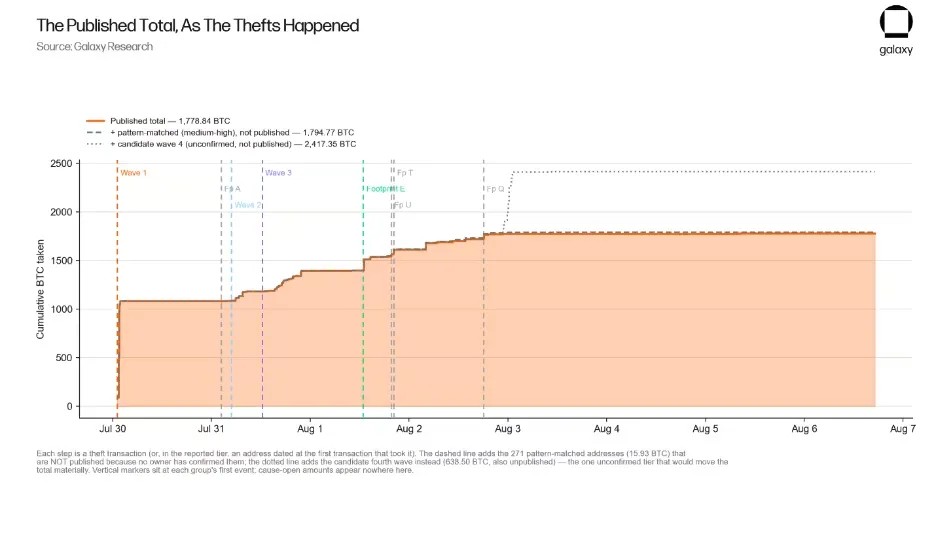
Researchers from the company contacted 190 victims and confirmed the theft of bitcoin from more than 8600 addresses. However, the final damage could be significantly higher: when considering unconfirmed episodes, the volume of stolen funds is estimated at 2417.35 $BTC or ~$153 million.
Source: Galaxy Research.

The attack began at least on the morning of July 30, 2026. Malicious actors systematically recovered seed phrases generated by vulnerable Coldcard devices and then transferred the funds to addresses under their control.

The cause was a software error. In 2021, Coldcard manufacturer Coinkite updated the device firmware, changing the mechanism for generating cryptographic entropy. Due to a bug, the new random number generator did not work correctly, and the devices silently switched to another entropy source, which proved critically insufficient for protecting private keys.

Essentially, the problem existed for several years but manifested only now: with sufficient computational resources, malicious actors were able to reproduce private keys created on vulnerable devices.

New Attacks Have Ceased

Galaxy notes that among the confirmed attack chains, the last one is dated August 6. After this date, new victims continue to come forward to the researchers, but no confirmed cases of further hacking have been found yet.

Researchers suggest the attacks ceased for two reasons: owners of vulnerable wallets managed to transfer funds to new addresses, or the majority of available funds had already been stolen. Experts recommend that users still storing bitcoin on single-signature Coldcards immediately move their assets to new addresses.

However, it appears this is not the work of a single malicious actor. Galaxy detected at least 33 additional traces of activity and considers it highly likely established that the vulnerability was used simultaneously by several attackers.

Most Bitcoin Remains with Hackers

Of the approximately 1778 $BTC confirmed as stolen, about 1531 $BTC are still held at addresses controlled by the malicious actors. Another approximately 246 $BTC have already been moved post-theft.

About 65% of these funds passed through CoinJoin transactions, which complicate tracing the origin of the coins. Another 35% continued moving across the blockchain, including via the Peel Chain scheme, widely used for cryptocurrency laundering. Its principle of operation involves repeatedly "peeling off" small microtransactions from a large sum, with the remaining main portion being transferred to a new address.

A small portion of the stolen bitcoin has been spotted on centralized exchanges and cross-chain bridges. Galaxy has shared address lists with exchanges, compliance and investigation companies, as well as law enforcement agencies.

A Blow to the Self-Custody Narrative

The incident's peculiarity lies not only in the scale of losses. The victims were predominantly users who took the idea of bitcoin self-custody most seriously.

Galaxy notes that the affected individuals did not send coins to dubious exchanges, did not use risky DeFi protocols, and did not attempt to profit from high-yield instruments. They stored bitcoin in hardware wallets, considered one of the most secure ways to hold cryptocurrency.

Consequently, the incident struck a blow to the very narrative of self-custody. According to Galaxy, after the attacks began, the number of small bitcoin transfers to exchanges increased, and over the first four days, more than 22,000 $BTC flowed into centralized platforms. By August 8, the cumulative balance on exchanges reached 3.683 million $BTC — a historical high.

Multisignature Instead of a Single Point of Failure

One unexpected consequence of the attack was growing interest in multisig wallets. Galaxy emphasizes that no confirmed theft occurred from addresses protected by multisignature.

Representatives of Casa and Anchorwatch services reported a sharp increase in new clients and volumes of bitcoin being transferred into multisignature storage. Unchained co-founder Dhruv Bansal believes it is incorrect to view what happened as a victory for custodial services over non-custodial solutions. In his opinion, the real problem is the existence of a single point of failure: it could be an exchange, a hardware wallet manufacturer, or the user themselves.

Thus, the incident rather forces a reconsideration of the very approach to self-custody. Instead of trusting a single device, users can distribute risk among several keys and independent infrastructure components.

AI May Have Assisted Attackers

A separate alarming aspect is related to the use of artificial intelligence. Galaxy believes that at least some of the attackers very likely used AI models without strict cybersecurity restrictions — particularly Chinese open-source LLMs.

Meanwhile, Bitcoin Red Team researchers, who began mass scanning the ecosystem's codebase for vulnerabilities after the attack, encountered the opposite problem: restrictions imposed by leading US AI companies hindered them from using the most powerful models for defense.

Galaxy noted that this is especially important against the backdrop of AI proliferation: the capabilities for finding and exploiting code errors are becoming more accessible not only to developers and researchers but also to malicious actors.

Recall that in the first half of 2026, crypto projects lost about $1.1 billion due to hacks, and the number of confirmed exploits set a record for a six-month period, as calculated by Blockaid.

end-content

Trending Cryptos

Related Questions

QWhat is the core vulnerability that allowed hackers to steal Bitcoin from Coldcard wallets?

AA software bug in a 2021 firmware update that changed the cryptographic entropy generation mechanism. The new random number generator (RNG) malfunctioned, causing devices to silently fall back to an alternative, critically insufficient source of entropy. This weakness made private keys generated on vulnerable devices predictable to attackers with sufficient computational resources.

QAccording to Galaxy Research, why have the new attacks likely stopped since August 6, 2026?

AGalaxy Research suggests two main reasons: 1) Owners of vulnerable wallets have likely transferred their funds to new addresses, and 2) A large portion of the accessible funds had already been stolen by that time.

QWhat was a significant, broader consequence of this incident for the Bitcoin ecosystem's narrative?

AThe incident struck a blow to the narrative of self-custody. Victims were users who took security seriously and used hardware wallets, considered one of the safest methods. Following the attacks, data showed an increase in small Bitcoin transfers to exchanges, with total exchange balances reaching a historic high of 3.683 million BTC by August 8.

QWhich security method was highlighted as NOT being compromised in any of the confirmed thefts, leading to increased interest in it?

AMultisignature (multisig) wallets. Galaxy Research emphasized that no confirmed thefts occurred from addresses secured with multisignature. This led to a reported surge in new clients and funds being moved to multisig custody services.

QWhat role did Galaxy Research suggest Artificial Intelligence (AI) might have played in this attack?

AGalaxy believes at least some of the attackers likely used AI models with few cybersecurity restrictions (e.g., open-source Chinese LLMs) to help find and exploit the vulnerability. They contrasted this with Bitcoin defenders who found that restrictions on leading US AI companies hindered their ability to use powerful models for security audits.

Related Reads

Grayscale Forecasts Increase in Scarcity for Ethereum and Solana

Grayscale Research predicts that Ethereum (ETH) and Solana (SOL) could become scarcer assets due to proposed tokenomics changes in their respective blockchains. According to analyst Zach Pandl, both networks are considering protocol adjustments that would reduce the annual issuance rate of their native tokens. The report compares projected annual supply inflation over the next five years, estimating it could fall to around 0.4% for Ethereum and 1.1% for Solana by 2031, lower than gold's estimated 1.8% annual supply growth. Pandl notes that while the changes are still under community discussion, Solana's proposals have broader support and a higher chance of implementation. Reduced inflation would directly impact network stakers, as their rewards are funded by new token issuance. While stakers would receive fewer new tokens, the potential scarcity could support the market price of ETH and SOL. Non-staking holders could benefit directly from the decreased supply. For Ethereum, the debate on scarcity includes proposals like EIP-8363, which would burn a portion of staking rewards. Pandl concludes that the proposed changes would increase the scarcity of both assets and could create upward pressure on their prices. The analysis also notes Solana's ongoing infrastructure development, including the Alpenglow upgrade to speed up transaction finalization and significant growth in its tokenized asset ecosystem.

cryptonews.ru1h ago

Grayscale Forecasts Increase in Scarcity for Ethereum and Solana

cryptonews.ru1h ago

Trading

Spot

Hot Articles

What is $BITCOIN

DIGITAL GOLD ($BITCOIN): A Comprehensive Analysis Introduction to DIGITAL GOLD ($BITCOIN) DIGITAL GOLD ($BITCOIN) is a blockchain-based project operating on the Solana network, which aims to combine the characteristics of traditional precious metals with the innovation of decentralized technologies. While it shares a name with Bitcoin, often referred to as “digital gold” due to its perception as a store of value, DIGITAL GOLD is a separate token designed to create a unique ecosystem within the Web3 landscape. Its goal is to position itself as a viable alternative digital asset, although specifics regarding its applications and functionalities are still developing. What is DIGITAL GOLD ($BITCOIN)? DIGITAL GOLD ($BITCOIN) is a cryptocurrency token explicitly designed for use on the Solana blockchain. In contrast to Bitcoin, which provides a widely recognized value storage role, this token appears to focus on broader applications and characteristics. Notable aspects include: Blockchain Infrastructure: The token is built on the Solana blockchain, known for its capacity to handle high-speed and low-cost transactions. Supply Dynamics: DIGITAL GOLD has a maximum supply capped at 100 quadrillion tokens (100P $BITCOIN), although details regarding its circulating supply are currently undisclosed. Utility: While precise functionalities are not explicitly outlined, there are indications that the token could be utilized for various applications, potentially involving decentralized applications (dApps) or asset tokenization strategies. Who is the Creator of DIGITAL GOLD ($BITCOIN)? At present, the identity of the creators and development team behind DIGITAL GOLD ($BITCOIN) remains unknown. This situation is typical among many innovative projects within the blockchain space, particularly those aligning with decentralized finance and meme coin phenomena. While such anonymity may foster a community-driven culture, it intensifies concerns about governance and accountability. Who are the Investors of DIGITAL GOLD ($BITCOIN)? The available information indicates that DIGITAL GOLD ($BITCOIN) does not have any known institutional backers or prominent venture capital investments. The project seems to operate on a peer-to-peer model focused on community support and adoption rather than traditional funding routes. Its activity and liquidity are primarily situated on decentralized exchanges (DEXs), such as PumpSwap, rather than established centralized trading platforms, further highlighting its grassroots approach. How DIGITAL GOLD ($BITCOIN) Works The operational mechanics of DIGITAL GOLD ($BITCOIN) can be elaborated on based on its blockchain design and network attributes: Consensus Mechanism: By leveraging Solana’s unique proof-of-history (PoH) combined with a proof-of-stake (PoS) model, the project ensures efficient transaction validation contributing to the network's high performance. Tokenomics: While specific deflationary mechanisms have not been extensively detailed, the vast maximum token supply implies that it may cater to microtransactions or niche use cases that are still to be defined. Interoperability: There exists the potential for integration with Solana’s broader ecosystem, including various decentralized finance (DeFi) platforms. However, the details regarding specific integrations remain unspecified. Timeline of Key Events Here is a timeline that highlights significant milestones concerning DIGITAL GOLD ($BITCOIN): 2023: The initial deployment of the token occurs on the Solana blockchain, marked by its contract address. 2024: DIGITAL GOLD gains visibility as it becomes available for trading on decentralized exchanges like PumpSwap, allowing users to trade it against SOL. 2025: The project witnesses sporadic trading activity and potential interest in community-led engagements, although no noteworthy partnerships or technical advancements have been documented as of yet. Critical Analysis Strengths Scalability: The underlying Solana infrastructure supports high transaction volumes, which could enhance the utility of $BITCOIN in various transaction scenarios. Accessibility: The potential low trading price per token could attract retail investors, facilitating wider participation due to fractional ownership opportunities. Risks Lack of Transparency: The absence of publicly known backers, developers, or an audit process may yield skepticism regarding the project's sustainability and trustworthiness. Market Volatility: The trading activity is heavily reliant on speculative behavior, which can result in significant price volatility and uncertainty for investors. Conclusion DIGITAL GOLD ($BITCOIN) emerges as an intriguing yet ambiguous project within the rapidly evolving Solana ecosystem. While it attempts to leverage the “digital gold” narrative, its departure from Bitcoin's established role as a store of value underscores the need for a clearer differentiation of its intended utility and governance structure. Future acceptance and adoption will likely depend on addressing the current opacity and defining its operational and economic strategies more explicitly. Note: This report encompasses synthesised information available as of October 2023, and developments may have transpired beyond the research period.

1.9k Total ViewsPublished 2025.05.13Updated 2025.05.13

What is $BITCOIN

Discussions

Welcome to the HTX Community. Here, you can stay informed about the latest platform developments and gain access to professional market insights. Users' opinions on the price of BTC (BTC) are presented below.

活动图片