1inch Co-founder Anton Bukov Leaves, Launches New Project Second Tier

Foresight NewsPublished on 2026-07-17Last updated on 2026-07-17

Abstract

Anton Bukov, co-founder of the decentralized exchange aggregator protocol 1inch, has announced his departure from the company's daily operations. Bukov, who was instrumental in designing core 1inch architectures like the Router, Fusion, and cross-chain Swap, ceased involvement in November 2025 due to strategic and leadership disagreements, though he retains his co-founder title and 50% equity stake. Concurrently, Bukov unveiled his new venture, Second Tier (tier.xyz), describing it as infrastructure to "shorten the distance between economic intent and on-chain execution." He explicitly stated it is not a DEX or aggregator. The project's public-facing material is currently a manifesto criticizing systemic financial friction and advocating for building new architectural categories rather than competing within existing ones. No product details, team, or funding have been disclosed. The split highlights a strategic divergence within 1inch. While CEO Sergej Kunz has steered the company toward traditional finance integration—evidenced by a 2025 brand refresh and a major Coinbase partnership—Bukov emphasized a commitment to decentralized, permissionless DeFi principles. Bukov's exit coincides with a challenging period for 1inch. Q1 2026 data shows a 60.3% quarterly drop in its daily average trading volume to $97.1 million, underperforming the broader DEX aggregator market decline. Its market share fell from 25.2% to 17.0%, dropping it to fourth place among competitors. Key quest...


Written by: ChandlerZ, Foresight News


On July 16th, Anton Bukov, co-founder of the decentralized exchange aggregation protocol 1inch, published an open statement confirming his departure from the day-to-day operations of 1inch. Anton Bukov, who was responsible for designing core architectures such as the 1inch Router, Fusion, and cross-chain Swap, ceased his involvement in company operations at the end of November 2025 due to disagreements over strategic direction and leadership. However, he retains his co-founder status and 50% of the shares.


The statement also announced the launch of a new project, Second Tier (tier.xyz). Anton Bukov positions Second Tier as an infrastructure company aimed at "shortening the distance between economic intent and on-chain execution," explicitly stating that the new project is neither a DEX nor an aggregator.


A Manifesto Mentioning No Products


All the content currently presented by Second Tier to the public is a manifesto published on tier.xyz.



The manifesto does not mention any specific product forms, technical architectures, or launch timelines. Its core argument is that friction in the current financial system (middlemen, settlement delays, permission barriers) is artificially designed. Optimizing within the existing framework is merely a "trade-off." The truly effective approach is to jump to the next level (the second tier) and work at the layer where the constraints themselves can be redesigned. This is the origin of the name Second Tier.


The manifesto states that its goal is not to create a single product but to build multiple architectures, creating categories that previously did not exist rather than competing within existing ones. It also mentions that the systems the team builds will enter the market in an open manner.


In an interview with The Defiant, Anton Bukov confirmed that Second Tier currently has no public financing, has not announced its team members, and will not reveal product details before having usable systems. When asked if the new project is another DEX or aggregator, his response was straightforward: "No, and it's not targeted at 1inch."


Strategic Disagreements and the Split


In his statement, Anton Bukov stated that he was fired from 1inch at the end of November 2025. He mentioned that he had spent months prior pushing for changes in the company's leadership approach and communication mechanisms, ultimately leading to his removal.


1inch contested the term "fired," officially stating that Anton Bukov was not a direct employee and therefore could not legally be fired. They added that his work on architecture and security was a team effort, with other individuals responsible.


Anton Bukov characterized this split as a mature founder breakup, with disagreements over strategic direction, communication methods, and leadership style. He still holds 50% of 1inch's equity, retains the co-founder title, but no longer plays any role in the protocol's product architecture or security matters. 1inch officially confirmed that Anton Bukov has not participated in any work of affiliated organizations since December 2025, and protocol operations are unaffected.


The background of the split is essentially 1inch's accelerated shift towards traditional finance in the second half of 2025.


In October 2025, 1inch completed a brand overhaul. CEO Sergej Kunz described the company's vision as extending to all financial markets. In the same month, 1inch integrated its swap engine into the Coinbase App, becoming its largest client-side partnership in the US market. 1inch's target customers began shifting from DeFi-native users to institutional and traditional finance users.


However, Anton Bukov held the opposite stance. He emphasized in his statement, "I believe DeFi is the path to an open financial system, without friction, without intermediaries. I would rather build it myself than wait around." During his time at 1inch, he led the design of core modules such as the DEX aggregation router, the Fusion swapping mechanism, and cross-chain execution—tools whose design logic pointed towards decentralization and permissionless access. In mid-November 2025, he was still publicly supporting the developer version of the shared liquidity protocol Aqua, only to be told to leave a few weeks later.


The Current State of 1inch


Anton Bukov's public announcement of his departure comes at a time when 1inch is experiencing a significant business contraction.


According to the "State of 1inch Q1 2026" report released by Messari on May 22nd, 1inch's average daily trading volume fell from $244.9 million in Q4 2025 to $97.1 million in Q1 2026, a sequential decline of 60.3%. During the same period, the average daily trading volume for the entire DEX aggregator sector dropped from $4.6 billion to $2.7 billion, a decrease of about 40%, indicating that 1inch's decline significantly exceeded the industry average.
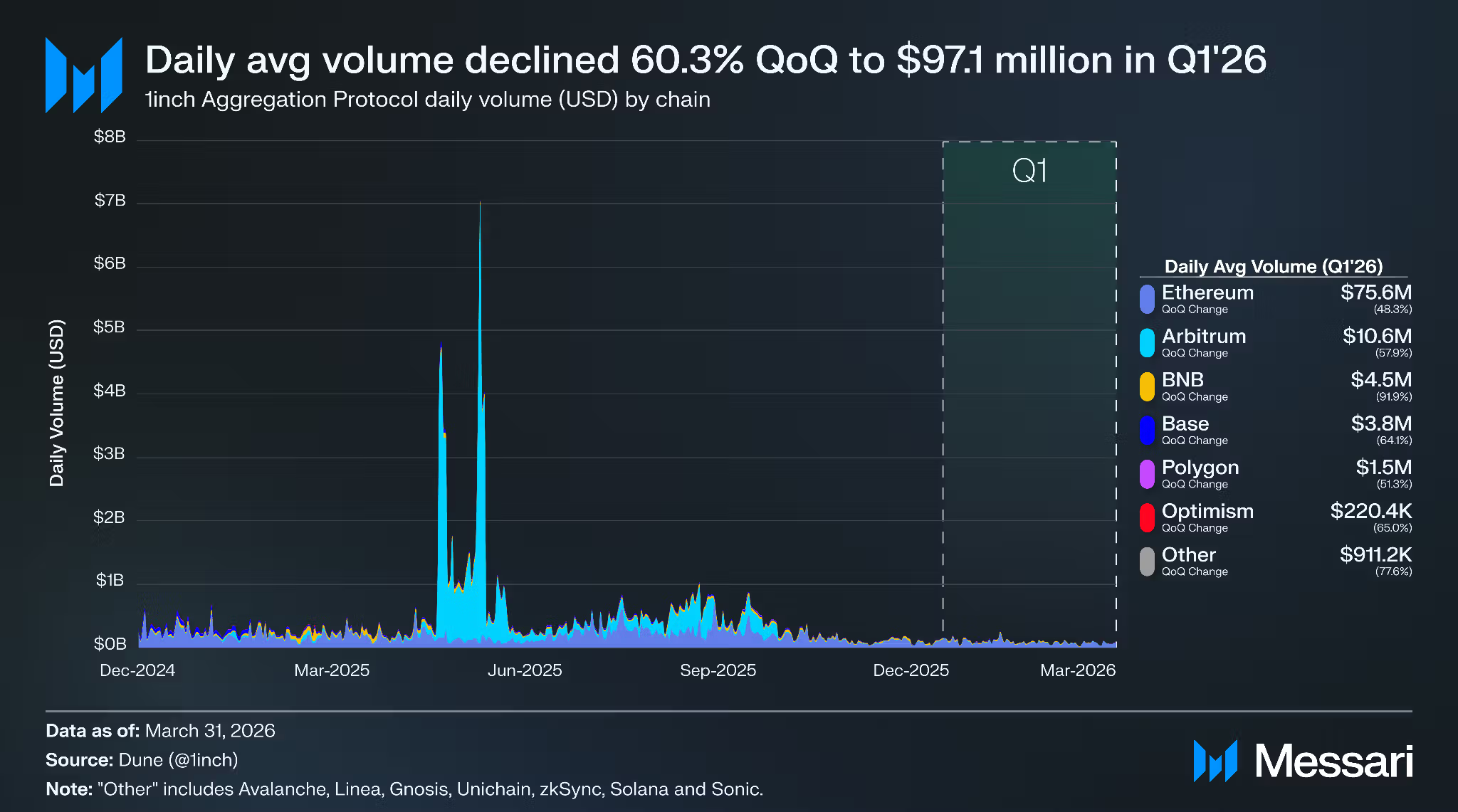


Regarding market share, 1inch's share on the networks it deployed on decreased from 25.2% in Q4 to 17.0% in Q1, its ranking falling from first to fourth, behind Kyber (23.9%), CoWSwap (18.0%), and ZeroEx (17.9%).


Additionally, 1inch's partnership with Ondo Finance routed over $2.5 billion in cumulative trading volume of tokenized stocks and ETFs on BNB Chain. The Limit Order Protocol's average daily trading volume on BNB Chain grew against the trend by 52.7%, making it the only chain showing growth. The Fusion protocol's average daily trading volume declined by only 26.5%, significantly better than the 60.3% drop for the aggregation protocol. The number of daily average Fusion orders actually increased by 31.3%, rising from 13,200 to 17,300, suggesting a shift among users towards smaller, higher-frequency trading patterns.


Sergej Kunz, in response to Anton Bukov's departure, emphasized that it does not affect the infrastructure and system operations of the 1inch network. Market reaction was muted, with the 1INCH token dropping only about 1% within 24 hours of the news announcement.


Pending Questions


Anton Bukov currently holds 50% of 1inch's equity and retains the co-founder title but has no say in the protocol's operations. He has not indicated plans to sell his shares or take any shareholder action. Second Tier remains in a purely conceptual stage—no product, no financing, and no publicly announced team.


It remains to be seen how Anton Bukov will handle his 1inch equity, when Second Tier will transform from a manifesto into a usable product, and whether 1inch's institutionalization path can reverse the trend of declining trading volume.


Trending Cryptos

Related Questions

QWhy did Anton Bukov leave 1inch, and what is the core reason for the disagreement?

AAnton Bukov left the daily operations of 1inch due to disagreements on strategic direction, communication methods, and leadership style. He was focused on building a decentralized, permissionless DeFi system, while 1inch's leadership, led by CEO Sergej Kunz, was accelerating a strategic shift towards courting traditional financial institutions and users. Bukov stopped participating in company operations in November 2025 after failing to push for changes in the company's leadership approach.

QWhat is the main concept or goal of Anton Bukov's new project, Second Tier (tier.xyz)?

AThe main goal of Second Tier is to shorten the distance between economic intent and on-chain execution. It is positioned as an infrastructure company that aims to work at a higher level ('the second tier') where the constraints and frictions (like intermediaries, settlement delays, permissioned access) inherent in the current financial system can be redesigned, rather than making trade-offs within the existing framework. Bukov explicitly states it is not a DEX or an aggregator.

QWhat was the state of 1inch's business performance in Q1 2026 according to the article?

AIn Q1 2026, 1inch experienced significant business contraction. Its daily average trading volume fell 60.3% to $97.1 million from $244.9 million in Q4 2025. Its market share across deployed networks dropped from 25.2% to 17.0%, causing it to fall from first to fourth place among DEX aggregators. The overall DEX aggregator sector saw a smaller decline of about 40% in daily volume during the same period.

QHow did 1inch officially respond to Anton Bukov's claim that he was 'fired'?

A1inch contested Anton Bukov's claim of being 'fired.' The company's official statement argued that Bukov was not a direct employee and therefore could not be legally terminated. They also noted that the architectural and security work he was involved in was a team effort with other responsible personnel. The company confirmed he ceased all work for associated organizations in December 2025.

QDespite the overall decline, which specific 1inch protocol features showed relatively positive performance in Q1 2026?

ADespite the sharp decline in the core aggregation protocol, 1inch's Fusion protocol showed relatively better performance. Its daily average trading volume fell by only 26.5%, much less than the 60.3% drop for the aggregator. Furthermore, the number of daily Fusion orders actually increased by 31.3%, from 13,200 to 17,300, indicating a shift towards smaller, more frequent trades.

Related Reads

The Price of DeFi Mass Adoption: Understanding the Profit Distribution and Hidden Risks of Aave Stable Vaults

**Title:** The Price of DeFi Mass Adoption: Understanding Aave Stable Vaults' Profit Distribution and Hidden Risks **Summary:** Aave Labs' new "Stable Vaults" product aims to simplify DeFi for mainstream users by offering fixed yields, a rarity in crypto. The model inserts a middleman layer between users and Aave's underlying lending pools. This layer, often a fintech app or digital bank, absorbs interest rate volatility, guaranteeing users a pre-set stable return while capturing any excess yield from Aave's underlying pools. In exchange for this predictable "peace of mind" and services like customer support and simplified onboarding, users sacrifice potential higher yields and take on new counterparty risks from the operating entity and its infrastructure. The article illustrates this with the example of payroll provider Rise, which transparently passes through most Aave yield, versus the higher profit margins possible through Stable Vaults. While a rational trade-off for many non-expert users prioritizing simplicity and security, the system centralizes risk and obfuscates true market yields. Aave benefits by attracting sticky, non-speculative capital crucial for its long-term economic model, highlighting the industry's shift towards catering to fundamental human preferences for convenience over complex, self-managed financial systems.

Foresight News7m ago

The Price of DeFi Mass Adoption: Understanding the Profit Distribution and Hidden Risks of Aave Stable Vaults

Foresight News7m ago

Stripe's $53.4 Billion Acquisition of PayPal: The Final Piece of the Stablecoin Empire Puzzle

Stripe has reportedly made a $53.4 billion acquisition offer for PayPal, a move that could signal a major shift in the stablecoin landscape from a "technology race" to a "customer war." Over recent years, Stripe has been quietly building nearly every layer of a stablecoin empire: acquiring the issuance platform Bridge, wallet provider Privy, co-incubating the payments-focused Layer 1 network Tempo with Paradigm, and joining the Open USD (OUSD) alliance stablecoin initiative. What it lacks, however, is a massive direct consumer user base. PayPal, with its hundreds of millions of active accounts, the Venmo app, and its own PYUSD stablecoin, would provide exactly that. The acquisition could create a closed-loop system where Stripe handles the merchant side, PayPal/Venmo serve consumers, and transactions are settled via stablecoins on a blockchain like Tempo, potentially bypassing traditional card networks and their fees. While the deal is not yet finalized and may face hurdles—including potential resistance from PayPal's board or a higher bid—the mere offer suggests Stripe's strategic focus may have evolved. It indicates that having superior infrastructure alone may not be enough; distribution and user access are critical battlegrounds. Questions remain about how PYUSD, OUSD, and Venmo would integrate with Stripe's stack, and whether private equity co-investor Advent International would prioritize such crypto experiments. If successful, this acquisition could significantly boost Tempo's position in the competitive public blockchain space and further push crypto-based payments into the mainstream, potentially fulfilling PayPal's original vision of an internet-native currency through a new, crypto-native infrastructure.

marsbit20m ago

Stripe's $53.4 Billion Acquisition of PayPal: The Final Piece of the Stablecoin Empire Puzzle

marsbit20m ago

Hyperliquid's "Stock Price" for ChangXin Memory Tech Hits $8.64: How Was This Price Determined Before the IPO?

Title: Hyperliquid's "Stock Price" for CXMT Hits $8.64: How is This Pre-IPO Price Determined? Summary: On Hyperliquid, a derivative contract tracking the pre-IPO value of Chinese chipmaker Changxin Xinqiao (CXMT) has been trading, with its price reaching $8.64. This price is not a real stock price or a direct IPO valuation, but the result of a specific market mechanism. Trade.xyz deployed this "Pre-IPO Perpetual" (IPOP) contract via Hyperliquid's HIP-3 framework. It tracks the expected USD value of one Changxin A-share post-listing. The contract started with an artificial "discretionary reference price" of $5 set by Trade.xyz. Subsequent trading prices are primarily determined by supply and demand on Hyperliquid's on-chain order book. Since there's no tradable现货 before the IPO, the contract price isn't forced to align with the official IPO price of 8.66 RMB (~$1.28). Key mechanics shape the price: 1. **Order Book-Driven**: The actual成交价 comes from limit orders matched on-chain. 2. **Internal Oracle & Smoothing**: An internal oracle, run by Trade.xyz, calculates a smoothed price based on the order book's "impact price" using a 30-minute exponential moving average (EWMA). This oracle price influences funding rates. 3. **Mark Price for Risk**: A separate Mark Price, derived from the median of the internal oracle and other inputs, is used for calculating profit/loss and liquidation. 4. **Discovery Bound (Price护栏)**: A 20% "Discovery Bound" limits how far the price can move from the current reference point. However, if the price hits the bound, the reference price can be re-anchored upward (or downward) up to 7 times. This explains the阶梯状 jumps to $6, $7.2, and $8.64. 5. **Low Funding Rate**: A minimal funding rate (0.005 multiplier) allows positions to be held with low cost before the IPO, but it provides a weak anchor. Post-IPO, the contract is expected to convert to a standard stock perpetual, with its oracle switching to the actual A-share price converted to USD. This transition could cause price jumps and potential liquidations if there's a significant gap between the pre-IPO contract price and the real market price. In essence, the $8.64 price is a composite of: a人为设定的起点 + on-chain order book supply/demand +内部 oracle 平滑 + low funding rate damping + a moving price护栏. It represents a collective bet by specific market participants on the future public market valuation, not the company's current or official IPO price.

marsbit21m ago

Hyperliquid's "Stock Price" for ChangXin Memory Tech Hits $8.64: How Was This Price Determined Before the IPO?

marsbit21m ago

Prices From the Future Fool the Oracle, Ostium Drained of $24 Million in Five Minutes

Ostium, a perpetual trading platform, suffered a security incident on July 15, resulting in significant losses from its public liquidity vault. Initial analyses from Blockaid, Cyvers, and PeckShield estimate losses of up to $24 million. The exploit occurred over a five-minute window. According to security firms, the core issue was not a missing signature, but a data integrity failure: a registered price oracle (PriceUpKeep) submitted authorized price reports with manipulated future timestamps, creating false trading profits. The protocol’s verification process confirmed the signatures as authorized but did not enforce price sanity checks or timestamp boundaries, allowing the manipulated data to be accepted for settlement. This caused the liquidity vault to pay out on these fraudulent profits. Ostium’s co-founder confirmed the team paused trading within an hour and is collaborating with law enforcement and security experts. The extracted funds were reportedly swapped for ETH, with a portion moved to Tornado Cash. The incident highlights risks in DeFi oracle designs where cryptographic signature verification is insufficient without additional safeguards for data validity, timestamp freshness, and price reasonableness. Ostium's response and planned fixes—including stricter timestamp validation, independent price checks, and circuit breakers—will be critical to preventing similar exploits.

marsbit43m ago

Prices From the Future Fool the Oracle, Ostium Drained of $24 Million in Five Minutes

marsbit43m ago

Trading

Spot

Hot Articles

How to Buy 1INCH

Welcome to HTX.com! We've made purchasing 1inch (1INCH) simple and convenient. Follow our step-by-step guide to embark on your crypto journey.Step 1: Create Your HTX AccountUse your email or phone number to sign up for a free account on HTX. Experience a hassle-free registration journey and unlock all features.Get My AccountStep 2: Go to Buy Crypto and Choose Your Payment MethodCredit/Debit Card: Use your Visa or Mastercard to buy 1inch (1INCH) instantly.Balance: Use funds from your HTX account balance to trade seamlessly.Third Parties: We've added popular payment methods such as Google Pay and Apple Pay to enhance convenience.P2P: Trade directly with other users on HTX.Over-the-Counter (OTC): We offer tailor-made services and competitive exchange rates for traders.Step 3: Store Your 1inch (1INCH)After purchasing your 1inch (1INCH), store it in your HTX account. Alternatively, you can send it elsewhere via blockchain transfer or use it to trade other cryptocurrencies.Step 4: Trade 1inch (1INCH)Easily trade 1inch (1INCH) on HTX's spot market. Simply access your account, select your trading pair, execute your trades, and monitor in real-time. We offer a user-friendly experience for both beginners and seasoned traders.

2.8k Total ViewsPublished 2024.03.29Updated 2026.06.02

How to Buy 1INCH

Discussions

Welcome to the HTX Community. Here, you can stay informed about the latest platform developments and gain access to professional market insights. Users' opinions on the price of 1INCH (1INCH) are presented below.

活动图片