Bitcoin ETF inflows are back, but THIS signal says don’t celebrate yet!

ambcryptoPublished on 2026-07-20Last updated on 2026-07-20

Abstract

Bitcoin ETF inflows have turned positive this month with over $200 million after two months of significant outflows, coinciding with BTC's price rebound. However, key signals suggest it's too early to celebrate a full return of institutional bullishness. The Coinbase Premium Index remains negative, indicating weak spot buying demand from U.S. investors. Furthermore, capital is rotating into Ethereum, as evidenced by three consecutive weeks of gains in the ETH/BTC ratio and stronger relative inflows into ETH ETFs. While Bitcoin's ETF flows have improved, the broader institutional picture lacks confirmation, with the recovery appearing more as a short-term rotation rather than a structural shift in demand.

After weeks of persistent selling pressure, institutional demand is starting to recover.

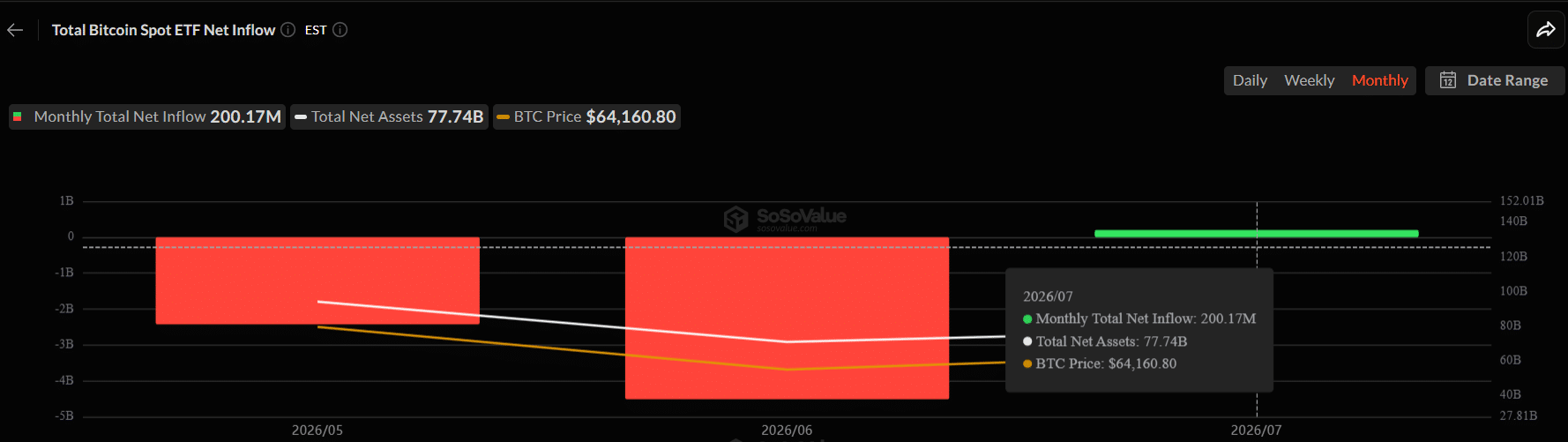
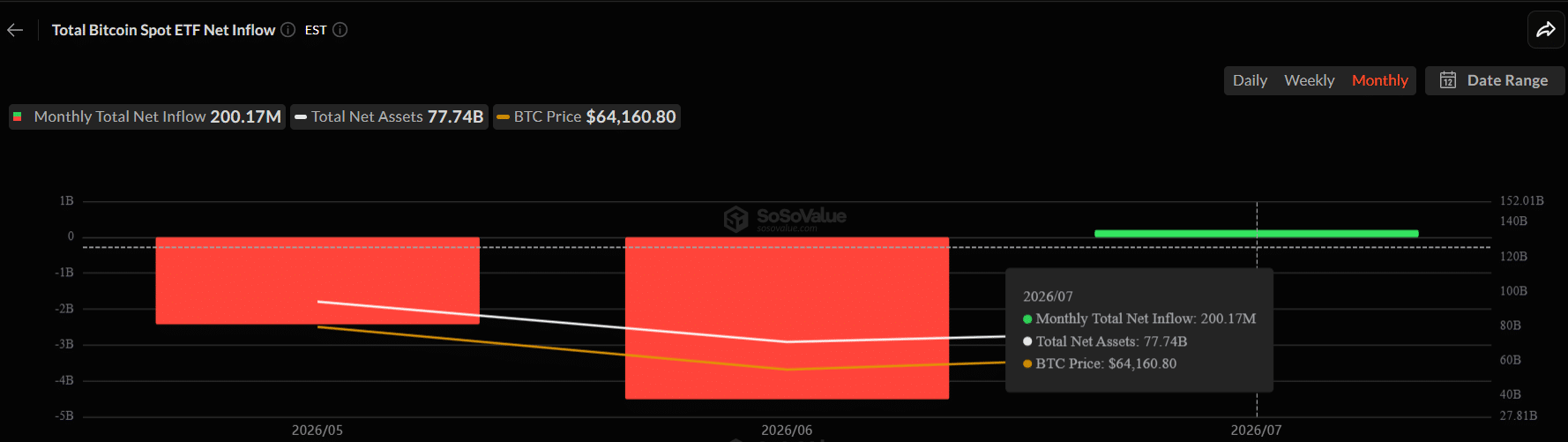
To put it into perspective, U.S. spot Bitcoin ETFs recorded over $6 billion in net outflows over the past two months. Notably, this coincided with Bitcoin’s nearly 25% correction, highlighting how closely ETF flows have tracked BTC’s price action.

With inflows now turning positive again, it’s no surprise the market is beginning to question whether institutional sentiment is finally shifting.

As the chart below shows, more than $200 million has flowed into Bitcoin ETFs so far this month, alongside BTC’s 9%+ rebound. Simply put, Bitcoin’s recovery still depends heavily on institutional positioning, making ETF flows a key signal to watch in the weeks ahead.
Source: SoSoValue

That said, it may still be too early to call this a full-blown return of institutional demand.

According to CryptoQuant, Bitcoin’s Coinbase Premium Index remains in negative territory despite BTC rallying from $58k to $64k.

In other words, U.S. investors are still not aggressively buying the dip, suggesting the latest rally lacks strong spot demand from institutions.

More importantly, the biggest risk to Bitcoin’s [BTC] recovery may not be weak ETF inflows alone.

Instead, another key on-chain signal suggests the recent $200 million in ETF inflows could simply reflect a short-term rotation, rather than the beginning of a broader structural shift in institutional demand.

ETF inflows alone don’t confirm a bullish reversal

As the largest cryptocurrency by market cap, Bitcoin remains the market’s anchor.

However, despite Bitcoin ETF inflows recovering and BTC.D climbing 1.5% over the past week to hover around 60%; capital continues rotating into Ethereum.

The ETH/BTC ratio has now posted three straight weeks of gains and is heading into a fourth. The key takeaway? This rotation doesn’t look like a fluke.

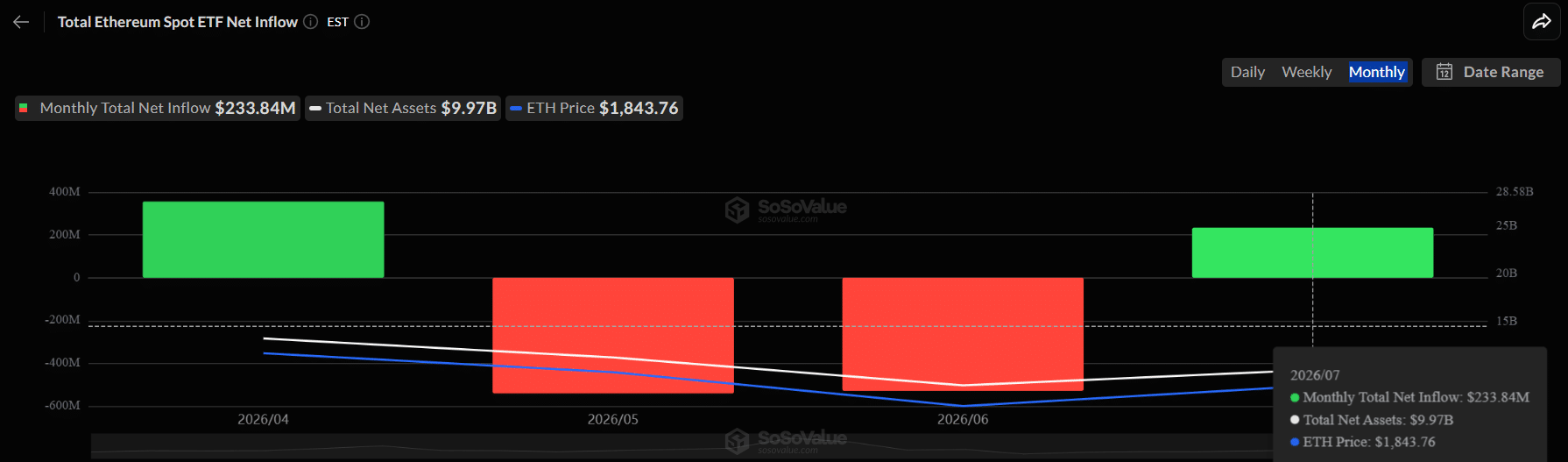
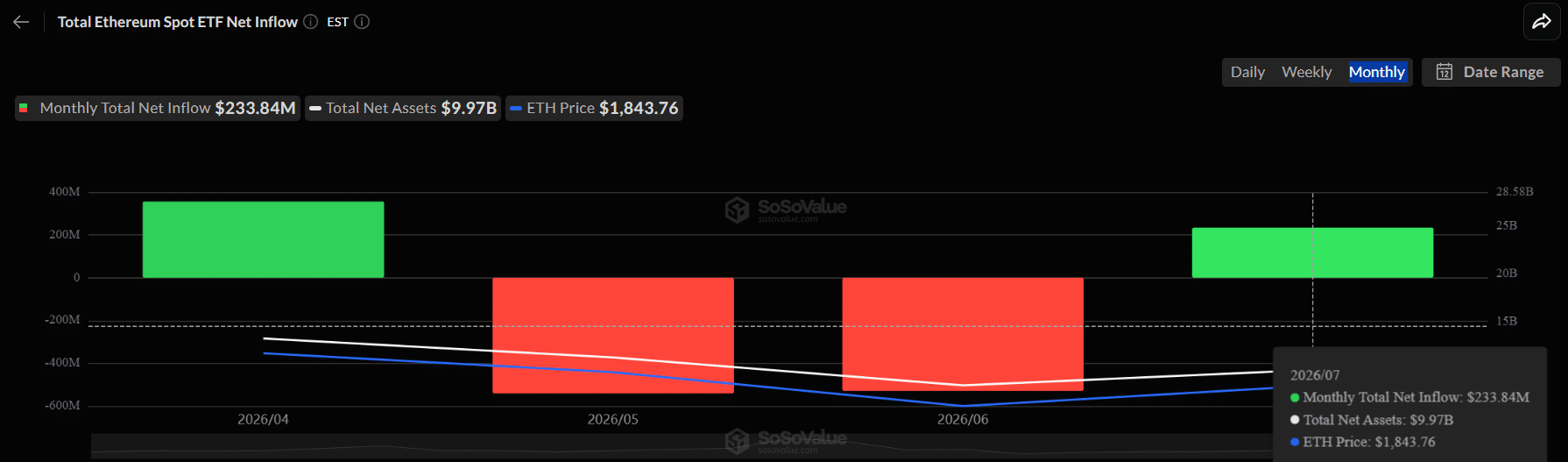
As the chart below shows, Ethereum ETFs have attracted more than $233 million in net inflows this month, outpacing Bitcoin on a relative basis. More importantly, ETH ETFs saw significantly smaller outflows during the recent correction.

In other words, Ethereum faced less institutional selling on the way down and is attracting stronger buying on the way back up, a clear sign that institutional capital is favoring ETH over BTC.
Source: SoSoValue

In essence, Bitcoin’s recent ETF inflows look more measured than euphoric.

Pair that with a negative Coinbase Premium Index and Ethereum’s [ETH] continued strength across both technicals and institutional flows, and Bitcoin’s latest recovery starts to look more like a short-term rotation than the beginning of a broad structural shift in institutional demand.

The bottom line? ETF inflows have undoubtedly improved, but the broader institutional picture hasn’t fully flipped. Until U.S. spot demand strengthens and Bitcoin starts reclaiming relative strength against Ethereum, the latest recovery still lacks a key confirmation signal.



Final Summary

Trending Cryptos

Related Questions

QWhat does the article say about the relationship between recent Bitcoin ETF flows and BTC's price movement?

AThe article states that recent Bitcoin ETF inflows have closely tracked Bitcoin's price action. After about $6 billion in net outflows over the past two months coincided with a nearly 25% BTC correction, the current positive inflows of over $200 million this month have coincided with a 9%+ rebound.

QWhy might the recent Bitcoin ETF inflows not signal a strong bullish reversal, according to the on-chain data cited?

AAccording to the article, the Coinbase Premium Index remains in negative territory despite Bitcoin's rally, suggesting U.S. investors are not aggressively buying the dip. This indicates the rally lacks strong spot demand from institutions.

QWhich cryptocurrency is currently attracting stronger relative institutional inflows compared to Bitcoin, and what evidence supports this?

AEthereum (ETH) is attracting stronger relative institutional inflows. Evidence includes: Ethereum ETFs have seen over $233 million in net inflows this month, outpacing Bitcoin on a relative basis. The ETH/BTC ratio has gained for three consecutive weeks, and Ethereum ETFs saw smaller outflows during the recent market correction.

QWhat key takeaway does the article provide regarding the nature of Bitcoin's recent recovery based on the presented data?

AThe key takeaway is that Bitcoin's recent recovery looks more like a short-term rotation of capital rather than the beginning of a broad structural shift in institutional demand. This is due to measured ETF inflows, a negative Coinbase Premium Index, and Ethereum's continued strength in both technicals and institutional flows.

QAccording to the article, what is the crucial confirmation signal still missing for Bitcoin's latest recovery?

AThe crucial missing confirmation signal is the strengthening of U.S. spot demand for Bitcoin and Bitcoin starting to reclaim relative strength against Ethereum. Until these occur, the broader institutional picture hasn't fully flipped to support a sustained bullish reversal.

Related Reads

L2 'Recalibration': When L1 Becomes Its Own Rollup, What Is Ethereum's Endgame?

The article discusses the evolving relationship between Ethereum's Layer 1 (L1) and Layer 2 (L2) solutions, moving beyond the initial "L2 for scaling" model. As Ethereum L1 itself scales (increasing Gas Limit, statelessness, zkEVM), the unique value proposition of L2s shifts from merely providing cheap execution to offering differentiated features like application-specific optimization, privacy, and flexible governance. The piece explores three key themes: 1. **L2's New Role:** L2s are transitioning from a pure scaling technology to a spectrum of execution environments with varying degrees of security inheritance from Ethereum L1. 2. **Interoperability as State Trust:** Solving L2 fragmentation is less about cross-chain bridges and more about enabling faster, trust-minimized state verification between environments. This involves initiatives like faster L1 finality, intent-based architectures (Open Intents Framework), and native account abstraction. 3. **Blurring Layers:** With the potential integration of zk-proofs into L1 validation (making L1 akin to its own "Rollup") and the concept of "Native Rollups," the rigid boundary between L1 and L2 may fade. The future could be a unified system with multiple execution domains (for DeFi, gaming, privacy, etc.) sharing a common security, settlement, and state framework. In conclusion, Ethereum's goal is not to abandon L2s or re-centralize everything on L1, but to re-integrate the fragmented user experience—liquidity, accounts, applications—while preserving the scaling benefits of a multi-environment ecosystem. The endgame is a cohesive "one chain" feeling for users, powered by diverse but securely interconnected execution layers.

marsbit8m ago

L2 'Recalibration': When L1 Becomes Its Own Rollup, What Is Ethereum's Endgame?

marsbit8m ago

The Encryption Bill Clarity's Challenge: A Thorny Path of Bipartisan Compromise in the U.S.

U.S. lawmakers are attempting to advance the Clarity Act, a significant crypto market structure bill, but its path is fraught with partisan hurdles. The process has been rocky since January, when a prior bipartisan deal in the Senate Banking Committee was upended. A key compromise in May on "yield" issues allowed the bill to move forward in committee, but only with the conditional support of two Democratic senators, Angela Alsobrooks and Ruben Gallego. They emphasized that their final vote depends on reaching an agreement on ethics provisions for elected officials. Ultimately, the Senate Agriculture Committee passed its version along party lines without Democratic support. As Republicans push for a full Senate vote in July, the demand for strong ethics language has expanded beyond Democrats. Additional controversies surround provisions related to yields (aligning some Republicans with large banks) and developer protections (opposed by enforcement agencies). Core concerns about illicit finance and consumer protection remain central to the debate. Despite consensus on the need for legislation, achieving the necessary bipartisan compromise is proving difficult. While momentum exists—including recent meetings between senators and White House officials—a reconciled bill text faces skepticism. Senator Gallego has stated that without ethics terms acceptable to Democrats, they will not provide the needed votes. The immediate goals for the crypto community in Congress are unclear: a symbolic Senate vote before the August recess, eventual passage into law by 2026, or forging a final compromise framework. The arduous, vote-by-vote effort to build bipartisan support continues, mirroring the traditional legislative grind the industry must now navigate.

Foresight News59m ago

The Encryption Bill Clarity's Challenge: A Thorny Path of Bipartisan Compromise in the U.S.

Foresight News59m ago

Trading

Spot

Hot Articles

What is $BITCOIN

DIGITAL GOLD ($BITCOIN): A Comprehensive Analysis Introduction to DIGITAL GOLD ($BITCOIN) DIGITAL GOLD ($BITCOIN) is a blockchain-based project operating on the Solana network, which aims to combine the characteristics of traditional precious metals with the innovation of decentralized technologies. While it shares a name with Bitcoin, often referred to as “digital gold” due to its perception as a store of value, DIGITAL GOLD is a separate token designed to create a unique ecosystem within the Web3 landscape. Its goal is to position itself as a viable alternative digital asset, although specifics regarding its applications and functionalities are still developing. What is DIGITAL GOLD ($BITCOIN)? DIGITAL GOLD ($BITCOIN) is a cryptocurrency token explicitly designed for use on the Solana blockchain. In contrast to Bitcoin, which provides a widely recognized value storage role, this token appears to focus on broader applications and characteristics. Notable aspects include: Blockchain Infrastructure: The token is built on the Solana blockchain, known for its capacity to handle high-speed and low-cost transactions. Supply Dynamics: DIGITAL GOLD has a maximum supply capped at 100 quadrillion tokens (100P $BITCOIN), although details regarding its circulating supply are currently undisclosed. Utility: While precise functionalities are not explicitly outlined, there are indications that the token could be utilized for various applications, potentially involving decentralized applications (dApps) or asset tokenization strategies. Who is the Creator of DIGITAL GOLD ($BITCOIN)? At present, the identity of the creators and development team behind DIGITAL GOLD ($BITCOIN) remains unknown. This situation is typical among many innovative projects within the blockchain space, particularly those aligning with decentralized finance and meme coin phenomena. While such anonymity may foster a community-driven culture, it intensifies concerns about governance and accountability. Who are the Investors of DIGITAL GOLD ($BITCOIN)? The available information indicates that DIGITAL GOLD ($BITCOIN) does not have any known institutional backers or prominent venture capital investments. The project seems to operate on a peer-to-peer model focused on community support and adoption rather than traditional funding routes. Its activity and liquidity are primarily situated on decentralized exchanges (DEXs), such as PumpSwap, rather than established centralized trading platforms, further highlighting its grassroots approach. How DIGITAL GOLD ($BITCOIN) Works The operational mechanics of DIGITAL GOLD ($BITCOIN) can be elaborated on based on its blockchain design and network attributes: Consensus Mechanism: By leveraging Solana’s unique proof-of-history (PoH) combined with a proof-of-stake (PoS) model, the project ensures efficient transaction validation contributing to the network's high performance. Tokenomics: While specific deflationary mechanisms have not been extensively detailed, the vast maximum token supply implies that it may cater to microtransactions or niche use cases that are still to be defined. Interoperability: There exists the potential for integration with Solana’s broader ecosystem, including various decentralized finance (DeFi) platforms. However, the details regarding specific integrations remain unspecified. Timeline of Key Events Here is a timeline that highlights significant milestones concerning DIGITAL GOLD ($BITCOIN): 2023: The initial deployment of the token occurs on the Solana blockchain, marked by its contract address. 2024: DIGITAL GOLD gains visibility as it becomes available for trading on decentralized exchanges like PumpSwap, allowing users to trade it against SOL. 2025: The project witnesses sporadic trading activity and potential interest in community-led engagements, although no noteworthy partnerships or technical advancements have been documented as of yet. Critical Analysis Strengths Scalability: The underlying Solana infrastructure supports high transaction volumes, which could enhance the utility of $BITCOIN in various transaction scenarios. Accessibility: The potential low trading price per token could attract retail investors, facilitating wider participation due to fractional ownership opportunities. Risks Lack of Transparency: The absence of publicly known backers, developers, or an audit process may yield skepticism regarding the project's sustainability and trustworthiness. Market Volatility: The trading activity is heavily reliant on speculative behavior, which can result in significant price volatility and uncertainty for investors. Conclusion DIGITAL GOLD ($BITCOIN) emerges as an intriguing yet ambiguous project within the rapidly evolving Solana ecosystem. While it attempts to leverage the “digital gold” narrative, its departure from Bitcoin's established role as a store of value underscores the need for a clearer differentiation of its intended utility and governance structure. Future acceptance and adoption will likely depend on addressing the current opacity and defining its operational and economic strategies more explicitly. Note: This report encompasses synthesised information available as of October 2023, and developments may have transpired beyond the research period.

960 Total ViewsPublished 2025.05.13Updated 2025.05.13

What is $BITCOIN

Discussions

Welcome to the HTX Community. Here, you can stay informed about the latest platform developments and gain access to professional market insights. Users' opinions on the price of BTC (BTC) are presented below.

活动图片