Single-Day Plunge of 30%, Arthur Hayes Suddenly Liquidates: Why Did ZEC Get Exploded by Security Issues?

foresightnews_apiPublished on 2026-06-05Last updated on 2026-06-05

Abstract

On June 5th, Zcash founder Zooko Wilcox disclosed a critical soundness vulnerability in the project's latest Orchard privacy pool. This flaw, found in the elliptic curve multiplication constraints, could allow an attacker to create unlimited counterfeit ZEC within the shielded pool, with transactions appearing valid. The vulnerability was discovered in late May by security researcher Taylor Hornby, who utilized Anthropic's new Opus 4.8 AI model for a targeted audit. The Zcash ecosystem had already performed an emergency network upgrade to patch the issue. However, the detailed disclosure triggered severe market panic, causing ZEC's price to plummet over 30% in a single day. Notably, prominent investor Arthur Hayes announced he had sold his entire ZEC position following the news. The incident starkly challenges the "technological trust" narrative central to privacy coins. Despite years of top-tier cryptographic audits, the bug persisted until uncovered with advanced AI-assisted research. This highlights the growing gap between theoretical perfection and practical implementation in privacy technology. The event serves as a industry-wide warning: in an AI-driven security landscape, the assumption that "undiscovered equals safe" is obsolete. It underscores the urgent need for continuous, proactive security practices combining AI audits, formal verification, and rapid response mechanisms.


Author: Ma He, Foresight News


On June 5th, Zcash founder Zooko Wilcox, along with Jason McGee and Taylor Hornby, published a detailed article disclosing a critical soundness vulnerability in the project's latest privacy layer, the Orchard pool, which could be exploited to create an unlimited amount of counterfeit ZEC in a covert environment.
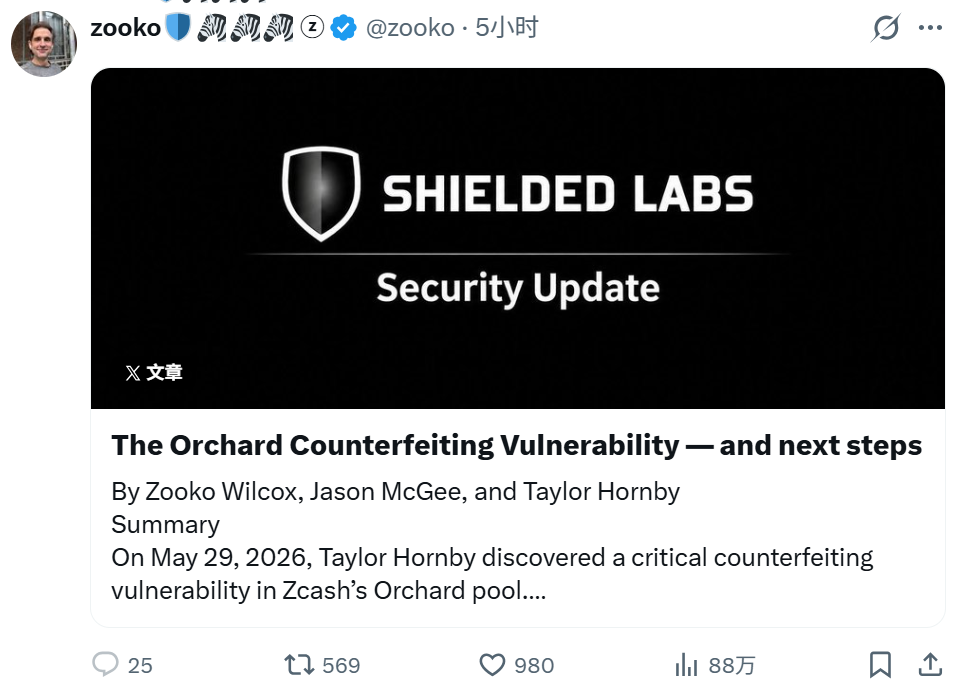


Although the Zcash ecosystem had already urgently completed a network upgrade to fix the issue, after the detailed impact was disclosed, ZEC's price experienced severe volatility, with a single-day drop exceeding 30% at one point, touching lows around $411.
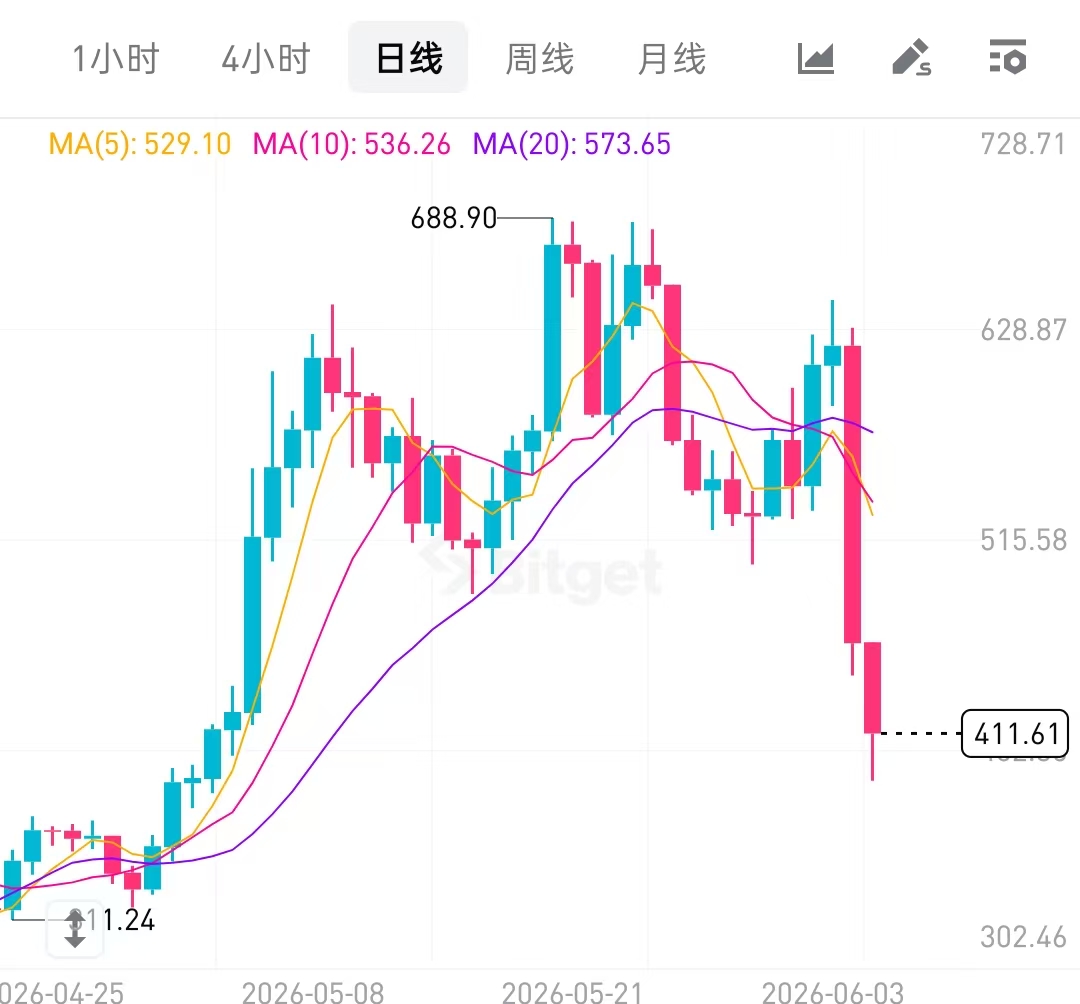


Zcash has been the absolute star in the privacy coin track over the past six months, surging from around $200 in March this year to a peak of $688. Figures including AllianceDAO co-founder Wang Qiao, Bankless founder David Hoffman, and the "shilling king" Arthur Hayes have all expressed high optimism about its performance.


However, after the vulnerability was discovered, Arthur Hayes tweeted that he had sold his entire ZEC holdings. He stated that after reading the vulnerability details and observing ZEC's 30% pullback, he decided to completely close his position for profit. He mentioned he would continuously re-evaluate and, if subsequent evidence proved his assumptions wrong, would consider buying back at lower prices.


So, what exactly happened with Zcash?


In simple terms, Orchard is a privacy vault within Zcash that is "completely opaque" to the outside; after people deposit funds, neither the outside world nor the blockchain itself knows how much money is inside or who owns it. The vulnerability this time lies in the vault's "verification lock"—this lock was supposed to be extremely rigorous, allowing only legitimate transactions to pass verification. However, due to a loosely written mathematical constraint (akin to a loose gear in the lock), an attacker could forge a key that appears completely legitimate, trick the system, and create new ZEC out of thin air within the vault.


This incident directly challenges the narrative of the privacy coin track that "technological trust is core value."


As the earliest public chain to scale the application of zk-SNARKs for private transactions, Zcash's Orchard pool, activated with the NU5 upgrade in May 2022, has been regarded as a more efficient evolution of the Sapling pool, hosting a large amount of private funds. Now, vulnerabilities discovered by security researchers using the latest AI models are forcing the entire industry to re-examine the gap between privacy technology theory and practice.


Vulnerability Discovery Originated from AI-Assisted Audit


The discovery process of the vulnerability was dramatic.


In April 2026, Shielded Labs hired senior security engineer Taylor Hornby to conduct ongoing security research targeting the Zcash protocol, aiming to discover issues before malicious actors.


On May 28th, Anthropic released the Opus 4.8 model. The next day, Taylor used this model combined with traditional methods to conduct a highly targeted review of the Orchard circuit, discovering the issue: an insufficient constraint in elliptic curve multiplication within the halo2_gadgets crate, allowing attackers to input arbitrary false values into the multiplication operation while verification would still pass. This meant it was possible to construct seemingly fully valid Orchard actions—that is, generate counterfeit ZEC within the Orchard pool, and due to privacy features, on-chain differentiation between real and fake was impossible.


Taylor immediately disclosed the issue to ZODL core engineers, who confirmed the severity of the vulnerability within hours and initiated an emergency response.


The foundation's initial security announcement tried to downplay the severity, describing it as a "double-spend risk," and assured that the "rotation mechanism protected the total supply from inflation," attempting to use "total supply security" to stabilize market sentiment and conceal the harsh reality that the Orchard pool might have already been flooded with counterfeit coins, diluting honest users' assets.


By June 4th, founder Zooko's statement supplemented the fatal details. He candidly admitted that "cryptographically, it is impossible to prove whether the vulnerability had been exploited before the fix," and publicly disclosed the "possibility of infinite ZEC forgery." It was this frank admission by the founder that directly punctured the "safety illusion" maintained by the foundation earlier, triggering the market's panic sell-off.


Zooko


Because if an attacker had, over the past few years, already used the vulnerability to mint 1 million fake ZEC inside the Orchard pool and cashed out by withdrawing to the transparent pool via the rotation mechanism before the fix, the total supply indeed didn't inflate, but the real assets of users within the Orchard pool had already been evaporated and harvested in a targeted manner. Once the rotation limits are announced next week, the Orchard pool will face the largest "bank run" in the history of privacy blockchains, with the assets of users who retreat later being permanently locked.


In the AI Era, "Unfound Vulnerability Equals Security" No Longer Holds True


Orchard, since its activation in 2022, underwent years of security audits by top cryptographers yet still contained bugs, only discovered through targeted research combined with the latest AI tools. This serves as a warning for many privacy solutions (including other ZK privacy projects): theoretically "perfect" mathematical constructs may still have omissions in engineering implementation.


Taylor Hornby's use of Anthropic Opus 4.8 to pinpoint the Orchard flaw in an extremely short time proves that AI can be a powerful aid for white-hat researchers, but also implies that attackers can similarly use similar tools to mine high-value targets faster.


If project teams fail to establish continuous, proactive security review mechanisms, the window from vulnerability discovery to malicious exploitation will shrink dramatically. While Zcash gained the upper hand this time by proactively investing in security research,


for the entire crypto industry, this is more like a collective warning: in the AI-driven security offense and defense race, any reliance on the侥幸心理 of "safe because undiscovered for years" is no longer valid. Only by internalizing AI auditing, formal verification, and rapid response capabilities as standard practices can privacy protocols truly withstand the pressure tests of the new era.

Related Reads

Anthropic Cries Wolf: Is the AGI Threat Real, or Just an IPO Story?

Anthropic has published an article titled "When AI builds itself," discussing the emerging concept of "recursive self-improvement," where AI begins to actively participate in designing, training, testing, and optimizing its own subsequent versions. The company presents internal data showing that by May 2026, over 80% of code merged into its codebase was written by Claude, its AI model. Claude's capabilities have expanded to handling complex, open-ended engineering tasks, achieving a 76% success rate in such areas, and even contributing to research processes, such as optimizing code performance and conducting AI safety experiments. Anthropic outlines an evolution from human-driven development to AI-assisted workflows, culminating in the current stage where AI agents can autonomously write, run, and delegate code. The company cautions that the path toward a "closed loop," where AI continuously improves itself, is becoming visible. It calls for coordinated global mechanisms to potentially slow or pause frontier AI development to allow safety research and societal structures to catch up. However, the timing of this warning coincides with Anthropic's preparations for an IPO, framing the narrative not just as a safety concern but also as a demonstration of Claude's advanced capabilities and its integral role in accelerating Anthropic's own R&D—creating a potential "flywheel" effect for competitive advantage. This contrasts with OpenAI's recent, more policy-oriented discussion of the same risks, highlighting the competitive dynamics in the AI industry as companies position themselves in both the technological and regulatory landscape.

marsbit20m ago

Anthropic Cries Wolf: Is the AGI Threat Real, or Just an IPO Story?

marsbit20m ago

BIT Research: ETF Purchases Have Slowed, Strategy (MicroStrategy) Has Slowed, What Else Can Drive Bitcoin's Rise?

Market Refocus on Inflation and Rate Expectations Weighs on Bitcoin Currently, the market is in a phase of macro-repricing dominated by inflation and interest rate expectations. Bitcoin, which previously benefited from easy liquidity and low inflation, is seeing its core bullish drivers weaken. These drivers were market expectations for interest rate cuts and strong inflows from Bitcoin ETFs and institutions like MicroStrategy (referred to as "Strategy" in the text). The logic has shifted. Recent high inflation data (e.g., CPI hitting 3.8% in a May 2026 report) has caused the market to sharply reduce its rate cut expectations for 2025 and even price in potential hikes. This is a key constraint for Bitcoin, as it lacks cash flows and is highly sensitive to rate expectations. Concurrently, institutional capital flows have slowed significantly. Following the hot CPI data, Bitcoin ETFs saw accelerated outflows, with around $4.3 billion leaving over a period. MicroStrategy's ability to keep adding substantial Bitcoin to its balance sheet is also diminishing. Together, ETF and MicroStrategy holdings total roughly $110 billion, but their momentum as growth engines is cooling. In summary, Bitcoin's current pressure stems not from its own fundamentals but from a changing macro environment. As long as inflation stays elevated, Bitcoin is likely to remain in a consolidating phase. However, historically, inflation eventually peaks. Once it recedes and rate cut expectations rebuild, institutional capital could return, potentially fueling a new and more robust recovery phase for Bitcoin.

marsbit27m ago

BIT Research: ETF Purchases Have Slowed, Strategy (MicroStrategy) Has Slowed, What Else Can Drive Bitcoin's Rise?

marsbit27m ago

Earning 1000 Trillion in Half a Year, 'Pocketing' 20 Million per Capita: This Round of Wealth Creation in the Korean Stock Market is Unprecedented in Scale

The South Korean stock market is experiencing an unprecedented wealth surge in 2026, with household equity and fund asset values soaring by over 1,000 trillion KRW (~$730bn) year-to-date. This translates to an average per capita wealth increase of roughly 20 million KRW, fueled by a historic 109% rally in the KOSPI index. The boom is driven by three converging forces: an AI-driven semiconductor supercycle boosting giants like Samsung and SK Hynix; the government's "Value-Up" market reforms addressing long-standing corporate governance issues; and aggressive real estate regulations that have locked capital within financial markets, preventing profits from flowing back into property. This has triggered a wealth effect, boosting high-end consumption significantly. However, the gains are highly concentrated. The two semiconductor behemoths account for over half the index's value, but retail investors own relatively low stakes in them, systematically missing the biggest rallies. Wealth and consumption benefits are skewed towards luxury goods and imported cars, bypassing mainstream retail. Further risks stem from excessive leverage, with high trading volume in leveraged ETFs, and a market sentiment heavily reliant on the AI sector's fortunes and speculative rumors. While this cycle marks a potential shift from real estate to equities as a primary wealth generator for Koreans, its sustainability, amid structural imbalances and leverage, remains a critical test.

marsbit33m ago

Earning 1000 Trillion in Half a Year, 'Pocketing' 20 Million per Capita: This Round of Wealth Creation in the Korean Stock Market is Unprecedented in Scale

marsbit33m ago

Trading

Spot
Futures

Hot Articles

How to Buy ZEC

Welcome to HTX.com! We've made purchasing Zcash (ZEC) simple and convenient. Follow our step-by-step guide to embark on your crypto journey.Step 1: Create Your HTX AccountUse your email or phone number to sign up for a free account on HTX. Experience a hassle-free registration journey and unlock all features.Get My AccountStep 2: Go to Buy Crypto and Choose Your Payment MethodCredit/Debit Card: Use your Visa or Mastercard to buy Zcash (ZEC) instantly.Balance: Use funds from your HTX account balance to trade seamlessly.Third Parties: We've added popular payment methods such as Google Pay and Apple Pay to enhance convenience.P2P: Trade directly with other users on HTX.Over-the-Counter (OTC): We offer tailor-made services and competitive exchange rates for traders.Step 3: Store Your Zcash (ZEC)After purchasing your Zcash (ZEC), store it in your HTX account. Alternatively, you can send it elsewhere via blockchain transfer or use it to trade other cryptocurrencies.Step 4: Trade Zcash (ZEC)Easily trade Zcash (ZEC) on HTX's spot market. Simply access your account, select your trading pair, execute your trades, and monitor in real-time. We offer a user-friendly experience for both beginners and seasoned traders.

3.2k Total ViewsPublished 2024.03.29Updated 2026.06.02

How to Buy ZEC

Discussions

Welcome to the HTX Community. Here, you can stay informed about the latest platform developments and gain access to professional market insights. Users' opinions on the price of ZEC (ZEC) are presented below.

活动图片