Charles Schwab Calculated and Revealed the Fair Value of Bitcoin (BTC)! Here's What It Should Be!

cryptonews.ruPublished on 2026-07-28Last updated on 2026-07-28

Abstract

The article discusses a recent analysis by Charles Schwab's head of crypto research, Jim Ferraroli, on Bitcoin's fair value. Despite Bitcoin's price dropping to around $63,000 due to market sell-offs and Federal Reserve interest rate concerns, Ferraroli asserts its fair value is approximately $95,000. This valuation is based on Bitcoin mining economics, specifically production costs, rather than short-term market sentiment. He notes that while efficient miners produce one BTC for about $60,000, the cost can rise to $95,000 for less efficient operations. Ferraroli compares this to traditional commodities, where production costs are a key valuation metric. He emphasizes that the $95,000 figure is an economic estimate, not a price target. Additionally, he identifies the ~$60,000 mining cost level as a crucial fundamental support zone for Bitcoin, aligning with its 200-week moving average. Ferraroli concludes that it's uncertain whether Bitcoin will reach $95,000 within the next six months. The piece includes a standard disclaimer that this is not investment advice.

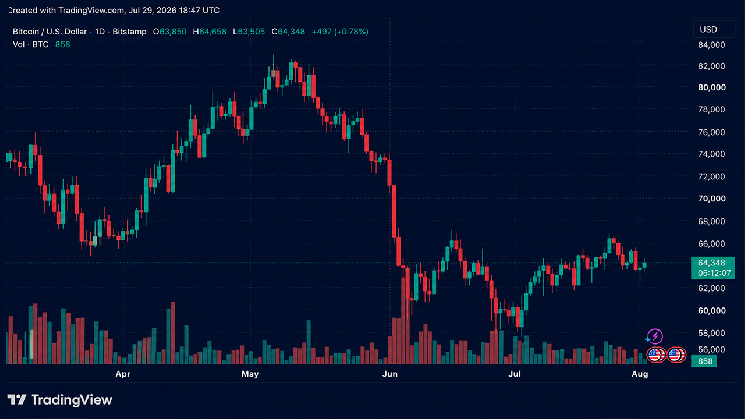
The upward momentum of the leading cryptocurrency, Bitcoin, has once again been interrupted. Yesterday, after starting the new week above $65,000, $BTC fell to $63,000 due to a sharp sell-off on Asian markets related to memecoin trading and renewed concerns about the Fed raising interest rates.

As the $BTC price continues to fall sharply due to macroeconomic events, a prominent figure has determined Bitcoin's fair value to be $95,000.

Jim Ferraioli, Head of Crypto Research at Charles Schwab, a leading player in the cryptocurrency market, argued that the fair value of Bitcoin, regardless of its current market price, is around $95,000.

Ferraioli stated that this valuation is based on the economic indicators of Bitcoin mining, not short-term market sentiment.

In an interview with Coindesk, Ferraioli emphasized that one of the most important metrics for evaluating Bitcoin is its cost of production.

He noted that the most efficient miners produce one $BTC for around $60,000, while for less efficient miners this figure can rise to $95,000.

Comparing it to traditional commodity markets, Ferraioli noted that producers typically operate with relatively low margins, and said that for $BTC, production costs are also an important metric for assessing its fair value.

However, he added that the $95,000 level is not a target price for $BTC, but rather an estimate or forecast based on economic data.

The $60,000 Level Could Be a Strong Support Level for Bitcoin!

According to Ferraioli, the mining cost of approximately $60,000 represents an important fundamental support level for Bitcoin.

This level also coincides with Bitcoin's 200-week moving average, which has recently been in the $60,000–$62,000 range.

In conclusion, Ferraioli added that it is impossible to predict whether Bitcoin will reach the $95,000 mark within the next six months.

*This is not investment advice.

end-content

Trending Cryptos

Related Questions

QAccording to the article, what is the fair value of Bitcoin estimated by Jim Ferrall from Charles Schwab?

AJim Ferrall from Charles Schwab estimates the fair value of Bitcoin to be approximately $95,000.

QWhat does Jim Ferrall cite as the primary basis for his $95,000 Bitcoin fair value estimate?

AHe bases his estimate on the economic metrics of Bitcoin mining, specifically the production costs, and not on short-term market sentiment.

QWhat key support level for Bitcoin's price is mentioned, and what fundamental indicator does it align with?

AThe approximately $60,000 mining cost level is mentioned as a key fundamental support level for Bitcoin. It aligns with Bitcoin's 200-week moving average.

QDid Jim Ferrall present the $95,000 level as a specific price target for Bitcoin?

ANo, he clarified that the $95,000 level is not a price target but rather an assessment or forecast based on economic data.

QWhat two factors does the article state contributed to Bitcoin's price drop from above $65,000 to $63,000?

AThe drop was caused by a sharp sell-off on Asian markets related to 'token' trading and renewed concerns about the Federal Reserve raising interest rates.

Related Reads

USDT Supply Shrinks by $5.5 Billion While Stablecoin Turnover Hits Record High

The supply of stablecoins has contracted for the first time in years, with total market capitalization falling 4.3% from its May peak to $308.5 billion. Despite this decline, June saw a record $1.83 trillion in adjusted transaction volume for stablecoins, a 60% increase from May. This divergence suggests a shift in usage patterns: less capital is sitting idle, while the remaining supply circulates more rapidly through payment and trading systems. Specifically, the supply of Tether's USDT decreased from approximately $189.54 billion to $184 billion between May 1 and July 29, while Circle's USDC supply fell from $77.27 billion to $72.41 billion. Part of this capital appears to have moved into tokenized Treasury products, a sector whose value has grown to over $16 billion, partly driven by regulations like the 2025 GENIUS Act that prohibit interest payments on payment-focused stablecoins. Transaction velocity is emerging as a key metric, with stablecoins now turning over about six times per month—double the rate from two years ago. USDC, despite having a smaller supply than USDT, processed about $1.21 trillion in adjusted volume in June, leading in settlement activity. While a significant portion of on-chain volume may not represent genuine economic payments, identifiable real-world payments have grown sharply, reaching an estimated $390 billion in 2025. The data indicates stablecoins are evolving from static collateral into active financial infrastructure.

cryptonews.ru4m ago

USDT Supply Shrinks by $5.5 Billion While Stablecoin Turnover Hits Record High

cryptonews.ru4m ago

A7 to Provide Unique Expertise on Stablecoin Settlement to the Market

Beginning September 1, 2026, Russia's "On Digital Currencies and Digital Rights" law will establish rules for cryptocurrency circulation, significantly expanding tools for importers and exporters. Company A7, a user of the largest ruble-pegged stablecoin A7A5, has announced its readiness to share its unique expertise in digital asset operations with foreign trade participants. According to Oleg Ogienko, Director of Government Relations and International Ties for the A7A5 project, the company's specialists have developed significant expertise in legally formalizing such transactions, compliance, currency control, and interacting with infrastructure participants. Following the law's enactment, A7 will continue applying this expertise for client operations and plans to adapt its business processes as the Bank of Russia issues related regulatory acts. The Bank of Russia clarified that exporters and importers will be able to conduct cross-border settlements in digital currency either through intermediaries or directly, though domestic use of such assets will remain restricted. All requirements for operators and settlement participants will be detailed in the regulator's subordinate acts. A7 had previously highlighted the high degree of transaction freedom in foreign trade as a key advantage of Russia's developing crypto-asset regulation model, while noting limitations for individuals and a banking-centric system that could hinder market growth.

cryptonews.ru9m ago

A7 to Provide Unique Expertise on Stablecoin Settlement to the Market

cryptonews.ru9m ago

Trading

Spot

Hot Articles

What is $BITCOIN

DIGITAL GOLD ($BITCOIN): A Comprehensive Analysis Introduction to DIGITAL GOLD ($BITCOIN) DIGITAL GOLD ($BITCOIN) is a blockchain-based project operating on the Solana network, which aims to combine the characteristics of traditional precious metals with the innovation of decentralized technologies. While it shares a name with Bitcoin, often referred to as “digital gold” due to its perception as a store of value, DIGITAL GOLD is a separate token designed to create a unique ecosystem within the Web3 landscape. Its goal is to position itself as a viable alternative digital asset, although specifics regarding its applications and functionalities are still developing. What is DIGITAL GOLD ($BITCOIN)? DIGITAL GOLD ($BITCOIN) is a cryptocurrency token explicitly designed for use on the Solana blockchain. In contrast to Bitcoin, which provides a widely recognized value storage role, this token appears to focus on broader applications and characteristics. Notable aspects include: Blockchain Infrastructure: The token is built on the Solana blockchain, known for its capacity to handle high-speed and low-cost transactions. Supply Dynamics: DIGITAL GOLD has a maximum supply capped at 100 quadrillion tokens (100P $BITCOIN), although details regarding its circulating supply are currently undisclosed. Utility: While precise functionalities are not explicitly outlined, there are indications that the token could be utilized for various applications, potentially involving decentralized applications (dApps) or asset tokenization strategies. Who is the Creator of DIGITAL GOLD ($BITCOIN)? At present, the identity of the creators and development team behind DIGITAL GOLD ($BITCOIN) remains unknown. This situation is typical among many innovative projects within the blockchain space, particularly those aligning with decentralized finance and meme coin phenomena. While such anonymity may foster a community-driven culture, it intensifies concerns about governance and accountability. Who are the Investors of DIGITAL GOLD ($BITCOIN)? The available information indicates that DIGITAL GOLD ($BITCOIN) does not have any known institutional backers or prominent venture capital investments. The project seems to operate on a peer-to-peer model focused on community support and adoption rather than traditional funding routes. Its activity and liquidity are primarily situated on decentralized exchanges (DEXs), such as PumpSwap, rather than established centralized trading platforms, further highlighting its grassroots approach. How DIGITAL GOLD ($BITCOIN) Works The operational mechanics of DIGITAL GOLD ($BITCOIN) can be elaborated on based on its blockchain design and network attributes: Consensus Mechanism: By leveraging Solana’s unique proof-of-history (PoH) combined with a proof-of-stake (PoS) model, the project ensures efficient transaction validation contributing to the network's high performance. Tokenomics: While specific deflationary mechanisms have not been extensively detailed, the vast maximum token supply implies that it may cater to microtransactions or niche use cases that are still to be defined. Interoperability: There exists the potential for integration with Solana’s broader ecosystem, including various decentralized finance (DeFi) platforms. However, the details regarding specific integrations remain unspecified. Timeline of Key Events Here is a timeline that highlights significant milestones concerning DIGITAL GOLD ($BITCOIN): 2023: The initial deployment of the token occurs on the Solana blockchain, marked by its contract address. 2024: DIGITAL GOLD gains visibility as it becomes available for trading on decentralized exchanges like PumpSwap, allowing users to trade it against SOL. 2025: The project witnesses sporadic trading activity and potential interest in community-led engagements, although no noteworthy partnerships or technical advancements have been documented as of yet. Critical Analysis Strengths Scalability: The underlying Solana infrastructure supports high transaction volumes, which could enhance the utility of $BITCOIN in various transaction scenarios. Accessibility: The potential low trading price per token could attract retail investors, facilitating wider participation due to fractional ownership opportunities. Risks Lack of Transparency: The absence of publicly known backers, developers, or an audit process may yield skepticism regarding the project's sustainability and trustworthiness. Market Volatility: The trading activity is heavily reliant on speculative behavior, which can result in significant price volatility and uncertainty for investors. Conclusion DIGITAL GOLD ($BITCOIN) emerges as an intriguing yet ambiguous project within the rapidly evolving Solana ecosystem. While it attempts to leverage the “digital gold” narrative, its departure from Bitcoin's established role as a store of value underscores the need for a clearer differentiation of its intended utility and governance structure. Future acceptance and adoption will likely depend on addressing the current opacity and defining its operational and economic strategies more explicitly. Note: This report encompasses synthesised information available as of October 2023, and developments may have transpired beyond the research period.

1.1k Total ViewsPublished 2025.05.13Updated 2025.05.13

What is $BITCOIN

Discussions

Welcome to the HTX Community. Here, you can stay informed about the latest platform developments and gain access to professional market insights. Users' opinions on the price of BTC (BTC) are presented below.

活动图片