Overnight, GPT-5.6 Sol Was Accelerated 14x by OpenAI

marsbitPublished on 2026-08-14Last updated on 2026-08-14

Abstract

OpenAI, in collaboration with chipmaker Cerebras, has unveiled a limited preview of an "Ultrafast Mode" for its flagship GPT-5.6 Sol model. This new service tier reportedly achieves output speeds of up to 750 tokens per second—a 14x increase over the standard mode's baseline of ~53 tokens/s—without any loss in quality. Key to this acceleration is Cerebras's wafer-scale architecture (WSE-3), which houses model parameters entirely in on-chip SRAM to eliminate the memory bandwidth bottlenecks typical of traditional GPU clusters. In benchmark testing on the challenging "Humanity's Last Exam" (HLE), GPT-5.6 Sol in Ultrafast Mode answered all 2500 questions in 11 hours and 11 minutes, compared to over 78 hours for a competitor model, while maintaining similar accuracy. The speed boost also translated to a 5.6x faster end-to-end performance on the GDP-Val benchmark for economically valuable knowledge work. OpenAI highlights several potential applications for such rapid inference, including real-time event response and reliability analysis, dynamic financial research and security, complex customer support, interactive shopping assistance, and accelerated research and experimentation workflows that enable multiple iterative cycles within a single workday. This advancement may allow users to deploy the highest-tier models for tasks previously requiring slower secondary models, significantly compressing multi-step agent workflows from hours to minutes.

Is AI starting to leverage information asymmetry?

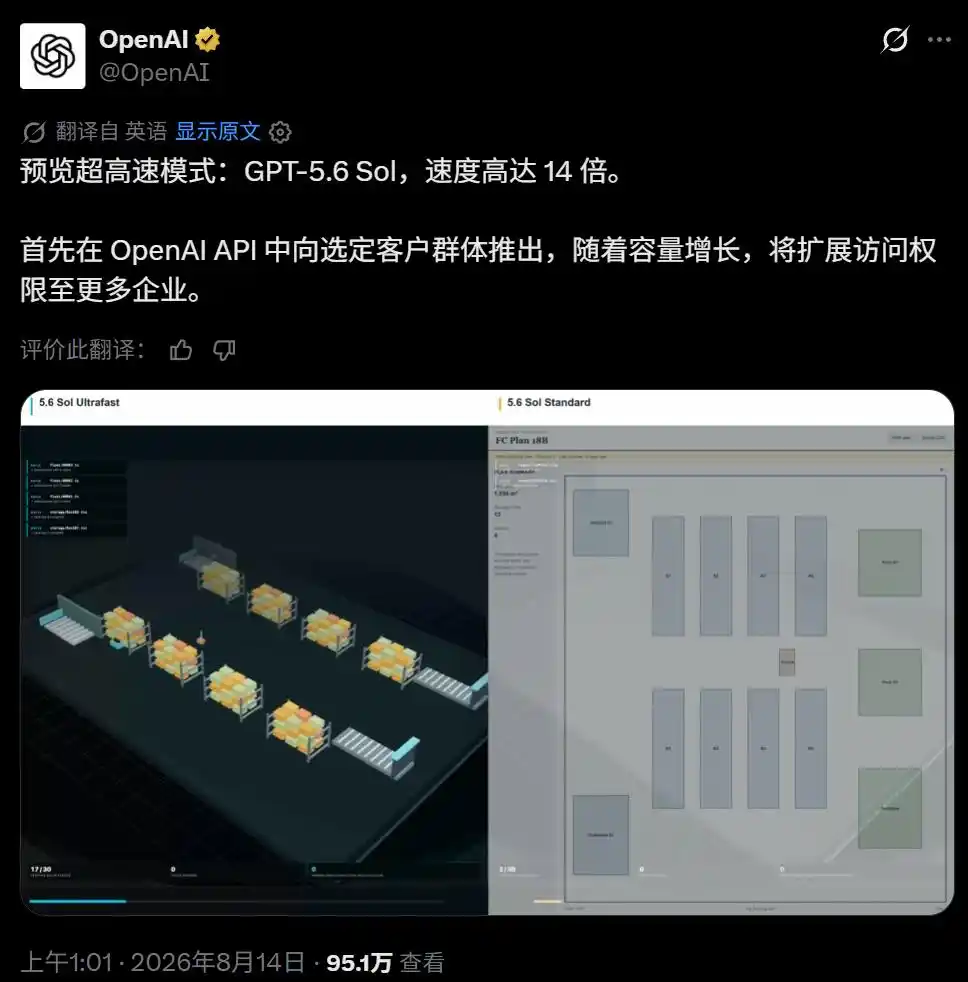
In the early hours of August 14th, OpenAI, in partnership with AI chip manufacturer Cerebras, officially previewed a new service tier called "Ultrafast Mode" for its flagship model GPT-5.6 Sol.

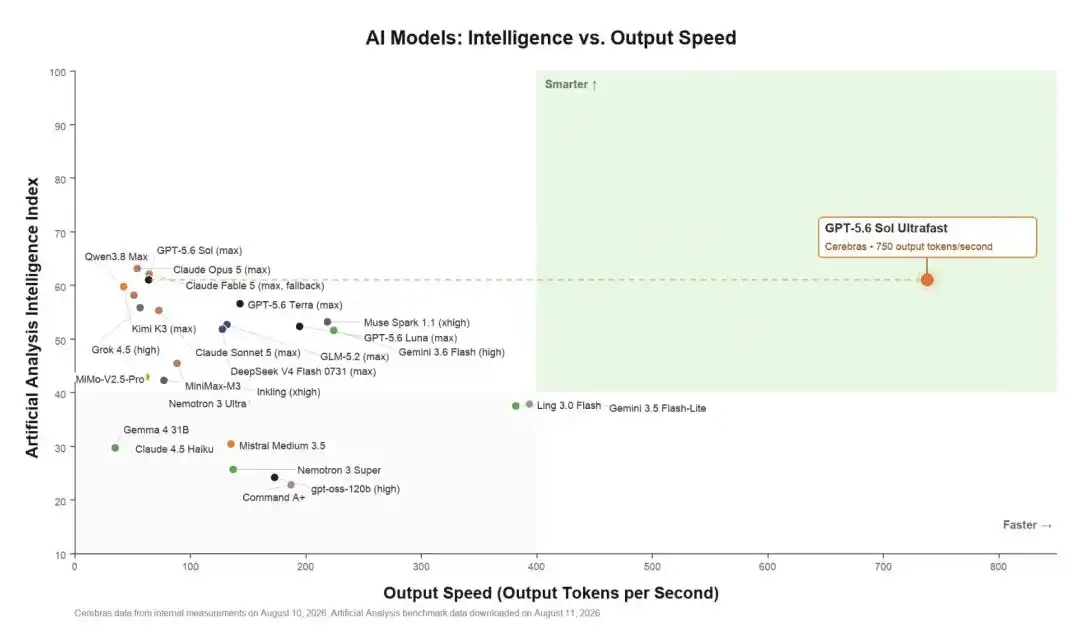
In this mode, the output speed of GPT-5.6 Sol can reach up to 750 tokens/s. Compared to the baseline inference speed of about 53 tokens/s in the current Standard mode, this represents a speed increase of up to 14 times, with no reduction in quality. For perspective, the accelerated GPT-5.6 Sol is 11 times faster than Fable 5 and 5 times faster than Opus 4.8 in its Fast mode.

The Ultrafast mode will be launched first in the OpenAI API and is currently available in a limited preview to some customers.
For this, OpenAI and Cerebras also created a comparison table showing the current speed and intelligence of leading AI large models. GPT-5.6 Sol Ultrafast holds an absolutely leading position:
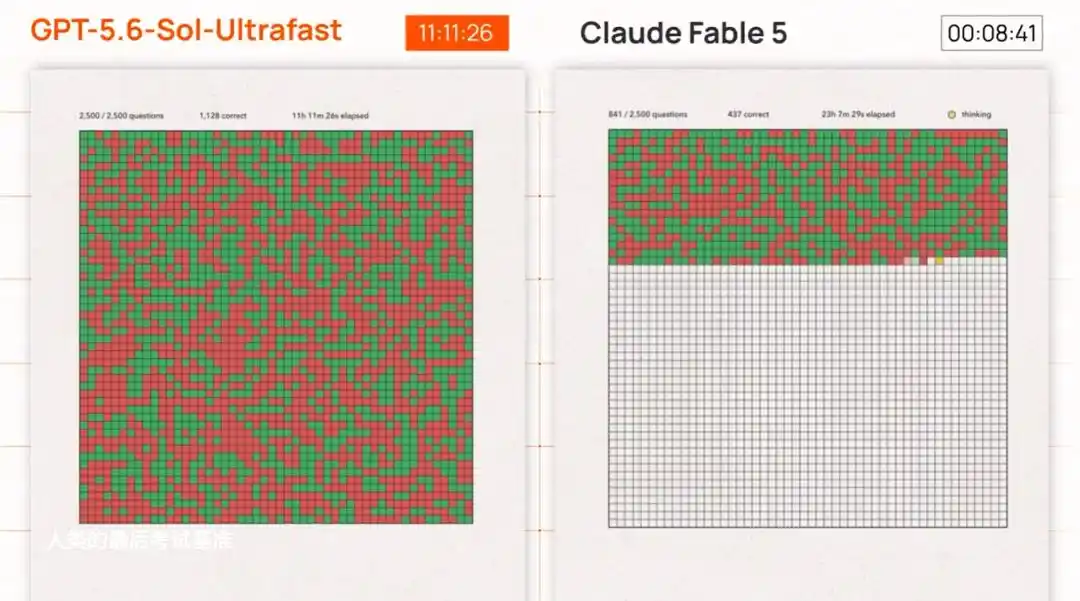
In Cerebras's blog, engineers described tests conducted on the "Humanity's Last Exam" (HLE) benchmark, where they compared the Ultrafast-accelerated model with direct competitors. As we know, HLE is a challenging model benchmark containing 2500 questions, typically only solvable by Ph.D.s in fields like chemistry, economics, and literature.

GPT-5.6 Sol in Ultrafast mode answered all questions in just 11 hours and 11 minutes. In contrast, Claude Fable 5 required 78 hours and 27 minutes—over three days of continuous computation—to reach the same conclusions. GPT's Ultrafast mode completed the frontier of human knowledge in a single workday, achieving nearly 7 times the speed of Claude Fable while maintaining similar accuracy.
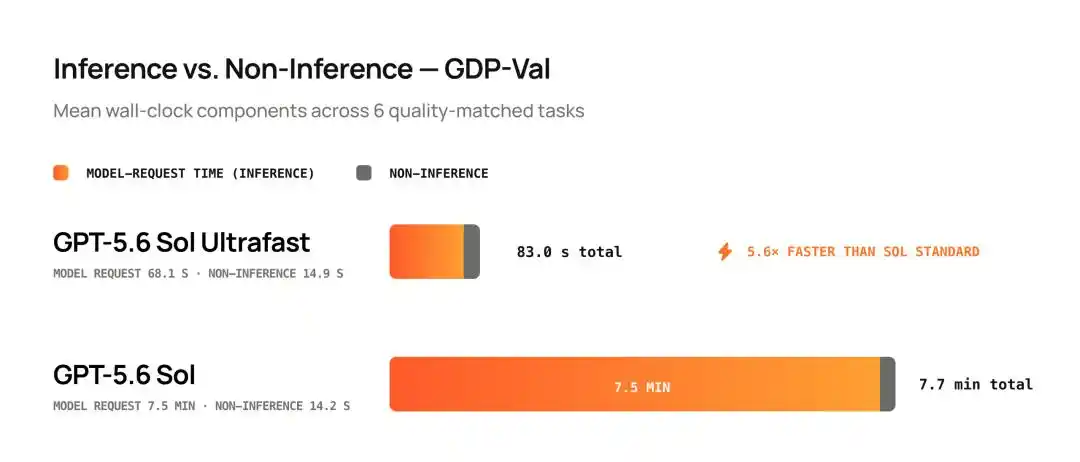
As model capabilities continue to improve, the application scope of fast inference will also expand. GPT-5.6 Sol is OpenAI's best-performing model to date for legal documents, financial models, and engineering reports. On the GDP-Val benchmark (which measures economically valuable knowledge work tasks), Ultrafast achieved a 5.6x end-to-end speed improvement without any drop in quality, fully demonstrating how faster reasoning speeds can accelerate economically valuable work.
Faster AI processing adds significant possibilities to emerging workflows. People can now deploy agents onto the critical path of problems. OpenAI lists some application scenarios for you:

  • Incident response and reliability: When critical systems fail, AI analyzes application logs, recent code changes, and engineer reports to identify potential causes and help prepare fixes while the incident is still ongoing.
  • Financial research and security: Analyzing market signals, evaluating trades, and identifying suspicious activities in rapidly changing market conditions.
  • Customer support and voice: Resolving complex customer issues in real-time, even when finding answers requires multiple steps or systems, without interrupting the conversation.
  • Commerce: Answering product questions, checking inventory, personalizing recommendations, and resolving checkout issues while shoppers are still deciding, preventing hesitation from turning into abandoned carts.
  • Real-time research and experimentation: Transforming research that previously required overnight processing into interactive work sessions, allowing teams to test ideas, check results, adjust methods, and run another experiment without breaking their workflow.

Internally at OpenAI, developers tested GPT-5.6 Sol in Ultrafast mode. Incident response is an example of using Ultrafast. When an alert triggers, engineers need to build an accurate picture of the incident while systems and evidence are still changing. With Sol-level intelligence, teams can quickly read logs, analyze traces, summarize conversations, determine the next steps for investigation, and assist in preparing or verifying fixes. Ultrafast mode reduces the delay between observing a signal, verifying hypotheses, and choosing the next action, while engineers remain responsible for judgment and deployment.

In research, the OpenAI team uses Ultrafast to quickly search knowledge bases, query data, and rapidly gather, organize, and summarize information from various tools. A common research workflow used to involve team members launching a batch of experiments overnight and reviewing results the next morning. With Ultrafast, the discovery process can be shortened, supporting multiple iterations within a single workday.

The breakthrough of Ultrafast mode lies in breaking the memory bandwidth bottleneck of traditional GPU clusters during the autoregressive decoding stage of large models. Its implementation primarily relies on Cerebras's wafer-scale hardware architecture.
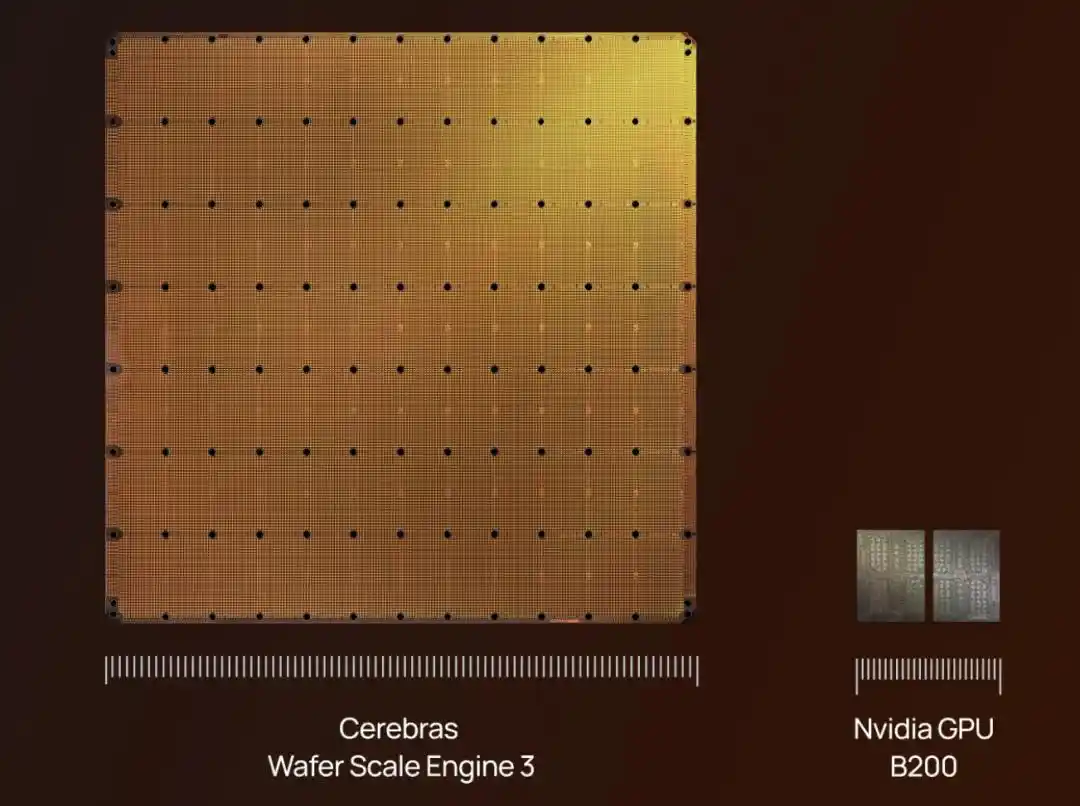
Among AI chip manufacturers, Cerebras's solution is unique: its successive chip generations are manufactured from entire silicon wafers, integrating vast numbers of computing cores and ultra-high-speed interconnection networks on a single die.

Traditional GPUs, when running autoregressive token generation for large models, are limited by memory bandwidth, requiring constant transfer of massive model weights between off-chip HBM and computing cores. Additionally, multi-card partitioning introduces communication delays across chips (via PCIe/NVLink).

In contrast, each of Cerebras's latest wafer-scale chips (WSE-3) integrates 4 trillion transistors, delivers 125 petaflops of AI compute power, and features up to 44 GB of on-chip high-speed SRAM. Model parameters reside directly in the high-bandwidth on-chip SRAM, eliminating the wait time associated with repeatedly loading weights from off-chip memory.

Of course, as a cutting-edge flagship model, the full parameter count of GPT-5.6 Sol obviously far exceeds the chip's capacity. Cerebras also has a "Pipelined across wafers" mechanism. This distributes the various network layers of the model across multiple wafers, with each layer's parameters residing in the SRAM of its respective chip, allowing tokens to seamlessly flow between wafers in a pipeline.

For many large model users, a 14x speedup for the flagship model means that many tasks that previously required switching to secondary models (like Luna and Terra) can now be confidently run at full power. For Agent tasks requiring multi-round tool use, code generation/debugging, and complex chain-of-thought reasoning, processes that used to take hours can be compressed into minutes.

Faster speeds might also mean a shift in how we use AI:

Within the AI community, people are already looking forward to Ultrafast mode versions for Luna and Terra. The only question is whether Cerebras's chips will be sufficient.

References:

https://openai.com/index/previewing-ultrafast/

https://www.cerebras.ai/blog/accelerating-gpt-5-6-sol-ultrafast-with-openai

This article is from the WeChat public account "Almost Human" (ID: almosthuman2014), by the machinehearts team focused on large models.


Trending Cryptos

Related Questions

QWhat is the key feature of OpenAI's newly previewed 'Ultrafast Mode' for GPT-5.6 Sol, and what is its claimed performance improvement?

AThe key feature is a 14x increase in output speed, reaching up to 750 tokens per second (tokens/s), compared to the Standard mode baseline of approximately 53 tokens/s, without any reduction in quality.

QWhich AI chip manufacturer did OpenAI partner with to achieve the speed boost for GPT-5.6 Sol's Ultrafast Mode?

AOpenAI partnered with the AI chip manufacturer Cerebras to achieve the speed boost for the Ultrafast Mode.

QAccording to the article, in what major test did GPT-5.6 Sol Ultrafast demonstrate a significant speed advantage over its competitor Claude Fable 5?

AIn the 'Humanity's Last Exam' (HLE) benchmark test, GPT-5.6 Sol Ultrafast answered all 2500 questions in 11 hours and 11 minutes, while Claude Fable 5 took 78 hours and 27 minutes, making it almost 7 times faster.

QWhat is the fundamental technical reason mentioned for the speed breakthrough in Ultrafast Mode, addressing a limitation of traditional GPU clusters?

AThe breakthrough comes from Cerebras's wafer-scale hardware architecture, which keeps the entire model's parameters in the chip's high-bandwidth on-chip SRAM. This eliminates the memory bandwidth bottleneck and the latency caused by repeatedly loading weights from external memory (like HBM in GPUs) and cross-chip communication.

QWhat are two potential application scenarios for Ultrafast AI models listed in the article?

ATwo potential application scenarios are: 1) Event response and reliability: Analyzing logs and reports in real-time to help diagnose and fix critical system failures as they occur. 2) Real-time research and experimentation: Turning overnight research processes into interactive sessions, allowing teams to iterate on ideas and test results multiple times within a single workday.

Related Reads

GPT-5 Also Has Tip-of-the-Tongue Moments, Google Tested 4.5 Million Times: The Keys Are Lost

Google researchers have discovered that advanced AI models like GPT-5 and Gemini 3 experience a phenomenon akin to the human "tip-of-the-tongue" state, where they possess knowledge but fail to retrieve it. Their study, "Empty Shelves or Lost Keys?" (ICML 2026), introduces the "Knowledge Portrait" framework to analyze factual knowledge in models, distinguishing between failure to encode a fact versus failure to recall it. Testing on 13 models across 2.15 million queries from the WikiProfile benchmark revealed that state-of-the-art models successfully encode 95-98% of facts into their parameters. However, when asked directly, they fail to recall 26-34% of these known facts. Enabling chain-of-thought ("thinking") reasoning reduces this recall failure to 11-12%, recovering 40-65% of the previously unrecalled but encoded facts. The research identifies two key bottlenecks: recalling obscure ("long-tail") facts and answering reversed queries (e.g., "Who is Tom Cruise's mother?" vs. "Whose son is Tom Cruise?"). While scaling model size effectively reduces encoding failures, it does little to improve recall rates. In larger models, recall failure becomes the dominant source of factual errors, accounting for over 70% of mistakes in GPT-5.2. The findings suggest that for top models, the primary challenge is no longer storing knowledge but accessing it efficiently. Future accuracy gains may depend more on improved inference-time methods and "meta-cognitive" abilities, enabling models to recognize when they need to engage in deeper reasoning to retrieve information they already know.

marsbit16m ago

GPT-5 Also Has Tip-of-the-Tongue Moments, Google Tested 4.5 Million Times: The Keys Are Lost

marsbit16m ago

The Dollar is a Technology: Stablecoins Are Exporting U.S. Institutions to the World

This article argues that stablecoins and blockchain infrastructure are becoming a vehicle for exporting American financial systems globally. The core thesis is that the U.S. dollar, as a "technology," is increasingly embedded in blockchain rails, moving beyond a reserve currency to represent the institutional stability of the United States itself. The piece highlights three key areas where this is happening: 1. **Cross-border payments and trade finance:** Companies like Keyrails use stablecoins and blockchain to streamline and secure trade finance for emerging markets (e.g., Nigeria-China trade), offering faster, often cheaper dollar liquidity than traditional systems. 2. **Programmable collateral and credit:** Platforms like SemiLiquid allow institutions to use tokenized assets (e.g., treasuries, stocks) as "programmable collateral" for loans without moving them from custody, unlocking capital efficiency and improving transparency in institutional lending. 3. **Financing real-world assets:** Protocols like USD.AI create lending markets for productive, hard-to-finance assets like AI GPUs, connecting global stablecoin liquidity to physical capital. The author concludes that the true value of these new blockchain-based financial platforms lies not just in transaction volume, but in the deep, hard-to-replicate "context" (data, trust, operational knowledge) they build around specific economic activities like trade and asset finance. This represents crypto's evolution into an operating system for real-world capital formation, moving beyond speculation.

marsbit20m ago

The Dollar is a Technology: Stablecoins Are Exporting U.S. Institutions to the World

marsbit20m ago

Ethereum Glamsterdam Upgrade: Largest-Scale Underlying Restructuring Yet, Mainnet Date Still Undecided

The upcoming Ethereum "Glamsterdam" upgrade is viewed by core developers as the most significant protocol-level refactoring since The Merge, fundamentally altering how the network processes transactions and manages its state to advance L1 scaling. Its core goals are: accelerating processing via parallelization, increasing capacity, and enhancing sustainability through adjusted fees that better reflect long-term data storage costs. The upgrade features two headline proposals. First, **ePBS (EIP-7732)** on the consensus layer aims to formalize proposer-builder separation directly within the protocol, eliminating reliance on off-chain relayers. This built-in mechanism is designed to provide a more secure and efficient block production pipeline, extending the critical validation window to allow the network to handle more data, particularly for Layer2s. Second, **BALs (EIP-7928)** on the execution layer introduces block-level access lists. These lists specify the data each transaction will access beforehand, allowing the network to identify and safely execute non-conflicting transactions in parallel, rather than strictly sequentially. This also speeds up new node synchronization. Glamsterdam also includes配套 proposals to reprice storage costs (aiming for a predictable ~120 GiB annual state growth) and the cost of data-reading operations to better align with modern hardware costs and prevent spam. Regarding the timeline, the initial schedule targeting a mainnet activation on September 16, 2026, has likely been delayed. Following the launch of a new dedicated testnet (Plataberget), the deployments on the Sepolia and Holesky testnets are now expected in September, with the mainnet launch potentially pushed to Q4 2026 or later, as developers prioritize correctness over a fixed date.

marsbit20m ago

Ethereum Glamsterdam Upgrade: Largest-Scale Underlying Restructuring Yet, Mainnet Date Still Undecided

marsbit20m ago

Trading

Spot

Hot Articles

Discussions

Welcome to the HTX Community. Here, you can stay informed about the latest platform developments and gain access to professional market insights. Users' opinions on the price of SOL (SOL) are presented below.

活动图片