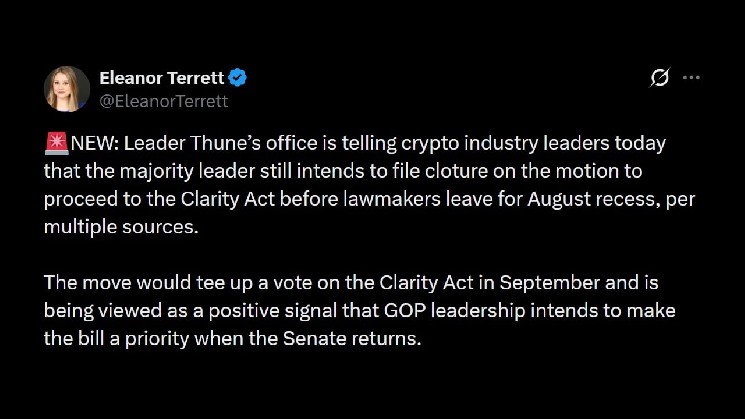
What Will Happen to Bitcoin if the Clarity Act (the 'Bull Market' Law) Is Not Passed Soon? A Prominent CIO Assesses...

cryptonews.ruPublished on 2026-08-07Last updated on 2026-08-07

Abstract

Matt Hogan, Chief Investment Officer of crypto asset management firm Bitwise, stated that if the Clarity Act, aimed at establishing a regulatory framework for the crypto market in the U.S., is not passed this week, it could lead to a short-term downturn in the cryptocurrency market. In a memo, Hogan noted that the most positive market scenario if the bill fails would be investors quickly pricing in this outcome. He suggested that a significant drop in expectations for the bill's passage, particularly reflected in prediction markets like Polymarket, could help reduce regulatory uncertainty. Hogan explained that if the act fails, a sharp decline in prediction market odds to at least 10% would remove this uncertainty. While the market might wobble briefly, it would set up a better position for an upward trend in the fall. Hogan views immediate passage this week as the best scenario but unlikely, with Senate hearings more probable in September. The key, he emphasized, is for investors to accept that the Clarity Act won't pass in the short term, allowing the market to price this in, find a bottom, and eliminate the uncertainty.

Matt Hougan, Chief Investment Officer of Bitwise, a crypto asset management company, stated that if the Clarity Act, aimed at creating a regulatory framework for the cryptocurrency market in the United States, is not passed this week, it could lead to a short-term downturn in the cryptocurrency market.

In a statement on this issue published in the Bitwise CIO memo, Hougan noted that if the bill is not passed, the most positive scenario for the market would be for investors to quickly factor this possibility into their calculations.

Hougan said that a significant reduction in expectations regarding the likelihood of the Clarity Act's passage, particularly in the Polymarket sector, could help reduce regulatory uncertainty in the market.

Hougan made the following statements:

"If Clarity does not pass scrutiny this week, at best, the probability of a significant drop in prediction markets to at least 10% would allow us to get rid of this uncertainty. In such a scenario, the market may briefly wobble, but it would put us in a more favorable position for an upward trend in the fall."

According to the Bitwise representative, while the best scenario for the market would be for the bill to pass this week, this appears unlikely. Hougan stated that a more likely scenario is the postponement of Senate hearings to September, and current events point precisely to that.

Hougan said the key point is for investors to come to terms with the fact that the Clarity Act will not be passed in the short term.

"I was hoping the market would quickly price this in, and Clarity would acknowledge that it's not happening now. This would help the market reach a bottom and eliminate uncertainty."

*This is not investment advice.

end-content

Trending Cryptos

Related Questions

QWho is the author of the statements regarding the potential impact of the Clarity Act on the crypto market, and what is his position?

AThe author is Matt Hougan, the Chief Investment Officer (CIO) of the crypto asset management company Bitwise.

QWhat is the main short-term risk for the crypto market if the Clarity Act is not passed this week, according to Matt Hougan?

AAccording to Matt Hougan, if the Clarity Act is not passed this week, it could lead to a short-term decline in the cryptocurrency market.

QWhat does Matt Hougan suggest is the 'most positive scenario' for the market if the bill is not passed?

AHe suggests that the most positive scenario is that investors would quickly price this possibility in, and a significant drop in the forecast probability of the Act's passage (e.g., to 10% or below on Polymarket) would help remove regulatory uncertainty. This could allow the market to bottom out and set up for an upward trend in the fall.

QWhat does Matt Hougan believe is more likely than the Clarity Act passing this week?

AHe believes it is more likely that Senate hearings on the bill will be postponed until September, with current events pointing in that direction.

QWhat is the key point Hougan emphasizes for investors regarding the Clarity Act?

AThe key point he emphasizes is for investors to come to terms with the fact that the Clarity Act will not be passed in the short term, as the market pricing in this reality would help eliminate uncertainty.

Related Reads

Bill CLARITY Proposes Adding Requirements for Cryptoplatform Developers

A new amendment to the CLARITY bill proposes creating a category called "non-decentralized financial trading protocols." This includes individuals or groups with direct or indirect control over a protocol's functions, operations, or consensus rules. These entities would be required to register with the Commodity Futures Trading Commission (CFTC). The bill also mandates the CFTC and Treasury Department to develop specific rules and standards for these platforms. The stated goal is to distinguish truly decentralized projects from those that are effectively controlled, for example, through a majority of governance tokens or a project treasury. The amendment aims to resolve previous debates by clearly assigning compliance responsibilities, including for customer funds, to developers and governing communities even if they don't hold the assets directly. Additionally, the updated bill proposes legal protections for stablecoin issuers and exchanges that freeze assets suspected of being involved in illicit activity, shielding them from civil lawsuits demanding unfreezing. All crypto platforms would also be subject to bank-like regulations. The senator sponsoring the amendments hopes they will garner broader support for the CLARITY bill in an upcoming procedural Senate vote. The bill retains an "ethics provision" prohibiting government officials and their spouses from issuing, promoting, or engaging in crypto business, though a separate proposal could allow certain individuals, like former President Trump, a tax deferral on crypto asset sales.

cryptonews.ru45m ago

Bill CLARITY Proposes Adding Requirements for Cryptoplatform Developers

cryptonews.ru45m ago

Novo Holdings points to lack of investment in quantum applications

Novo Holdings reports that from 2014-2025, about 70% of the $13.9 billion in private investment in the quantum sector went to hardware and components. Investment in business applications remains insufficient relative to their potential value. By early September 2026, disclosed private funding for quantum companies had already surpassed the total for all of 2025. The report argues that while initial hardware investment was necessary, the next phase requires funding for specialized algorithms and services alongside computer development. These solutions should help customers with specific tasks like selecting molecules for research. Developers who create hard-to-replicate services—combining algorithms, proprietary data, and client integration—will gain an advantage. The life sciences, including pharmaceuticals, are identified as a highly promising field for early quantum applications. However, even early fault-tolerant computers are not expected to handle entire drug development workflows. Instead, they will tackle critical, small-scale tasks where classical approximations fail, such as calculating chemical bond behavior. More routine calculations will still be performed by classical computers. For a quantum service to be commercially valuable, its results must tangibly influence a client's next decision, like which experiment to run. Useful applications in materials science, energy, and chemistry may emerge earlier than in pharma. The report outlines two scenarios: early fault-tolerant systems in the late 2020s/early 2030s and more scalable systems from the mid-2030s. Key risks include progress in classical computing and AI potentially reducing quantum advantages, and the possibility of in-house development by pharmaceutical firms or cloud providers.

cryptonews.ru47m ago

Novo Holdings points to lack of investment in quantum applications

cryptonews.ru47m ago

U.S. Treasury's $5 Billion+ Buyback of 10-Year Bonds Failed to Stop Their Sell-Off

On September 10th, the U.S. Treasury, led by Scott Bessent, conducted a significantly larger-than-usual buyback of long-term government bonds, purchasing $5.2 billion worth. However, this intervention failed to halt a continued sell-off, with the yield on the benchmark 10-year Treasury note rising above 4.85% for the first time since 2023 and hitting nearly 4.98% the next day. Investors viewed the scale of the operation as insufficient for the massive $32 trillion U.S. debt market. They cited persistent pressures including rising oil prices, inflation risks, a large budget deficit, and expectations of further Federal Reserve rate hikes as reasons the buyback couldn't reverse the trend. The Treasury had announced it was prepared to buy up to $6 billion in long-term debt, triple its standard $2 billion operation. Yet, it only accepted $5.2 billion of the over $10 billion in investor offers. Market participants, including strategists from Bank of America and Amundi, criticized the move as too timid and potentially counterproductive, signaling government "nervousness" without addressing core issues. Key factors driving yields higher include the U.S. national debt exceeding $40 trillion, soaring debt servicing costs, strong new borrowing needs, and inflationary pressures from high energy prices. Additional concerns were raised by proposals for large new government spending. Analysts concluded the market is effectively "fighting the U.S. Treasury," with the intervention unable to overcome these fundamental headwinds.

cryptonews.ru48m ago

U.S. Treasury's $5 Billion+ Buyback of 10-Year Bonds Failed to Stop Their Sell-Off

cryptonews.ru48m ago

Trading

Spot

Hot Articles

How to Buy COMP

Welcome to HTX.com! We've made purchasing Compound (COMP) simple and convenient. Follow our step-by-step guide to embark on your crypto journey.Step 1: Create Your HTX AccountUse your email or phone number to sign up for a free account on HTX. Experience a hassle-free registration journey and unlock all features.Get My AccountStep 2: Go to Buy Crypto and Choose Your Payment MethodCredit/Debit Card: Use your Visa or Mastercard to buy Compound (COMP) instantly.Balance: Use funds from your HTX account balance to trade seamlessly.Third Parties: We've added popular payment methods such as Google Pay and Apple Pay to enhance convenience.P2P: Trade directly with other users on HTX.Over-the-Counter (OTC): We offer tailor-made services and competitive exchange rates for traders.Step 3: Store Your Compound (COMP)After purchasing your Compound (COMP), store it in your HTX account. Alternatively, you can send it elsewhere via blockchain transfer or use it to trade other cryptocurrencies.Step 4: Trade Compound (COMP)Easily trade Compound (COMP) on HTX's spot market. Simply access your account, select your trading pair, execute your trades, and monitor in real-time. We offer a user-friendly experience for both beginners and seasoned traders.

5.6k Total ViewsPublished 2024.03.29Updated 2026.06.02

How to Buy COMP

Discussions

Welcome to the HTX Community. Here, you can stay informed about the latest platform developments and gain access to professional market insights. Users' opinions on the price of COMP (COMP) are presented below.

活动图片