Opinion: AI Bubble Bursts, Bitcoin and Other Risky Assets Are the First to Be Impacted

marsbitPublished on 2026-06-30Last updated on 2026-06-30

Abstract

BIS Warns AI Investment Boom Could Trigger Market Stress, Impacting Bitcoin First The Bank for International Settlements (BIS) warns that a potential bursting of the "AI bubble" could tighten liquidity and severely impact risk assets like Bitcoin in the near term. Major tech firms are projected to spend over $1 trillion on AI infrastructure in 2025-2026. The BIS cautions that if returns fail to meet expectations, a sudden withdrawal of financing could turn this investment boom into a prolonged bust, creating ripple effects across financial markets. While AI holds long-term economic promise, the current scale and speed of investment, coupled with intense competition and physical bottlenecks (e.g., semiconductors, power grids), mirror historical bubbles. The report highlights that the AI funding web—spanning corporate debt, private credit, and complex vendor agreements—makes systemic risks harder to see. A disappointment in AI adoption could transmit stress through this chain, widening credit spreads and pressuring weaker borrowers. For Bitcoin, the initial reaction to such a market shock would likely be defensive. As liquidity tightens, investors typically sell liquid assets first, and Bitcoin often trades in line with other risk assets during portfolio de-risking. Recent correlations, like Bitcoin's drop following a sharp decline in South Korea's stock market, support this view. However, the longer-term outcome for Bitcoin depends on the policy response. If an AI-driven c...

Author: CryptoSlate

Compilation: Deep Tide TechFlow

Deep Tide Introduction: The Bank for International Settlements warns that the five tech giants will invest $1 trillion in AI infrastructure from 2025 to 2026. If the return on investment falls short of expectations, a funding squeeze could first impact risky assets like Bitcoin. While loose monetary policy may benefit Bitcoin in the long run, traders must first survive this round of sell-offs.

Over the past year, AI trading has become one of the main pillars supporting global risk appetite.

However, the Bank for International Settlements (BIS) is now warning: if expected returns fail to materialize, this spending frenzy could become a source of financial stress.

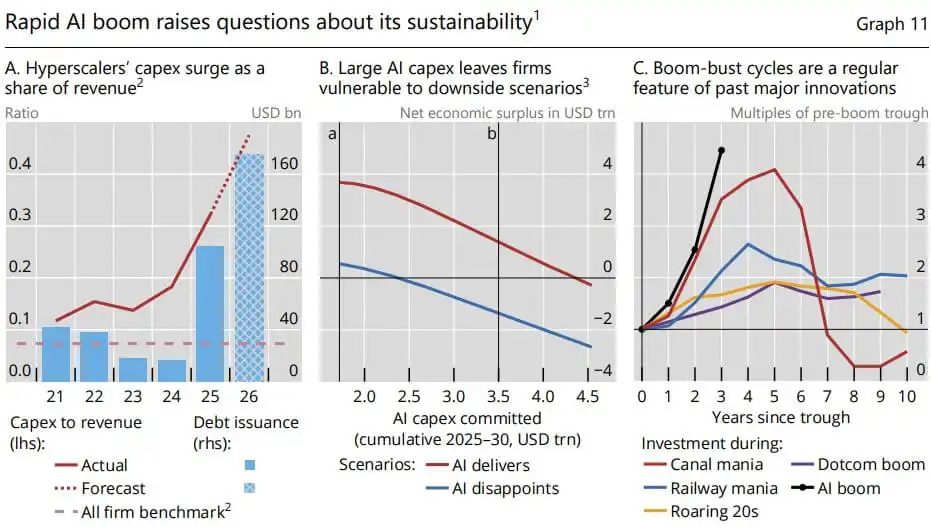
In its annual economic report, the Basel-based institution that advises central banks noted that the five largest cloud computing giants will have AI-related capital expenditures exceeding $1 trillion in 2025 and 2026.

The BIS stated that such massive investment raises the question of whether companies are committing too much capital before their business models are fully validated.

The BIS said:

"Disappointing returns could trigger a sudden withdrawal of financing, turning the capital expenditure boom into a prolonged investment slump, with knock-on effects on financial conditions."

For Bitcoin traders, the implications of this warning extend far beyond the chip and data center race in Silicon Valley.

A sharp reversal in AI spending could tighten liquidity in equity and credit markets, forcing cryptocurrencies to face a tough test: in a sell-off, will Bitcoin initially behave like another risky asset, or will its long-term monetary narrative regain strength after the shock?

AI Spending Boom Draws Central Bank Attention

The Bank for International Settlements (BIS), a forum for central banks, warned in its annual economic report that the race for AI dominance may be pushing investment to levels that future returns cannot sustain.

The BIS stated:

"If supply bottlenecks limit production, the current capital expenditure surge may not be sustainable. Fierce competition for market leadership could further fuel overinvestment, as seen in previous innovation waves, increasing the risk of a sharp reversal if AI returns disappoint."

The issue is not a lack of economic potential for AI. The BIS indicated that this technology could ultimately boost productivity in ways different from earlier waves of automation and software development. If AI systems can self-improve and help generate new ideas, the long-term macroeconomic impact could be significant.

But the near-term financial risks are different. Companies like Google, OpenAI, and Anthropic are pouring huge sums of money without clarity on how much revenue the spending will generate, how long that revenue will last, or how quickly the infrastructure behind AI will become obsolete.

In practice, the largest tech companies are splurging on chips, cloud capacity, data centers, power supplies, and networking equipment, competing for users and market share.
The scale of this race has helped solidify investor confidence in tech stocks while boosting demand for suppliers and infrastructure companies linked to AI construction.

However, the BIS warned that intense competition itself creates fragility. If every major player spends heavily to avoid falling behind, the entire industry could end up with overcapacity, lower returns, and financing structures difficult to maintain once optimism fades.

This dynamic has occurred before. The BIS pointed to earlier investment booms associated with canals, railways, electrification, and the internet.

While each technology later transformed the economy, they also produced periods where investors financed too much, too fast, ultimately leading to painful reversals.

With this in mind, the BIS concluded:

"The scale and speed of the current AI investment boom, coupled with expectations of a significant productivity boost, resemble these precedents and highlight the potential near-term downside risks."

Compounding the issue are severe physical bottlenecks. The insatiable demand for computing power is straining supplies of advanced semiconductors, grid equipment, and raw electricity.

According to the BIS, this surging demand is already pushing up electricity prices, potentially feeding into broader inflation measures—at a time when geopolitical conflicts in the Middle East are independently straining global supply chains.

Credit Risks Build Beneath Equity Rally

Meanwhile, the BIS's concerns extend far beyond a simple stock market correction to how an AI shock could affect the broader financial system.

While the early stages of AI development were funded largely by the massive cash reserves of Silicon Valley giants, the current trillion-dollar scale of investment relies more on debt and increasingly opaque financing structures.

The BIS noted that AI infrastructure now spans corporate debt markets, private credit, lease financing, data center construction, energy contracts, and supplier agreements.

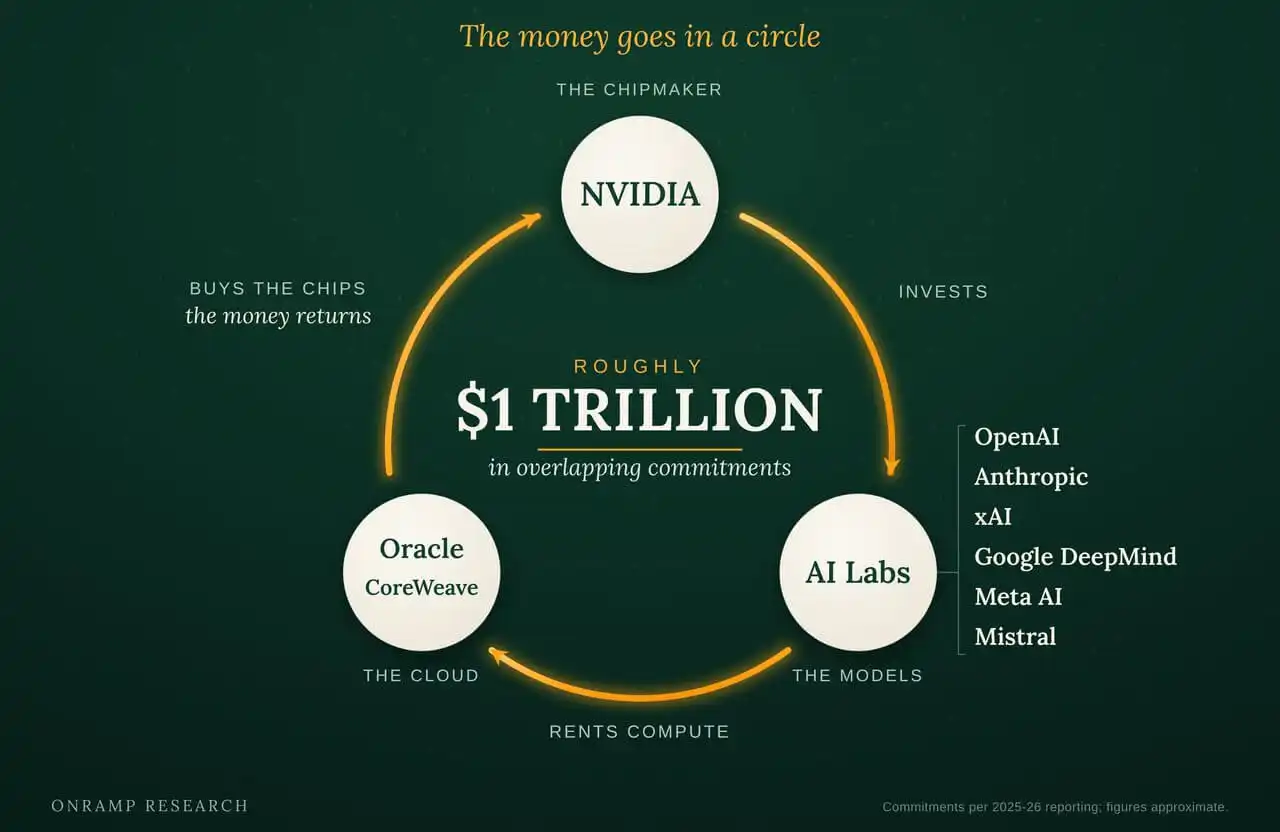
Chipmakers, cloud providers, AI labs, and data center operators are becoming increasingly interconnected through equity investments, procurement commitments, and long-term capacity trades.

Indeed, Bitcoin-focused financial services firm Onramp Bitcoin recently pointed out:

"A web of overlapping commitments now binds AI construction into roughly a $1 trillion loop: Nvidia invests in AI labs like OpenAI, the labs lease cloud capacity from Oracle and CoreWeave, and those cloud services buy Nvidia chips. The same dollar can be booked simultaneously as investment, funding, revenue, and sales, so headline numbers are no longer as meaningful as they appear."
The BIS warned that these arrangements can make risks harder to see, noting that this network of claims is built on expectations of future demand. If AI adoption continues to accelerate, this structure can be self-reinforcing.

But if demand disappoints, stress could reverberate back through the chain.

This could lead to a scenario where suppliers might lose orders, and data center developers might struggle to fill capacity.

Meanwhile, private credit funds could face stress on loans linked to software, infrastructure, or tech borrowers. Banks might find their exposure to private credit and non-bank finance more complex than surface numbers suggest.

This is why the BIS's warning extends beyond tech stocks. A decline in AI-related stocks directly hurts investors. A broader reassessment of AI financing could tighten credit conditions for companies relying on the same funding environment.

Credit spreads have remained relatively narrow, reflecting investor belief that borrowers can continue servicing debt.

A sharp repricing of equity risk could quickly change that. Once lenders demand more risk compensation, weaker borrowers face higher refinancing costs, reduced access to capital, and pressure to cut investment.

This is the path through which AI disappointment could evolve into a macro event.

Bitcoin's Initial Reaction May Be Defensive

In such an economic shock, Bitcoin's role would be complex. Proponents of the asset often describe it as a hedge against currency debasement, fiscal stress, and financial system fragility. Its supply is fixed, it has no corporate issuer, and it does not rely on corporate profits or debt repayment schedules.

These properties could become more attractive if an AI credit crunch ultimately forces policymakers to ease financial conditions. But in the early stages of a broad sell-off, Bitcoin would likely face the same pressure as other risk assets.

When liquidity tightens, investors typically sell liquid positions first. Bitcoin trades continuously, can be sold quickly, and is held by many investors who also own stocks, exchange-traded products, derivatives, and other high-beta assets. This makes it vulnerable during portfolio de-risking.

Recent market behavior supports this concern. CryptoSlate recently reported that Bitcoin fell below $63,000 after South Korea's benchmark KOSPI stock index plunged nearly 10% last week.

This decline suggests that liquidity conditions, leverage, and risk appetite can overwhelm the scarcity narrative for extended periods.

A market shock triggered by AI could follow a similar sequence. Tech stocks linked to construction might fall first. As investors reassess debt linked to data centers, suppliers, and private financing vehicles, credit spreads could widen. Funds facing losses or margin pressure might subsequently cut positions in cryptocurrencies and other liquid assets.

At that stage, Bitcoin wouldn't need a direct link to AI infrastructure to be affected. It just needs to be part of the same risk budget.

Liquidity Questions Follow

But the second stage depends on the government's response to the ensuing market distress.

If a reversal in AI investment remains confined to a small group of tech companies, the damage could be limited. Stocks would reprice, suppliers would adjust, investors would reassess valuations, without forcing a major shift in monetary policy.

But the risk flagged by the BIS is that the spending boom is already large enough to affect the broader financial system.

This suggests that a significant pullback in AI capital expenditure could simultaneously hit corporate investment, employment, household wealth, and credit availability. If inflation remains high and central banks feel unable to cut rates quickly, these pressures could become more severe.

This creates a difficult scenario for risk assets. Higher inflation could keep policy tight even as investment weakens. Tighter credit could expose leverage in private markets. Falling stock prices could reduce household wealth and slow consumption. Each channel could reinforce the others.

For Bitcoin, the policy path is crucial. This asset typically performs best when liquidity is expanding, real rates are falling, and investors anticipate central bank support for markets. A credit shock that ultimately brings looser money could restart that trade.

BitMEX co-founder Arthur Hayes believes that an AI crash could help propel Bitcoin significantly higher if authorities respond by re-creating liquidity, and investors shift away from debt-laden financial structures.

This view remains speculative, but it captures why some crypto traders see AI capital expenditure and credit markets as potential drivers for the next Bitcoin cycle.

But the timing is uncertain. Therefore, traders betting on an eventual liquidity response may still have to endure the preceding drawdown.

Bitcoin rose 2.28% in the past 24 hours and is currently ranked first by market capitalization.

Broader Market Status

Currently, the total cryptocurrency market capitalization is $2.09 trillion, with a 24-hour trading volume of $81.45 billion. Bitcoin's dominance is 57.97%.

For two years, buying more Bitcoin was enough to push up treasury stock prices. Strategy's BTC Yield is now declining, Metaplanet's market capitalization is below the value of its Bitcoin holdings, and new entrants in Europe are asking investors to fund them at terms no one is pricing.


Trending Cryptos

Related Questions

QAccording to the BIS's warning, what could be the initial impact on Bitcoin and other risk assets if the trillion-dollar AI investment boom fails to deliver expected returns?

AThe initial impact would likely be a sharp sell-off. Liquidity could tighten across equity and credit markets, forcing investors to de-risk their portfolios. As a highly liquid asset held by many of the same investors exposed to tech stocks and high-beta assets, Bitcoin would be vulnerable to these initial waves of selling pressure and would likely behave like another risk asset.

QWhat specific financial system vulnerabilities does the BIS highlight regarding the current AI infrastructure investment boom?

AThe BIS highlights vulnerabilities in the complex and opaque financing web binding the AI ecosystem. This includes corporate debt, private credit, leasing, and long-term capacity contracts between chipmakers, cloud providers, AI labs, and data center operators. This structure, built on expectations of future demand, could transmit stress throughout the chain if demand disappoints, potentially impacting banks with indirect exposure and tightening credit conditions more broadly.

QWhy might Bitcoin's price action be complex in the scenario of an AI-induced market shock, according to the article?

ABitcoin's price action would be complex due to a potential two-phase reaction. In the initial phase, it would likely fall alongside other risk assets as investors sell liquid holdings. However, if the shock is severe enough to force central banks to ease monetary policy and inject liquidity to prevent a broader crisis, Bitcoin's long-term narrative as a hedge against monetary debasement could reassert itself, potentially leading to a significant rally in a subsequent phase.

QWhat historical precedents does the BIS cite to support its concern about the current AI investment surge?

AThe BIS cites historical investment booms associated with major technological innovations like canals, railroads, electrification, and the internet. While these technologies ultimately transformed economies, they also led to periods where investment and financing raced ahead of sustainable returns, resulting in painful reversals and downturns.

QApart from financial risks, what other challenge does the BIS identify that could hinder the AI investment boom?

AThe BIS identifies severe physical bottlenecks as a major challenge. The insatiable demand for computing power is straining supplies of advanced semiconductors, grid equipment, and raw electricity. This is already pushing up electricity prices and could contribute to broader inflationary pressures, adding another layer of economic complexity.

Related Reads

US CFTC Launches Broad Investigation into Polymarket, Is the Prediction Market Party Coming to an End?

The U.S. Commodity Futures Trading Commission (CFTC) is conducting a broad investigation into the prediction market platform Polymarket, focusing on its business practices including social media promotions. This follows a bipartisan letter from U.S. senators urging the CFTC to probe alleged fraudulent marketing tactics used to promote gambling-like products. The action coincides with a period of explosive growth for the prediction market sector, driven by events like the World Cup, with platforms like Kalshi and Robinhood reporting record trading volumes and revenue. The investigation signals a potential end to the sector's unregulated expansion and may lead to clearer federal oversight, particularly regarding investor protection and distinguishing prediction markets from traditional sports betting. The CFTC's move has also intensified a jurisdictional conflict with multiple U.S. states (including Kentucky and New York), which have sued platforms like Polymarket and Kalshi, accusing them of operating illegal sports betting and threatening state gambling tax revenues. Furthermore, the CME Group has sued the CFTC, challenging its approval of certain prediction market products. The report also highlights the political and capital interests intertwined with the industry. Donald Trump Jr. holds advisory and investment roles in both Kalshi and Polymarket, and the Trump administration has previously emphasized federal regulatory authority over these markets. The CFTC's investigation into Polymarket is framed as a step towards formalizing the industry's regulatory landscape, moving it from a phase of "wild growth" towards a more structured future.

marsbit1h ago

US CFTC Launches Broad Investigation into Polymarket, Is the Prediction Market Party Coming to an End?

marsbit1h ago

U.S. CFTC Launches Extensive Investigation into Polymarket, Is the Prediction Market Frenzy Season Cooling Down?

The U.S. Commodity Futures Trading Commission (CFTC) has launched a broad investigation into the prediction market platform Polymarket, focusing on its business practices including social media activities. This follows a bipartisan letter from U.S. senators urging the CFTC to probe allegations of paid influencer false marketing and fraudulent promotion of gambling-like products to American users. The investigation comes as the prediction market sector experiences explosive growth, largely driven by the World Cup. Weekly trading volumes have hit record highs, exceeding $14.4 billion, with platforms like Kalshi and Robinhood's new venture seeing significant activity. Major firms like Meta are also showing interest in the space. This regulatory scrutiny signals a potential end to the sector's "wild growth" phase. The CFTC's move also highlights an escalating jurisdictional conflict between federal regulators and state authorities. Over a dozen states, including Kentucky and New York, have sued platforms like Polymarket and Kalshi, accusing them of operating illegal sports betting, which threatens state gambling tax revenues. The CFTC is countersuing to assert its exclusive federal jurisdiction over these "event contracts" as derivatives. Furthermore, the CFTC's approval of Kalshi's Bitcoin perpetual futures contract has sparked a lawsuit from traditional exchange CME, alleging regulatory overreach. The political and capital landscape is intricate, with Donald Trump Jr. holding advisory roles and investments in both Kalshi and Polymarket. This connects capital, political influence, and regulatory bodies, suggesting the current investigation may be a step toward formalizing the industry's rules rather than halting its progress.

Odaily星球日报1h ago

U.S. CFTC Launches Extensive Investigation into Polymarket, Is the Prediction Market Frenzy Season Cooling Down?

Odaily星球日报1h ago

Trading

Spot

Hot Articles

What is $BITCOIN

DIGITAL GOLD ($BITCOIN): A Comprehensive Analysis Introduction to DIGITAL GOLD ($BITCOIN) DIGITAL GOLD ($BITCOIN) is a blockchain-based project operating on the Solana network, which aims to combine the characteristics of traditional precious metals with the innovation of decentralized technologies. While it shares a name with Bitcoin, often referred to as “digital gold” due to its perception as a store of value, DIGITAL GOLD is a separate token designed to create a unique ecosystem within the Web3 landscape. Its goal is to position itself as a viable alternative digital asset, although specifics regarding its applications and functionalities are still developing. What is DIGITAL GOLD ($BITCOIN)? DIGITAL GOLD ($BITCOIN) is a cryptocurrency token explicitly designed for use on the Solana blockchain. In contrast to Bitcoin, which provides a widely recognized value storage role, this token appears to focus on broader applications and characteristics. Notable aspects include: Blockchain Infrastructure: The token is built on the Solana blockchain, known for its capacity to handle high-speed and low-cost transactions. Supply Dynamics: DIGITAL GOLD has a maximum supply capped at 100 quadrillion tokens (100P $BITCOIN), although details regarding its circulating supply are currently undisclosed. Utility: While precise functionalities are not explicitly outlined, there are indications that the token could be utilized for various applications, potentially involving decentralized applications (dApps) or asset tokenization strategies. Who is the Creator of DIGITAL GOLD ($BITCOIN)? At present, the identity of the creators and development team behind DIGITAL GOLD ($BITCOIN) remains unknown. This situation is typical among many innovative projects within the blockchain space, particularly those aligning with decentralized finance and meme coin phenomena. While such anonymity may foster a community-driven culture, it intensifies concerns about governance and accountability. Who are the Investors of DIGITAL GOLD ($BITCOIN)? The available information indicates that DIGITAL GOLD ($BITCOIN) does not have any known institutional backers or prominent venture capital investments. The project seems to operate on a peer-to-peer model focused on community support and adoption rather than traditional funding routes. Its activity and liquidity are primarily situated on decentralized exchanges (DEXs), such as PumpSwap, rather than established centralized trading platforms, further highlighting its grassroots approach. How DIGITAL GOLD ($BITCOIN) Works The operational mechanics of DIGITAL GOLD ($BITCOIN) can be elaborated on based on its blockchain design and network attributes: Consensus Mechanism: By leveraging Solana’s unique proof-of-history (PoH) combined with a proof-of-stake (PoS) model, the project ensures efficient transaction validation contributing to the network's high performance. Tokenomics: While specific deflationary mechanisms have not been extensively detailed, the vast maximum token supply implies that it may cater to microtransactions or niche use cases that are still to be defined. Interoperability: There exists the potential for integration with Solana’s broader ecosystem, including various decentralized finance (DeFi) platforms. However, the details regarding specific integrations remain unspecified. Timeline of Key Events Here is a timeline that highlights significant milestones concerning DIGITAL GOLD ($BITCOIN): 2023: The initial deployment of the token occurs on the Solana blockchain, marked by its contract address. 2024: DIGITAL GOLD gains visibility as it becomes available for trading on decentralized exchanges like PumpSwap, allowing users to trade it against SOL. 2025: The project witnesses sporadic trading activity and potential interest in community-led engagements, although no noteworthy partnerships or technical advancements have been documented as of yet. Critical Analysis Strengths Scalability: The underlying Solana infrastructure supports high transaction volumes, which could enhance the utility of $BITCOIN in various transaction scenarios. Accessibility: The potential low trading price per token could attract retail investors, facilitating wider participation due to fractional ownership opportunities. Risks Lack of Transparency: The absence of publicly known backers, developers, or an audit process may yield skepticism regarding the project's sustainability and trustworthiness. Market Volatility: The trading activity is heavily reliant on speculative behavior, which can result in significant price volatility and uncertainty for investors. Conclusion DIGITAL GOLD ($BITCOIN) emerges as an intriguing yet ambiguous project within the rapidly evolving Solana ecosystem. While it attempts to leverage the “digital gold” narrative, its departure from Bitcoin's established role as a store of value underscores the need for a clearer differentiation of its intended utility and governance structure. Future acceptance and adoption will likely depend on addressing the current opacity and defining its operational and economic strategies more explicitly. Note: This report encompasses synthesised information available as of October 2023, and developments may have transpired beyond the research period.

522 Total ViewsPublished 2025.05.13Updated 2025.05.13

What is $BITCOIN

Discussions

Welcome to the HTX Community. Here, you can stay informed about the latest platform developments and gain access to professional market insights. Users' opinions on the price of BTC (BTC) are presented below.

活动图片