Bitcoin Has Yet to Hit Bottom, While Exchange AscendEX Has Already "Run Away"

Foresight NewsPublished on 2026-07-09Last updated on 2026-07-09

Abstract

On July 6, 2026, cryptocurrency exchange AscendEX officially announced it is ceasing operations, with a complete shutdown scheduled for July 1, 2026. The platform cited the full implementation of the EU's MiCA regulation alongside market, financial, and operational challenges. Users can no longer perform most functions, with accounts limited to withdrawal purposes only. Prior to the announcement, on-chain investigator ZachXBT had issued warnings about significant withdrawal delays and a severe lack of high-liquidity assets (like ETH, USDT, SOL) in AscendEX's public hot wallets. Following the news, ZachXBT confirmed that the exchange lacks sufficient liquid assets to process multiple verified seven-figure withdrawal requests. AscendEX acknowledged that all withdrawals now require manual review, with no guarantees on processing times. Chain analysis via Arkham Intelligence shows the platform's marked wallets hold minimal readily accessible funds, with most recent activity being small withdrawals. One highlighted wallet reportedly contains only $13.46 million in altcoins. AscendEX, formerly known as BitMax, launched in 2018 and raised $50 million in a 2021 funding round. However, it suffered a major security breach in December 2021, losing approximately $77.7 million from hot wallets. The exchange compensated users but never fully recovered. The current crisis underscores the inherent risks of centralized exchanges, where poor liquidity management, regulatory pressure, and be...


Written by: Ma He, Foresight News


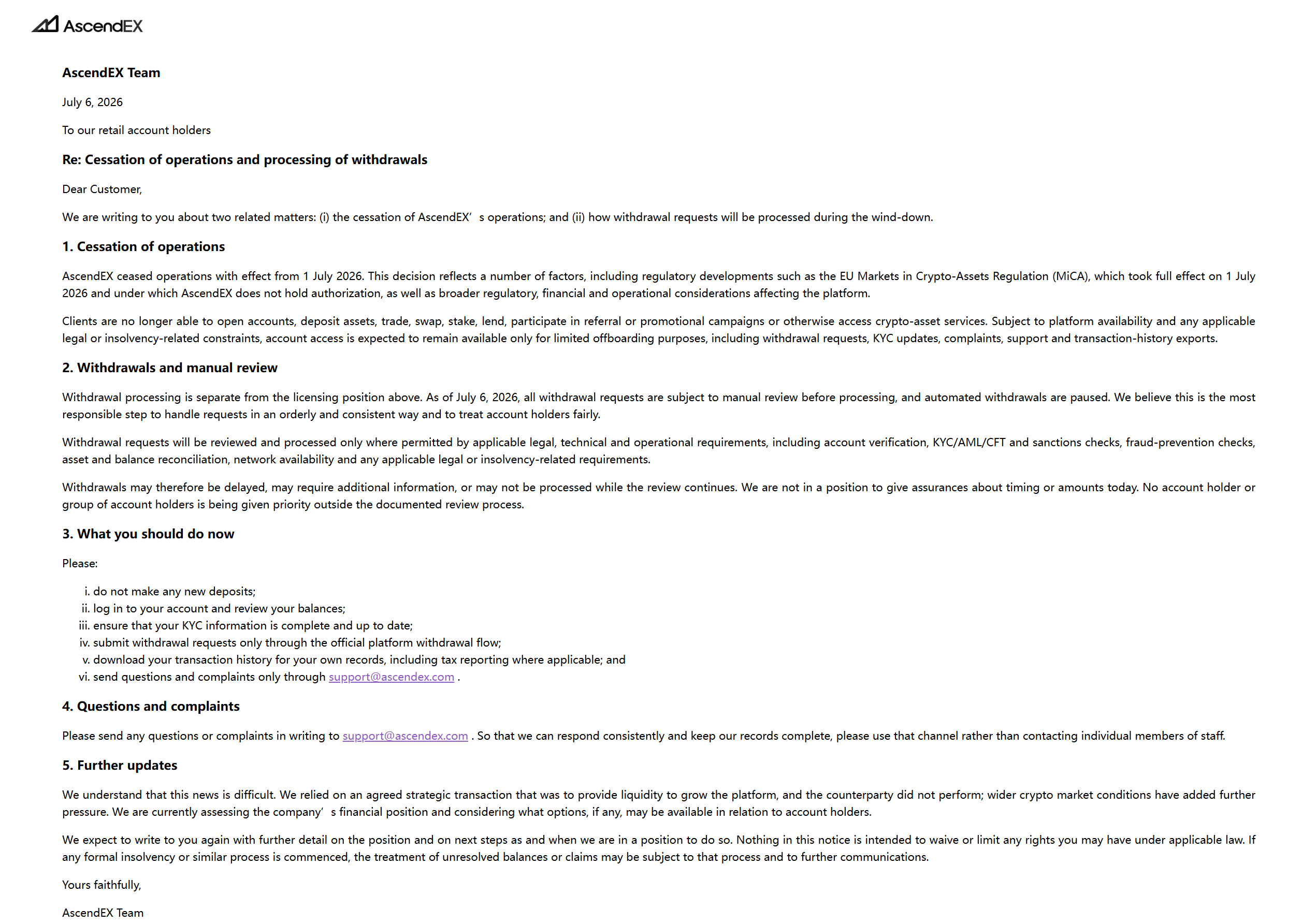
On July 6, the exchange AscendEX officially confirmed that it has ceased operations. The platform's official website published a letter to users on July 6, clearly stating that all business will be completely terminated starting July 1, 2026, due to the full effect of the EU's Markets in Crypto-Assets Regulation (MiCA) and multiple factors including market, financial, and operational influences. Users can no longer open accounts, deposit funds, trade, exchange, stake, borrow, or participate in any activities. Accounts are now limited to withdrawal purposes only.


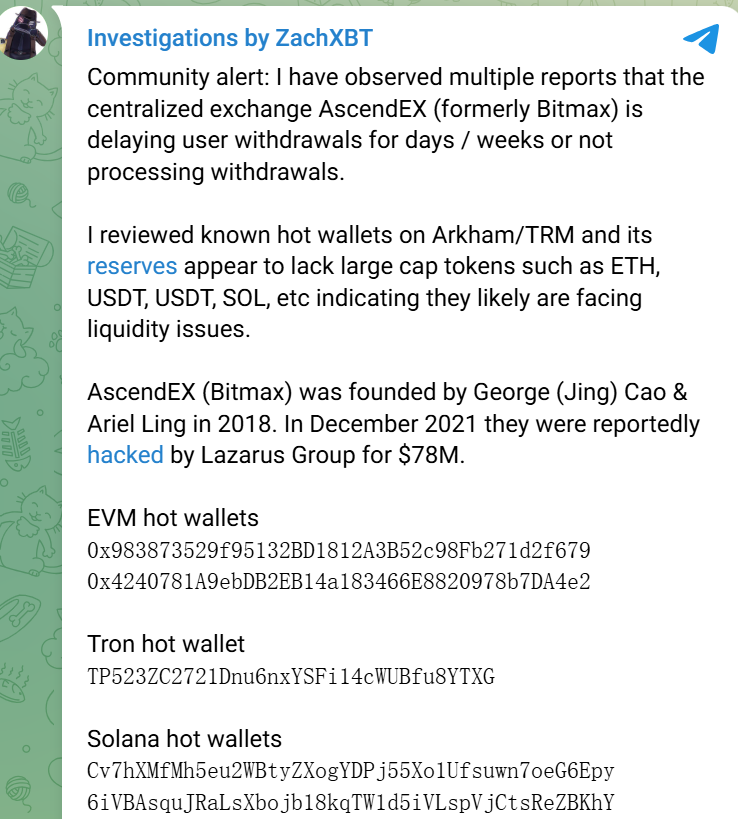
On-chain investigator ZachXBT responded immediately after the announcement was released, pointing out that AscendEX's publicly known hot wallet currently lacks sufficient liquid assets to process several verified user withdrawal requests in the seven-figure range (amounting to millions of USD). For several weeks prior, ZachXBT had repeatedly publicly warned about the platform's withdrawal delays. Using tools like Arkham Intelligence and TRM Labs to analyze its hot wallet data, he discovered a severe shortage of high-liquidity assets such as ETH, USDT, and SOL.


ZachXBT explicitly advised the community not to deposit funds into this CEX and demanded that the platform respond to the withdrawal delays and hot wallet liquidity issues.


In its announcement, AscendEX stated, "Starting July 6, 2026, all withdrawal requests will be subject to manual review before processing. Automatic withdrawals have been suspended. Withdrawals may be delayed, may require additional information, or may not be processed while the review is ongoing. We cannot currently guarantee processing times or amounts. Beyond the documented review process, no account holder or group of account holders is being given priority."


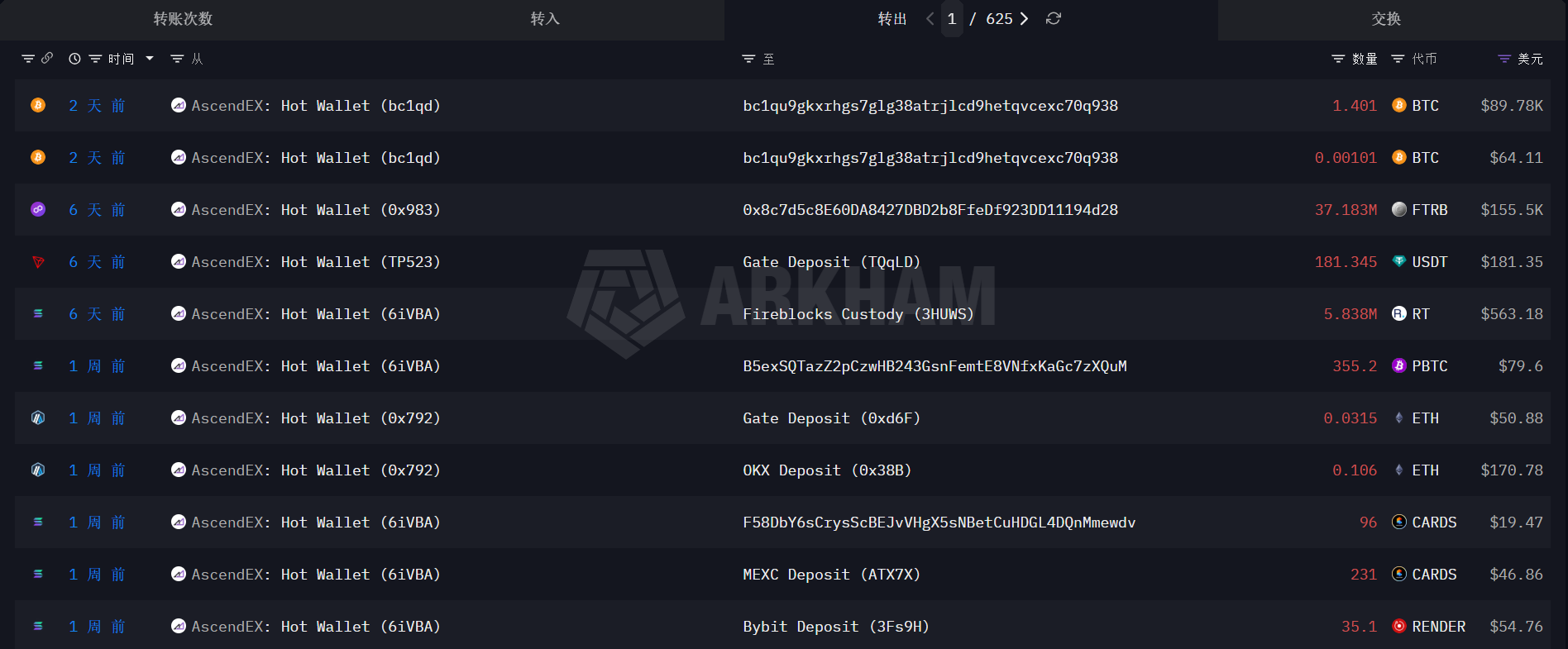
The author observed on Arkham's on-chain platform that the funds available for withdrawal in its wallet addresses are currently extremely limited. In the past two days, aside from withdrawing tens of thousands of dollars worth of BTC, all other withdrawals have been small amounts and occurred a week ago.


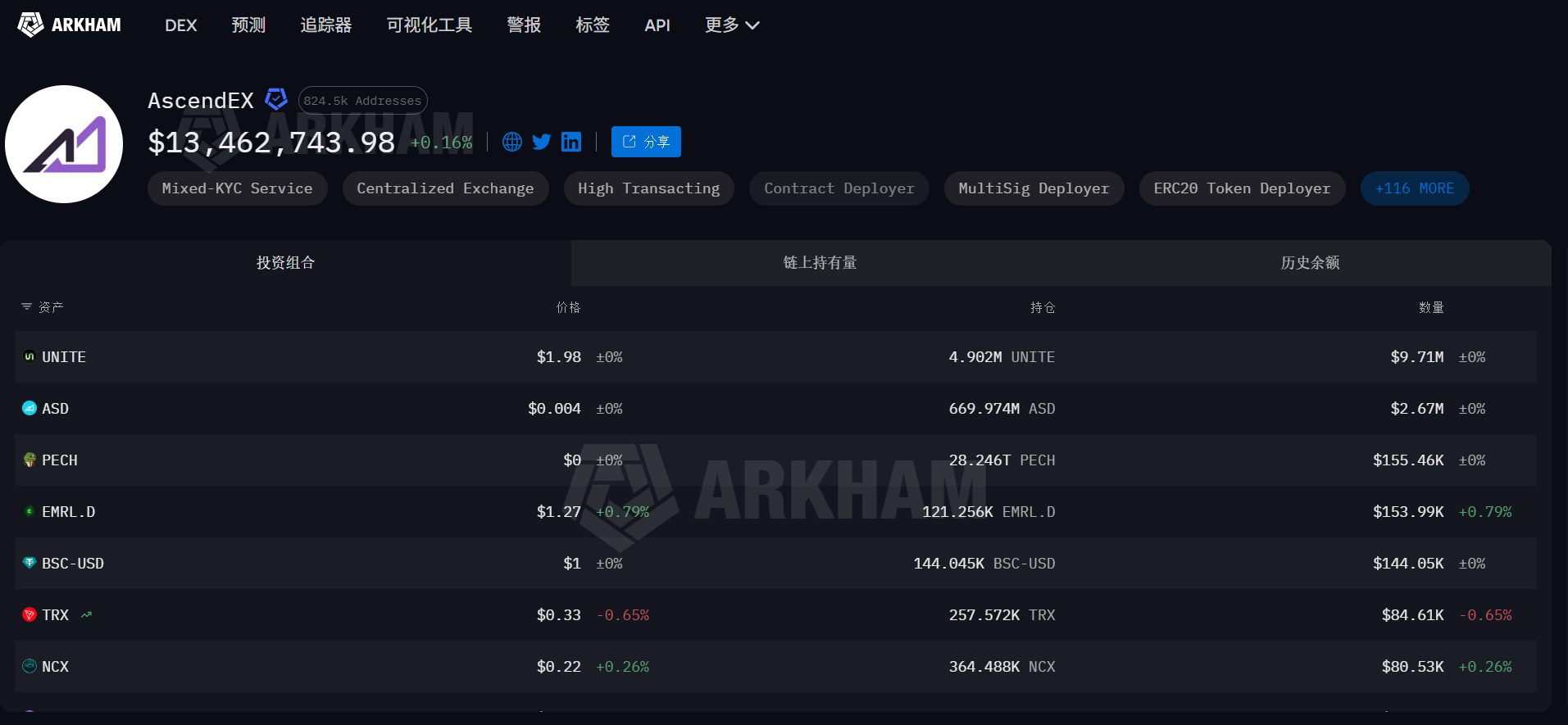
As of now, one of its marked wallets only contains $13.46 million worth of altcoins.


It is worth mentioning that the exchange had initially hoped to introduce liquidity through strategic mergers, acquisitions, or restructuring, but ultimately failed. As of now, no further official updates have been released regarding further repayment plans or financial details.


Formerly BitMax


AscendEX's official website indicates that its predecessor was BitMax.io, which officially launched in August 2018. Its co-founder and CEO is George Cao, and the COO is Ariel Ling. George Cao has a background in quantitative trading and venture capital, having previously built quantitative platforms in financial markets. Ariel Ling has worked at institutions such as Deutsche Bank and Barclays.



During the 2019-2020 period, BitMax quickly rose to prominence in the crypto bull market. In March 2021, the platform rebranded to AscendEX. In the same year, it completed a $50 million Series B funding round led by Polychain Capital and Hack VC.


However, in December 2021, a major security incident disrupted this stability. Attackers exploited a vulnerability in AscendEX's hot wallet, stealing approximately $77.7 million in assets across chains including Ethereum, BNB Chain, and Polygon (estimates from firms like PeckShield put the figure around $80 million). The platform quickly confirmed the unauthorized transactions and promised to cover user losses with its own funds. This incident became one of several exchange hacks that year, also exposing the inherent risks of hot wallets in daily liquidity management.


Following this, AscendEX continued operations, but the industry environment had undergone profound changes. Increasingly stringent global regulations, intensified competition, and volatile crypto market cycles gradually accumulated pressure. This culminated in a concentrated outbreak of problems in mid-2026.


Exchanges Face a Shakeout


ZachXBT, as an independent on-chain detective, relies on publicly available blockchain data and professional tools (like Arkham, TRM) rather than insider information or rumors. This makes his warnings highly verifiable.


In the AscendEX incident, he pointed out liquidity risks several days in advance. He continued to track the hot wallet status even after the platform's announcement, emphasizing "verified multiple seven-figure user withdrawal requests."


In community discussions, some voices mentioned that AscendEX has been described as a "mom-and-pop shop" style of operation (George Cao is reportedly married to a financial personnel). This event once again highlights the inherent risks of centralized exchanges: even in the absence of hacking attacks, mismanagement of liquidity, lagging regulatory compliance, and pressures from a deep bear market can all trigger a bank-run style crisis. The 2021 hot wallet theft and the 2026 liquidity shortage issue echo each other—hot wallets are designed for daily operations but often become the focal point of dual pressures from liquidity and security.


Furthermore, the exchange's attempt to shift blame for ceasing operations to regulation is widely questioned. AscendEX never obtained any regulatory authorization from the EU, so the implementation of MiCA fundamentally does not affect its original operating model. It is merely using the industry trend of compliance implementation as a respectable, force majeure-style excuse for a "dignified end."


A major shakeout is underway for some crypto exchanges since the wild growth of DeFi in 2020-2021. For the industry, small and medium-sized platforms face pressure to exit or restructure, while platforms with transparent proof of reserves, strong regulatory licenses, and robust risk controls demonstrate greater resilience. For users, perhaps the way to guard against risks is to keep crypto assets in non-custodial wallets or on exchanges with publicly disclosed, transparent reserves.


Trending Cryptos

Related Questions

QAccording to the article, why did AscendEX officially announce it is ceasing operations?

AAscendEX cited the full implementation of the EU's Markets in Crypto-Assets (MiCA) regulation, combined with market, financial, and operational challenges, as the reasons for ceasing operations from July 1, 2026.

QWhat major issue did the on-chain investigator ZachXBT identify regarding AscendEX's ability to process user withdrawals?

AZachXBT identified that AscendEX's public hot wallets lacked sufficient liquid assets to process verified user withdrawal requests worth millions of dollars (seven-figure sums).

QWhat significant security incident impacted AscendEX in December 2021?

AIn December 2021, attackers exploited a vulnerability in AscendEX's hot wallets, stealing approximately $77.7 million (estimated around $80 million) in assets across chains like Ethereum, BNB Chain, and Polygon.

QWhat was AscendEX's original name before its rebranding in 2021?

AAscendEX was originally named BitMax.io when it launched in August 2018. It rebranded to AscendEX in March 2021.

QHow does the article suggest users can better protect their crypto assets from risks like those seen with AscendEX?

AThe article suggests that users can better protect their assets by keeping them in non-custodial wallets or on exchanges that provide transparent proof of reserves and have robust risk controls.

Related Reads

Zuckerberg Begins Betting on Prediction Markets, While Asian Countries Still View Them as Gambling

Mark Zuckerberg is backing prediction markets, with Meta developing its own app "Arena," signaling major tech validation. This industry now sees over $14 billion in monthly volume. These markets function as binary contracts (payout $1 if an event occurs, $0 if not), with trading prices reflecting real-time event probabilities. Results are settled by oracles. Prediction markets originated from informal political betting and academic experiments like the Iowa Electronic Markets. Their core mechanism relies on "skin in the game"—participants risk their own money, making aggregated information more reliable than polls or expert opinions. They have proven accurate in forecasting areas like monetary policy, elections, and market events. While Western markets are integrating them into regulated financial systems, many Asian jurisdictions still classify them as gambling, leading to regulatory divergence. This stance creates three major issues for Asia: regulatory arbitrage and capital outflow, loss of informational sovereignty as valuable social data accumulates offshore, and a lack of user protection within a formal framework. The article argues that Asia's focus should shift from blocking these markets to responsibly harnessing the data they generate within a regulated system. The current avoidance of discussion cedes leadership and advantages to foreign entities.

Foresight News42m ago

Zuckerberg Begins Betting on Prediction Markets, While Asian Countries Still View Them as Gambling

Foresight News42m ago

Trading

Spot

Hot Articles

What is $BITCOIN

DIGITAL GOLD ($BITCOIN): A Comprehensive Analysis Introduction to DIGITAL GOLD ($BITCOIN) DIGITAL GOLD ($BITCOIN) is a blockchain-based project operating on the Solana network, which aims to combine the characteristics of traditional precious metals with the innovation of decentralized technologies. While it shares a name with Bitcoin, often referred to as “digital gold” due to its perception as a store of value, DIGITAL GOLD is a separate token designed to create a unique ecosystem within the Web3 landscape. Its goal is to position itself as a viable alternative digital asset, although specifics regarding its applications and functionalities are still developing. What is DIGITAL GOLD ($BITCOIN)? DIGITAL GOLD ($BITCOIN) is a cryptocurrency token explicitly designed for use on the Solana blockchain. In contrast to Bitcoin, which provides a widely recognized value storage role, this token appears to focus on broader applications and characteristics. Notable aspects include: Blockchain Infrastructure: The token is built on the Solana blockchain, known for its capacity to handle high-speed and low-cost transactions. Supply Dynamics: DIGITAL GOLD has a maximum supply capped at 100 quadrillion tokens (100P $BITCOIN), although details regarding its circulating supply are currently undisclosed. Utility: While precise functionalities are not explicitly outlined, there are indications that the token could be utilized for various applications, potentially involving decentralized applications (dApps) or asset tokenization strategies. Who is the Creator of DIGITAL GOLD ($BITCOIN)? At present, the identity of the creators and development team behind DIGITAL GOLD ($BITCOIN) remains unknown. This situation is typical among many innovative projects within the blockchain space, particularly those aligning with decentralized finance and meme coin phenomena. While such anonymity may foster a community-driven culture, it intensifies concerns about governance and accountability. Who are the Investors of DIGITAL GOLD ($BITCOIN)? The available information indicates that DIGITAL GOLD ($BITCOIN) does not have any known institutional backers or prominent venture capital investments. The project seems to operate on a peer-to-peer model focused on community support and adoption rather than traditional funding routes. Its activity and liquidity are primarily situated on decentralized exchanges (DEXs), such as PumpSwap, rather than established centralized trading platforms, further highlighting its grassroots approach. How DIGITAL GOLD ($BITCOIN) Works The operational mechanics of DIGITAL GOLD ($BITCOIN) can be elaborated on based on its blockchain design and network attributes: Consensus Mechanism: By leveraging Solana’s unique proof-of-history (PoH) combined with a proof-of-stake (PoS) model, the project ensures efficient transaction validation contributing to the network's high performance. Tokenomics: While specific deflationary mechanisms have not been extensively detailed, the vast maximum token supply implies that it may cater to microtransactions or niche use cases that are still to be defined. Interoperability: There exists the potential for integration with Solana’s broader ecosystem, including various decentralized finance (DeFi) platforms. However, the details regarding specific integrations remain unspecified. Timeline of Key Events Here is a timeline that highlights significant milestones concerning DIGITAL GOLD ($BITCOIN): 2023: The initial deployment of the token occurs on the Solana blockchain, marked by its contract address. 2024: DIGITAL GOLD gains visibility as it becomes available for trading on decentralized exchanges like PumpSwap, allowing users to trade it against SOL. 2025: The project witnesses sporadic trading activity and potential interest in community-led engagements, although no noteworthy partnerships or technical advancements have been documented as of yet. Critical Analysis Strengths Scalability: The underlying Solana infrastructure supports high transaction volumes, which could enhance the utility of $BITCOIN in various transaction scenarios. Accessibility: The potential low trading price per token could attract retail investors, facilitating wider participation due to fractional ownership opportunities. Risks Lack of Transparency: The absence of publicly known backers, developers, or an audit process may yield skepticism regarding the project's sustainability and trustworthiness. Market Volatility: The trading activity is heavily reliant on speculative behavior, which can result in significant price volatility and uncertainty for investors. Conclusion DIGITAL GOLD ($BITCOIN) emerges as an intriguing yet ambiguous project within the rapidly evolving Solana ecosystem. While it attempts to leverage the “digital gold” narrative, its departure from Bitcoin's established role as a store of value underscores the need for a clearer differentiation of its intended utility and governance structure. Future acceptance and adoption will likely depend on addressing the current opacity and defining its operational and economic strategies more explicitly. Note: This report encompasses synthesised information available as of October 2023, and developments may have transpired beyond the research period.

686 Total ViewsPublished 2025.05.13Updated 2025.05.13

What is $BITCOIN

Discussions

Welcome to the HTX Community. Here, you can stay informed about the latest platform developments and gain access to professional market insights. Users' opinions on the price of BTC (BTC) are presented below.

活动图片